Showing posts with label Oblio's Lounge. Show all posts

Tuesday, May 2, 2023

Oblio's Has Been Sold

On April 27, Oblio’s Lounge was sold. Mark Schultz and Todd Cummings, who have operated Oblio’s for the past 44 years, sold their tavern at 434 N. Main Street to Cory Krolczyk and Blake Kieler (I hope to have more about the new owners in the near future).

Todd Cummings (left) and Mark Schultz.

On April 25, Cummings and Schultz announced the sale and that they would be departing the business. Here’s the farewell message they posted on Facebook.

In 1979, the two of us made a somewhat rash decision. We stepped into a role that neither of us was totally prepared for. We became the proprietors of Oblio’s, a space that has been central to the social life of Oshkosh since 1885. Our plans for the future of this place were less than clear. But those vague aspirations were given shape by you, the people who came through the door year after year to encourage us, support us, and befriend us. Along the way, we’ve learned that our job wasn’t just about running a bar. You’ve entrusted us with something more; the privilege of taking part in a welcoming tradition that makes all of us closer to one another. The time has come for us to pass that torch. The institution of Oblio’s will endure. This place is not about the two of us. It is about all of us together. And that is more important now than ever. We cannot find the words to express the depth of our gratitude, so these will have to do. Thank you.

Please join us May 6th 3pm-8pm for the passing of that torch.


This marks a new phase for what is perhaps Oshkosh’s most storied bar.
Here are a few links that lead to some of those stories...
The history of what is now Oblio’s from 1884 through the modern era: Part 1 & Part 2.
Oblio’s when it was the Annex, a speakeasy.
And here’s a general link to every post I’ve written tagged as part of the Oblio’s story.

Sunday, September 11, 2022

Oblio’s Lounge and a Taste of 1937

Here’s what was cooking in Oshkosh in 1937…

A menu from Angel’s Coffee Shop, circa 1937. Click the image to enlarge it.

Angel’s Coffee Shop was located in the south half of the building now occupied by Oblio's Lounge at 434-436 N. Main Street. The menu was found hidden behind a wall in that same part of the building earlier this year.


Angel’s was run by a Greek immigrant named Angel Litras. He came to Oshkosh in 1925 after marrying a southside woman named Eva Sweet. He opened his coffee shop in April of 1937.

Oshkosh Daily Northwestern, April 16, 1937.

Litras' restaurant inhabited the space that had previously been occupied by the Schlitz Beer Hall. Here's what that area looks like now...


The north side of the property had been home to a restaurant called the English Kitchen. The restaurant and the beer hall were connected by a doorway. The image below shows the view looking east into the English Kitchen in 1902. The door leading south into the Schlitz Beer Hall is seen on the right.


Here's a more recent view of that same space.


The bar in the photo above was built by Robert Brand and Sons of Oshkosh in1936. It was installed that fall when another Greek immigrant named John Kuchubas launched his tavern there. Kuchubas called his place John Brown's Bar.

John Kuchubas behind his bar.

John Kuchubas and Angel Litras worked in cahoots with one another. The aforementioned door was left open, allowing customers to pass freely between Kuchubas’ tavern and Litras’ restaurant. Here's a portion of an ad from 1939 that spells out what they were up to.

Oshkosh Daily Northwestern, April 15, 1939.

The bar thrived. The coffee shop didn't. Angel Litras closed his restaurant sometime around 1942. The space then sat vacant for a couple of years before it became an auto supply store. On the south side of Oblio's, you may have noticed the garage door leading out onto the patio. The garage door opened onto an alley behind the auto store.


The last, stand-alone business on the south side of the property was Rudy's Shoe Rebuilders. Rudy's opened in 1992.


After Rudy's closed in the summer of 2005, the door between the two spaces was opened again. In fact, it was taken out altogether. The two spaces have been joined ever since. The former home of the Schlitz Beer Hall is back in the beer business; incorporated into Oblio's Lounge. One of the most historically significant public spaces in Oshkosh has come full circle.

The return of Schlitz to the Schlitz Beer Hall. Co-owners of Oblio’s Todd Cummings, on the left, and Mark Schultz, second from the right wearing a hat.

Notes
The story of Oblio’s and the other saloons and taverns that have occupied this building is far deeper than what I’ve posted here. To begin exploring that history, Click Here and then Here.
For a photo tour and a general chronology, Click Here.
For a story from the 1920s when this place was raided for being a speakeasy, Click Here.


Monday, May 2, 2022

When You're Out of Schlitz...

Through most of March and April, Oblio's Lounge was without Schlitz due to those unending “supply-chain” issues. Todd at Oblio’s told me that during the drought there was a guy who kept coming in and asking if Schlitz was back on tap yet. Todd would tell him it wasn’t and the guy would walk back out. I sort of admire that. And I’m glad his wait is over. Schlitz is pouring again at Oblio’s. 

The first Schlitz was served there 137 years ago when Oblio’s was called the Schlitz Beer Hall. Back then, the building was owned by August Uihlein, the president of Schlitz Brewing Company.


Sunday, May 2, 2021

The Return of Oblio's

When Oblio's Lounge re-opened on April 12, it marked the beginning of another chapter for one of Oshkosh's best-known and longest-lived bars. Oblio's had been closed for more than six months beginning last October when COVID-19 infections were spreading rapidly in Oshkosh. Locking the door was a step that owners Mark Schultz and Todd Cummings didn't take lightly.

Mark Schultz (left) and Todd Cummings of Oblio's.

"We thought that what we were doing was right for us and the community," says Cummings. "I don't begrudge anybody for staying open. We have 42 years of business here, so it's a little bit different for us. It was just what we thought was right for us and our customers."

"That was the thing," Schultz says. "We think what we did was the right thing for our situation. Some people disagree. That's their right to disagree. But we were both on the same page this whole time."

It was just the second time in the past 135 years that the beer had stopped flowing at 432-434 N. Main Street. The building that is home to Oblio's was built in 1884 from a plan drawn by noted Oshkosh architect William Waters. The first saloon there, the Schlitz Beer Hall, took up residence shortly thereafter.

The sign for the Schlitz Beer Hall appears at the upper right. Circa 1887.

Schlitz Brewing purchased the building in 1886. At the time, there were already more than 80 saloons in the city. All but six of them sold nothing but locally-made beer. The Schlitz Beer Hall was one of the few places where variety was featured. The saloon became the 19th-century equivalent of a craft beer bar. Everything from Pilsner and Vienna lager to porter and stout was served there.

More than just pale lager; the Schlitz beers of1891.

It was a precocious start for a location that would go on to have more influence on the beer culture in Oshkosh than any other series of saloons or taverns in the city's history. But that high profile wasn’t always advantageous.

At the turn of the century, the Beer Hall became the target of prohibitionists who lobbied city hall to have its saloon license revoked. When Prohibition arrived in 1920, the Beer Hall became a speakeasy. The now renowned taproom was the sight of the first raid in Oshkosh by federal agents on a doomed mission to stem the flow of illegal liquor here. In 1927, during the depths of Prohibition, the bar was finally forced to close. It remained closed for the next nine years.

What is now Oblio's Lounge is shown at the extreme left, circa 1927.

Though the recent, six-month closure of Oblio's was comparatively short, it felt much longer for Mark Schultz and Todd Cummings. “It's become such a part of our DNA after doing it all these years," says Cummings.

When he and Schultz purchased the building in 1985 they became just its fourth owner. By that point, the two of them had already been running Oblio’s for 6 years and had managed to again make the bar into a destination for beer enthusiasts.

1997

The roots of craft beer in Oshkosh were established at Oblio's. But at the moment, things are different. Almost half of the bar's 27 tap lines are not currently being used.

"After we closed, we emptied all of the beer lines and had the distributors take the kegs back," says Schultz. “ We're gradually building the line-up back up. At this point, we want to make sure we're only putting fresh beer on.”

“We're also doing smaller barrels," Cummings says, "which is quite a bit more expensive. We want to keep the beer flowing and fresh. We're trying to ease back into it with a nice balance of beers."

Balance has long been a hallmark of the tap list at Oblio’s. It's become something of a rare take in a craft-beer market besotted with gimmickry. “Our demand isn't that great for those sorts of beers,” Cummings says. “We've dipped our toes into that, but overwhelmingly that's not what our clientele is asking for. Maybe it’s a clientele that's a little more experienced; or knowledgable. I don't want to sound condescending, but I think Oblio's customers come in looking for certain types of beer. We're not pushing an agenda, we're more trying to provide what our customers want.”


It’s that relationship with the customer that Cummings and Schultz say they missed the most during the time Oblio’s was closed. “There was never the thought of not reopening,” Cummings says. “It’s more than just Mark and me, it's this building and its history and the generations of people who come here. There's a lot of feeling of family here.”

“We really missed everybody,” Schultz adds. “It's so good just to see them again.”

Notes
A slightly different version of this post will appear in Wednesday’s Oshkosh Herald.

This piece touches only lightly on the deep history of this bar. There’s so much more to the story. You can find the full story in two parts Here and Here.

Sunday, May 5, 2019

Beer History Tuesday at Oblio's

This Tuesday, May 5, I'll be talking about our local beer history as seen through the lens of Oblio's Lounge. What is now Oblio's has been playing a central role in the beer scene here since 1885. 

The talk gets started at 6 p.m. at Oblio's and is on behalf of the Winnebago County Historical and Archaeological Society. You can check out the Facebook event page here. Hope to see you there.


Monday, August 21, 2017

The Night They Raided Oblio's

August 26, 1921. It was a Friday. The night began like a low comedy.

At 7:50 p.m., a pack of Prohibition officers arrived in Oshkosh. There were nine of them in all. Five were federal agents. The other four were state cops.

They came by train. There were supposed to be two cars waiting for them at the Chicago & Northwestern depot on Broad Street. There were no cars. The nine agents scurried into a thicket of trees behind the train station. Grown men hiding behind trees.

Chicago & Northwestern Depot with trees in the background.
Prohibition began in 1920. By 1921, Oshkosh’s cops were already notorious for their lax enforcement of the dry law. The feds didn’t trust them. They didn't include Oshkosh police in their plan for the evening’s raids. Now that plan was in jeopardy. The cars still hadn’t arrived. The nine agents huddled in the brush trying to figure out what to do next.

An Oshkosh patrolman had spotted them sneaking off into woods. Something was wrong here. From the train depot, he called for support. The Prohibition agents were still hiding when the back-up arrived. The Oshkosh cops shagged them out.

After the Prohibition agents had explained themselves, their cars finally arrived. Off they went. There was no time to lose. Word would quickly spread that they were in town.

Minutes later the agents arrived downtown. They headed directly for one of Oshkosh’s most conspicuous speakeasies. A Main Street cafe with a sardonic name. The Annex Thirst Parlor.


Before Prohibition, before it had transformed into the Annex Thirst Parlor, it was the Annex Sample Room. Today we know it as Oblio’s Lounge.


In 1921, Albert H. Steuck was running the place. Steuck was born in Oshkosh in 1872. In 1900, he took over the Schlitz Beer Hall on Main St. He was 28. He’d recently quit his job working for the streetcar in Milwaukee. He’d recently gotten married. He’d recently moved back home to Oshkosh.

Right away, Steuck changed the name of the place. The old Schlitz Beer Hall became the Annex Sample Room.

1903 Oshkosh City Directory.

Wine was fine, but his butter and bread were the mugs of Schlitz he sent sliding down the bar. Steuck attracted a boisterous crowd. Young “sports” who liked to gamble and drink. They’d hang around waiting for the boxing results Steuck would announce as they came in over the phone. They'd hang out the front door and hurl insults at people walking down Main Street.

"A.H. Steuck was called before the (saloon) committee and notified that young men who frequented his place were accustomed to passing remarks concerning people who passed, particularly the policemen.”
  - Oshkosh Daily Northwestern, June 20, 1908.

Steuck was warned to rein it in. If he didn’t, they’d pull his license.

In 1920, he did lose his license. Same as every other saloon keeper in town. Prohibition was on. But nobody went dry. Steuck bought a license to sell soft drinks. The pretense was laughable.

A license to serve non-intoxicating "liquors" in Oshkosh issued to Al Steuck.

On that August night in 1921, they weren’t drinking soda at the Annex Thirst Parlor. They were having whiskey. And then the Prohibition agents barged in. Steuck didn’t even try to hide it. There was nothing he could do. They arrested Steuck. The raiders moved on.

The agents had split into two groups. They quickly spread across town going after bars either owned by or connected to breweries. Steuck’s place was owned by Schlitz Brewing Company.

A few blocks south on Main they arrested Fred Rahr. His saloon had been tied to the Rahr Brewing Company

Fred Rahr's saloon at the corner of Ceape and N. Main streets.

On the south side, they busted August Witzke. Witzke’s saloon was owned by the Oshkosh Brewing Company.

The Witzke Saloon at 1700 Oregon St.

At 17th and Iowa, they arrested August Ziebell. Ziebell was another one connected to the Rahr Brewing Company.

The saloon run by August Ziebell at 17th and Iowa. Now the TNT Tap.

The agents hit a dozen suspected speakeasies that night. Most of the raids came to nothing. It may have had something to do with the botched start and being outed by the Oshkosh police.

“In a number of instances, they found the saloons closed and dark. The officers expressed surprise this morning, inquiring since when do the saloons close at 9 o’clock in this city?”
  - Oshkosh Daily Northwestern; August 29, 1921.

By midnight, everything was done. The following morning the agents delivered their liquid evidence to city hall for safe keeping.

The old Oshkosh City Hall at the northwest corner of Otter and State streets. 

They were met at city hall by Oshkosh Mayor Arthur C. McHenry. The mayor wasn’t happy. He lit into the raiders. “Mayor McHenry quite forcibly stated that the ‘city of Oshkosh’ was not in sympathy with prohibition enforcement,” The Northwestern reported. Welcome to Oshkosh.

Most of those swept up in the raids paid their fines ($200-300) and went on their way. Not Al Steuck. He decided to take his chances in court. At first, that strategy worked.

District courts, like the one in Oshkosh, were often lenient in their treatment of dry-law violators. Steuck took advantage of the situation. He initially appears to have walked away from the charges against him without being punished. Then the feds stepped in again.

A month after Steuck had been busted, a federal grand jury was convened to address the non-prosecution of Prohibition violations occurring in Wisconsin's district courts. Steuck’s name was on the list when the grand jury handed down its first set of indictments.

On October 31, 1921, federal agents arrived in Oshkosh and arrested Steuck again. This time, they took him to Milwaukee. Now he was in deep. Steuck was arraigned in federal court. He pleaded not guilty and was released on a $1,000 bond.

There was no getting out of it this time. On November 15, Steuck changed his plea to guilty on all five counts against him. They threw the book at him. Rarely were first time violators given jail time. Steuck got three months in the house of corrections.

When he returned to Oshkosh in 1922, Steuck went back to the Annex Thirst Parlor. But things were never the same. Another violation would have put him away for years. He couldn’t chance it.

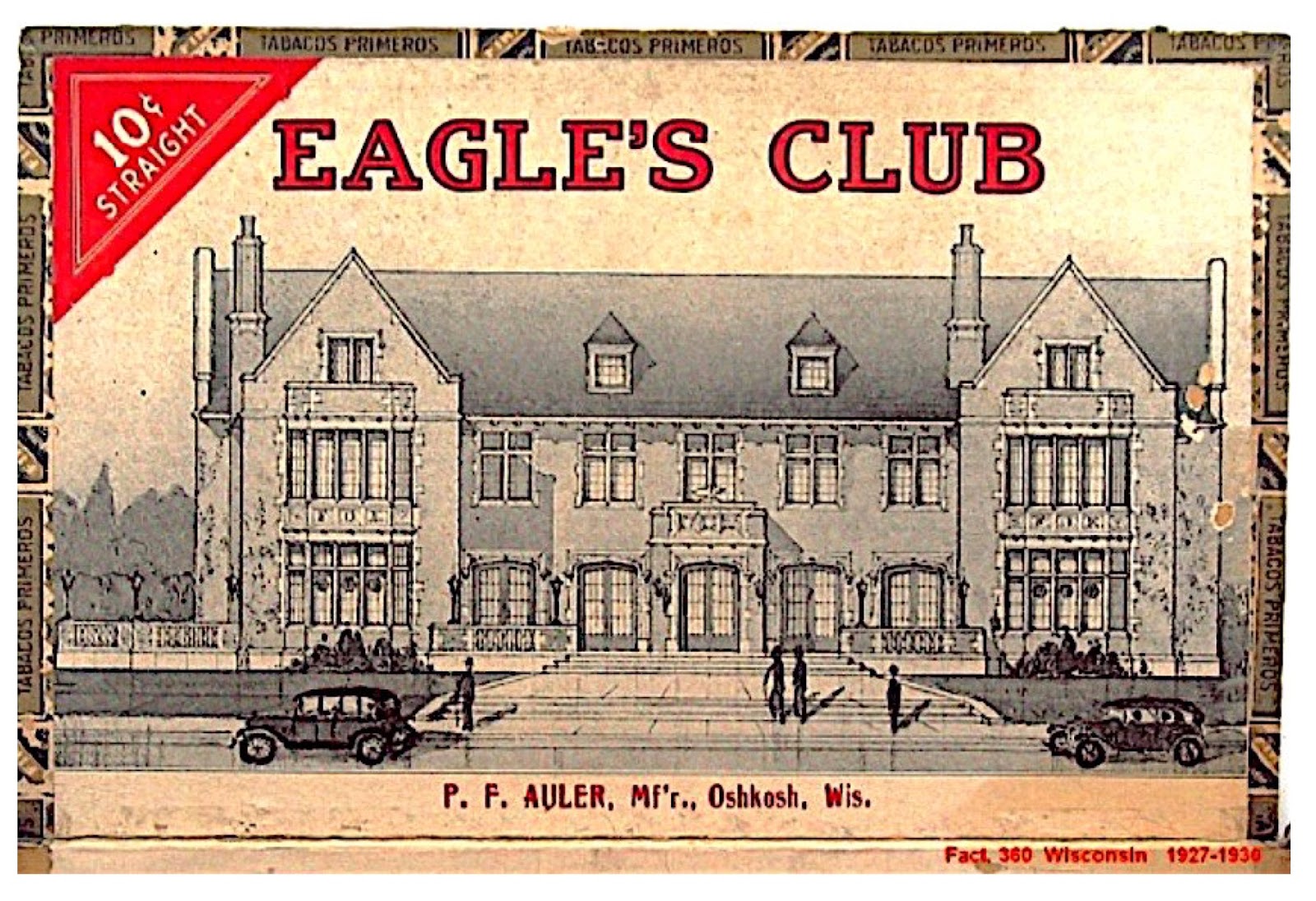
The Annex ground slowly to a halt. Steuck finally closed the doors in 1927. Steuck sold off the bar’s fixtures and moved on. A decade would pass before another bar went in what is now 432-434 N. Main Street.

In February 1928, the new Eagles Club opened on Washington Ave. Al Steuck became its first manager.

Oshkosh Eagle's Club brand cigar box, circa 1928.

Albert H. Steuck died in Oshkosh on December 4, 1947. He’s buried in Lake View Memorial Park.


Monday, November 28, 2016

At Oblio's, 80 Years Ago...

The bar we know today as Oblio's held its grand opening on this day in 1936. The Daily Northwestern contained a full page ad for the new tavern on the eve of its opening. The notice began with a message from the proprietor.

John Brown personally invites you to the GRAND OPENING TOMORROW of one of Oshkosh’s finest and most beautiful taverns at 164 MAIN STREET (now 434 N. Main St). Nothing has been left undone to make this a really delightful place for discriminating men and women.

The tavern’s name was John Brown's Bar. But there was no John Brown there. The name was an alias, likely used as a hedge against the lingering nativism of the era. The actual name of the proprietor was John Konstantine Kuchubas, a Greek immigrant whose picture still hangs on the wall at Oblio’s.

John Konstantine Kuchubas

Kuchubas was born in Greece in 1884, the same year construction was completed on the building where he installed his tavern. As a teenager, Kuchubas served in the Greek military before fleeing his homeland at the age of 18. It's not clear when he arrived in Oshkosh, but by 1915 he was here working in pool halls. A year later, Kuchubas married Oshkosh native Elsie Zwickey.

Through the dry years, Kuchubas ran a pool hall with his brother-in-law John Zwickey. Named the Pastime Billiard Parlor, the business was located at what is now 436 N. Main, just one door north of where he would go into the tavern business.

When Kuchubas launched John Brown’s Bar it became the first tavern since the late 1880s to occupy the north half of the building originally known as the Dichmann Block. The neighboring (southern) portion of the building had been home to the Schlitz Beer Hall for decades. But that establishment was outlawed with the advent of Prohibition in 1920.

The division of the two, separate spaces remains clearly visible at Oblio's.

Former Site of The Schlitz Beer Hall Within Oblio's
The main bar room at Oblio's where Kuchubas opened John Brown's Bar.

The pool halls Kuchubas ran didn't hold liquor licenses. And at 52 years old, he had no previous experience running a tavern. But that wasn’t necessarily a liability. With the end of Prohibition in 1932, the rules governing taverns had been re-written. Even old-time saloonists were having to learn the business anew.

Among the primary changes was the role played by brewers. Before Prohibition, brewery ownership of saloons meant that brewers often maintained broad control over a tavern’s operation. That influence had been reduced to a minimum, due to new legislation that followed the repeal of Prohibition. It meant that for the first time, beers other than those brewed by Schlitz would be served in the building Schlitz had owned since 1886.

The ties to Schlitz were no longer binding, but they hadn't been severed. Though he sold other beer in bottles, Schlitz remained the only beer Kuchubas offered on draft. The ad for his grand opening shows the prominent position held by the Milwaukee brewery at John Brown's Bar.

Oshkosh Daily Northwestern, November 27, 1936

Kuchubas ran John Brown’s Bar until 1955 when he retired at age 71. He died 15 years later in 1970. Kuchubas is buried in Riverside Cemetery, some 5,000 miles from the place of his birth.

There are two pictures of Kuchubas in Oblio's. Both show him seated behind the art-deco style bar built for him by the Robert Brand & Sons Company of Oshkosh.


Kuchubas imprint on the tavern waned over the years. With it went much of the bar’s original luster. The connection to Schlitz ended in 1972 when the brewery sold the building. It became Oblio's in 1974.

When Mark Schultz and Todd Cummings took over Oblio's in 1979 it marked a turning point. Cummings and Schultz, who also own the building, have rehabilitated this historic bar. Their renovations included the removal of a drop ceiling to reveal the original, high ceiling of pressed tin. In 2005 they merged the separate rooms once occupied by the Schlitz Beer Hall and John Brown's Bar.

Few public spaces of this vintage reveal the influence of their origin in such an immediate and approachable way. Oblio's is one of those rare places. It's all still there, right down to the Schlitz.


Tuesday, June 7, 2016

Beer Here, This Week

A few quick words about the beer around here this week…
Last Saturday's Rainbow over Bare Bones

The Launching of the Short’s
You may have noticed beer from Michigan Short's Brewing Company showing up recently on tap lists on store shelves in Oshkosh. This week, Short’s will make a bigger splash with launch parties at Chester V’s and Oblio’s.

• Tuesday, June 7, Oblio’s will host a Short’s launch party from 6-8 p.m.
• Then on Wednesday, June 8, Chester V’s will host a Short’s tap takeover from 7-9 p.m.

If you can’t hit either of those, you can always swing by Ski’s for a taste of Short’s. The downtown market currently has Short’s flagship beers in stock, including Bellaire Brown and Huma Lupa Licious. Speaking of Ski’s, they’re also now offering mix 4 and 6 packs. Check that out here.

And if you want to find out what Short’s is all about, here are two guys who have a few things they’d like to tell you.

Bare Bones Anniversary Party
Hard to believe, but Bare Bones has been up and running for a year now. Seems like only yesterday this was happening.

The celebration at Bare Bones begins Thursday, June 9, with a tent party featuring live music from Bare Bones brewmaster RJ Nordlund. Food will be available from Tasty Weiner's on Wheels.

Then on Friday, June 10th, Bare Bones will have a Pig Roast by Hillbilly Bob with live music by Bad Habitz. It’s been an adventurous year for Bare Bones, they have plenty to celebrate.

Check out the brewery's Facebook event page for more.

Butte des Morts Beer
Sunday, June 12, at 1 p.m., I’ll be speaking at the Butte des Morts Lion’s Club about the history of brewing and salooning in Butte des Morts. For such a little place, Butte des Morts sure had a lot going on when it came to beer.

Here’s the best part: There’s going to be beer to sample. I put together a recipe for the sort of beer that was being brewed in Butte des Morts Beer in the 1860s. The recipe was brewed at Bare Bones by assistant brewer Jody Cleveland and will be offered during and after the program. Here’s all the info. Hope to see you there!

Monday, April 11, 2016

Bottling Schlitz in Oshkosh

In last week’s post about the Schlitz blitz in Oshkosh I mentioned the extensive bottling plant Schlitz built at what is now Commerce Street between Pearl and High. This week, I want to take a look at the folks who were running it and some of the bottles that came out of the place.

First, let’s get our bearings. If you were to head over to Commerce Street today searching for the Schlitz bottling plant, here’s what you’d see. The bottling plant was located just about smack dab in the middle of the building where 4 imprint is located.


Here again, is the 1903 map I posted last week showing the layout of the Schlitz facility.


The Schlitz bottling plant was completed in 1891. Schlitz would send wooden kegs full of beer by train to Oshkosh where the local plant manager was responsible for getting it into bottles. Often those bottles were imprinted with the name of the man running the plant.

Charles Maulick
The first manager of the Schlitz branch in Oshkosh was Charles Maulick. He also ran the Schlitz Beer Hall (now Oblio’s Lounge) during this period at what is now 432-434 N. Main Street. Here are a couple of the early bottles that came out of the Schlitz bottle works in Oshkosh.


Next, we have something incredibly rare. In fact, it may be one of a kind. This is a recently discovered bottle from the Maulick era embossed with the Schlitz name. The green/blue tint is caused by iron in the sand from which the bottle was made. These bottles weren’t used long by Schlitz. After the turn of the century, the brewery used brown bottles exclusively for its beer to “Protect its purity.”


Here’s the stopper used to cork that bottle. It’s imprinted with the Charles Maulick logo.


Peter Henrichs
Maulick bailed on the bottling business either in the latter half of 1898 or early 1899. He was succeeded as Schlitz’s primary Oshkosh agent by a man named Peter Henrichs. Though Henrichs appears to have run the plant for a year or more, I’ve neither seen nor heard of any bottles bearing his name.

Louis Plate
By 1902, Plate had assumed bottling operations for Schlitz in Oshkosh. This was a heady period for Schlitz. It had just surpassed Pabst as the largest brewery in the world, producing more than 1 million barrels of beer annually. Here’s an ad from May 1902 featuring the Schlitz man in Oshkosh.


By 1903, Plate had left the bottling plant to run Schlitz Hall at the corner of State and Washington streets in Oshkosh. Bottles embossed with his name are exceedingly rare. Here’s one that’s in great shape.


Emil Thom
Lifelong Oshkosh resident, Emil Thom took over the Schlitz branch after Plate departed. The first notices for Thom as the Schlitz agent began appearing in 1903. Here’s an attractive ad for Schlitz that ran in the Oshkosh Northwestern during Thom’s tenure. You’ll notice his name at the bottom.


A couple of Thom bottles filled in Oshkosh and embossed with his name.

William F. Ganzer
By 1908, William Ganzer was running the Schlitz branch here. He remained at the helm longer than any of his predecessors. The onset of Prohibition cost him his job.

Here’s an ad from 1913 when Ganzer was peddling Schlitz (you’ll see his name near the bottom). In this one, Schlitz is trash talking the John Gund Brewing Company of La Crosse for its use of clear bottles.


A couple of nice looking Ganzer bottles, brown of course.


Schlitz shuttered its Oshkosh branch just prior to Prohibition beginning in 1920. The property was sold by the brewery in 1928. When Prohibition ended in 1933, Schlitz beer returned to Oshkosh. But it was no longer bottled here. Gone were the days of the Schlitz agent roaming the city on a clattering wagon packed with blob-top bottles of beer filled in Oshkosh.


Thanks, in a big way, to Bob Bergman and Steve Schrage for help with this post. Their input was invaluable.