Showing posts with label Oshkosh Breweriana. Show all posts
Showing posts with label Oshkosh Breweriana. Show all posts
Wednesday, May 3, 2023
Oshkosh Breweriana with Jared Sanchez
Jared Sanchez, who launched the bi-annual B’gosh It’s Good Breweriana show in Oshkosh back in 2020, was recently featured on the Beer Collector YouTube channel. It’s a nice spot and gives a good look at the collection of Oshkosh breweriana Jared is building. Here is the video…


Monday, April 24, 2023
B'Gosh It's Good Again
The B'Gosh It's Good Breweriana Show hits Fifth Ward Brewing again this Saturday. It's always a fun event. Grab a beer and go strolling through the brewery to see an incredible array of historic brewery collectibles.
The event runs from noon until 4pm, Check out the event page for details.

Tuesday, January 17, 2023
Since 1864...
When you see brewery advertising based on history, you can bet it’s probably going to be bullshit. This one, from 1992, is full of it.

Chief Oshkosh Red Lager had absolutely no connection to the Chief Oshkosh brand produced by the Oshkosh Brewing Company. And the “Since 1864” thing is entirely off the mark.

Chief Oshkosh Red Lager had absolutely no connection to the Chief Oshkosh brand produced by the Oshkosh Brewing Company. And the “Since 1864” thing is entirely off the mark.
The first Chief Oshkosh, a non-alcoholic beer made by the Oshkosh Brewing Company, wasn’t introduced until 1928. It became an alcoholic beer at the end of Prohibition in 1933 and was discontinued altogether in 1972.
Chief Oshkosh Red Lager was introduced in 1991 by Mid-coast Brewing, an Oshkosh-based company, that made its beer at the Stevens Point brewery. That said, it was good beer for the short time it lasted. Chief Oshkosh Red Lager came to an end in 1994.
Tuesday, September 13, 2022
B'Gosh It's Good Again
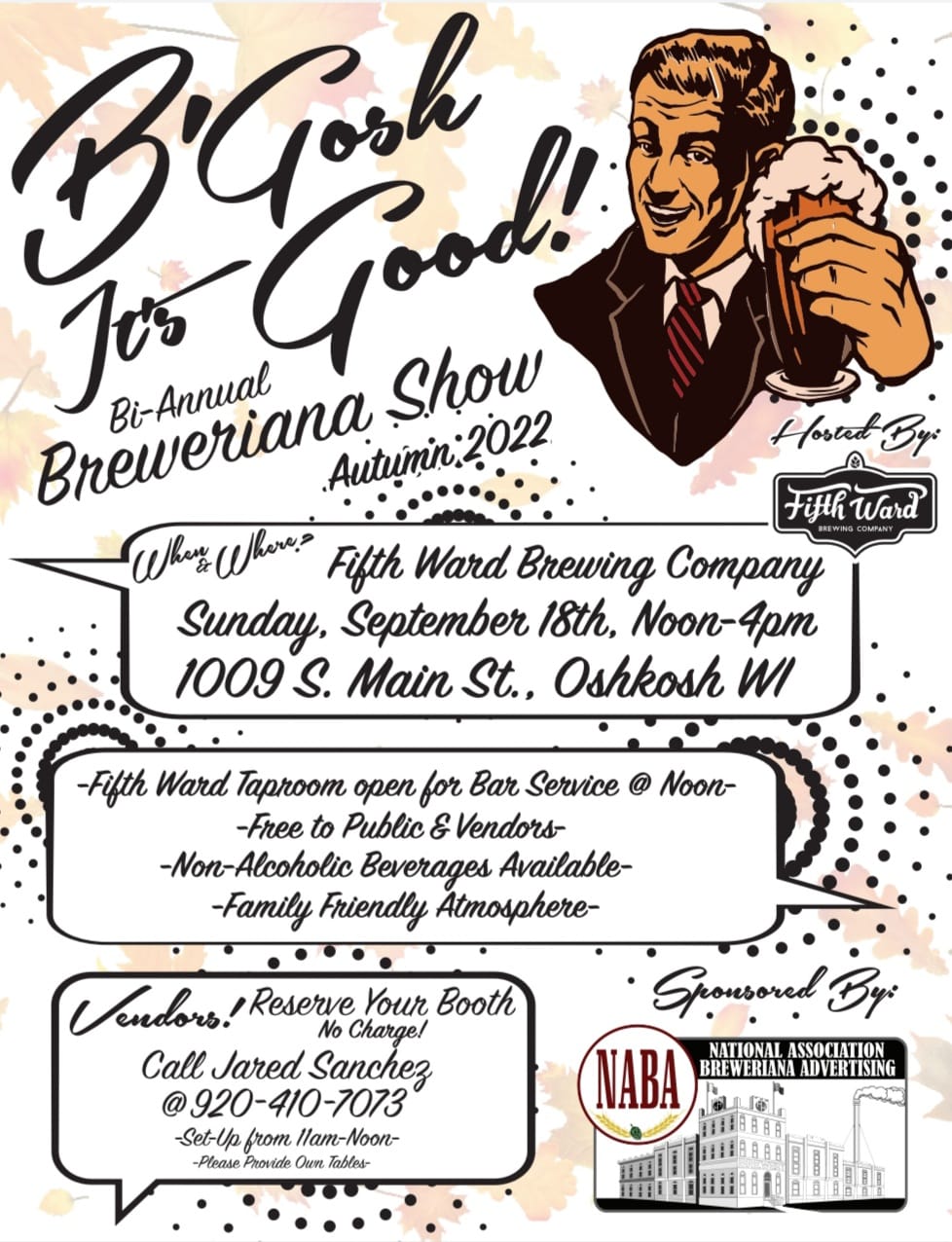
The bi-annual B'Gosh It's Good breweriana show returns this Sunday to Fifth Ward Brewing Company in Oshkosh. More than 30 collectors will be on hand showing off, selling, and trading their vintage brewery memorabilia. This show is free and open to the public. And it’s always a blast with plenty of beer-based eye candy for your perusal. The show runs from noon until 4 pm.
If you’re a collector who would like to have a table at the show, click here for details on how to get involved.
If you’re a collector who would like to have a table at the show, click here for details on how to get involved.
Sunday, September 4, 2022
The Nearly Lost Labels of Peoples Brewing
Sneaking into Oshkosh's abandoned breweries became a hobby for some kids in the early 1970s (you can read about that here). Many of them were collectors of beer cans and other brewery memorabilia. The thrill of going into the untended breweries was heightened by the possibility of coming out with something worth saving. Those kids walked away with bottles, cans, beer labels, signs, log books... Anything bearing a trademark was fair game.
The scavenging led to the recovery of countless pieces of Oshkosh breweriana that otherwise would have been lost. The haul included some incredibly obscure items. This for example:
The Hunt for a New Label
Peoples Brewing Company was aiming to update its image in 1958. The brewery had been using the same label for Peoples Beer since 1952. But the atomic age had given way to the space age. The old label was looking dated.
That label was replaced by one that would become an iconic Wisconsin beer label. We’ll see that in a moment. First, let's have a look at a few of the labels that didn't make the cut.
The images below are scans of prototypes that were in the running to become the new label for Peoples Beer. These were rescued by one of those young brewery raiders. They were discovered in the deserted office at Peoples Brewing in 1973. Peoples had closed the previous year.


The eventual winner was more dynamic than any of the other labels on the table for consideration. By mid-November of 1958, the new label for Peoples Beer was in circulation. More than 60 years later, it still looks like the right choice.
The scavenging led to the recovery of countless pieces of Oshkosh breweriana that otherwise would have been lost. The haul included some incredibly obscure items. This for example:
 |
| A prototype beer label, 1958. |
The Hunt for a New Label
Peoples Brewing Company was aiming to update its image in 1958. The brewery had been using the same label for Peoples Beer since 1952. But the atomic age had given way to the space age. The old label was looking dated.
 |
| The Peoples label from 1952 until 1958. |
That label was replaced by one that would become an iconic Wisconsin beer label. We’ll see that in a moment. First, let's have a look at a few of the labels that didn't make the cut.
The images below are scans of prototypes that were in the running to become the new label for Peoples Beer. These were rescued by one of those young brewery raiders. They were discovered in the deserted office at Peoples Brewing in 1973. Peoples had closed the previous year.


No correspondence or other information accompanied the artwork. They were tucked into a cardboard folio stamped by Norway Gravure and dated September 9, 1958. The Norway, Michigan printer was then one of the largest suppliers of American beer labels. Norway Gravure made labels for Blatz, Budweiser, Miller, Pabst, and Schlitz, among many others.

One of the rescued prototypes appears to have been in strong contention for final selection.
The label below was fully realized and pasted onto an artboard with an accompanying bottle-neck label. This is about as rare as a beer label gets.
The label below was fully realized and pasted onto an artboard with an accompanying bottle-neck label. This is about as rare as a beer label gets.

The eventual winner was more dynamic than any of the other labels on the table for consideration. By mid-November of 1958, the new label for Peoples Beer was in circulation. More than 60 years later, it still looks like the right choice.
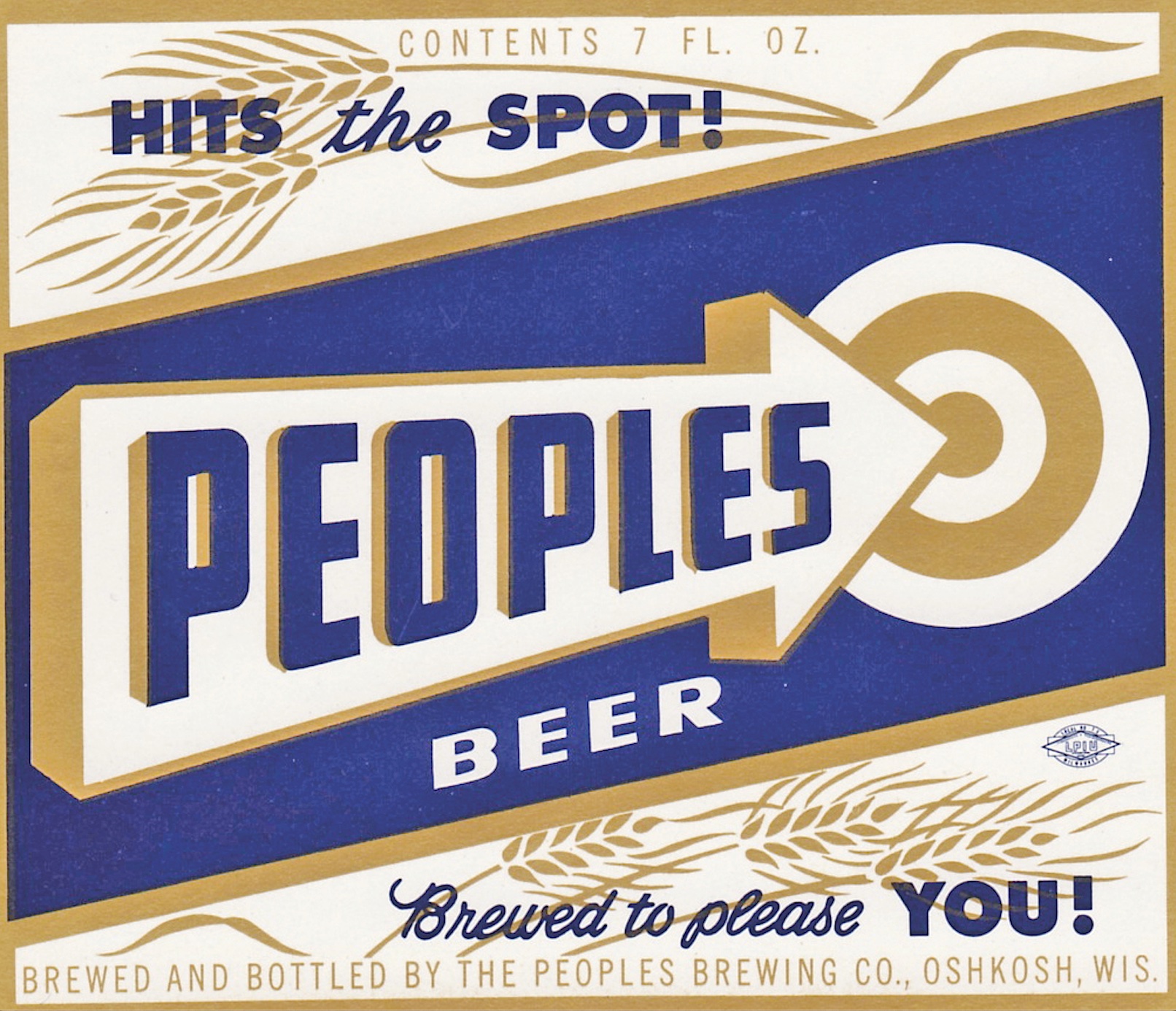 |
| The 1958 design, here used for a 7-ounce bottle. |
Monday, May 2, 2022
B'Gosh It's Good!
 |
| Jared Sanchez |
Jared Sanchez launched the B'Gosh It's Good Breweriana Show in Oshkosh in 2020. It was the first time a breweriana show had taken place here in almost 40 years. The bi-annual event held at Fifth Ward Brewing has developed into something special. At yesterday's show, vendors from around the state displayed an array of items drawn from Wisconsin's storied beer culture. That all of this happens within a working brewery makes it a truly unique experience. The next one takes place this fall. Don't miss it!
Tuesday, April 26, 2022
B'Gosh It's Good
The B'Gosh It's Good breweriana show is this Sunday starting at noon at Fifth Ward Brewing in Oshkosh. This event has grown into something like a pop-up beer museum with 30 collectors on hand showing off their vintage brewery memorabilia. It's free and if you'd like to be a vendor there are a couple of spots still left (contact Jared Sanchez here). I'll be there, too, with copies of my book Winnebago County Beer: A Heady History. Stop by, grab a beer, and give a peruse to some incredible pieces of beer history. The show runs from noon until 4 pm. Check out the Facebook event page for more details.

Thursday, March 24, 2022
Remembering Ron Akin
Dr. Ronald Akin of Oshkosh passed away on Monday, March 21st. Ron was a leading figure in the field of Wisconsin breweriana and the preeminent collector of breweriana related to Oshkosh.
He was born and raised in Hortonville. Ron came to Oshkosh in 1955 to attend UW-Oshkosh where he excelled as an athlete. Ron would later become a full professor at UW-Oshkosh while also coaching several sports.
His interest in breweriana was instigated by his sons Dan and David after they began collecting beer cans in the early 1970s.
"So, I became a collector too, collecting anything related to any of the closed Oshkosh breweries," Ron once explained to me. "Back then, there was so little information available on those breweries. I wanted to know more. Collecting breweriana became part of that and as I learned more, I discovered how important the breweries were to the history of Oshkosh.”
The collection Ron built was unrivaled. His fellow collectors came to know him for his tenacity. But Ron was equally generous in sharing his discoveries. He often invited inquisitive strangers into his home to acquaint them with the incredible pieces he was dedicated to preserving.
As his knowledge and collection grew, Ron began publishing articles in breweriana journals. People started asking him to give talks about Oshkosh brewing history. He was always happy to oblige.
I met Ron for the first time in December of 2010. We were at the Oshkosh Public Library to hear a lecture about Frank J. Hess & Sons, a Madison cooperage that made wooden beer barrels in the early 1900s. After the talk, Ron's wife, Kenlynn, introduced us. She had somehow diagnosed that I shared her husband's affliction: a consuming interest in anything related to old breweries.
They invited me to their home and Ron led me through his immense collection. I was stunned. I didn't realize it then, but our destination was already being set. Not long after that visit, Ron suggested that we collaborate on a book about the history of Oshkosh’s breweries. We went straight to work. The Breweries of Oshkosh was published in September of 2012.
I wasn't the only person to be swept into Ron's orbit. As breweriana collector Dale Applebee recently told me, "Ron definitely inspired a lot of people into collecting Oshkosh memorabilia." He seemed to have a knack for spotting those who shared his passion. He kept that fire burning even in his last years, becoming a mentor to younger collectors like Jared Sanchez.
"I had bought a Tonka Truck off of eBay and I had no idea that the seller was Ron Akin," Jared says. "When I arrived to pick up my purchase we talked for a few minutes and he asked if I collected anything else. I told him I collected Chief Oshkosh Beer items and his face lit up. He asked me if I wanted to see his collection. The moment I saw his basement, my life was never the same."
Jared has gone on to establish the B'Gosh It's Good Breweriana Show held bi-annually at Fifth Ward Brewing in Oshkosh. It’s a prime example of Ron's abiding influence.
Ron Akin will be sorely missed. But his presence will be felt for years to come. He will continue to inspire.

 |
| Ron Akin |
He was born and raised in Hortonville. Ron came to Oshkosh in 1955 to attend UW-Oshkosh where he excelled as an athlete. Ron would later become a full professor at UW-Oshkosh while also coaching several sports.
His interest in breweriana was instigated by his sons Dan and David after they began collecting beer cans in the early 1970s.
"So, I became a collector too, collecting anything related to any of the closed Oshkosh breweries," Ron once explained to me. "Back then, there was so little information available on those breweries. I wanted to know more. Collecting breweriana became part of that and as I learned more, I discovered how important the breweries were to the history of Oshkosh.”
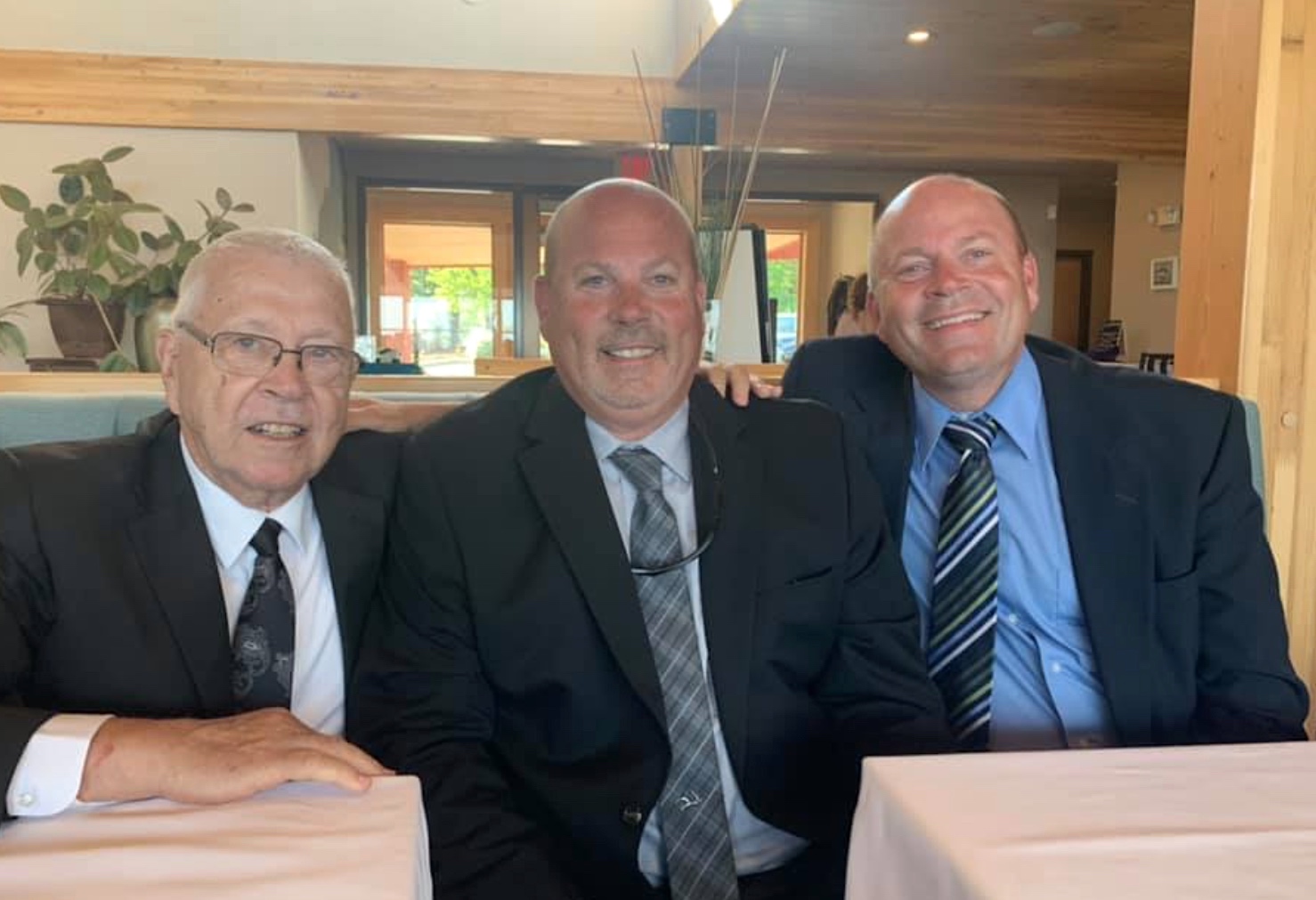 |
| Ron with his sons, David (in the middle) and Dan. |
The collection Ron built was unrivaled. His fellow collectors came to know him for his tenacity. But Ron was equally generous in sharing his discoveries. He often invited inquisitive strangers into his home to acquaint them with the incredible pieces he was dedicated to preserving.
As his knowledge and collection grew, Ron began publishing articles in breweriana journals. People started asking him to give talks about Oshkosh brewing history. He was always happy to oblige.
 |
| Ron and Kenlynn Akin. |
I met Ron for the first time in December of 2010. We were at the Oshkosh Public Library to hear a lecture about Frank J. Hess & Sons, a Madison cooperage that made wooden beer barrels in the early 1900s. After the talk, Ron's wife, Kenlynn, introduced us. She had somehow diagnosed that I shared her husband's affliction: a consuming interest in anything related to old breweries.
They invited me to their home and Ron led me through his immense collection. I was stunned. I didn't realize it then, but our destination was already being set. Not long after that visit, Ron suggested that we collaborate on a book about the history of Oshkosh’s breweries. We went straight to work. The Breweries of Oshkosh was published in September of 2012.
 |
| Ron with a proof of the Breweries of Oshkosh cover. To his left is his brother George and son David. |
I wasn't the only person to be swept into Ron's orbit. As breweriana collector Dale Applebee recently told me, "Ron definitely inspired a lot of people into collecting Oshkosh memorabilia." He seemed to have a knack for spotting those who shared his passion. He kept that fire burning even in his last years, becoming a mentor to younger collectors like Jared Sanchez.
 |
| Ron with Jared Sanchez and Jared’s daughter Emmalynn. |
"I had bought a Tonka Truck off of eBay and I had no idea that the seller was Ron Akin," Jared says. "When I arrived to pick up my purchase we talked for a few minutes and he asked if I collected anything else. I told him I collected Chief Oshkosh Beer items and his face lit up. He asked me if I wanted to see his collection. The moment I saw his basement, my life was never the same."
Jared has gone on to establish the B'Gosh It's Good Breweriana Show held bi-annually at Fifth Ward Brewing in Oshkosh. It’s a prime example of Ron's abiding influence.
Ron Akin will be sorely missed. But his presence will be felt for years to come. He will continue to inspire.

A few additional notes…
Ron had a remarkable career at UW-Oshkosh. Here are a few more notes about his athletic and coaching accomplishments there.
In 2003, Ron gave a talk about the Oshkosh Brewing Company at the Grand Opera House. His presentation was filmed by Oshkosh Community Access Television. The Oshkosh Public Library has a copy of it on DVD. You can check that out here.
There are numerous stories about Ron inviting folks into his home to see his collection of Oshkosh breweriana up-close. My friend Frankie wrote about her visit. You can see that here.
The next edition of Jared Sanchez’s B'Gosh It's Good Breweriana Show will take place on May 1, 2022. There’s more information on that here.
Monday, September 27, 2021
B’Gosh it’s Good at Fifth Ward on Sunday
The third B’Gosh it’s Good Brewery Collectables Trade Show is this Sunday at Fifth Ward Brewing in Oshkosh. Stop by, grab a beer, and check out the incredible array of brewery memorabilia this event pulls in. The show begins at noon and it's free!

Tuesday, May 11, 2021
Breweriana Show at Fifth Ward
The B'Gosh It's Good Breweriana show is this Sunday, May 16 at Fifth Ward Brewing.

Stop by, grab a beer, and peruse all manner of choice brewery memorabilia. They'll have 26 vendors and lots of Oshkosh items on hand. And it is FREE! The show starts at Noon. Last fall's show was great, this one should be even better...


Stop by, grab a beer, and peruse all manner of choice brewery memorabilia. They'll have 26 vendors and lots of Oshkosh items on hand. And it is FREE! The show starts at Noon. Last fall's show was great, this one should be even better...
 |
| Last year's breweriana show at Fifth Ward. |

Sunday, March 21, 2021
The Wanderings of an 800-Pound Chief
Here we have about 800 pounds of baked earth. It's six-feet in diameter, 110 years old, and well-traveled.

For 75 years, that clay medallion was the emblem of the Oshkosh Brewing Company (OBC). After OBC closed in 1971, the emblem remained on the face of the defunct brewery for 15 more years. It endured in stark contrast to the decay gathering all around it.

The emblem was produced in 1911. It was to be the crowning jewel on the new brewery OBC was building at 16th and Doty. They had gone to Chicago and commissioned the nation's premier supplier of terracotta work.
"Up in Oshkosh, once the home of the red man, now the home of the lumber kings and yachting regattas, the Oshkosh Brewing Company has caused its somewhat unique trademark to be “done” in terra cotta, and the Northwestern Terra Cotta Company was called upon to do the job.”
– The Clay-Worker, February 1912.
The knowing gaze of the chief had been fixed in place by the time the new brewery opened to the public in May 1912.
And there the emblem remained even as the brewery was being torn down. On December 27, 1986, with the demolition well underway, the emblem was put up for auction.
About 100 people gathered in front of the crumbling brewery on that Saturday morning. Nine of them, including Lynne Webster, had come to place bids. Webster was an Oshkosh Chamber official and was there to bid on behalf of the City of Oshkosh. She could go as high as $6,600. But within minutes of the first call, Webster was out of the running.
The minimum bid was set at $1,000. From there, the price quickly shot past $7,000. In 20 minutes it was over. The winning bid of $8,800 was placed by Paul Winter, a 27-year-old former Oshkosh resident who had, at one time, lived near the brewery. Winter said he spent about $1,000 more than he had intended to. “A person gets kind of caught up with an auction,” he said. The total with tax came to $9,240. That didn't include the cost of getting the embedded piece down off the brewery. Winter was given two weeks to accomplish that.

Lynne Webster was disappointed but unbowed. In the days following the auction, she began recruiting donors to raise money to purchase the emblem from Winter. The primary donor would be A. Thomas Schwalm. His family had helped to found OBC in 1894.
A. Thomas Schwalm was also a past brewmaster at OBC. He had left the brewery in August of 1950 to become co-publisher of the Oshkosh Daily Northwestern. Schwalm was not at all happy that the emblem had fallen into the hands of a private collector. "We were going to get that emblem a long time ago," he said, "I didn't want it to be lost."
It almost certainly would have been lost had Thomas Schwalm not filled the funding gap needed to get it back. "I think his connection over there at the brewery – it touched him," Lynne Webster later recalled. "He saved a bit of his personal history, but also a part of the city's history."
A week after the auction, Paul Winter was persuaded to sell the emblem to the city for $9,040. That was $200 less than he had committed to pay for it. "It was a really tough decision," Winter said. He wanted it to stay in Oshkosh “where everyone could share in its beauty.”
As part of the deal, the city agreed to have a fiberglass reproduction of the emblem made for Winter. The replica was expected to cost another $2,500. Lynne Webster said that Thomas Schwalm also paid for that.

City officials immediately announced plans to turn the emblem into a monument. Thomas Schwalm said he hoped it would help remind people that Oshkosh was once a center for brewing. The last brewery in Oshkosh – Peoples Brewing – had closed 15 years earlier. “This is a segment of Oshkosh history that we no longer have," said Lynne Webster. "This monument will commemorate all the different breweries that are no longer here.”
Meanwhile, the city needed to decide where the emblem would go. An advisory committee that included Webster was formed to identify potential locations. Three months later, they had narrowed the choices to three: The exterior west-facing wall of the Oshkosh Public Museum; the south exterior wall of the Oshkosh Centre near the Main Street Bridge; and in South Park near the intersection of West South Park and Ohio.
While the committee deliberated, James Metz – editorial page editor of the Oshkosh Northwestern, campaigned for the emblem to be placed at the museum. Metz ran an informal poll in the paper and then announced the museum site to be the overwhelming favorite of those who responded. Metz and his cohort didn't have their way.
In July 1987, the emblem was placed on the south wall of the Oshkosh Centre. The site was favored by the Landmarks Commission for being the most visible location of those under consideration. Thomas Schwalm paid for the mounting. The emblem remained there for the next 20 years.
After two decades, the emblem came down again. It was removed to make way for the 2008 remodeling of the Oshkosh Centre, which is now the Oshkosh Convention Center.
This time, there wasn't a debate about where it would go next. The Oshkosh Public Museum took possession of the emblem in March of 2008. Museum director Brad Larson said it would cost about $12,000 to create a proper display for the piece. The Kuenzl Foundation donated $5,000 towards the project. The Kuenzl family had launched the Gambrinus Brewery in Oshkosh in 1875 and was one of the three founding families behind the formation of the Oshkosh Brewing Company.
The emblem was placed in a brushed-metal framework and covered with a clear, thermoplastic shield. In September 2009 it was mounted outside the main entrance to the Oshkosh Public Museum. You can see it there today. The 110-year-old face of clay at the center of the emblem appears as composed as ever.
A Few Notes...
A word of thanks to Paul Winter. Thanks also to Anna Cannizzo of the Oshkosh Public Museum. They both helped to clarify information related to the emblem and the replica that was made from it. And thanks to Tom Denow and Scott Krumenauer for sharing their pictures of the emblem while it was still on the brewery.
About that replica: It was created by the Oshkosh Public Museum from a latex mold reinforced with plaster. The fiberglass reproduction was then painted to match the colors of the original emblem. The museum kept the mold, but it eventually deteriorated and has since been discarded. Winter said he was pleased with how the reproduction of the emblem turned out.
A couple of weeks ago I put up a related post about the years of decay and eventual demolition of the Oshkosh Brewing Company's brewery. That can be found here.
You can find more on the tangled history of Chief Oshkosh and beer here.

For 75 years, that clay medallion was the emblem of the Oshkosh Brewing Company (OBC). After OBC closed in 1971, the emblem remained on the face of the defunct brewery for 15 more years. It endured in stark contrast to the decay gathering all around it.

The emblem was produced in 1911. It was to be the crowning jewel on the new brewery OBC was building at 16th and Doty. They had gone to Chicago and commissioned the nation's premier supplier of terracotta work.
"Up in Oshkosh, once the home of the red man, now the home of the lumber kings and yachting regattas, the Oshkosh Brewing Company has caused its somewhat unique trademark to be “done” in terra cotta, and the Northwestern Terra Cotta Company was called upon to do the job.”
– The Clay-Worker, February 1912.
 |
| The Northwestern Terra Cotta Company of Chicago. |
The knowing gaze of the chief had been fixed in place by the time the new brewery opened to the public in May 1912.
 |
| The new brewery of the Oshkosh Brewing Company. 1600 block of Doty Street. |
And there the emblem remained even as the brewery was being torn down. On December 27, 1986, with the demolition well underway, the emblem was put up for auction.
 |
| A flyer for the 1986 auction. |
About 100 people gathered in front of the crumbling brewery on that Saturday morning. Nine of them, including Lynne Webster, had come to place bids. Webster was an Oshkosh Chamber official and was there to bid on behalf of the City of Oshkosh. She could go as high as $6,600. But within minutes of the first call, Webster was out of the running.
 |
| Auctioneer Don Wagner taking bids. |
The minimum bid was set at $1,000. From there, the price quickly shot past $7,000. In 20 minutes it was over. The winning bid of $8,800 was placed by Paul Winter, a 27-year-old former Oshkosh resident who had, at one time, lived near the brewery. Winter said he spent about $1,000 more than he had intended to. “A person gets kind of caught up with an auction,” he said. The total with tax came to $9,240. That didn't include the cost of getting the embedded piece down off the brewery. Winter was given two weeks to accomplish that.

Lynne Webster was disappointed but unbowed. In the days following the auction, she began recruiting donors to raise money to purchase the emblem from Winter. The primary donor would be A. Thomas Schwalm. His family had helped to found OBC in 1894.
 |
| Catherine (Schwalm) Clark and her brother Thomas Schwalm. |
A. Thomas Schwalm was also a past brewmaster at OBC. He had left the brewery in August of 1950 to become co-publisher of the Oshkosh Daily Northwestern. Schwalm was not at all happy that the emblem had fallen into the hands of a private collector. "We were going to get that emblem a long time ago," he said, "I didn't want it to be lost."
 |
| OBC in the 1960s. |
It almost certainly would have been lost had Thomas Schwalm not filled the funding gap needed to get it back. "I think his connection over there at the brewery – it touched him," Lynne Webster later recalled. "He saved a bit of his personal history, but also a part of the city's history."
A week after the auction, Paul Winter was persuaded to sell the emblem to the city for $9,040. That was $200 less than he had committed to pay for it. "It was a really tough decision," Winter said. He wanted it to stay in Oshkosh “where everyone could share in its beauty.”
As part of the deal, the city agreed to have a fiberglass reproduction of the emblem made for Winter. The replica was expected to cost another $2,500. Lynne Webster said that Thomas Schwalm also paid for that.
 |
| Bringing down the emblem in January 1987. |

City officials immediately announced plans to turn the emblem into a monument. Thomas Schwalm said he hoped it would help remind people that Oshkosh was once a center for brewing. The last brewery in Oshkosh – Peoples Brewing – had closed 15 years earlier. “This is a segment of Oshkosh history that we no longer have," said Lynne Webster. "This monument will commemorate all the different breweries that are no longer here.”
 |
| The demolition Peoples Brewing, 1974. |
Meanwhile, the city needed to decide where the emblem would go. An advisory committee that included Webster was formed to identify potential locations. Three months later, they had narrowed the choices to three: The exterior west-facing wall of the Oshkosh Public Museum; the south exterior wall of the Oshkosh Centre near the Main Street Bridge; and in South Park near the intersection of West South Park and Ohio.
While the committee deliberated, James Metz – editorial page editor of the Oshkosh Northwestern, campaigned for the emblem to be placed at the museum. Metz ran an informal poll in the paper and then announced the museum site to be the overwhelming favorite of those who responded. Metz and his cohort didn't have their way.
In July 1987, the emblem was placed on the south wall of the Oshkosh Centre. The site was favored by the Landmarks Commission for being the most visible location of those under consideration. Thomas Schwalm paid for the mounting. The emblem remained there for the next 20 years.
 |
| Looking north over the Main Street Bridge towards the Oshkosh Centre. The Chief Oshkosh emblem is highlighted in yellow. |
After two decades, the emblem came down again. It was removed to make way for the 2008 remodeling of the Oshkosh Centre, which is now the Oshkosh Convention Center.
This time, there wasn't a debate about where it would go next. The Oshkosh Public Museum took possession of the emblem in March of 2008. Museum director Brad Larson said it would cost about $12,000 to create a proper display for the piece. The Kuenzl Foundation donated $5,000 towards the project. The Kuenzl family had launched the Gambrinus Brewery in Oshkosh in 1875 and was one of the three founding families behind the formation of the Oshkosh Brewing Company.
The emblem was placed in a brushed-metal framework and covered with a clear, thermoplastic shield. In September 2009 it was mounted outside the main entrance to the Oshkosh Public Museum. You can see it there today. The 110-year-old face of clay at the center of the emblem appears as composed as ever.
 |
| Oshkosh Public Museum. |
A Few Notes...
A word of thanks to Paul Winter. Thanks also to Anna Cannizzo of the Oshkosh Public Museum. They both helped to clarify information related to the emblem and the replica that was made from it. And thanks to Tom Denow and Scott Krumenauer for sharing their pictures of the emblem while it was still on the brewery.
About that replica: It was created by the Oshkosh Public Museum from a latex mold reinforced with plaster. The fiberglass reproduction was then painted to match the colors of the original emblem. The museum kept the mold, but it eventually deteriorated and has since been discarded. Winter said he was pleased with how the reproduction of the emblem turned out.
A couple of weeks ago I put up a related post about the years of decay and eventual demolition of the Oshkosh Brewing Company's brewery. That can be found here.
You can find more on the tangled history of Chief Oshkosh and beer here.
Wednesday, September 30, 2020
Breweriana Show in Oshkosh
On Sunday, October 4, beginning at noon, Fifth Ward Brewing Company in Oshkosh will host a brewery collectibles trade show. The free event will feature beer-related memorabilia that spans more than a century of American brewing history. It's been almost 40 years since the last time a show like this was held in Oshkosh. The man who's working to organize it wasn't even alive then.
 |
| Jared Sanchez. |
Jared Sanchez is 32, and despite having a full-time job, a wife, and a young daughter, he manages to make time for his obsession: collecting items related to American brewing history. Or as hobbyists like Sanchez call it, breweriana.
"My interest in brewing history began when my college roommate, Zach Clark, started brewing beer in our college house basement with Ian Wenger," Sanchez says. Clark and Wenger went on to establish Fifth Ward Brewing. Meanwhile, Sanchez was studying up on Oshkosh brewing history and searching for remnants of the city's old breweries. But his pursuits grew more focused after a 2014 chance encounter with fellow collector Ron Akin.
Akin is co-author of the book The Breweries of Oshkosh and has amassed the preeminent collection of Oshkosh-related brewery memorabilia. "I had bought a Tonka Truck off of eBay and I had no idea that the seller was Ron Akin," Sanchez says. "When I arrived to pick up my purchase we talked for a few minutes and he asked if I collected anything else. I told him I collected Chief Oshkosh Beer items and his face lit up. He asked me if I wanted to see his collection. The moment I saw his basement, my life was never the same."
Now, Sanchez wants to pay the inspiration forward. "I wanted to set up this show as a way to promote the hobby and bring collectors together in the area and spark some local interest in the brewing history of Oshkosh," he says. "I wanted to put something together where we could all gather and enjoy time together and share our interests."
Many of the items displayed will have ties to Oshkosh, but Sanchez says the scope of the show will be broad. "People can expect to see items from breweries all across the state and country," he says. “There will be items from before Prohibition all the way up to more current things."
At least 15 vendors will be on hand to display their items. Sanchez encourages those who might be interested in showing their collections to contact him at 920-410-7073. His goal is to generate enough interest to ensure that it won’t be another 40 years before the next breweriana show happens here. “I hope to host this event annually,” Sanchez says. “I want to keep the hobby alive so that brewing history is never forgotten.”

Wednesday, February 5, 2020
Oshkosh Breweriana Collector Steve Schrage
The Oshkosh Public Library is hosting an exhibit titled Neighbors Past and Present: The Wisconsin German Experience. It illustrates the history of German immigrants who settled in Wisconsin in the 19th century. Part of the exhibit's local flair is a display curated by Steve Schrage. He's a collector of memorabilia related to Oshkosh's early brewing industry, itself an outgrowth of German migration here. The items Schrage contributed to the exhibit are part of a collection he's been building for the past 15 years. It began with a few hundred unwanted beer cans.
"My uncle was cleaning out his basement and he had this collection of beer cans he was trying to get rid of, so he gave them to me," Schrage says. "Most of them were in rough shape, but there were a few cans from Oshkosh breweries in there and that caught my interest. I grew up in Oshkosh, but I didn't know much about there being breweries here. So I started doing research, and found out, wow, Oshkosh had several breweries. I thought that was really cool. After that, I began searching for anything related to the old breweries."
He found plenty. Beer trays and beer signs and cans and labels and bottles bearing names like Kuenzl, Glatz, and Rahr – all of them German immigrants who came to Oshkosh and helped to establish the city's early beer culture. But as Schrage's collection grew, he found himself particularly drawn to the most elusive and fragile pieces of breweriana. He began focusing almost entirely on embossed bottles issued by Oshkosh's independent beer bottlers in the late 1800s.
Beginning in the 1870s, a subthread of the brewing industry in Oshkosh developed around the growing popularity of bottled beer. Prior to this, nearly all of the beer served here came out of wooden kegs. But as the production of glass bottles became more common, a handful of saloon keepers and brewery workers noticed an opportunity. They would purchase glass bottles in bulk and fill them with beer made at one of the local breweries. The novelty of bottled beer fetched a handsome price. Soon there were bottling operations in every ward.
At their peak in the late 1880s, there were no fewer than a dozen beer bottling houses operating in Oshkosh. Each of their owners would have his name embossed on his bottles in hopes they would be returned. But often they were simply discarded. What was then viewed as little more than an empty package is now a highly sought after collector's item. Schrage's sees a story in every one of them.
"I like to think about the people who drank from those bottles," he says. "How hard they worked and what life for them must have been like. And the people who filled them, one bottle at a time. They didn't have bottling machines, this was all done by hand. Some of them are even hand blown. Some are more than 130 years old. It's just amazing that something so fragile could last that long."
Finding those bottles is like searching for the proverbial needle in a haystack. If only it was hay they were hidden in. A number of Schrage's bottles were excavated from the filled-in reservoirs of former outhouses. "Yep, a lot of them ended up in the privy," Schrage says. He was introduced to bottle digging by fellow Oshkosh collector Bob Bergman, who has built much of his collection by digging and diving for rare bottles.
"The first time I went diving with Bob, I found a Frank Thielen bottle," Schrage says. "That was it, I was hooked." Thielen was an Oshkosh saloon owner who in the 1880s was also bottling beer. His bottles are now considered extremely rare.
"They're gone," Schrage says. "What has survived is already in the collections of other people like me who wouldn't think of giving them up. The only way to get them now is to find the ones that haven't been discovered. That Thielein bottle had probably been underwater for more than 100 years. It's incredible to think of. There are some treasures down in that river."
A generous selection of Schrage's treasures, including some of his rare bottles, will remain on display at the Oshkosh Public Library until February 28th.
This article also appeared in the February 5, 2020 edition of the Oshkosh Herald.
 |
| Steve Schrage with his son Smith and daughter Kennedy at the Oshkosh Public Library Exhibit. |
"My uncle was cleaning out his basement and he had this collection of beer cans he was trying to get rid of, so he gave them to me," Schrage says. "Most of them were in rough shape, but there were a few cans from Oshkosh breweries in there and that caught my interest. I grew up in Oshkosh, but I didn't know much about there being breweries here. So I started doing research, and found out, wow, Oshkosh had several breweries. I thought that was really cool. After that, I began searching for anything related to the old breweries."
He found plenty. Beer trays and beer signs and cans and labels and bottles bearing names like Kuenzl, Glatz, and Rahr – all of them German immigrants who came to Oshkosh and helped to establish the city's early beer culture. But as Schrage's collection grew, he found himself particularly drawn to the most elusive and fragile pieces of breweriana. He began focusing almost entirely on embossed bottles issued by Oshkosh's independent beer bottlers in the late 1800s.
Beginning in the 1870s, a subthread of the brewing industry in Oshkosh developed around the growing popularity of bottled beer. Prior to this, nearly all of the beer served here came out of wooden kegs. But as the production of glass bottles became more common, a handful of saloon keepers and brewery workers noticed an opportunity. They would purchase glass bottles in bulk and fill them with beer made at one of the local breweries. The novelty of bottled beer fetched a handsome price. Soon there were bottling operations in every ward.
At their peak in the late 1880s, there were no fewer than a dozen beer bottling houses operating in Oshkosh. Each of their owners would have his name embossed on his bottles in hopes they would be returned. But often they were simply discarded. What was then viewed as little more than an empty package is now a highly sought after collector's item. Schrage's sees a story in every one of them.
"I like to think about the people who drank from those bottles," he says. "How hard they worked and what life for them must have been like. And the people who filled them, one bottle at a time. They didn't have bottling machines, this was all done by hand. Some of them are even hand blown. Some are more than 130 years old. It's just amazing that something so fragile could last that long."
Finding those bottles is like searching for the proverbial needle in a haystack. If only it was hay they were hidden in. A number of Schrage's bottles were excavated from the filled-in reservoirs of former outhouses. "Yep, a lot of them ended up in the privy," Schrage says. He was introduced to bottle digging by fellow Oshkosh collector Bob Bergman, who has built much of his collection by digging and diving for rare bottles.
"The first time I went diving with Bob, I found a Frank Thielen bottle," Schrage says. "That was it, I was hooked." Thielen was an Oshkosh saloon owner who in the 1880s was also bottling beer. His bottles are now considered extremely rare.
"They're gone," Schrage says. "What has survived is already in the collections of other people like me who wouldn't think of giving them up. The only way to get them now is to find the ones that haven't been discovered. That Thielein bottle had probably been underwater for more than 100 years. It's incredible to think of. There are some treasures down in that river."
A generous selection of Schrage's treasures, including some of his rare bottles, will remain on display at the Oshkosh Public Library until February 28th.
This article also appeared in the February 5, 2020 edition of the Oshkosh Herald.
Sunday, February 10, 2019
A Picture of Beer
Here's a lovely Oshkosh Brewing Company lithograph circa 1901.

And here's the real thing.

Not long after that lithograph came out, OBC abandoned those clunky, porcelain bottlers stoppers. The brewery switched over to bottles that fit crown-style caps, similar to those you see today. Those new caps may be more convenient, but the old plugs have an undeniable romance about them.


And here's the real thing.

Not long after that lithograph came out, OBC abandoned those clunky, porcelain bottlers stoppers. The brewery switched over to bottles that fit crown-style caps, similar to those you see today. Those new caps may be more convenient, but the old plugs have an undeniable romance about them.

Tuesday, October 3, 2017
Every Knob Has a Story
Here we have five tap knobs. All from Peoples Brewing Company of Oshkosh. They span five decades of draft beer. Each has its story. The first of the bunch comes from the early 1930s.

Wurtzer beer was released at the end of Prohibition in 1933. This was also when the branded tap knob became commonplace. After Prohibition, taverns were required to clearly identify the draft beer they served. These ball knobs were what everybody used.
With the 1940s came WWII. The Germanic heft of Würtzer was too much to bear. Peoples dropped it. The beer became known simply as Peoples Beer.

Peoples redesigned its logo in 1951. They aimed for something modern and sleek. At the same time, Peoples introduced its new catchphrase, "HITS the SPOT!"

In the 1960s, those well-worn ball knobs were being phased out. Brewers sought to set their beer apart. Tap handles grew larger. More eye-catching. This is a Peoples handle from the 1960s.

Here's the end of the line. When first shown this, I thought it was counterfeit. A reliable source assures me it's not. This is purported to be from 1971. A year later, Peoples Brewing closed. They'd come a long way from Würtzer.


Wurtzer beer was released at the end of Prohibition in 1933. This was also when the branded tap knob became commonplace. After Prohibition, taverns were required to clearly identify the draft beer they served. These ball knobs were what everybody used.
With the 1940s came WWII. The Germanic heft of Würtzer was too much to bear. Peoples dropped it. The beer became known simply as Peoples Beer.

Peoples redesigned its logo in 1951. They aimed for something modern and sleek. At the same time, Peoples introduced its new catchphrase, "HITS the SPOT!"

In the 1960s, those well-worn ball knobs were being phased out. Brewers sought to set their beer apart. Tap handles grew larger. More eye-catching. This is a Peoples handle from the 1960s.

Here's the end of the line. When first shown this, I thought it was counterfeit. A reliable source assures me it's not. This is purported to be from 1971. A year later, Peoples Brewing closed. They'd come a long way from Würtzer.

Monday, August 15, 2016
Gambrinus Rising
After last week’s depressing post about the demise of the Gambrinus Brewery it occurred to me that, symbolically at least, the flag of that old brewery is still flying. To explain, I’ll need to start by showing you a picture.
Here’s the Gambrinus Brewery, circa 1893. Look towards the tip of the arrow atop the brewery’s cupola.

Let’s zoom in on that….

What we’re looking at is a large weathervane that spun with the wind blowing over the Gambrinus Brewery. It depicts King Gambrinus, patron saint of brewers. Gambrinus is holding a stein. He’s standing next to a beer barrel.
For a brewery named Gambrinus, it was only natural that King Gambrinus would become its favored symbol. The image was used frequently in the brewery’s advertising. Here’s an example. This is a close-up of a corner sign that hung outside the Adolph Baier tavern at the northwest corner of Ohio Street and 7th Ave. The image is a bit hazy, but that’s Gambrinus in the middle with a mug of beer held aloft.

The image quality is going to improve as we move along, I promise.
Let’s get back to the story of that weathervane….
When the Gambrinus Brewery was taken down, the Kuenzl family saved the symbolic figure that hovered over their brewery all those years. It wound up in the hands of Lorenz Kuenzl’s grandson. He was also named Lorenz Kuenzl. His nickname was Shorty. Here's a photo of Shorty Kuenzl, circa 1960.
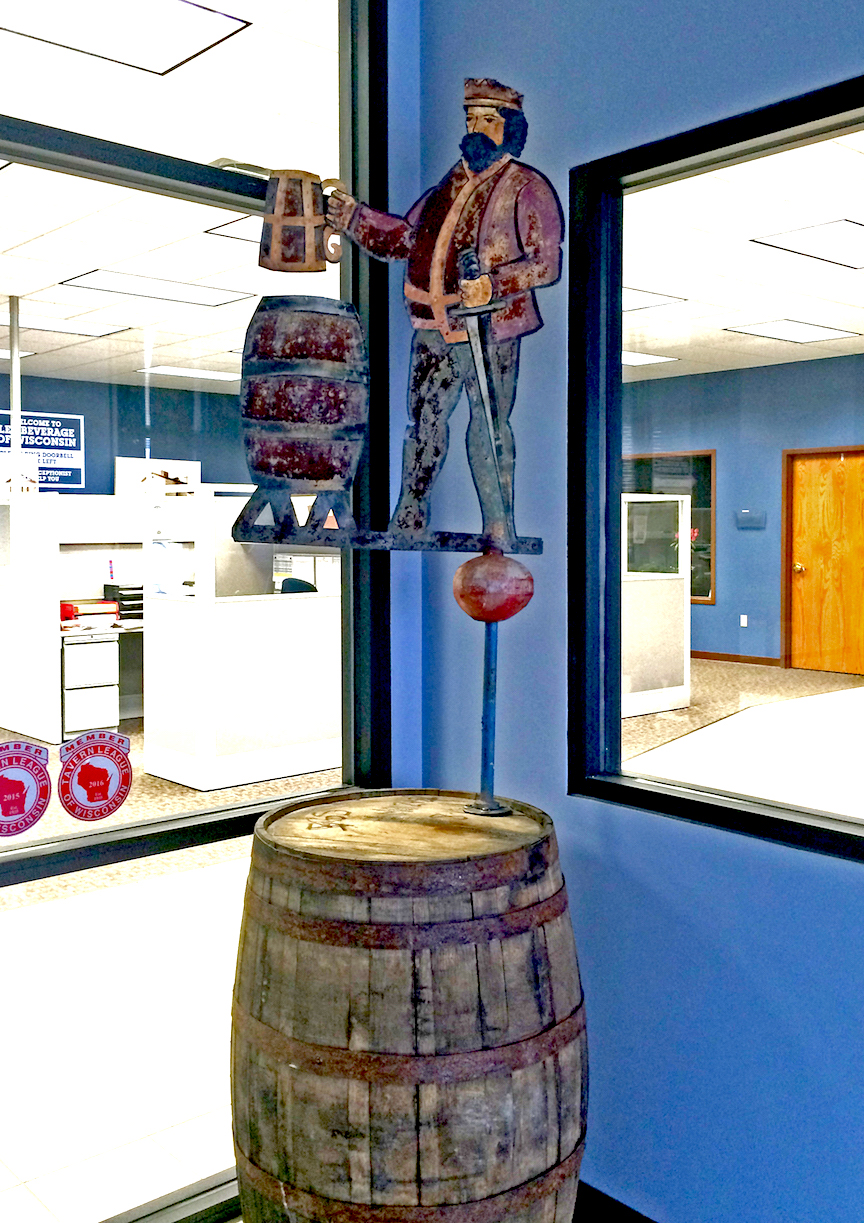
Shorty Kuenzl had a long and interesting beer career in Oshkosh, most of it with the Oshkosh Brewing Company. Kuenzl retired from OBC in 1963. He then went on to play a major role in Lee Beverage, an Oshkosh-based beer distributorship. When Kuenzl went to Lee Beverage, the King Gambrinus weathervane came with him. And that’s where it is today.
Let’s finally get a good, up-close look at this thing.

Considering its age, the piece has held up magnificently. It’s at least 125 years old and spent much of its time being battered by the elements. At Lee Beverage, it was resting in storage for years, but now it’s out again. It’s mounted atop a wooden barrel near the entrance to the building.

I’ve spent a lot of time researching the elder Lorenz Kuenzl and his brewery. Sometimes I think I know the man far better than I really do. But when I think of that weathervane and imagine the hundreds of times Kuenzl looked up to see it there above his brewery, I realize he’s still an utter mystery to me. He always will be.
For an in-depth history of the Gambrinus Brewery, go here.
Here’s the Gambrinus Brewery, circa 1893. Look towards the tip of the arrow atop the brewery’s cupola.

Let’s zoom in on that….

What we’re looking at is a large weathervane that spun with the wind blowing over the Gambrinus Brewery. It depicts King Gambrinus, patron saint of brewers. Gambrinus is holding a stein. He’s standing next to a beer barrel.
For a brewery named Gambrinus, it was only natural that King Gambrinus would become its favored symbol. The image was used frequently in the brewery’s advertising. Here’s an example. This is a close-up of a corner sign that hung outside the Adolph Baier tavern at the northwest corner of Ohio Street and 7th Ave. The image is a bit hazy, but that’s Gambrinus in the middle with a mug of beer held aloft.

The image quality is going to improve as we move along, I promise.
Let’s get back to the story of that weathervane….
When the Gambrinus Brewery was taken down, the Kuenzl family saved the symbolic figure that hovered over their brewery all those years. It wound up in the hands of Lorenz Kuenzl’s grandson. He was also named Lorenz Kuenzl. His nickname was Shorty. Here's a photo of Shorty Kuenzl, circa 1960.
 |
| Photo courtesy of Kay Kuenzl-Stenerson |
Let’s finally get a good, up-close look at this thing.

Considering its age, the piece has held up magnificently. It’s at least 125 years old and spent much of its time being battered by the elements. At Lee Beverage, it was resting in storage for years, but now it’s out again. It’s mounted atop a wooden barrel near the entrance to the building.
I’ve spent a lot of time researching the elder Lorenz Kuenzl and his brewery. Sometimes I think I know the man far better than I really do. But when I think of that weathervane and imagine the hundreds of times Kuenzl looked up to see it there above his brewery, I realize he’s still an utter mystery to me. He always will be.
For an in-depth history of the Gambrinus Brewery, go here.
Subscribe to:
Posts (Atom)


