Showing posts with label Franz Wahle. Show all posts

Friday, December 6, 2019

Stevens Point Brewing Company

My friend John Harry has a new book out entitled Stevens Point Brewing Company. It’s about the history of just that.
Inside, I came across this...


That’s Christina Wahle in a photo probably taken in the mid-1880s. She moved to Oshkosh with her husband Franz Wahle in 1867. They bought land at the south end of Doty Street and launched what would later become the Glatz Brewery. Their son Frank was an early partner in the bar now known as Oblio's.

The Wahle's came to Oshkosh from Stevens Point where in 1857 where they had helped establish what is now Stevens Point Brewing. That connection between brewing in Oshkosh and Stevens Point runs fairly deep (see HERE and HERE, for example).

As I’ve been reading Harry’s book I haven’t been able to keep from thinking, what would Peoples Brewing or the Oshkosh Brewing Company be like today if they had managed to survive like Stevens Point Brewing has? It’s made for an interesting, unintended, subtext. This is a book well worth checking out.

Thursday, June 29, 2017

The Roots of Point's 160th Anniversary Ale

Stevens Point Brewery released its 160th Anniversary Ale earlier this month. I was surprised Point would brew an ale to commemorate the date. This brewery built its reputation on lager beer. I had a couple pints of the beer at Chester V's. And thoroughly enjoyed it. I wanted to know more about it.


The recipe for 160th Anniversary Ale was found in the brewery's archive by Point brewmaster Gabe Hopkins. I contacted the brewery and was told the recipe was dated 1905. There weren't many Wisconsin breweries making ales in 1905. Lager beer was king here at this time.

I've been sifting through old, Point Brewing Co. ads from the early 1900s. I can't find any mention of an ale being made at Point during that period. Here's a typical Point ad from 1903.


At the turn of the century, the word beer was synonymous with lager. Especially in Wisconsin. Ale was treated as a distinct category. In the 1903 ad, Pink's Pale isn't identified as either beer or ale.

Here's an ad from 1908 that seems intentionally ambiguous. The two beers are referred to simply as Brew. These could be ale or beer.


Perhaps the brewery thought such distinctions were meaningless. I've seen other ads where it's implied that Pink's Pale was beer as opposed to ale. But I haven't seen any case where it's made explicit. And I've never seen an ad from the years around 1905 indicating Point was making ale.

That doesn't mean Point didn't brew an ale. As I mentioned, lager beer was all the rage in Wisconsin in 1905. Ale was thought of as less refined. Old fashioned. If Point was brewing an ale they may well have thought it better to not brand it as such.

The thing is, Point Brewing started out making ales. Below is an ad from 1859. This appeared two years after George Ruder and Franz Wahle launched their partnership and what would become Point Brewing Company.

Stock Ale. Lager Beer. No dancing around there. However, these days when we hear Stock Ale, we tend to think of strong, English-style beers. But "Stock" was a term applied to any ale or beer that was aged.

The Stock Ale Ruder and Wahle were brewing probably had nothing to do with England. Both men were German immigrants. Ruder was from Nuremberg in Bavaria. Lager Beer country. Wahle was from the north where, in his time, ale was predominant. Ruder and Wahle's Stock Ale was probably along the lines of what's now called an Altbier. An ale that undergoes a cold aging or "lagering" period.

That brings us back to Point's 160th Anniversary Ale. The brewery's description of the beer says it was "brewed using a traditional German-style all-malt recipe." According to brewmaster Gabe Hopkins, the beer most resembles the Düsseldorf Altbier style of warm-fermented beers brewed in Germany’s North Rhine-Westphalia region.

The North Rhine-Westphalia region is where our man Franz Wahle hailed from. Wahle left Point in 1867. Was his influence still being felt there in 1905?

It would seem this type of beer is embedded in Point's DNA. You don't need to know all this stuff to enjoy the beer, but it certainly doesn't hurt. For me, it makes the experience richer.

One last thing. As I mentioned in a post the other day, that when Franz Wahle left Stevens Point, he came to Oshkosh and began brewing here. We may have more of a connection to this beer than you'd guess. But that's usually how it works with beer. What's right under our nose is often more than we imagine.

Point's 160th Anniversary Ale is only available on draft. As of this morning, it's still on at Chester V's.


Monday, June 26, 2017

150 Years Ago at Glatz Park...

The sign at the entrance to Glatz Park reads, “On this site in 1869 John Glatz and Christian Elser established a brewery.” True enough. But the story begins earlier. There was a brewery there before Glatz or Elser ever set eyes on that land. It was built by a German immigrant named Franz Wahle.

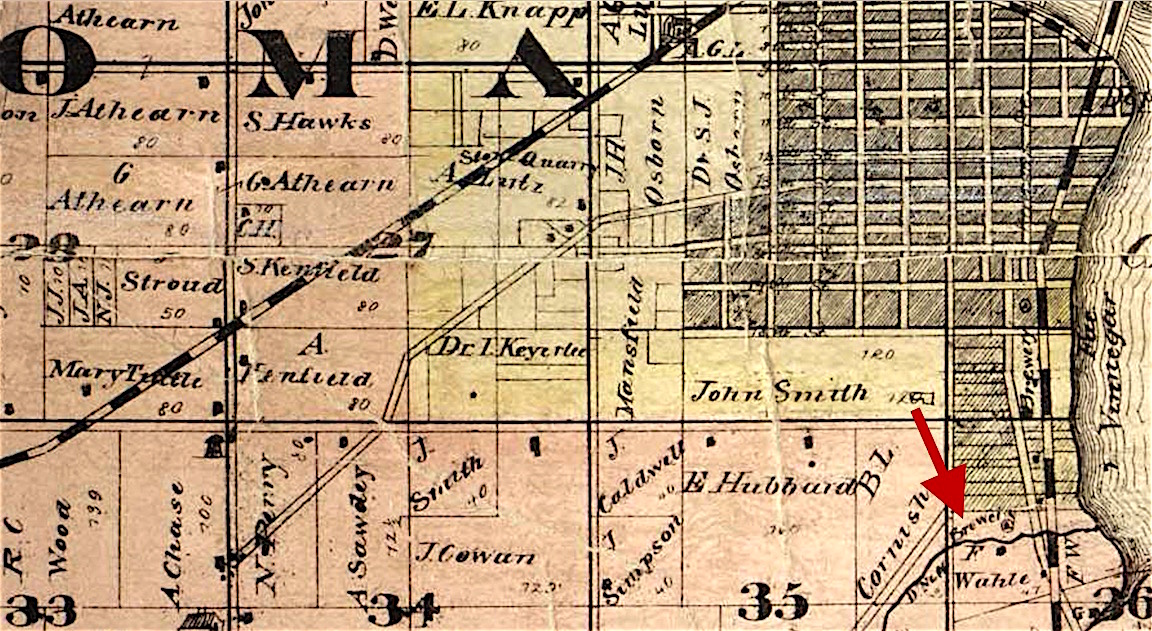
On September 23, 1867, Franz Wahle took possession of what is now Glatz Park. It was the northern most portion of a 48-acre farm. Wahle built the first brewery there.

1873 map showing the location of the brewery and Wahle's farm.
Wahle was born in the northern German town Niedermarsberg in 1826. He moved to America in 1854. Before coming to Oshkosh, he had spent the previous 10 years running what is now the Stevens Point Brewery. In 1867, Wahle sold that brewery to Andrew and Jacob Lutz and went to Oshkosh.

There isn't a picture known to exist of the brewery Wahle built on the Glatz Park site. But there is a picture of his brewery in Stevens Point. Wahle was said to have also built that brewery. The brewery he built in Oshkosh would likely have looked quite similar.

Wahle's former brewery in Stevens Point.
There were five breweries operating in Oshkosh when Wahle arrived here. Among them, Wahle's operation would be unique. His was Oshkosh's only true farm brewery. An early inventory from the farm shows it produced corn, potatoes, apples, grapes and hay. Wahle also kept livestock including hogs, cows, horses and sheep. Less is known about what he was producing in his brewery.

Wahle appears to have done no advertising for his brewery in Oshkosh. That's surprising considering how frequently he advertised his Stevens Point brewery. There he was producing both ales and lagers. Wahle probably did likewise here.
Wausau Central, January 17, 1861.
Wahle's low Oshkosh profile makes for frustrating research. Mention of his Oshkosh brewery is scant. Even his obituary says almost nothing about his extensive brewing career. Today, the omission seems especially glaring.

Wahle's time as a brewer ended here in 1869 when he leased his brewery to John Glatz and Christian Elser. The brewery Wahle built was destroyed by fire in 1871. The following year, Glatz and Elser purchased the property from Wahle and rebuilt the brewery.

Under Glatz and Elser, it came to be known as the Union Brewery. John Glatz bought out Elser in 1879. Glatz merged his brewery with two others in Oshkosh to form the Oshkosh Brewing Company in 1894. All that remains of the old Glatz Brewery is the stone wall in Glatz Park.


Franz Wahle sold his farm in April 1882. He died five months later. Wahle was 56 years old. The brewer who was instrumental in launching what is now one of America's oldest breweries is buried in Riverside Cemetery.