Monday, June 5, 2017

Yours with a Jerk: Getting Stewed and Lewd in Butte des Morts

“Sam where did you go the Fourth, did you go to Bogk’s? You and me went there last year and got pretty drunk, at least I did.”
   - From a letter written by G.R. Woodworth to Samuel Odell dated August 7, 1864.

G.R. Woodworth was in Minnesota when he wrote that letter. Samuel Odell was in Butte des Morts. He’d been in Butte des Morts since 1856. He ran a general goods store. Odell’s store was on Main St. near the shore of Lake Butte des Morts.

Odell's store, located in the larger of the two building on the right.

Exactly and directly one block east of Odell’s store there appears to have been a tavern. That property was owned by brothers Gustavus Bogk and Frederick Bogk. I suspect that is the “Bogk’s” Woodworth was referring to.

The Bogk brothers property was on Erie St. They bought it in 1857. A couple years later, The Petford Hotel was built next door, where Tilly's Too Tavern now stands.

Tilly's Too Tavern near the corner of Washington & Erie streets.
In early 1864, the  Bogk brothers lost their property for non-payment of taxes. But the brothers weren’t done slinging beers. Gustavus Bogk headed to Oshkosh where he eventually established The Oshkosh City Beer and Pleasure Gardens. In 1865, Frederick Bogk bought the Butte des Morts Brewery. The brewery was right behind Sam Odell’s store.

It was while searching for anything at all about the brewery that I came across G.R. Woodworth’s letters to Samuel Odell. The letters reveal nothing about the brewery. But there’s much they do reveal. Check this out...

Well Sam I received your epistle a long time ago and was glad to hear that your Bowells was regular... Everything is high here Except Fucking. That is very low and Plenty to be had at the old Prick… Sam give my love to all of the Girls and tell Mary Ann that I will come back if there is any chance to, since Peter and Dalton left my chance would be good I think. How does Neilson make it go, does he get as much trade as Pete did? Tell Sarah fish to Kiss my Arse… Sam burn this letter as soon as you read it.

Amen.
From your Friend
G.R. Woodworth
Fairibault Minn.
August 7, 1864

Amen, indeed.

The letters to Odell were transcribed by Scott Cross, archivist for the Oshkosh Public Museum. Cross began posting the letters online in 2007. At that time Cross wrote, “Odell collected and kept everything, from advertising flyers and broadsides to posters and personal correspondence. Among his collection of personal correspondence are letters from a friend, G. R. Woodworth and some unidentified married women. These letters and notes are extremely rare since they deal with the subjects of sexuality and infidelity.”

For example...

Friend Sam
Frank says that you are shoving it to Jane Brown. If that is so, Bully for you. That is better than Mrs. Becker. Don’t you think so? … Sam, do you go over to see Lucy Abels now? I would like to be down there about a week. I think that I could have some fun…. Sam, you would have had a good time if you had been with me last night and got your Old Root Scraped. If I was in your place I would get out of that place and come up here where you can make something. Sam, give my respects to Mr. & Mrs. Hull and my love to Mary Ann petford and get all the fucking you can. 

Write as soon as you get this and tell me the news.
Amen
Don’t show this Letter to anyone
From your Friend
G.R. Woodworth
Fairibault, Minn.
February 6, 1865

Woodworth left Minnesota. He went to New York. He badgered Odell to join him. “I don’t see what the Devil you stay in Butte de Morts for…  If I was in your place I would get out of that place and come up here where you can make something.”

Despite all his swagger, you get the sense Woodworth seemed to miss Butte de Morts.

Well Sam Here I am in a store doing a Bully Business and making money... I received a letter from Ed Moran. He said that he had been to Osage and had got back to Butte. He could not keep away from Miss Jones. He is a Hell of a Boy… Sam, I have made $400 since I came home and have got in a Bully place to make more. I have not Drank a Drop of anything since I left Oshkosh… Sam, how does Lucy Abels get along? I would like to see her and Diddle her once more. I suppose all the folks in Butte think that I am a Dam little fool, but I can take care of myself yet… Write as soon as you get this. Don’t show this to anyone.

Yours with a Jerk
G.R. Woodworth
Cherry Creek
Chautauqua County, New York
December 2, 1865

Odell didn’t take Woodworth’s advice. Just the opposite. Odell put down roots in Butte des Morts. In 1866, he purchased the store he’d been leasing from Lathrop Hull. Odell would never leave. But he traveled widely in the little village. Just read the letters.

Samuel Odell married for the first time in 1891, He was 60 years old. His bride was 32-year-old Sarah Van Doren of Winneconne.

Odell died in 1912. He was 92 at the time of his passing. His obituary left out all the good stuff. It mentions he was related to a famous New York family that included a former Governor of that state. As if that mattered. They even botched his headstone. The marker reads O’Dell instead of Odell.

Odell was buried in Winneconne Cemetery on Wednesday, April 10, 1912.  At his funeral, Rev. Gebaroff spoke of “Odell's active interest in Christian work.” It’s too bad G.R. Woodworth wasn’t there. He could have sent his friend off with the sort of flourish Odell deserved... Yours with a Jerk.

Samuel Odell's marker in Winneconne Cemetery.

Thursday, June 1, 2017

Summertime Beers from Bare Bones & Lion's Tail

We're talking summer beers with Alex Wenzel of Lion's Tail Brewing in Neenah and RJ Nordlund of Bare Bones Brewery in Oshkosh. The two recently teamed up to get beers from Bare Bones and Lion's Tail into cans for the coming summer. Nordlund also discusses his new CD, Ghosts. Check out a video from the album here.

Monday, May 29, 2017

Big Bottles of Wartime Beer

America entered World War II in 1941. With that came rationing. Restrictions were placed on everything from rubber to butter. Tin was in short supply. For brewers, capping all those beer bottles suddenly became a problem. Their solution: bigger bottles.

1942
Big bottles of beer were nothing new in Oshkosh. Quart-sized bottles were used by some bottlers here from the late 1870s into the early 1900s.

For example, here's a quart bottle from the 1880s. It's from Frank Lutz, an independent beer bottler. His bottling plant was on Oregon St. just across from St. Vincent Church.


With the turn of the century came mechanized bottling and metal crown caps. Bottling beer became faster and easier. Especially when using smaller bottles. By 1910, brewers in Oshkosh had all but abandoned the quart bottle.

In 1938, the Oshkosh Brewing Company brought the bigger bottles back. Here's the label seen on OBC's quart bottles.


At first, the quart bottles were a novelty. They became a necessity when wartime rationing arrived in 1942. Bottle caps grew scarce. Quart bottles grew prevalent. Here’s one from Oshkosh’s Rahr Brewing Company.


The ultimate in big beers was the picnic bottle. At more than a foot tall, the picnic bottle held a half gallon of beer. Better yet, it was unpasteurized draft beer. At OBC, they went full-on retro. The brewery capped its picnic bottles with the old Lightning Style Stoppers first seen in the 1870s.


Here's a better look at that label.


Metal rationing ended in 1946. OBC ditched its picnic bottles. The half-gallon growler is our modern equivalent. Like the old picnics, they're filled with unpasteurized, draft beer. More importantly, we again have local breweries to fill them.


Monday, May 22, 2017

Gilt Edge, a Forgotten Oshkosh Beer

Gilt Edge Beer marked a turning point for the Oshkosh Brewing Company. Introduced in 1900, the brand was designed to raise the profile of the brewery.


Since its inception in 1894, OBC had made its reputation on German-style keg beers sold in saloons. Gilt Edge was a deviation. This was to be an overtly modern beer. An American beer.

Gilt Edge was a light, pale lager. It was just over 4% ABV. It was sold only in bottles. The packaging was elegant. The bottles were clear. They were sealed with a porcelain stopper on a wire hinge. A yellow ribbon was tied at the neck of each bottle.


The intention was to produce a beer that could stand on the same shelf as the pricier, nationally distributed brands. Beers like Pabst Blue Ribbon, Budweiser, and Miller's Buffet. Bottled beers sold in upscale restaurants and posh bars on Main St.

Gilt Edge became OBC’s most expensive beer. The target audience was young. American born. The affluent offspring of German and Bohemian immigrants.

Gilt Edge drinkers in the early 1900s.

By 1905, the marketing of Gilt Edge had taken an absurd turn. Like many breweries at that time, OBC often promoted its beer as if it were a health drink. With Gilt Edge, the brewery amplified that rhetoric.  At times, the claims bordered on parody. OBC suggested that Gilt Edge was non-intoxicating. That it was a stimulant. A tonic. A special kind of medicine to revive invalids.

1907. "She will build up rapidly if you will give her a glass of beer three times a day."

Nobody bought that. And fewer were buying Gilt Edge. The brand lasted until 1913. By then, the porcelain stoppers had been replaced with tin caps. Those yellow ribbons were long gone. The dainty beer with the fancy name was jettisoned as the brewery winnowed its lineup.

But at OBC, they never forgot. After Gilt Edge went out of production, the brewery established a real estate company to manage its saloon properties. The directors of OBC named their new company Gilt Edge.

Monday, May 15, 2017

From Brewhouse to Whorehouse in 1930s Oshkosh

The Kentucky Ave. Brewhouse
This has always been a wild town. Take 1930 for example. Prohibition was lingering on. Beer had been illegal for a decade. Yet it was everywhere in Oshkosh. It came pouring out of wildcat breweries. They were scattered across this city. Some wildcats were hidden in houses. Like this one...

1627 Kentucky Ave.

Looks like a typical Oshkosh home. It did in 1930, too. That was the point. Because in the basement was something else. A beer factory.

The Safford family lived there in 1930. It was not the best of times for the Saffords. Vette Safford, the family patriarch, had passed away in 1926. He was 50 years old. He left a wife named Mabel and six children. Five of the kids were still living at home. The youngest was nine.

After Vette’s death, the Saffords bounced around town. They lived on New York for a while. Then they moved over to Scott. Next they rented the house on Kentucky. It was between Bent and Murdock streets. Most of the block was empty lots.

Then and now on Kentucky Street. Location of the Safford’s home is marked by the red dots.

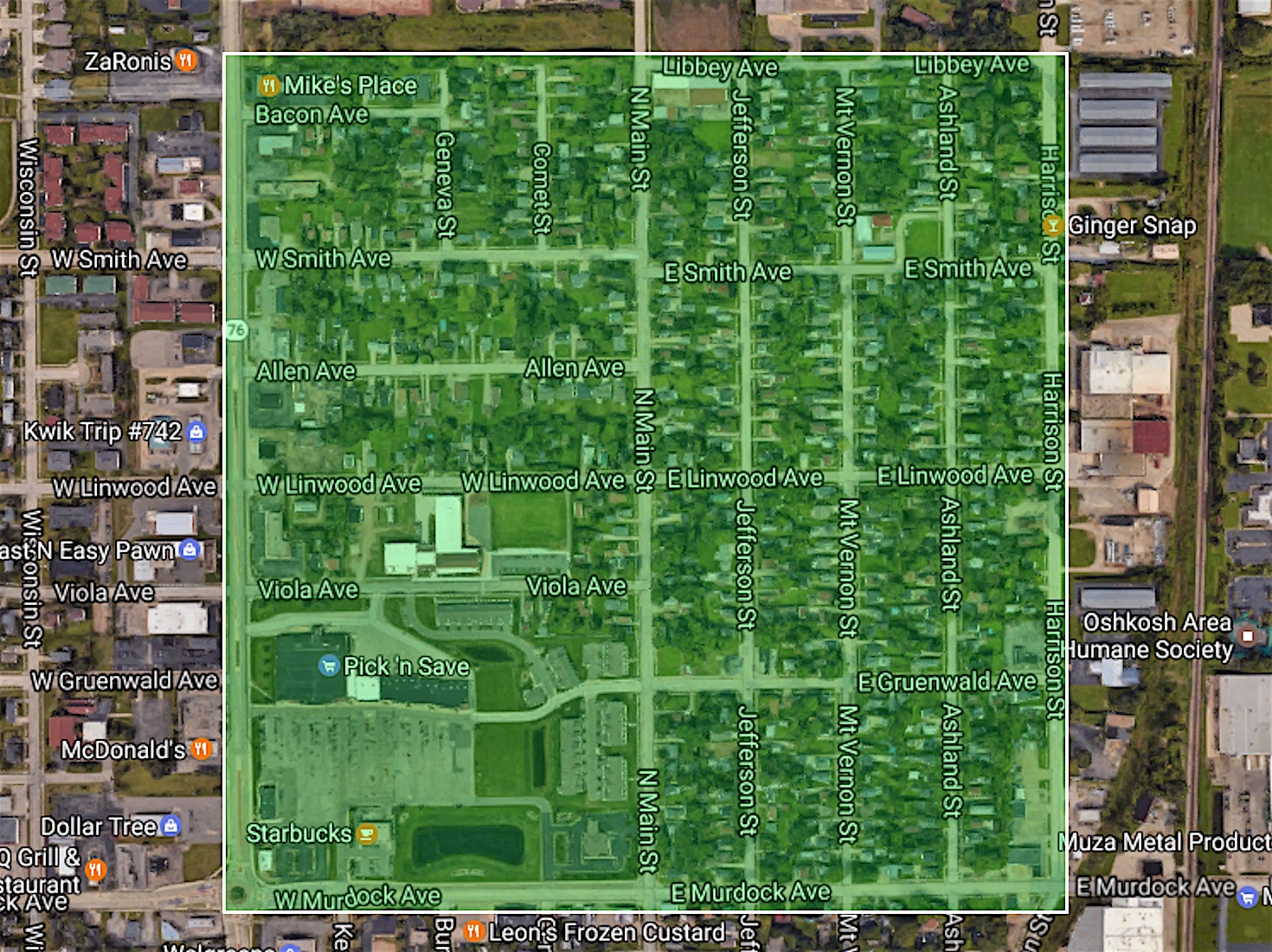
There are 14 homes along that stretch today. There were just four when the Saffords lived there. They were at the southern border of the Nordheim neighborhood. It was considered the toughest part of Oshkosh. Just the place for a bootlegger. Perhaps Neil Safford had already considered that.

The Nordheim highlighted in green.

At the start of 1930, Neil Safford was 29 and single. With Vette dead, he was supporting the family. Neil worked as an electrician. Apparently, that wasn’t cutting it. He turned his attention to bootlegging beer.

Neil had no background in the beer business. Neil was not deterred. He converted the basement of the Kentucky Ave. home into a brewery. He ramped up quickly. He got shut down even quicker. Safford’s brewery was in operation for less than a year when the feds came barging in.

The night of February 14, 1930, was blistering cold. The Daily Northwestern reported that Wisconsin was “plunged into sub-zero temperatures, whipped by biting winds… accompanied by whistling snow.” Good cover for cops. The Saffords never saw them coming. Federal Agents broke through the door just after dark.

The Milwaukee Sentinel reported that the raid occurred as bottling operations were set to begin. There was plenty ready to bottle. Safford had 2,000 gallons of finished beer on hand. Enough for almost 900 cases of beer. That’s production at a level consistent with some craft breweries operating in this area. And Safford wasn’t just making beer. He also had four gallons of moonshine down there.

The cops smashed the equipment. They drained the beer and booze onto the floor. They arrested Neil. He was taken to Milwaukee. Thrown in jail. The next day he ponied up $1,000 and was cut loose. He returned to Oshkosh. After that, young Neil went straight and narrow.

Ten months after his illegal brewery had been smashed, Neil Safford was the married father of a baby boy. He moved from Oshkosh to Wausau in the late 1930s. He eventually ended up in California. He died there in 1990.

Those are the facts. Now, let’s stroll into weeds. There’s a juicy, loose end to this story.

The Harrison St. Whorehouse
The Daily Northwestern alleged that Neil Safford was supplying beer to a soft drink parlor in the Nordheim. In Oshkosh, the term “soft drink parlor” was usually accompanied by a wink. The term was a euphemism for a speakeasy.

The Daily Northwestern didn’t give the address of the soft drink parlor allegedly connected to Safford’s brewery. In 1930, however, there was just one such place licensed to operate in the Nordheim. It was run by a woman named Olive Foelsch.

Straight out of St. Louis, Olive Fisher married an Oshkosh cab driver named Rudy Foelsch in the summer of 1913. Olive was 23. Rudy was 41. This at a time when cab drivers in Oshkosh were getting all kinds of flack. They’d become notorious for being conduits to prostitutes and whorehouses. As a 1913 Wisconsin vice report stated, “The drivers know all the sporting women and the prostitutes know all the drivers.”

Rudy and Olive dispatched the Foelsch Taxi Line in 1916. They moved up the food chain. They took over an old flophouse named the Blackstone. It was at what is now Pearl and Division streets. They renamed it the Foelsch Hotel and got a liquor license. All was swell until Prohibition arrived in 1920. With that, Rudy and Olive headed for the Nordheim.

Their new digs were out on Harrison St. On the east edge of the Nordheim. Out there you could get away with almost anything. Rudy and Olive were going to put that to the test. They established a soft drink parlor (wink!). The building still stands. And it’s still home to a tavern. Today it’s named Ginger Snap.

2314 Harrison St.

In 1926, Rudy Safford died at the ripe age of 55. Olive kept right on at it. When Prohibition ended in 1933 she went legal. At least on the booze side. Olive wasn’t just selling drinks, though. The Foelsch Tavern was well known for being a house of prostitution. Her reputation caught up with her on a Saturday night in July 1937.

A raid headed by District Attorney Magnusen and Sheriff Paul Neubauer late Saturday night led to charges of keeping a disorderly roadhouse against Olive Foelsch, of Foelsch's tavern... Mrs. Foelsch waived preliminary examination, pleading guilty… It was her first offense, she stated. Judge Hughes fined her $200 and costs or six months.

Two inmates of the establishment, Dorothy Smith and Jean Bois, waived preliminary hearings and entered pleas of guilty... They were fined $50 and costs or 60 days each. Both claimed it was their first offense.
     – Oshkosh Daily Northwestern, July 19, 1937

Olive left town about five years later. She moved to San Diego. Just like Rudy, she died at age 55. Oh, the stories this woman could have told. Sadly, we’ll never get to hear them.


Sunday, April 30, 2017

Putting a Cork in it...

I'm working on a project that'll take me away from the blog for a couple of weeks. If all goes well, I should be back to blogging right around May 15. Until then, Prost!

An Oshkosh Brewing Company bottle stopper, circa 1895.

Thursday, April 27, 2017

Fletch's Local Tap House

Fletch's Local Tap House opens Saturday, May 6 at 570 N. Main St. in downtown Oshkosh. Here's a video introduction to Oshkosh's new craft beer bar.

Monday, April 24, 2017

The Old Ruedinger Saloon on South Main

There’s a crumbling mess at the northeast corner of 8th and S. Main. There's a story there, too. It was home to one of the South Side’s early saloons. Now it’s like this...


The first saloon at this corner opened in 1875. Over the next 45 years, a stream of barmen flowed through, each calling the place their own. They came and went. Aside from the bar, most of them had one thing in common. They were related, one way or another, to a farmer named Valentine Ruedinger.

Valentine Ruedinger emigrated to America from Württemberg, Germany in 1848. He was 19. He was broke. He settled in the Town of Nekimi. Ruedinger went to work farming. He acquired land and a wife. Both were copiously fertile. Before long, the Ruedingers had eight children, 100 acres, and money to spare.

In 1865, Ruedinger bought property at what was then Kansas and 8th streets. The lot was positioned on the north end of the “Brooklyn” side of town. Manufacturing concerns, hotels, and rooming houses stood clustered about it. Here's a drawing of that neighborhood circa 1867. The red star is at the intersection of 8th and Kansas (now S. Main).


It was an ideal location for a beer joint. But Ruedinger was no barman. His son-in-law on the other hand…

Joseph Kloeckner

Joseph Kloeckner was gregarious in the extreme. Born in Germany in 1848, he’d grown up in the hospitality business. The Kloeckner's operated a well-known hotel and winery in Heddesheim. Joe Kloeckner wasn’t interested. He turned 18 and left for America.

Kloeckner headed straight for Wisconsin. He hit Oshkosh. He said it was his first love. His second was Valentine Ruedinger’s daughter Anna. They married in the summer of 1875. Kloeckner opened the saloon shortly after. He and Anna moved into an apartment above.

Here’s an ad for the saloon from the 1879 Oshkosh City Directory. The address, however, appears incorrect. All other listings show the address as 49 Kansas St.


Call they did. The saloon thrived. Kloeckner made the most of it. Friendships formed over the bar led to business and political opportunities. Kloeckner partnered in a furniture company. He helped launch a bank. Joe’s neighbors elected him alderman of the Third Ward.

In 1882, Kloeckner was nominated for a State Assembly seat. One of his backers quipped, "We have got a candidate now who possesses the implements of war — a bar." It wasn't enough. Kloeckner lost the race. But not his momentum.

Kloeckner’s ambition outgrew the saloon. In the fall of 1885, a new deputy revenue collector would be appointed. Kloeckner coveted the post. The saloon would hinder his chances. In April, he sold the bar back to Valentine Ruedinger. Kloeckner got the job he was after. The bar got new proprietors.

Valentine Ruedinger’s sons Willie and John took over. It became the Ruedinger Brothers Saloon. The brothers went to town. Literally. They left their farms and moved into apartments above the saloon.
1886 City Directory
"Fresh beer always on tap..."  The Ruedinger brothers had an in on that. Brother John married the daughter of Leonhardt Schwalm, co-founder of Horn & Schwalm's Brooklyn Brewery. A good connection for a barman. There was a downside. John August Ruedinger couldn't stop drinking the stuff. His alcoholism flourished at 49 Kansas St. Rocky times were ahead.

Insurance map from 1890. The Saloon is shown at the corner of 8th & Kansas streets.
In 1890, the bar was commonly known as the Ruedinger Brothers Saloon. By then, though, the business was a one-man show. John Ruedinger's drink problem worsened. His wife, Henrietta, was headed down the same path. By 1887, they were out of the picture. John and Henrietta returned to their farm in Black Wolf. John's tailspin accelerated. He was placed under guardianship in 1898. He died in 1902.

Back at the bar, Willie was running things solo. He had his own ideas. He began selling English-style ales. At the time, locally-brewed lager beer dominated. Porter was not your typical South-Side fare.

1889 City Directory
In 1891, Willie purchased the property from Valentine Ruedinger. Ownership didn't make life any easier.

Willie had married a woman from New Glarus named Marie Genal. Her family had been in the hotel business forever. In 1893, Willie and Marie had a son. They named him William August Ruedinger. After the boy was born, their marriage went to hell. Things got ugly. Quick.

Willie had borrowed money to purchase the saloon. As the marriage soured, Marie's father, JF Genal, stepped in. He bought the mortgage. It meant Willie was now in debt to an adversary – his father-in-law. The Genal family had Willie boxed in. So he moved out. Marie and William Jr. stayed. Marie’s new boyfriend moved in with them. His name was Peter Reifer.

In the old days, the Reifers had been the Ruedinger’s neighbors. They lived in the Town of Nekimi on a farm adjacent to the Ruedinger farm. Peter and Willie had grown up together. Now Peter had Willie's wife, Willie's boy, and Willie's bar. Willie still held the deed, but it hardly mattered. By 1898, the place was known as Peter Reifer's saloon.

Marie married Peter Reifer. Willie washed his hands of all of it. He sold the property to Marie. Cheap. He unloaded it for a tenth of what he’d paid for it.

The arrangement at the saloon grew fluid. Marie maintained ownership, but from year to year the business was listed under different proprietors. Eventually, another Ruedinger got behind the bar.

Willie and Marie's son, William August Ruedinger, took over the saloon in 1914. He had just turned 21. Here's a picture of him at the entrance. He's wearing a white apron. This was taken about the same time he became the proprietor.


Did you notice the Oshkosh Brewing Company sign in the background? You couldn't have missed it had you been walking by in 1914. The monochrome photo doesn't do it justice. Here's how it looked in its day, in glorious color.


Young William bailed shortly after the 1914 picture was taken. Peter Reifer took over again. In 1916, he put his brother Ben behind the bar. That didn't work out at all. Ben Reifer contracted TB and died. It was straight downhill from there.

The impending doom of national Prohibition induced the shuddering of countless saloons. The old Ruedinger stand was among them. The building was already vacant when Prohibition hit in 1920. The beer and melodrama were drained from the place. Marie finally sold the building in 1946. She died three years later.


The building at 716 S. Main slowly eroded into what is there now. It's held everything from battery shops to the Sacred Circle Spirit Shop, which last offered "metaphysical supplies and services" there in 2009. Did they divine the spirit of a Ruedinger roaming around?

Last December, the property was purchased by the Redevelopment Authority of the City of Oshkosh. It’s only a matter of time. The wrecking ball will soon arrive to pulverize the old Ruedinger saloon.


Thursday, April 20, 2017

Fifth Ward Brewing Company Prologue

Fifth Ward Brewing Company of Oshkosh is slated to open later this year. Here’s Ian Wenger and Zach Clark from Fifth Ward telling their story...


Monday, April 17, 2017

Rahr's All-Malt Beer

In 1953, The Rahr Brewing Company of Oshkosh produced something rare. The brewery made an all-malt beer. In the 1950s, few American breweries made beer this way. At that time, nearly all American beers were brewed with a significant addition of corn or rice. Here's a bottle of the Rahr's 1953 beer.


It was brewed to commemorate the 1953 Oshkosh Centennial. The beer was an homage to the history of brewing in Oshkosh. The Rahr's new that history well. The family had been making beer here since 1865. At that time, every brewery in Oshkosh produced all-malt beers. Corn didn't find its way into Oshkosh's breweries until the 1870s (there's more on that here).

But aside from the grain bill, the centennial beer was quite different from beers made in Oshkosh 100 years earlier. Those beers would have been dark. This one, as the label says, was pale. It was the Rahr's version of a Pilsner. Here's the ad introducing Rahr's all-malt Centennial Brew. This is clipped from the Oshkosh Daily Northwestern of June 8, 1953.


It's wonderful that an obscure brewery in Oshkosh would be one of the few in America to produce an all-malt beer in the 1950s. I suspect the Rahrs saw this as a kind of last hurrah. By 1953, the brewery was sinking fast. The end was coming. It was only a matter of time.

In 1956, Rahr Brewing closed. There wouldn't be another all-malt beer brewed commercially in this city until 1995 when Fox River Brewing Company opened.

One last thing. That bottle of Rahr's Beer at the top of this post belongs to a friend of mine. His name is Grant Peterson. Grant used to be a delivery driver for Peoples Brewing Company.  He showed me that bottle the other day at Oblio's. When I was admiring his bottle, it struck me that here we have a former driver for Peoples with an old bottle of Rahr's in a tavern that was a tied to Schlitz. This city is wrapped in a web of beer.