Monday, September 16, 2019

Butch: The Life of an Oshkosh Bootlegger

"There were any number of wildcats in Oshkosh,” Cyril said. “But there were two big operations. Butch Youngwirth ran one of them. He was quite a guy."

Cyril worked as a driver during Prohibition transporting bootleg alcohol in and out of Oshkosh. The wildcats he spoke of were breweries that produced beer during the dry years. Cyril knew Butch Youngwirth well. And there's no doubt that Butch was quite a guy.

His full name was Frank Joseph Youngwirth. He was born on August 7, 1892, in Marshfield, Wisconsin. His parents were immigrants from Bohemia who had come to America in the late 1880s. The family moved to Oshkosh when Butch was still a boy. Frank and Albina Youngwirth would have 18 children in all. Butch was their oldest.

The Frank and Albina Youngwirth family, circa 1910. Young Butch stands tall in the center of the back row.

He grew up on the south side in a house on 6th between Idaho and Knapp streets. There was a saloon at one end of the block and a church at the other. His father was a laborer who also sometimes worked as a bartender at Joseph Nigl's saloon at 9th and Ohio. The Youngwirths were part of a growing population called Highholders – a tight-knit community of working-class Bohemian and Bavarian immigrants living south of the Fox River in Oshkosh’s 6th and 13th wards.

Butch Youngwirth's boyhood home at 906 West 6th Avenue.

Butch wasn't much for school. He quit before he had turned 15. He took a job in a lumber yard. He was 20 and still living at home when he married Henrietta “Hattie” Smith in 1913. Hattie was a few months older than Butch and, like him, she was first-generation American.

Butch and Hattie on their wedding day, April 2, 1913.

The newlyweds moved to the other side of town. They rented a small house on a V-shaped lot at the northwest corner of Pearl and Jackson. It wasn't much. Butch got a job working at a machine shop on Oregon. Hattie stayed home and had babies. Their first was named Harold. He was born 10 months after they had married. Almost every year after, there was another baby on the way. Over the next seven years, Hattie gave birth to six more children.

Hattie and Butch, circa 1918, with their four children (left to right) Norman, Dorothy, Clarence, and Harold.

The Youngwirths were scraping by. Butch couldn't seem to settle into anything. He bounced from job to job and the family went from one rented home to the next. They eventually moved back to the 6th Ward and into a rented house on 5th Street. It was practically in the back yard of the house where Butch had grown up. He was working as a roofer when apparently he decided he’d had enough of this kind of living.

In October 1921, Hattie gave birth to George, their fifth son. He would be the last of their seven children. A few months later, Butch took a lease on a soda parlor at the northeast corner of 6th and Ohio. Soda parlors were unheard of in Oshkosh until Prohibition began in 1920. Now there were almost a hundred of them. They had been saloons before the dry law went into effect. Butch's place was one of those that made the switch.

556 West 6th Avenue, the former home of Butch's speakeasy.

There had been a bar there since about 1877 when the property was purchased by John Luck who converted the building into a grocery store/saloon. They had been selling liquor there ever since. The Oshkosh Brewing Company bought the saloon in 1906 and ran it as a tied house until Prohibition hit. In May 1922, the brewery sold the property to a woodworker named John Mauritz who, in turn, leased the building to Butch. Butch got a license to sell soft drinks and went into business for himself.

Butch had no interest in selling soda water. There was no money in that. Like nearly all of Oshkosh's new soda parlors, Butch's place operated as a speakeasy. It wasn’t long before he attracted the attention of the police. On August 7, 1922, Butch Youngwirth celebrated his 30th birthday. A week later, he was arrested on a charge of selling bootleg liquor at his soda parlor. He had picked the wrong time to launch a speakeasy.

Since the start of Prohibition, Oshkosh police had shown little interest in enforcing the dry law. That changed – temporarily at least – after the July 29, 1922 death of Marie Repp. The 19-year-old Repp, had drowned in Sawyer Creek after attending a dancing and drinking party held at a former saloon on what is now Oshkosh Avenue. Her death brought on a public outcry for the police to do something about the tide of bootleg booze flowing through the city. Butch was caught up in the ensuing dragnet.

On the night of August 14, 1922, Butch's speakeasy was raided by Oshkosh Police Chief Arthur Gabbert. Gabbert walked in to find a  young girl with a glass of booze in front of her. Butch was arrested and fined. It was the one and only time he would be arrested on a liquor violation during Prohibition.

The incident did nothing to change his mind about the new path he was on. Butch would go on operating his speakeasy at 6th and Ohio until at least 1926. And as late as 1930, he was still sometimes telling people who didn't know him that he made his living running a soft drink parlor. Everybody who knew him knew better.

This photo, circa 1925, is believed to have been taken inside Butch's speakeasy at 6th and Ohio. Butch stands behind the bar. The lack of signs or advertising for anything relating to alcohol is in stark contrast to the four men with mugs of beer standing at the bar.

It's unknown exactly when Butch transitioned from retailing alcohol to producing it. It's likely, however, that by 1924 he had already begun making his first forays into beer production. Butch was a brewer. Beer was the only drink he made. In Oshkosh, like much of Wisconsin, beer remained the alcoholic beverage of choice throughout the dry years.

The city grew rife with wildcat breweries. They sprung up in nearly every part of town. There were a number of organizations behind these breweries. "There was quite a few, little small ones," said the former bootlegger named Cyril. "Maybe 7 or 8 of them, I'd say, at least."

There were two organizations, though, that operated on a larger scale. Butch built his outfit into one of them. The other had its headquarters at the southwest corner of 9th and Knapp at a tavern that came to be known as the Böhmerwald.

What would become the Böhmerwald Tavern in the early 1900s.

An Oshkosh bootlegger named Slim was among those involved in the Böhmerwald group. “When I started, the agreement was made that we'd make the kegged beer and buy the bottled beer from them (Butch’s group),” Slim said. “Then something happened along the line there. First thing you know, they were making kegged beer and we were making bottled beer.”

These were not simple, homebrewing set-ups. These were commercial, albeit illegal, breweries in the truest sense. Some had bottling lines and pasteurized their beer. Others sold beer by the keg into saloons and private clubs. Some employed salesmen and delivery drivers and had production levels that surpass those of the craft breweries we have today.

One such brewery that Butch kept was located at 1325 Oregon. It operated in tandem with a speakeasy run by Mary Kollross at that same address. Mary's brother Eddie Kollross was part of Butch's outfit. When that brewery was raided by federal agents in 1930, they discovered more than 160 barrels of finished beer on hand and a four-head bottling machine.

The middle building with white siding at 1325 Oregon Street was the location of one of Butch’s breweries.

The risk of a brewery being raided was ever-present. For Butch, that risk was more financial than existential. "He’d pay the guy who owned the land to keep the brewery there, and also to take the rap if they got caught," Cyril said. "If they got sent to the House of Corrections in Milwaukee, Butch would pay him well for the time he spent there. I think about a hundred bucks a week."

Meanwhile, the beer kept on flowing. "He had quite a few places in town where he could be back in business in 24 hours if the feds came in and busted things up," Cyril said. "He only had one going at a time, but the others were always ready." Butch's oldest son Harold said that at one point his father had seven breweries; some in production others in waiting.

Butch wasn't averse to getting his family involved. One of his breweries was in the basement of the home where his sister Mollie lived at 826 West 6th Avenue. Her husband, Hubert "Hub" Molitor, was later arrested when he was caught working at what appears to have been another of Butch's breweries located on a farm on 20th Ave. When that brewery was raided in 1931, more than 350 barrels of fermenting beer were found on the premises. Federal agents described it as "a most elaborate plant... filled with large vats."

 The Oshkosh Daily Northwestern headline from August 26, 1931, after the raid on what was, in all probability, one of  Butch’s breweries.

The tall, thin young man who married Hattie Smith in 1913 had become a person he could scarcely have imagined a decade earlier. In the latter half of the 1920s, Butch's illicit operation flourished and he made no bones about who was boss. "He was an honest man," Cyril said, "but I'll tell you, you towed the mark when you worked for him. He was as honest as you could find, but he was big too, and he was about as wide as he was tall."

Butch was 6'3" and weighed about 250 pounds. His physical presence was central to the persona he adopted. "The guy was so intimidating," said his grandson Wayne Youngwirth. "He had hands that were just massive and he could be such a prick. He always wore this big ring. That thing was the size of a super-bowl ring. He'd sit there and turn it around on his finger when he talked to you."

"You remember old Bruno Siewert?" Cyril said. "He was a great big, heavy butcher. He was about as big as Butch. Well I’ll tell you, I walked into a tavern one time and Bruno Siewert was there drunk and so was Butch; he had a good shine on. And Bruno Siewert picked up a half-barrel full of beer, you know it was one of them wooden kegs and they were heavy. He put it on his shoulder and walked back and forth across the barroom with it. He set it down and said 'I'll give a hundred dollars to anybody here that can do that.' Butch gets up and says, 'Well, you just lost yourself a hundred dollars.'"

It was all part of the show. By the end of the 1920s, he had made himself notorious. "Butch was the most well known because he was always out and about drinking and gambling," Cyril said. "Geez, he was a wild man. Everybody knew him. I remember him and his buddies driving around in their Buicks every Monday to make their collections at the saloons. When they got all the money, they’d go over to this place, sit in a booth and put the money in a big pile in front of them. Then they'd start counting it. But they never bothered to count the singles. Just the big stuff. The singles they put off to the side."

That same scene was played out in the Youngwirth home. Butch's youngest son, George, recalled beer peddlers coming to the house at two or three in the morning to drop off money they had collected. The dining table would be heaped with cash. "I remember Butch made $38,000 one year and $40,000 the next," Cyril said. "That was a lot of money in those days."

It certainly was. And what Butch didn’t gamble away he kept mostly for himself. At the time, modern homes in Oshkosh were selling for less than $5,000. But Butch was keeping Hattie and their seven children in a $25 a month rental (since demolished) at 8th and Knapp. Butch wasn't spending much time there.

In the spring of 1925, Butch who was then 32, impregnated a 20-year-old woman who lived nearby his family’s home. Her name was Caroline Nachtmann and she lived with her parents at 1048 West 7th Avenue. She remained there after the birth of her daughter, Phyllis Ann Nachtmann, on December 17, 1925. Caroline's relationship with Butch was ongoing. It's not known when Hattie learned of it or of the daughter Butch had fathered. But their marriage deteriorated in the years that followed.

His relationship with Hattie wasn't the only thing coming to an end. By 1931, there was little doubt that Prohibition would be repealed. The return of legal beer was assured after Franklin D. Roosevelt was elected president in 1932. That spelled doom for the bootleggers. Butch’s business was wiped out when beer was legalized in April 1933. He wasn’t caught unprepared.

In 1930, Butch and Eddie Kollross bought a saloon formerly owned by Pabst Brewing. The building was near the northeast corner of Wisconsin and Pearl. There had been a speakeasy there during the early years of Prohibition. In August 1932, Butch bought out Eddie's stake in the property. And in 1933, after beer became legal again, he re-named the bar Butch's Tavern. He joined the Bartender's Union. He went legit.

Butch's post-Prohibition business card.

It was not a smooth period of transition. In 1932, he'd crashed his car into a vehicle on 4th Street. The occupant of the other car, Theodore Staerkel, was injured in the collision. Butch drove off. He was arrested the following morning and charged with drunk driving and leaving the scene of an accident. Staerkel wanted charges pressed, but a week later changed his mind to the dismay of the district attorney. Butch got off with a $100 fine.

Then in 1934, Butch and Hattie's oldest daughter, Dorothy, died at their home following a tonsillectomy. She was 18 years old. Butch and Hattie divorced not long after. The kids stayed with her. Hattie later moved the family into a modest home she purchased at the corner of 10th and Knapp. Butch moved into an apartment above his tavern on Wisconsin. His oldest son, Harold, went to work for him tending bar.

Butch with his parents in the early 1940s.

The former bootlegger settled into an existence more mundane than the one he had grown accustomed to. He had managed to put some money into real estate and stocks, but as the years went on almost all of that was sold off to pay for his gambling and the price of maintaining a reputation that had become central to the identity he liked to project.

"In taverns, he was always buying drinks and trying to be the big-time operator," recalls his grandson Wayne Youngwirth. "He was always throwing money around." Butch wouldn't talk about bootlegging, but as Wayne came of age he began to learn bits and pieces of the story. And there was a certain privilege that came with being his grandson. Wayne said, "By the time I was 15, my brother and me were going into bars and everybody knew we were Butch's grandsons. These older guys would say 'Get Butch's grandson one.' No one ever gave us any shit."

But the downside was fierce. "Grandpa was such a mean son of a bitch," Wayne said. "I could tell you story after story about him. He never was a family guy, but he would come over every Sunday for dinner. My dad helped him out all the time, but Butch would never do a damned thing to help him. None of his boys liked to talk about him because of all of the shit he pulled when they were growing up. He’d come home in the middle of the night screaming and hollering, all bombed, and then there were the mistresses and all of that. They knew everything, they saw it. My dad forgave him all the time for the bullshit he pulled. I never could understand that."

Hattie died in 1957 at the age of 65. She was buried in Lake View Memorial Park next to the grave of her daughter Dorothy. Butch was still seeing Caroline Nachtmann. For years she worked at Diamond Match, just down the street from his tavern. She still lived in the house at 1048 West 7th Avenue where she had raised their daughter. The house had become hers after the death of her mother in 1954. Caroline Nachtmann committed suicide in that house in 1965. She tied an electric cord around her neck and hung herself from a sewage pipe in the basement. Her body was discovered later that day by Phyllis, the daughter Butch had fathered.

Butch sold his tavern to his son Harold in 1963. He retired the following year at the age of 72. A year after that, Harold sold the bar to the Wisconsin Board of Regents. They tore it down. Butch moved into a small apartment attached to the tavern owned by his son Leroy at 7th and Knapp.

Leroy’s Bar at 701 Knapp Street.
The adjoining building at 703 Knapp is the apartment where Butch resided during the final years of his life.

"Grandpa, as he got older, was burning through everything he had," Wayne said. "Leroy built that apartment for him. My mom, who hated him, always had to take meals over. He didn’t go out much anymore."

On April 27, 1973, Butch was admitted to Mercy Medical Center. He never left. Butch died there on May 2, 1973. Frank Joseph Youngwirth was 80 years old.

"My dad called me and told me Grandpa passed away," Wayne said. “I had already heard it from Leroy. There was a lot of bitterness there. The kids all got together and I'll never forget it. I was sitting there and I knew it was going to get heated. Leroy got up and said, 'Where are we going to put him?' Then Clarence got up and said. 'That fucker is not going to be buried next to my mother. That fucker can rot in hell.' It was vicious. He was buried at Sacred Heart Cemetery next to his mistress. I helped carry that son of a bitch right there to his grave."

Butch’s headstone in Sacred Heart Cemetery.
The statue of the Madonna seen behind it stands beside the grave of Caroline Nachtmann.

Tuesday, September 10, 2019

Peoples Brewing and African American Entrepreneurship in the Civil Rights Era


John Harry, a graduate student in history at UW-Milwaukee, recently published a scholarly article in Voyageur Magazine about the final years of Peoples Brewing of Oshkosh. In conjunction with his article, Harry is speaking Thursday night (September 12) at Fifth Ward Brewing in Oshkosh. He'll be talking about Theodore Mack, the last president of Peoples, and Mack's role in leading Peoples as a black-owned brewery during the civil-rights era.

I've known John for a while now and can attest that he brings an interesting perspective to this complex story and how it relates to what was happening in our city in the early 1970s. John’s talk begins at 7pm. Hope to see you there!

Monday, September 9, 2019

The Strange Case of Peoples Beer in Nigeria

Theodore Mack had a line he often repeated for reporters. "When the going gets rough, I send me."

Theodore Mack

In 1972, the going for Mack got very rough. Since becoming president of Peoples Brewing in 1970 he had discovered just how brutal the beer business could be. In early 1972, Mack's brewery was faltering. Bills were going unpaid and the brewery’s board of directors was demanding answers. That fall, the downward thrust turned fatal. Peoples Brewing stopped making beer during the third week of October 1972. And that's when things got weird.

On November 2, Peoples Brewing sued the federal government claiming the brewery had been blocked from securing contracts to supply beer to the military. The lawsuit was an act of desperation. Peoples had already defaulted on loans backed by the Small Business Administration. The federal government was threatening to seize the brewery.

While that was playing out, Mack announced that he was considering moving Peoples to Alabama. On Friday, December 1, Mack led Alabama state legislator Fred D. Gray on a tour of his moribund brewery in Oshkosh. The two of them were childhood friends. After the tour, they drove to Milwaukee and held a news conference. Mack told reporters he would visit Alabama within the next 10 days. He said, "I don't run around the country unless I mean business."

The obstacles to this adventure would have been monumental. Considering the position he was in, it’s extremely unlikely that Mack would be able to raise the money or credit needed to move the brewery's operations to Alabama. Then there’s the fact that commercial brewing in Alabama wasn't even legal in 1972. Back in Oshkosh, Mack tempered his bluster. The Daily Northwestern reported on December 4 that Mack now "disclaimed" the stories about moving the brewery to Alabama.

Then came the plans for Africa. On January 8, 1973, Mack left for Nigeria. Four days later, he arrived in Ogbomosho, a city in southwest Nigeria. There, Mack met with a group of potential investors and pitched his idea for building a brewery in the city. In a letter signed by Mack dated January 16, 1973, he affirmed that the Nigerians, “Were very interested in the People’s Brewery Company being established in Ogbomosho.” The plan was to build a 200,000 barrel brewery at a proposed cost of $8 million. “It is believed by both parties that extreme haste is of the utmost essence in this matter,” Mack concluded.

Such high hopes. They may have been farfetched, but the idea itself was sound. The Nigerian beer market was booming and on the verge of another upsurge of growth. Mack’s plan might have worked.

Beer in Nigeria, 1970s.

What a drag it must have been for him to come back to the hopeless mess still waiting in Oshkosh. A couple of weeks after returning from Nigeria, Mack sent out a letter on Peoples Brewing Company stationary. The letter opened with...

Dear Stockholder:
There will be a stockholders meeting Tuesday, February 20, 1973, at 10:00 a.m., at Jabber’s Bar, 1518 South Main Street, Oshkosh. Jabber’s is adjacent to the brewery.


The shuttered brewery and the neighboring Jabbers Bar. The Pabst sign in front of Jabber's replaced a sign for Peoples Beer that had hung there when the brewery was open.
The meeting had to be held at the bar next door because there were no lights in the brewery. The power had been cut off. Mack went on in the letter to tell of the latest woes including the news that the Marshall & Ilsley Bank had informed him that “The Peoples Brewing Company has reverted back to the federal government.” It was a roundabout way of telling the shareholders that their money was lost. On a brighter note, Mack mentioned his recent trip to Nigeria. But he was not currently “in a position to reveal what transpired there.”

Fifteen months later there were wrecking balls knocking down the brewery on South Main in Oshkosh. The plan for the brewery in Nigeria came to nothing. The Peoples Brewing Company was dead. Mack quit the beer business. He remained in Oshkosh and went to work selling insurance for New York Life.


Tuesday, September 3, 2019

When Canned Beer Came to Oshkosh

Off we go to 1935 when canned beer first arrived in Oshkosh. And what was the first canned beer sold here? That would be this one, Pabst Export...


Pabst was the second American brewery to can its beer. The first was Krueger Brewing of Newark, which released its cream ale in cans in January 1935. In August 1935, Pabst began canning its Export Beer, and in early September 1935, those cans began rolling into Oshkosh.

Oshkosh Daily Northwestern, September 9, 1935.
These were flat-top cans without a tabbed opening. To get at the beer you had to use this new thing called a churchkey. If you bought the beer, they'd give you a churchkey to go with it. The instructions were printed on the side of the can.


Cans of Pabst Export were distributed in Oshkosh by Kuebler Distributing from its warehouse on the north side of Parkway just east of Main (the building is gone). Pabst advertised the new package heavily here. The ads touted the benefits of the "Keglined TapaCan” lined with a polymer coating to keep the beer tasting like beer and not like tin.

Oshkosh Daily Northwestern, September 24, 1935.

A case of canned Pabst Export sold for $2.75 when it was first introduced in Oshkosh. At the time, it was the most expensive beer sold here. Budweiser was also being sold in Oshkosh then for $2.75. In today's money that would be about $40. Meanwhile, a case of bottles of Chief Oshkosh or Peoples or Rahr's sold for a measly $1.75.

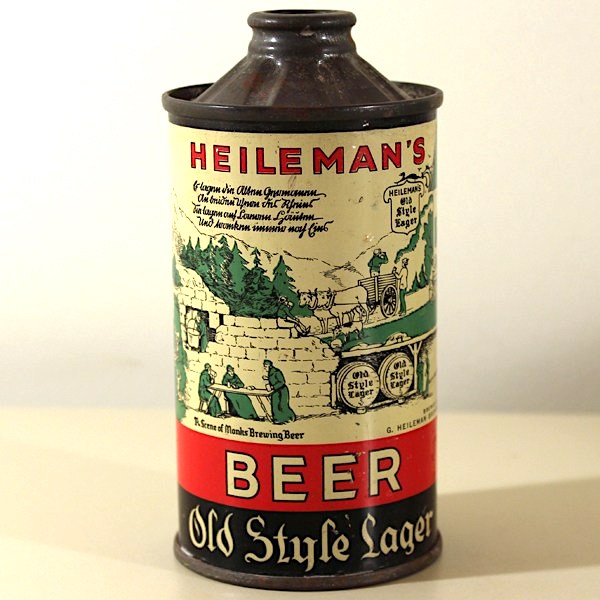
A few months after the Pabst cans appeared, G. Heilemann Brewing of La Crosse began selling cans of Old Style beer in Oshkosh. They arrived in time for the 1935 holiday season. It was the first cone-top style can sold here. Old Style was distributed here by Lee Beverage of Oshkosh, which is still going strong.

Oshkosh Daily Northwestern, December 18, 1935.


Next came Schlitz, hitting Oshkosh with its cone-top cans in March 1936. The Schlitz cone tops were also brought in by  Kuebler Distributing. This was an odd one. Schlitz promoted it as a kind of health-food... "Stay on the "sunny side" by drinking SCHLITZ SUNSHINE VITAMIN D BEER. It brings you Vitamin D... developed directly by the sun's rays!"

Oshkosh Daily Northwestern, May 27, 1936.


The cans kept on coming. The local breweries were in no hurry to join in. The Oshkosh Brewing Company became the first brewery here to can its beer. OBC introduced crowntainers of Chief Oshkosh in 1949. But by that time, the novelty of canned beer had faded. It was just another can of beer. Not anymore. The website Breweriana.com puts the value of this can at $2,800. And to think, you could have bought a six-pack of them in 1949 for less than a dollar.

Like to know more? Here's An Illustrated History of Oshkosh Beer Cans.

Tuesday, August 27, 2019

Andrew Roth Takes Over at Fox River

For the first time in a decade, there's a new brewmaster at Fox River Brewing Company. He's 29-year-old Andrew Roth.

Andrew Roth in Fox River’s Oshkosh brewhouse.
Roth becomes the sixth brewmaster at Fox River since the brewery opened in 1995. He replaces Kevin Bowen, who left Fox River earlier this month. Although Roth may be new as brewmaster, he isn't new to Fox River. He's been the lead brewer there for the past 10 months. Before coming to Fox River, Roth had worked as an assistant brewer at Pearl Street Brewery in La Crosse.

Roth will be leading a brewery that has seen its fortunes rise significantly over the past four years. Production has more than doubled in that time. Much of that growth is attributable to the popularity of BLÜ Bobber, Fox River's flagship beer. Roth doesn't have any intention of tinkering with that success. "I think I'd be fired if I went to change BLÜ Bobber," Roth says. "The Bago Brews are not going anywhere, that won't be changing."

But there will be plenty of other changes. "You're going to start seeing a lot of new stuff coming through," Roth says. "I'm still figuring out the schedule, but we're going to introduce a series of new beers in the taprooms with new releases coming out on Thursdays. We’re going to have a more planned release schedule and give people advance notice when new beers go on. We need to get better about that."

Among the first of the new beers will be Hoppy Otter, a hop-forward lager that defies easy categorization. It's made from English malts, German yeast, and American hops. "I can't think of a style for it in all honesty," Roth says. "It doesn't fit most of the guidelines. It's one I've done at home a few times and it’s always gone over well."

Though he began brewing professionally in 2015, Roth's approach is still very much rooted in the homebrew ethos of experimentation and creativity. He began making mead in 2010 and then stepped into beer after his father gave him a homebrewing kit for Christmas. "I kind of just got sucked into it," he says. "It consumes you. After a year or two of homebrewing, I realized I was sticking inordinate amounts of my time and energy into it. I hit kind of a wall in what I could do. I mean, it's hard to afford things like a lab or filtration when you're brewing at home. So I figured, if I'm going to keep brewing this much, somebody is going to need to start paying me for it."

Roth was making plans to launch a nano-brewery when he was hired by Pearl Street in 2015 as an apprentice brewer. He moved from Fond du Lac, where he had grown up, to La Crosse, but still maintained his ties to the local homebrewing community. Since 2016 he's been teaching a series of weekend brewing classes at The Cellar Brew Shop in Oshkosh. He's also remained active in the Central Wisconsin Vintners & Brewers, a homebrew club based out of Fond du Lac. Roth says now he'll need to begin drawing back from some of those activities.

As brewmaster at Fox River, Roth will have five brewers working under him and breweries in Appleton and Oshkosh to oversee. He's already begun making changes in the brewhouse. "We have a very manual system and we operate it off a lot of old school methods," Roth says. "I'm looking to bring modernization and more modern techniques to the brewhouse. And we are definitely looking at getting a deeper amount of lab work done."

All of this signals something of a new direction for Fox River. The continuity of the brewery's approach has been one of its strong points. But it's also left Fox River behind the curve when it comes to attracting the attention of drinkers seeking something other than the tried and true styles. That should begin to change under Roth. “I'm enjoying bringing some modernity to the brewery,” he says.

Tuesday, August 20, 2019

Happy John’s Happy Tap

Here's a quirky cul de sac of Oshkosh beer history. We're going back to 1907 when Oshkosh saloon keeper "Happy" John Wawrzinski came up with a better way of pouring kegged beer.

Wawrzinski ran Happy John’s Algoma Liquor House and Sample Room at the southwest corner of Oshkosh Avenue and Sawyer streets. The best picture I have of the place is from the early 1950s when it was Gordy's Bar. Here you go...


All that is long gone. It was wiped away by the City of Oshkosh after it purchased the property in 1974. The city knocked it down, paved it over, and made the land part of the street.

Let’s get back to that happier time with Happy John in 1907. Wawrzinski was serving up the Oshkosh Brewing Company's beer when he hatched an idea for a beer tap that would pour less foam and more beer.

The “novel construction” of the Wawrzinski tap prevented pressure within the beer keg from entering into the tap line. And that helped to eliminate excessive foaming when pouring a mug of nickel beer (the going rate at all Oshkosh saloons in 1907). It was also supposed to help keep contaminants in the tap from entering into the keg and spoiling the beer. Sounds great.

It was a complicated piece of work. Here is the design Wawrzinski submitted when he applied for a patent on his improved beer tap.

“Be it known that I, John Wawrzinski, residing in Oshkosh, in the county of Winnebago and State of Wisconsin, have invented new and useful Improvements in Beer-Taps.”

Wawrzinski's application was filed on April 12, 1907, by Benedict, Morsell, and Caldwell; a Milwaukee law firm specializing in patents, trademarks, and copyrights. On February 18, 1908, Wawrzinski was granted US Patent 879604 A. His patent expired in 1925. By that time, he was no longer pouring the Oshkosh Brewing Company's beer. OBC had halted production. Prohibition was on.

One of these days I need to get something posted here about the history of Wawrzinski’s saloon. It was quite the place in its day. A beer palace! I'll get to it... some day.

Tuesday, August 13, 2019

I’m Talkin’ Prohibition...


This Saturday, August 17, I’ll be at the Oshkosh Public Museum telling the story of Prohibition in Oshkosh. As you’ve probably already gathered by skimming this blog, this town went wild during the “dry” years.

The talk starts at 1pm. And after the talk, we’ll sample a few beers courtesy of Fifth Ward Brewing. FYI: The Museum charges an $8 admission fee for non-members ($6 for seniors). OPM members get in free. Hope to see you there!

For more info, CLICK THIS, or checkout the Facebook event page.

Monday, August 12, 2019

Kevin Bowen's Career at Fox River Brewing Comes to an End

Kevin Bowen is leaving Fox River Brewing Company. He’s moving to France and ending his 10-year run as the brewmaster for Oshkosh’s largest brewery.

Kevin Bowen in the Fox River Brewhouse in Oshkosh, 2016.

Bowen's tenure at Fox River is notable for several reasons, not the least of which is the dramatic growth he oversaw while running the brewery’s facilities in Oshkosh and Appleton. Since becoming brewmaster in 2009, Fox River's production has increased by more than 250 percent. The brewery went from limited distribution to sending beer into nearly every part of the state. Along the way, Bowen has picked up his share of awards while hueing to an approach that has informed his brewing from the start. "I just wanted to make balanced, clean, flavorful beers," he says. "We had some successes doing that."

Charlie Papazian presenting Bowen with a World Beer Cup award in 2012.

Bowen began his career with Fox River in 1998 bussing tables at the brewery's Appleton brewpub. He was 16 years old. "It was really my first job," he says.

The beer-making side of the operation immediately caught his attention. Before long he was helping out on the brewery's makeshift bottling line. "I went from the bottom up," Bowen says. "It was like an apprenticeship and I was bursting at the seams. I was in love with what I was learning."

By 2002, he was working full time in the brewery under Fox River brewmaster Brian Allen. “Brian took me under his wing,” Bowen says. “We wound up having a great mentor/protégé relationship. I learned the ropes by doing grunt work.”

In 2005, Bowen attended the Siebel Institute on a brewing scholarship. A year later he became brewmaster at the Hereford and Hops brewpub in Wausau. Bowen took over the position from Kevin Eichelberger, who went on to launch Red Eye Brewing.

Bowen was all of 24 years old and in his element. "It was an oversized brewing system, with plenty of capacity, so I could put a lager into a fermentor and not have to worry about it tying things up," he says. "That's where I really started getting passionate about lager beer and really figuring out how to brew them."

Bowen returned to Fox River in 2008, just prior to the departure of Brian Allen. "Brian and I worked together for a few months again before he left and I took over as the brewmaster," Bowen says. "Brian had been brewing mostly ales, and I brought back that lager flair that I was doing up at Hereford and Hops. I wanted to bring my own flavor to the brewery."

Bowen had re-entered Fox River at the beginning of its most subdued period. Following the financial crisis of 2007/2008, the brewery had retrenched; abandoning its forays into Green Bay, Madison, and Milwaukee and discontinuing most of its distribution. "Things were kind of at their quietest right then," Bowen says. "It gave me intimate time at the brewery to work it myself. That's also when the hop shortages of 2010 and 2011 hit."

The shortages forced Bowen to rework Fox River’s recipes. One of those he remade was Fox Light, a Kolsch-style beer that was among the brewery's top sellers. In 2010, he submitted his reformulated Kolsch to the biennial World Beer Cup and took a bronze medal. "It was the first brewer’s conference I had been to and it was for a German-style,” he says. “The panel was made up of German judges and I was going against several German brewers. To win that award at that time was huge for me.”

With that, came change. Production at Fox River began inching upwards and as the hop shortage eased Bowen brewed a series of hop-forward beers that challenged the brewery's norms. He became the first brewer in Oshkosh to produce modern, American-style IPAs. "It was crazy," said Jay Supple, CEO of Fox River Brewing. "All of a sudden, we were bringing IPAs out and they'd be gone in six days."

As production climbed, the brewery re-entered distribution and in 2015 installed a new bottling line at its Appleton location. "That led to us really building the brand," Bowen says. "It was that bottler that really got us out there." Much of what went into those bottles was BLU Bobber, a fruit beer introduced at Fox River by Brian Allen in 2004 and reshaped by Bowen over the ensuing years. Under Bowen, BLU grew into Fox River's best-selling beer.


"Retailers were continually asking us for more, but we had hit our absolute maximum capacity," Bowen says. "It was stressful for sure, but it was exciting, too. To get that embrace from ownership to go into this with me and for me to lead this thing for them was great. It was what I wanted for sure."

To circumvent the capacity issue, Fox River contracted with Hinterland Brewing in 2018 to produce BLU Bobber at its new facility in Green Bay. "We wouldn’t have been able to go statewide and continue to develop the relationships we already had if we hadn't done that," Bowen says. "It took us a good six months to get the recipe into their system and really dialed in so that it was the same as the beer we produce here."

Last year, between the breweries in Oshkosh and Appleton and the production he oversaw in Green Bay, Bowen pushed 3,587 barrels of beer through the Fox River pipeline. That's over 600 barrels of beer more than the brewery produced in its previous peak year of 2017.

"I guess that's what I'm most proud of," Bowen says. "The growth has been fantastic to see. It boils down to the beer being well received and the demand for it consistently growing 20 to 30 percent a year. I hope it continues to grow. Right now a lot of that is about servicing parts of the state we're just now hitting."

But that’s no longer going to be Bowen's concern. He leaves the brewery August 16th. On September 1st, he will be on his way to France.

"I had a bit of a milestone," Bowen says. "I'm not old enough to call it a mid-life anything, but I've been here for 10 years and I'm really proud of what we've done, but a lot of the hustle here is maybe more of a young guy's thing to wrestle with."

That's not entirely why he's going to France, though. "Well, on top of that I'm chasing a girl," he says. "We met a year ago, and it's really good. Her primary residence is in France. We had to decide if she would come back here or if I would go there."

"It was tough to make the decision, but I'm ready for that next step," Bowen says. "I'm ready to explore some different opportunities. I guess I'm a traditional brewer and I'm still passionate about traditional beers. Not that I'm really against or fed up with anything, but a part of why I'm going to Europe is because I've been enamored with that tradition that I learned through beer. Moving there is literally living out my beer-geek dream.”

“I looked at myself at 37 and said if I don't do this now… I don't know how to describe it really. Right now, I just want to immerse myself in that culture and see if I can get a job at a brewery there. I want to keep growing myself into a better brewer. I have these ambitions. I want to build a brewery, eventually. Partly, this is about learning how to take risks. I'm risking a lot. I'm letting go of something very stable that I've been a part of for a long time. Hopefully, it's the right thing to do and proves that risk is worth taking."

Monday, August 5, 2019

Introducing the Oshkosh Heritage Series

On Tuesday, August 6, at 5 pm, Bare Bones Brewery will release the first beer in its new Heritage Series, a collection of beers celebrating Oshkosh's enduring history as a center for brewing. The series begins with Wilhelm's Beer. It’s a classic, American lager brewed from the recipe used to make Peoples Beer in the 1950s and '60s. The recipe was supplied by the late Wilhelm Kohlhoff, a brewer at Peoples Brewing in Oshkosh from 1953 until 1968.
Wilhelm Kohlhoff
The Heritage Series beers will be available in the taproom at Bare Bones and each pint sold will be accompanied by a commemorative postcard such as the one seen above. The flipside of each card will detail the backstory of the beer and its place within our local beer history.

The Heritage Series
Jody Cleveland, head brewer at Bare Bones, and I will be collaborating on this series of beers over the coming months. We have approximately 18 beers queued up. The oldest of them has its roots in the early 1850s. Our goal is to present beers that showcase the breadth of Oshkosh brewing history from the mid-1800s to the late 1960s.

The recipes for these beers are derived from research I've done over the past 10 years. In some cases, we'll be working from comprehensive recipes that came directly from the brewhouse where the beer was originally made. For other beers, we'll be building up recipes based upon brewery inventories, brewer's notes, brewing practices employed by the brewery, descriptions of the beer, and analysis of the style from the period when the beer was made. In each case, we're confident we'll be able to create a valid representation of the beers we intend to recreate.

That said, there are certain limiting factors that need to be acknowledged in any historical recreation of a beer. Malts changed significantly over the time span we intend to cover and have continued to evolve in the years since. Hops have undergone a similar transformation. For example, cluster hops – a hop favored by 19th and 20th century Oshkosh brewers – is today a much stronger hop in terms of its bittering potential than the cluster hops used by the Horn and Schwalm Brewery of Oshkosh in the 1870s. Equipment is another factor. We won't be fermenting these beers in pitch-lined wooden tubs like Jacob Konrad did in Oshkosh in 1849. But there are ways to work within these constraints. And our beacon will always be flavor. We're striving to recreate the flavors of these earlier beers.

The plan is to produce these beers in small batches. Most, if not all of them, will be draft only offerings available exclusively in the Bare Bones taproom.

In advance of each beer, I'll have a post here exploring the background of the beer and how we approached the recipe. For Wilhelm's Beer, that information is already available HERE.

The story of our local brewing history is one thing, but actually getting to taste that history can make it come alive in a way no retelling can accomplish. Jody and I are hoping to reanimate that history one pint at a time.

Thursday, August 1, 2019

Rahr Special Malts

Post-Prohibition lager-beer color and grists. This is from the 1934 book A Century of Progress in Malting and Brewing from Rahr Malting Co. of Manitowoc, WI. I’ve reset the type to make it easier to read...