Sunday, November 15, 2020

Dick's Bedford Porter

The relationship between homebrewers and pro-brewers in Oshkosh runs DEEP. For example... Dick's Bedford Porter is brewed from a recipe by Dick Waltenberry of the Society of Oshkosh Brewers. Dick won the club's annual homebrew competition back in July with this beer, so Fox River Brewing brewed it on their big system in Oshkosh in early October. It's available now in bottles at Fox River and will soon be pouring there on tap as well.


Dick Waltenberry at the Fox River Kettle on October 2, 2020.


Tuesday, November 10, 2020

It’s Fifth Ward’s Third Anniversary

Time flies. Fifth Ward Brewing has been going strong for three years now. All this week, the brewery will celebrate its third anniversary with the release of a dozen different barrel-aged beers. It's an incredible line-up and I'll get to it in a moment, but first, there's this...

At Fifth Ward's grand opening on November 12, 2017, I took a picture of founders Ian Wenger and Zach Clark behind their bar on opening night.

Ian Wenger (left) and Zach Clark; November 12, 2017.

I took another one just before the brewery's first-anniversary party in 2018.

November 7, 2018.

They lined up again for the brewery's second anniversary in 2019.

November 4, 2019.

Yesterday morning, we added the latest to the series...

November 10, 2020.

I'm hoping we get to do this for years to come. But in the meantime, Fifth Ward is celebrating its third anniversary all this week with the release of a dozen, small-batch, barrel-aged beers. They're packaged in 22oz, waxed top bombers that will be available only at the brewery. Bottles are $15 each with sales beginning at 3 pm. To keep things safe, they've set up a heated tent in the beer garden so you can remain socially distant while queuing up for beer. Here's the rundown...


Tuesday, November 10

MORNING JOB
14.8% ABV | 450 Bottles | No limits.
A double mashed stout made with real, Wisconsin maple syrup, then aged in Bourbon barrels and conditioned on house-roasted coffee from New Moon in Oshkosh.

RAISINET JOB
14.8% ABV | 50 Bottles | One bottle per-person limit.
Double mashed stout brewed with real, Wisconsin maple syrup, then aged in Bourbon barrels and conditioned on raisin puree and liquid cocoa.

Wednesday, November 11

RYE BARREL BUFFALO PLAID
12.7% ABV | 175 Bottles | No Limits.
Maple rye scotch ale aged in rye whiskey barrels.

NUT JOB
13.2% ABV | 50 Bottles | One bottle per-person limit.
Double-mashed oatmeal stout aged in Bourbon and brandy barrels with raw coconut and hazelnuts.

Thursday, November 12

FOUND MARBLES
12.3% ABV | 100 Bottles | Two bottles per-person limit.
American barleywine aged in a wheated whiskey barrel.

TURTLE JOB
14.8% ABV | 50 Bottles | One bottle per-person limit.
Double mashed stout brewed with real, Wisconsin maple syrup then aged in Bourbon barrels, and conditioned on tart and sweet cherries, liquid cocoa, vanilla beans, and pecans.

Friday, November 13

BOURBON OLD FASHIONED FROOTENANNY
9% ABV | 100 Bottles | One bottle per-person limit.
Bourbon-barrel aged kettle-soured blonde with tangerine, sweet and tart Cherries, and NA bitters.

BRANDY BARREL TWO MAN JOB
13.2% ABV | 175 Bottles | Two bottles per-person limit.
Double-mashed oatmeal stout aged in a Brandy Barrel.

Saturday, November 14

CHOCOLATE JOB
13.2%ABV | 500 Bottles | No limits.
Double-mashed oatmeal stout aged in Bourbon and brandy barrels and conditioned on a double dose of cocoa nibs and liquid cocoa.

BANANA FOSTER JOB
14.8% ABV | 50 Bottles | One bottle per-person limit.
Double-mashed oatmeal stout aged in Bourbon and brandy barrels and conditioned bananas, vanilla bean, cinnamon, and walnuts.

VANILLA JOB
13.2% ABV | 50 Bottles | One bottle per-person limit.
Double-mashed oatmeal stout aged in Bourbon and brandy barrels and conditioned on a double dose of Madagascar vanilla beans.

SUPER CHUNK JOB
14.8% ABV | 50 Bottles | One bottle per-person limit.
Double mashed stout brewed with real, Wisconsin maple syrup, then aged in Bourbon barrels with white Chocolate and macadamia nuts.

Also on Saturday, Kitty Corona will be playing in the beer garden from 3-8pm. DD’s BBQ will also be on hand serving up Oshkosh’s finest smoked meats. For more on all of this, check out Fifth Ward's event page on Facebook. Happy Anniversary, guys!

Monday, November 9, 2020

Asterweiss, the Bottled Beer de Luxe

Here's another long, lost Oshkosh beer that no living person has tasted. It's Asterweiss from the Peoples Brewing Company of Oshkosh...


Peoples Brewing opened in June 1913 with two beers in its portfolio. First, there was Standard, the brewery's unpasteurized budget lager. It was packaged in brown, pint bottles and wooden kegs. Standard was what you'd get if you put a nickel on the bar and ordered a schooner of Peoples in one of the 25 or so Oshkosh saloons that served it in the summer of 1913. There were folks here who drank Standard by the gallon. In fact, Peoples encouraged that sort of consumption. The initial advertising for Standard noted that it was "a beer that you can indulge in quite freely without sensing any distasteful after effects." Bring out the funnel.


And then there was Asterweiss. This was not a beer to be guzzled. Here we have the high-toned stuff.


This was a classic, American-style pilsner. Asterweiss was brewed with artesian water and Bohemian hops. The grain bill was made up of Wisconsin-grown barley malt and it almost certainly had some corn in it. About 95% of American Pilsners made during this period did. At 4.5% ABV, it was a fully-aged lager with a light, golden color. Peoples described its appearance as "Clear, sparkling, bright."

Asterweiss was packaged in clear bottles that were pasteurized at the end of the bottling line. Each bottle was then individually wrapped in tissue paper. The brewery called it “The Bottled Beer de Luxe.” The presentation was meant to be an indication of its quality.

Oshkosh Daily Northwestern; April 29, 1916.

The fancy trapping didn't come cheap. At $1.40 for a case of 12-ounce bottles, Asterweiss was among the most expensive beers sold in Oshkosh. In today’s money that $1.40 would be worth about $37.30; or about $9.25 a six-pack. That's a little more than we pay for most craft beer six-packs sold here today.

In 1916, Peoples copyrighted the Asterweiss brand.


And shortly after that, things went bad. With the First World War weighing on the minds of many Americans, some people began looking askance at American breweries using Germanic branding for their beer. Weiss is the German word for white. Peoples bowed to the pressure. Asterweiss became Asterwite.


It got worse. In 1920 Prohibition came and Asterwite stopped being a beer altogether. But the brand didn't die. Peoples went on flogging Asterwite as a non-alcoholic, near beer. The once-mighty Asterweiss beer had been neutered, reduced to a mere "Beverage."

Prohibition-era Asterwite containing less than 1/2 of 1% Alcohol by Volume.

The Asterweiss brand finally died sometime around 1926, during the absolute depths of Prohibition. And it was left for dead when real beer returned in 1933. Lovely Asterweiss was consigned to the dustbin of brewing history. Now, only the collectors remember. These days, an Asterweiss tray like the one below can go for as high as $700.
Notes
I mentioned that Asterweiss almost certainly had some corn in its grist. A lot of people really have the wrong idea about the use of corn in American beer. I explored that in this post.

A Peoples’ beer named Aristo became the companion to Asterweiss in the brewery's portfolio. There's more on Aristo here.

Wednesday, November 4, 2020

Fox River's Barrel-Aged Sour Program

A slightly different version of this article appears in the November 4 edition of the Oshkosh Herald.

A sour beer can be a tough sell. For the casual beer drinker, the mere idea of sour beer can be off-putting. But that's a rather recent bias. Prior to the 19th century and the rise of industrial lager brewing, tart and sour flavors in beer were not only common, they were sought after and appreciated. Drew Roth isn't thinking he's going to undo a couple of centuries worth of received ideas about flavor. He's just trying to offer an alternative for those interested in exploring the breadth of what a traditional beer can be.

Roth is the brewmaster at Fox River Brewing and earlier this year he launched what is now the most extensive barrel-aged, sour-beer program Oshkosh has seen. To date, Fox River has released three beers in its "Foxxine" series of small-batch sours. Roth had been hoping to work something like this into the Fox River line-up since becoming the brewmaster there last year. He spotted an opportunity after the COVID-19 pandemic struck.

Drew Roth of Fox River Brewing.

"We hit the shutdown period and had this fully fermented batch of beer in the tank that we didn't think we were going to need," Roth says. "And we had these empty wine and bourbon barrels sitting idle that had outlived their use for non-sours. So the thought was, we've got these barrels, and I've got these sour cultures I know work, so instead of just dumping the beer, let's put it in the barrels. Worst-case scenario, we dump out the barrels."

The beer that went into those 59-gallon, oak barrels just happened to be ideal for Roth's purpose. "The original batch was the base beer for our Red Bobber," he says. "There's a sizable amount of wheat in there, which those mixed cultures love, and the hops are low enough not to inhibit the growth of the culture."

Roth has been working up his various sour cultures since his homebrewing days. They're a mix of wild yeast and bacteria that have the ability to re-ferment beer that has already undergone primary fermentation. The "bugs", as brewers sometimes call them, tend to work slowly and perform best in warmer temperatures. "We kicked the barrels out to a secondary storage facility where we filled them and inoculated them with the sour culture," Roth says. "They sat out there in a non-temperature controlled environment. During the summer I'm sure it was up to 90 degrees in there. That beer soured very quickly."

Some four months after the barrels had been filled, Foxxine #1 was released on September 17. It was the first mixed-culture beer Fox River had ever produced. Roth had made the most of the bad situation the pandemic had handed him. A beer on the verge of being flushed had been re-made into a tart, dry ale with notes of pineapple, vanilla, and oak similar to those found in barrel-aged Chardonnay.

That degree of flavor complexity is what differentiates Fox River's barrel-aged from the more commonly found and quickly produced "kettle sours" many craft brewers now offer. The latter beers tend to lean heavily on fruit juices, sugars, and other flavorings to quell the blunt acidity "quick souring" produces. Or as Roth says, "By adding anything to it to make it not sour anymore." Roth isn't opposed to using fruit in his sours, but he'd rather employ it as an accent rather than making it the main feature. For Foxxine #2, he used black currant to highlight the jammy, dark-fruit flavors produced from a separate sour culture working in tandem with the barrel aging.

"I don't foresee these super fruity, super sweet sours lasting too much longer," Roth says. "It just seems like every year or two we rediscover a beer that has already existed." He's hopeful that the barrel-aged sours he's making will get to see their time come again. In the meantime, Roth continues to build-up his barrelage. "I have eight barrels going right now,” he says. “The ninth one will be added soon and that's about as far I want to carry it for now."

"The goal is to keep bringing them out. I want to get to the point where we have a barrel-aged sour on at all times. It's going to be an ongoing project. I want to concentrate on the flavors we develop from the mixed cultures and the barrels and eventually get into blending beers from the different barrels to achieve specific flavor profiles. I love making them. As long as people keep drinking them I'll keep making them."

A Deeper Dive
The section above was written with the Oshkosh Herald's readers in mind. In those articles, I generally try to avoid going off the deep end into pure geekdom. But not here. When I interviewed Drew for this piece we went into the weeds about the mixed cultures he's using. Here are a few snippets from that conversation.  

At the moment, he's working with three separate mixed cultures. He also has a fourth culture that he's currently working up and hopes to introduce into the program in the not-too-distant future.

For Foxxine 1 he used what he's calling his American Sour Culture. This culture is a blend of lactic bacteria, pediococcus bacteria, and Brettanomyces yeast. Drew says it imparts "A citrusy, lactic tang from the lactic and pedio, with a hint of fruity funk from the Brett on the back end. The brett character in it is really subdued, a little more on the fruit than the funk." I had this beer on a couple of different occasions and each time I got a lot of pineapple out of it.

His second culture was used in Foxxine 2. He calls it his lambic culture. This one began from a small batch culture from The Yeast Bay. "It's got a ridiculous blend of different bacteria and yeast," he says. "It's one they don't do for commercial brewers. I propped it up as part of my homebrewed sour program originally." To me, this one came across as more citrusy; with some stone fruit, which lined up nicely with the black currant he used in the beer.

"The third culture is one that I refer to as our Flanders culture," Drew says. "We've got that one going now. I'll eventually transition that into brown, Oud Bruin style beers. With that one, you get more of an acetic character and then a different funk out of the brett."

Finally, there's a fourth culture that he's still developing. "I've got that one going at home," he says. "It was a wild yeast propagation from fermenting wine naturally, so the yeast and bacteria originate from red grapes. I added that into fresh-pressed apple juice this fall, so it will also have the cultures from the apple juice. For that one, I have a red wine barrel that we did a stout in. We'll see what happens."

That unpredictability is part of what makes these beers exciting. You never know exactly what you're going to get until you get it.

Monday, November 2, 2020

There's a Beer Named Rahr Pouring Again in Oshkosh

1972... Until a couple of weeks ago, that was the last time you could buy a beer with the name Rahr on it in Oshkosh. But now there's this...
The name on that can is going to be familiar to a lot of people around here. It should be. Rahr beer in Wisconsin predates the state joining the Union. The story is a winding tale of an immigrant family that came here in the mid-19th Century. It all began with a man named Wilhelm.

Wilhelm Peter Mathias Rahr, circa 1849.

In 1847, Wilhelm Peter Mathias Rahr arrived in Manitowoc Wisconsin. He had immigrated from Wesel, a city now part of North Rhine-Westphalia, in northeast Germany. The Rahr's had been brewing beer and vinegar there for as far back as the family could recall. In Manitowoc, Wilhelm Rahr established what would come to be known as the Eagle Brewery and later William Rahr and Sons. It was among the first lager-beer breweries in northeast Wisconsin.

A pre-Prohibition Meyercord sign for the William Rahr and Sons Brewery of Manitowoc.

Wilhelm's nephews August, Charles, and Henry followed in his wake. All three of them would spend time working at their uncle's Manitowoc brewery. Henry was the first to set out on his own. In 1858, he launched the Shantytown Brewery in what is now the Village of Bellevue; just southeast of Green Bay. Six years later, he established the East River Brewery on Main Street in Green Bay. That brewery would come to be known as the Rahr Green Bay Brewing Company.

Rahr Green Bay Brewing Company, 1895.

In 1865, the third Rahr family brewery was launched by brothers August and Charles Rahr in Oshkosh. Their brewery – originally named the City Brewery – would later become the Rahr Brewing Company of Oshkosh.
  
Rahr Brewing Co. of Oshkosh, 1930s.

The three Rahr breweries in Wisconsin continued their operations until 1920 when Prohibition arrived. At that point, the Manitowoc Rahrs abandoned brewing to concentrate on their already well-established malting business. Rahr Malting would grow into one of the world's largest producers of malted barley. The business remains in operation with its headquarters in Shakopee, Minnesota.

Both the Green Bay and Oshkosh Rahr breweries survived Prohibition and returned to making beer in 1933.

The 1936 Green Bay Packers featured on a post-Prohibtion beer label
from the Rahr Green Bay Brewing Company.

A Tavern sign for the Rahr Brewing Company of Oshkosh.

The Rahr Brewing Company of Oshkosh closed in 1956. But this wasn't the last time a beer named Rahr was brewed in Oshkosh. And even after the brewery closed you could still buy beer here with a Rahr label on it. Here's where the story gets convoluted.

The Rahr Brewery in Green Bay began distributing its beer in Oshkosh shortly before the Rahr's of Oshkosh closed their brewery. Though the Green Bay brewery was no longer controlled by the Rahr family, their name was still attached to the brewery's beer.

The Rahr Green Bay Brewing Company closed in 1966. Immediately after, the Oshkosh Brewing Company purchased the brewery's brands. OBC then began producing Rahr Beer in Oshkosh at its brewery on Doty Street.

A can of Rahr’s Beer brewed in Oshkosh by the Oshkosh Brewing Co.

When OBC closed in 1971, the Rahr brand was sold to the Peoples Brewing Company of Oshkosh, which continued making Rahr Beer until it closed in 1972. And that was the last time you could buy a beer in Oshkosh that had the Rahr name on it. That is, until a couple of weeks ago when a keg of Rahr's Original Beer went on tap at Bare Bones Brewery.


This Rahr wasn't brewed in Wisconsin. It comes to us from Forth Worth, Texas where Frederick “Fritz” Rahr – the great-great-grandson of Manitowoc’s Wilhelm Rahr – established Rahr & Sons Brewing in 2004. The Texas Rahr brewery recently began distributing its beer in Wisconsin. When it showed up at the liquor store in Gardina's last week, I felt duty-bound to pick up a sixer of it.


It's not bad. It's light and fairly dry with a clean, firm bitterness in the finish. I doubt that it tastes much like the Rahr beers that were once made here in Oshkosh. And that's not necessarily a bad thing.

The Rahr-branded beer made by OBC in Oshkosh after 1966 was a mess. I’ve seen that recipe and how they made it. It was concocted from, among other things, corn syrup, soy flakes, and hop extracts. They used to sell it for $2.50 a case and they'd sometimes give you a free 6-pack to boot. It was one of those beers.

On the other hand, Rahr's Elk's Head beer from the Oshkosh Rahr Brewery was considered by some to be the best post-Prohibition/pre-Craft beer produced in this city. I have the recipe for that beer and have home-brewed it several times. The Texas Rahr beer is fine, but it doesn't stand up to Elk's Head.

That said, I'm sure I'll be buying more of this Texas Rahr Beer. It makes me feel good to have a beer on the table with the Rahr name on it.

Notes


Thursday, October 22, 2020

Big Ed's 2020

When the first batch of Big Ed's Hop Yard Ale was brewed in 2016 it marked the first time in more than 130 years that an Oshkosh brewery made beer from locally grown hops. This year's version is black and outstanding. The unprocessed, freshly picked hops shine through. It's pouring now at Fox River. And for the first time, Big Ed's will also be available in bottles.


The hops for this year's batch of Big Ed's were picked on September 11 at Steve Sobojinski's hop yard in the Town of Nekimi. They netted 50 pounds of hops. The beer was brewed later that day at Fox River's Oshkosh brewery using the raw hops. This was the only fresh-hop beer made this year by an Oshkosh brewery.

The September 11 hop harvest.


Here's Fox River brewmaster Drew Roth with his take on the beer: "This year's batch is a Cascadian Dark ale that utilized cold steeped roast malt and midnight wheat giving the base beer a smooth, lightly chocolaty note that the green characters of the wet hops layer over nicely. Overall I think this is the best version of Big Ed's we have done so far."

Here's a look under the hood.

Malt Bill
2row (base malt)
Briess Roast Malt - Midnight Wheat
Victory Carapils

Bittering Hops
Magnum

Late addition fresh hops from Town of Nekimi harvest
Columbus - Cascade - Sterling
Centennial - Cluster

13.4° P Original Gravity
2.6° P Terminal Gravity
27.5° Lovibond
5.9 ABV
7.5 IBUs before wet hops

More on the Big Ed's back story can be found HERE, HERE, and HERE.

Monday, October 12, 2020

The Stevens Park Beer District

Oshkosh beer culture was born in the old Second Ward. Its cradle was bounded on the north by Washington Avenue, on the east by Lake Winnebago, on the south by the Fox River, and on the west by Bowen Street. Today it's called the Stevens Park Neighborhood.

An 1889 map of the Stevens Park Neighborhood.

This is where Oshkosh beer had its true beginning. The city’s first breweries were established here. Then came saloons and beer-bottling plants. And behind them all were scores of German immigrants who brought their love for beer along with them from the old world.

Workers at Lorenz Kuenzl’s Gambrinus Brewery on Harney Avenue, 1893.

The Breweries
The story of the Stevens Park Beer District begins with its breweries. The first three breweries established in Oshkosh were in the Stevens Park Neighborhood. In all, there have been five legal breweries in this part of town and at least one wildcat brewery. The earliest of those breweries began in 1849.

Konrad’s Lake Brewery
Oshkosh's first brewery was established by Jacob Konrad. He was born in 1823 in the ancient city of Koblenz in western Germany. After training as a brewer, he left for America arriving in Milwaukee in 1847. Konrad worked as a brewer there for a couple of years then headed off to Oshkosh.

In the summer of 1849, Konrad took possession of approximately two acres of land on the shore of Lake Winnebago. There he built what would come to be known as the Lake Brewery. The brewery stood on a parcel that's just south of Ceape. It wraps around what is now addressed as 74 Lake Street. The Lake Brewery would remain in operation there for the next 19 years.

A detail from an 1867 drawing depicting the modest Lake Brewery near the end of its run.

Schussler’s Oshkosh Brewery
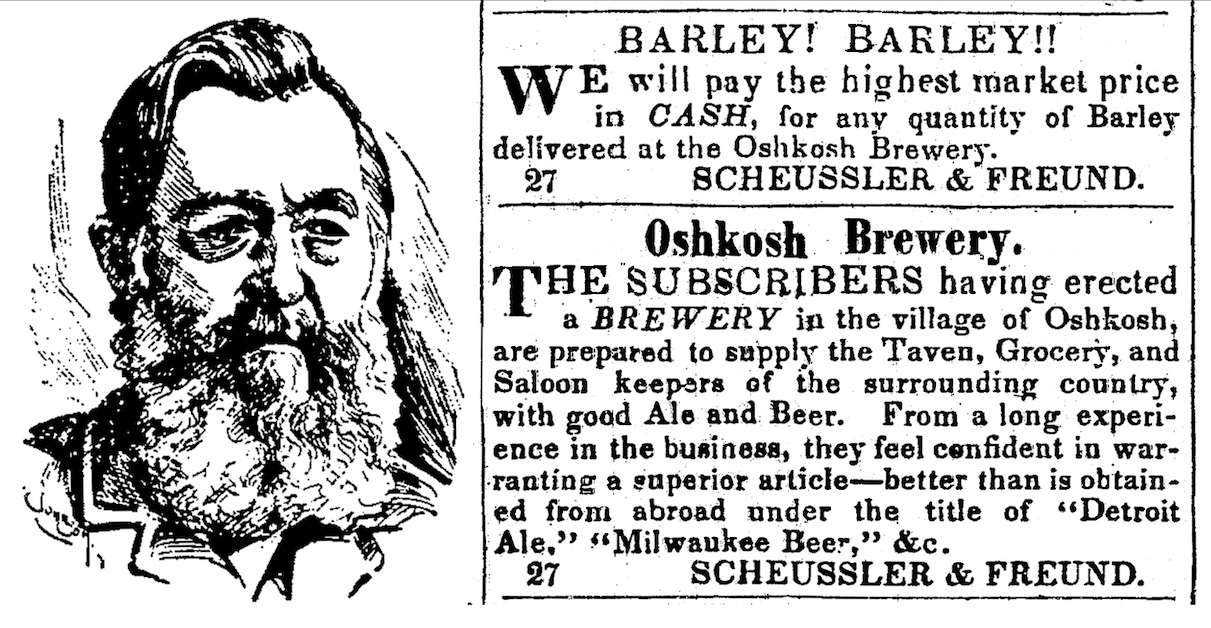
It wasn’t long before Jacob Konrad had competition in the neighborhood. Like Konrad, Joseph Schussler was born and trained as a brewer in Germany. By 1846 he was making beer in Milwaukee. In the fall of 1849, Schussler moved to Oshkosh. He built the Oshkosh Brewery on the north bank of the Fox River between Bowen and Frankfort streets in the area of what is now 1031 Bay Shore Drive.

A drawing of Joseph Schussler from the 1890s alongside
an ad from 1850 for his Oshkosh Brewery (Schussler's name is misspelled in the ad).

Schussler's Oshkosh Brewery was short-lived. But following its failure in June of 1852 another German brewer came along and took up the Oshkosh Brewery mantle.

Loescher’s Oshkosh Brewery
Bavarian-born brothers George and Frederick Loescher traveled what was becoming a well-worn path to Oshkosh. After training as brewers in Germany they immigrated to America in 1851 and headed for Milwaukee. After a short time there, they walked to Oshkosh. Yes, they walked it… about 90 miles on foot.

In September of 1852, the brothers purchased land on Bay Shore Drive (it was then called River Street) just west of Eveline. Their plot was just a couple of blocks east of where Schussler's Oshkosh Brewery had been. The Loescher brothers began building the new Oshkosh Brewery.
 
Loescher's Oshkosh Brewery shown in an 1858 map.

Frederick would soon leave Oshkosh to take over a brewery in Menasha. Brother George would go on making beer at the Oshkosh Brewery until 1878 when he accidentally burned the place to the ground. George Loescher wasn’t done. We’ll hear more from him in a moment.

From the 1868 Oshkosh City Directory.


The Rahr Brewing Company
The end of the Civil War in 1865 triggered another burst of brewery activity in the Stevens Park Neighborhood. In 1856 Charles Rahr migrated to America from northern Germany. His family had been making beer there for generations. After Rahr landed in America he headed straight for Wisconsin where his uncle Wilhelm had a brewery in Manitowoc, and his brother Henry was about to open a brewery in Green Bay. Charles Rahr worked in both those breweries before going off to fight in the Civil War.

Charles Rahr

When the war ended, Rahr set his sites on Oshkosh. In July of 1865, he and his brother August purchased five acres of land at the end of what is now Rahr Avenue on the shore of Lake Winnebago. The Rahr Brewing Company of Oshkosh was born.

The Rahr Brewery, circa 1890.

The Rahr brewery would be Oshkosh's longest-lived, family-owned brewery. It had been in business 91 years when it closed in 1956. Old-time Oshkoshers used to say the Rahrs made the best beer in the city.

The Gambrinus Brewery
While the Rahr’s were getting their brewery up and running, the Lake Brewery was in the midst of a transformation. The keys to Jacob Konrad’s old brewery had changed hands a couple of times before they were handed to Gottlieb Ecke in 1865. Ecke was a German immigrant who had been making his living cutting meat in Stevens Point before removing to Sawdust City to pursue his fortune as a brewer.
 
Gottlieb Ecke and his wife, Charlotte.
 
Ecke had larger ambitions than the little brewery on the lake could accommodate. In 1868, he began building a more modern brewery two blocks west of the Lake Brewery at what is now 1239-1247 Harney Avenue. Upon its completion, Ecke’s new brewery became the largest in Oshkosh. But Ecke didn’t have long to enjoy it. He died in 1871, two years after the brewery's completion.

In 1875 Lorenz Kuenzl – a Bohemian-born immigrant who had just completed a stint as the brewmaster for the Stevens Point Brewery – moved to Oshkosh and took over the Ecke Brewery. Kuenzl branded it the Gambrinus Brewery. The massive facility in the heart of the Stevens Park Neighborhood would serve as a landmark for years to come.

The Gambrinus Brewery on Harney Ave.
Lorenz Kuenzl is seen leaning on the fence in white sleeves and hat.

In 1894, Kuenzl merged the Gambrinus Brewery with two other Oshkosh breweries to form the Oshkosh Brewing Company. Brewing operations were moved to the south side of town and thereafter the Gambrinus Brewery operated as a bottling plant. In 1914 the brewery was dismantled.

Loescher’s 2nd Oshkosh Brewery
After burning down his first brewery in 1878, George Loescher built a new one just up the street at the northeast corner of Frankfort Street and Bay Shore Drive.


Loescher's new brewery, completed in 1880, was bigger and better than the old one.

From Rascher's Fire Insurance Atlas of Oshkosh, 1885.

But it wasn't bigger and better enough. The breweries on the south side of Oshkosh were ramping up at a pace Loescher couldn't match. And Loescher, known to have an unhealthy exuberance for his own product, died just four years into the new brewery's production run. His wife, Regina, and their son William would keep the brewery going until 1890. The vacated brewery was still standing in 1903 but it appears to have been demolished sometime soon after.

Sitter’s Wildcat Brewery
The last brewery launched in the Stevens Park Neighborhood was supposed to be a secret. And for a time it was. Mathias Sitter had grown up on Harney Avenue in the shadow of the Gambrinus Brewery. His father, Johann, had worked at that brewery before going off on his own to become an independent beer bottler in the early 1890s (more on that just ahead). Matt Sitter followed in his father’s footsteps, working as a beer distributor and bottler. When Prohibition came in 1920 his livelihood was taken away. So he went underground. Literally.

Sitter established a bootleg beer brewery in the basement of his home at what is now 1255 Harney Avenue. In conjunction with his wildcat brewery, Sitter ran a soda distribution business. It was the perfect shield for all those clattering bottles of bootleg beer being hauled out of his basement.

The former home of Sitter's wildcat brewery at 1255 Harney Avenue.

Sitter’s brewery met its end when federal agents raided the Sitter home on August 24, 1927. The jaws of those agents must have dropped when they saw the full-scale production facility Sitter had squeezed into that modest basement. The feds also found more than 350 cases of bootleg beer on hand. Matt Sitter was arrested and his brewery was put out of commission. But he returned with the end of Prohibition and reopened the family’s beer distribution business. Sitter Beverage continued to operate from the Stevens Park Neighborhood well into the 1940s.

The Bottlers
Prior to the 1900s, small breweries like those in Oshkosh often avoided bottling their beer. It was just too much work. But people still wanted bottled beer. Independent beer bottlers stepped in to fill the gap.

During the late 1800s and into the early 1900s, Oshkosh had at least 21 independent beer bottlers. Many of them were clustered in the Stevens Park Beer District. The bottlers would buy wooden kegs full of beer from local breweries and cart them back to their bottling plants on horse-drawn wagons. The beer from those kegs was then drained into bottles that were usually embossed with the name of the bottler. The beer may have been made at the Rahr Brewery, but you wouldn’t find the Rahr name anywhere on the bottle.
A bottle used by the Neumueller Brothers, bottlers of Rahr Brewing Company beer.

August Rahr
August Rahr was the first of the independent bottlers in the Stevens Park Neighborhood. He had started out in Oshkosh in 1865 as a partner with his brother Charles in the Rahr Brewery.

August Rahr

In 1883, August went his own way and set up a bottling house. His first plant was near Lake Winnebago on the south side of what is now Rahr Avenue. He moved the operation to the southeast corner of Rahr and Rosalia sometime around 1887. In addition to his bottling business, Rahr ran a grocery store and saloon from this location. He and his family lived in the rooms above.

August Rahr's former bottling house, saloon, and grocery still stands at 320 Rosalia.

August Rahr was bottling beer there as late as 1894. At that time, he was putting beer from the Oshkosh Brewing Company into his bottles. Here's one of the very early and rare August Rahr beer bottles from the 1880s. It would have been filled with Rahr Beer.
Johann Sitter
Johann Sitter was an Austrian immigrant who arrived in Oshkosh in 1883. He worked at the Gambrinus Brewery on Harney Avenue. Sitter left there to become an indy beer bottler in the early 1890s.

The Johann Sitter Family, October 1910.
Johann is seated second from the right.
His son, and future wildcat brewer, Mathias Sitter, aged 9, is seated next to him.

Initially, Sitter bottled primarily for the Gambrinus Brewery, but later he bottled and distributed Oshkosh Brewing Company beer. The Sitter plant would be the longest-lasting bottle house in the Stevens Park Neighborhood. His operation, based at what is now 1255 Harney Avenue, would continue until the start of Prohibition in 1920. Here’s a 14-ounce bottle used by Sitter in the early 1900s.


The Neumueller Brothers
German immigrants Fred and Ludwig Neumueller were independent beer bottlers from about 1893 until 1915. Their bottle house was on the south side of Rahr Avenue, near the Rahr Brewery. Not surprisingly, most of the Neumueller's bottles were filled with Rahr Beer. Here's one of their bottles that was being used around the turn of the century.


Havemann and Priebe
Dietrich Havemann and Carl Priebe were German immigrants who ran a bottling plant from a barn that stood on the north side of Ceape Avenue between Rosalia and Eveline streets. Havemann had financial ties to the Rahr Brewery, so there's a good chance he was filling his bottles with Rahr Beer. Priebe, on the other hand, shows up in advertisements for Oshkosh’s Horn and Schwalm Brewery as a bottler of their beer. The Havemann/Priebe bottling operation was active through the first half of the 1890s. Bottles from this facility are now extremely rare and exceedingly valuable. The Havemann bottle shown below recently sold for $300.


Herzog and Ihbe
August Herzog and Robert Ihbe ran a bottling plant at what is now 1225 Waugoo during the early 1900s. It remained in operation until 1916. Both Herzog and Ihbe also worked for the Oshkosh Brewing Company, which was probably the source of the beer that filled their bottles. Here's one of those bottles with just Herzog's name appearing on it.

Charles Noe
Through much of the 1890s, there was a bottling plant at what is now 202 Rosalia Street. It was run by Charles Noe, a German immigrant and Civil War vet. Like a few of these bottlers in the Stevens Park Beer District, Noe treated his bottling plant as if it were a saloon. In 1892, his neighbors complained and Noe was arrested for selling beer for on-premise consumption. It didn’t seem to hinder him. His bottle house was still going in the late 1890s. Here's a picture from the mid-1880s of our man Noe.


The Saloons
Oshkosh is well known for its neighborhood taverns. But the corner-bar phenomenon didn’t begin to flourish here until the 1880s. Prior to that, nearly all of the city’s saloons were clustered around the commercial centers of North Main, South Main, and Oregon streets.

In the Stevens Park Neighborhood, things were different. Breweries there often operated as defacto saloons. They served beer directly to their customers in much the same way that our brewery taprooms do today. Both the Loescher and Rahr breweries had become well established as drinking spots prior to the 1880s. As the population of the neighborhood grew, though, saloons began setting up.

Bogk’s Pleasure Gardens
The first saloon in the Stevens Park Neighborhood was in the midst of a vast, 10-acre beer garden that sprawled along the shore of Lake Winnebago between Ceape and Waugoo. It was opened in 1869 by Gustavus Bogk. Bogk was an immigrant from Rossla, Germany where his family ran a brewery and inn. He transplanted that spirit of gemütlichkeit to Oshkosh.
Gustavus Bogk

Bogk’s beer resort featured a dance hall, bathing houses, a restaurant, and a saloon. Sailboats were rented there in summer. In winter, there was skating. Bands played every Sunday all year long.


Too bad it didn’t last. Bogk was a serial entrepreneur with a singular talent for squandering capital. Bogk went broke causing the largest beer garden in the city to close after the summer of 1870. 

Jerry’s Bar
The oldest surviving saloon in the Stevens Park Neighborhood is Jerry’s Bar at 1210 Ceape Avenue. This tavern goes back to at least 1878 (I’m planning to write much more about this in the near future). It opened as both a saloon and bowling alley. Here's a photo taken in the early days when it was Jacob Wenzel’s place.


Wenzel was a German immigrant who came to Oshkosh in 1868. He started out here as a sign painter, but in the winter of 1883 he purchased the saloon and bowling alley on Ceape. After Wenzel’s death in 1911, the bar was leased to Gustav “Jerry” Wesenberg.

Jerry Wesenberg stands in front of his tavern, early 1960s.

Jerry’s Bar has been with the Wesenberg family ever since. It’s now owned and operated by Mike Koplitz and Scott Engel. Engel is Jerry’s Wesenberg’s great-grandson and the 4th Generation of Wesenbergs to work behind the bar at Jerry’s.

Mike Koplitz (Left) and Scott Engel of Jerry's.

Mick & Sue’s
The tavern at the northeast corner of Ceape and Rosalia was launched in 1884. The first owner was Andreas Kuenzl. He was the brother of Lorenz Kuenzl, owner of the Gambrinus Brewery on Harney Avenue. Andreas was the foreman at his brother's brewery prior to launching his bar. After Andreas Kuenzl died in 1894, his wife Anna took over the bar. At the time, it was one of just three Oshkosh saloons run by women.

In 1904, the bar was sold to the Oshkosh Brewing Company. The saloon became an OBC tied house and remained so until Prohibition hit in 1920. The bar has gone through many ownership changes over the intervening years. It’s now run by Mick and Sue Falk.

Mick and Sue's.

Woodchuck's Bar & Grill
Here’s another Stevens Park Neighborhood tavern that originated in the 1880s. The first saloon at what is now 351 Rosalia opened in May of 1888. The proprietor was Peter Auler, who had come to America from Germany in the mid-1860s. He was working as a cabinetmaker in Oshkosh in 1876 when he purchased the property at the southwest corner of Winnebago and Rosalia streets. Auler lived there 12 years before converting the space into a grocery/saloon.
A drawing of Peter Auler made in the early 1900s.

After Auler died in 1902, the saloon was sold to Clements Luck, yet another German immigrant. Initially, Luck kept the grocery/saloon setup intact. When Prohibition arrived in 1920, he ran the saloon side of the business as a speakeasy. At least, that is, until 1931 when his bar was raided by federal agents. Luck continued there until his death at age 79 in 1948. Here’s a picture from 1953, when the bar was called Hanley’s with Harold Hanley as the tavern’s proprietor.


The tavern became Woodchucks in 2008 when David Krueger took over the bar. Here’s a recent shot of what used to be Peter Auler’s saloon/grocery.


Jansen's Bar and Restaurant
The lineage of Jansen's stretches back to 1892. The story is tangled up with a saloon that stood directly to the south of Jansen's across Winnebago Avenue. It all begins, once again, with a German immigrant. His name was Martin Gerth.

In the summer of 1880, the 40-year-old Gerth, his wife Emilie, and their seven children left their home in the north of Germany and came to Oshkosh. Gerth went into business for himself opening a saloon and pool hall on what is now South Main Street (it was called Kansas Street back then). Gerth left that bar in 1886 to launch a new business at what is now 336 Bowen. It was the typical saloon/grocery setup with the Gerth family living in the attached flat.

The original Gerth saloon is shown on the right at 336 Bowen.
Jansen's is on the left at 344 Bowen.
Winnebago Avenue runs between the two properties.

In 1892, Gerth sold his business at 336 Bowen and launched another new saloon/grocery just across the street. This was the beginning of what is now Jansen's. In 1896, Gerth sold the business to his son Robert. A year later, Robert sold it to August Horn, president of the recently formed Oshkosh Brewing Company. The saloon ran as a tied house for the Oshkosh Brewing Company for years to come.

Today if you step into Jansen's you'll see plenty of memorabilia from the brewery that used to own the bar. The place retains a sense of its history without any pretense. It's one of the surviving treasures of the Stevens Park Beer District.

Jansen's

The Parting Glass
The Stevens Park Neighborhood is where the history of beer and brewing in Oshkosh begins. Walk along those streets now and you'd never suspect that around almost every corner there once stood a brewery or bottling plant. There's not a trace of those places left. All that remains are the bars. They're the abiding reminder of the early days and ways of the Stevens Park Neighborhood.

The end of an era. After the 1956 closing of the Rahr Brewery,
the Rahr Beer sign was taken down from Jerry's Bar.