Showing posts with label Allenville Hops. Show all posts

Thursday, July 25, 2019

Hidden Valley Hops Farm

Justin Gloede is doing something in the Town of Winchester that hasn't been done there in almost 140 years. He's putting in a new hopyard.

Justin Gloede (green shirt) in his hop yard.

 Three years ago, Gloede planted a small set of hops on his family's farm in the Town of Winchester. Those plants have thrived. The bounty of hop cones they produced surprised and encouraged him. This year, Gloede decided to get serious about hops. He built a 12-pole trellis that covers about a tenth of an acre and began putting down roots.

"I have about 70 plants in the ground right now," Gloede says. "I’ll have roughly 110 plants total after I finish planting next year. I’m also going organic. No pesticides."


This is a long-term project. The typical hop yard takes 4-5 years to reach its potential in terms of yield. Gloede's work now is mainly about getting his plants established and setting a foundation for future growth. Mother Nature hasn’t been much help.

"What a year to try and grow hops," Gloede says. "All this rain is killing me."

Another rain-soaked day in the Town of Winchester.

Nevertheless, Gloede's yard is taking root. He's put in a diverse mix that includes Cascade, Chinook, Hallertau, Nugget, Saaz, and Tettnanger. He’s also planted a hop that goes back to the origins of hop growing in Winnebago County.

Gloede was given permission to harvest roots from the site of the old Silas Allen farm in Allenville. Allen's hopyard, planted sometime around 1849, was likely the first in Winnebago County. Hops still grow wild there. That plot is located about a mile from Gloede's yard and the hops he's transplanted from it have quickly acclimated to their new home.

"The Allenville hops are exploding," he says. "I’m already looking at putting in two more rows of it, but that's still to be determined."

Gloede has joined the Wisconsin Hop Exchange, a statewide cooperative established to assist hop growers, and he would eventually like to help supply area breweries and homebrewers with locally sourced hops. He has room to expand and plans to purchase a pelletizer once he's able to produce a sufficient harvest.

"I’m going to find a way to get a pelletizer at some point," Gloede says. And I’ll be open to pelletizing other peoples hops, too. No idea if there’s a market for that, but we'll see."

Gloede is joining a farming lineage that was nearly forgotten in Winnebago County. In the 1870s there were more than 115 acres of hops spread across the four northcentral Winnebago County townships of Clayton, Vinland, Winchester, and Winneconne. By the early 1880s, all of it had been plowed under. Gloede's yard is in the heart of those fertile lands. He could not have picked a better place to stage a revival.

You can follow the progress of Gloede's yard at the Hidden Valley Hops Farm Facebook page.

Tuesday, August 28, 2018

When Hops Were King in Allenville

Hopyards once flourished in Winnebago County. From the 1850s until 1880, the county was among Wisconsin’s most productive hop-growing regions. This at a time when Wisconsin was a leader in U.S. hop production. It all came undone in Winnebago County after a devastating series of market upheavals and crop failures in the late 1870s. Farmers here plowed their hops under. They put cows and corn where the towering bines had grown. Silas M. Allen was there to see it all.


Born in 1867, Allen was raised on a hop farm in Allenville, just north of Oshkosh in the Town of Vinland. Allen's grandfather, also named Silas, appears to have been the person who introduced hop culture to Winnebago County. Silas the elder died in 1859. His hopyard survived, tended by his son Timothy, the father of Silas M. Allen.

Silas M. Allen was 13 when his family abandoned hop farming. It continued, however, to be a point of interest for him. A railway mail clerk by profession, history was Allen’s obsession. It led him to seek out and conduct interviews with early residents of Winnebago County. The information he gleaned helped flesh out his own memories of the emergent county.

In 1931, Allen’s store of knowledge about 19th-century life in Winnebago County was made public through a series of articles he wrote for the Oshkosh Daily Northwestern. Among them was a lengthy piece on farming. The piece was dominated by memories of the days when hops were king in Allenville. It's an invaluable record. The hop-related portions of it are excerpted below.

Allen’s history of hops was written some 50 years after the peak of hop farming in Winnebago County. It came at a time when, thanks to Prohibition, beer had been illegal for more than a decade. And five months after it was published, Silas M. Allen passed away at his home in Oshkosh. Following his death, the Daily Northwestern mentioned that Allen "was in a position to know more of the early history of the county than almost any other individual."

Time for me to get out of the way and let Allen have his say. I've included a number of captioned illustrations that I hope will benefit Allen's text. Aside from those intrusions, what follows is the writing of Silas M. Allen.

Allenville Hopyards Form an Interesting Background For Present Day Farm Methods

No person under 50 years of age has ever seen a hopyard in what is now the Allenville community, but from 1850 to 1880 hopyards in that section were a common sight.

From the Libby farm, now Hauler's, on route 41, to Tennis Miller's, near Lake Winneconne and from Albert Hinman's, west to Gillingham's corners, south to the Christian Boss farm, were a score or more of those fields or yards.

The highlighted area illustrates the hop-farming sections Allen references.
When Silas Allen settled there in 1846, he is supposed to have had a barrel of hop roots in his emigrant wagon.

He was soon followed by his father, Timothy Allen, by his brother, George, and by his brother-in-law, Frank King. They had come from Madison county, New York, and were hop growers there.

Timothy Allen was a dignified gentleman of the old school, one v,-ho, in traveling or going to church, rode on horseback ahead of the family conveyance. Being a strict Presbyterian, he did not, while living at Allenville. take an active part in the work of the Free-Will Baptist church. He died in 1856.

Hops are still raised in central New York, and our cousin, George Allen, of Brookfield, N. Y., was the largest single hop grower in that country. His last crop was raised in 1921, and consisted of 45 acres. The yards in Vinland were hardly over 10 acres each.

DIES OF SUNSTROKE
We do not know exactly the year hops were first planted there, but it must have been soon after Silas Allen's settling. He lived there only 13 years, dying from a sunstroke on July 16, 1859. (Note- July 16 of this year, 1931, was one of our hottest days.)

Riverside Cemetery, Oshkosh.
At his death, he owned the farms now known as the Sidney Smith farm, the Grimm, Jones, and Harry Allen farms, the 80 acres south of Allenville station, 120 acres next west of the J. S. ("Till") Cross farm, 40 acres of timber - west of that, and 80 acres of marsh in section I. town of Winchester, where he died.

This land was paid for by wheat and hops. Yet this man, hustler that he was, never had a horse-rake, mower, nor reaper, let alone a hay-loader, horse-fork, binder or sulky plow, nor did he dream of the great later inventions and improvements, milking machines, paved roads, automobiles or electric power.

OF NETTLE FAMILY
Botanically speaking, hops belonging to the nettle family, are really catkins. The leaves and stems are rough to the touch.

The catkins consist of several acute bracts or leaves and these leaves are attached to the stem in such a way as to form a cone. A bunch of these cones looks very much like a bunch of green grapes. The base of these leaves is covered with a yellow powder, which is the active principle of the plant.


The acreage, price, and production vary greatly from year to year. The state of Oregon is the great producing state now.

Hops contain 75 percent of water, and are dried down to 15 percent at 140 degrees of heat. Hops have many pests to damage them, lice and mildew being the greatest. About 20 million pounds are raised annually in the United States.

NEED EXPERT CARE
The soil most suitable for hops is the same as that for corn. A field of hops is called a hopyard. In setting out a yard, first the land was marked as if to be planted to corn by hand, the rows being four feet each way. In every second row. in every second mark, four roots were put, making the hill longer north and south. The hops roots looked- something like our modern vegetable oysters. The remaining hills were planted to corn, and as the hops grew the first year to only four or six feet, they did not interfere much with cultivating and harvesting the corn.

In the fall, after the corn was off. a large forkful of manure was placed on each hill of hops. This was both for protection against the cold of winter and for fertilizer the next year.

If it were the first hopyard, you went to the cedar swamps for hundreds of small cedar trees about four inches in diameter at the base and 16 feet long, the large end to be sharpened like a fence post.


FOLLOW THE SUN
In the spring, after the frost was out, these covers on the hills were removed and at each end of these hop hills, north and south, two holes were made with a hop spud, an iron bar like a crow bar with the ground end enlarged.

A hop spud, also known as a hop bar.
Into these holes the cedar poles were set by raising them in the air as high as your chin and plunging them into the holes.

As hop vines are climbers, going around with the sun, most of the young vines soon found the poles and began to climb. But some were unruly and some would be loosened by strong winds, so they had to be helped to find their places on the poles. This was a boy's job. All winter the women had been saving the legs of worn-out hand-knit woolen stockings This soft yarn ravelled made an ideal string to tie up the tender hop vines.

One wound the vine around the pole with the sun, then fastened it with a length of yarn with a twist of the ends, the kink in the yarn tightening it enough to hold the vine to the pole until it started growing around again.

LOOK LIKE GRAPES
By the middle of July the vines would have reached the top of the poles and branched out in all directions. At that time, a 10-acre hopyard was a very pretty sight.

As the hops began to form, they took on an appearance of bunches of green grapes, but with some leaves growing in the clusters. There are a number of farms in Vinland where the hop-houses are still standing, though in most cases the buildings have lost their distinguishing feature, the high end where the kiln was located. On the Albert Hinman farm is still standing a tepee-like stack of hop-poles.

A hop barn typical of the era.

The Hinman farm as it appeared in about 1880. The hop barn with its cone-shaped roof is seen at the center of the image.
 About Sept. 1 the hops were ready for picking. Girls were employed for this and they were usually secured from Poygan and Winchester. We usually had about 20 or 24 pickers but my mother used to tell me how, in her first year of married life and housekeeping in 1865, living in a log house, for four weeks they had 75 girls to cook for and to lodge in the big barn equipped with hand-made bedsteads, the bedticks filled with straw from the previous fall garnering.

ONE MAN, EIGHT GIRLS
The picking force was augmented by one man to tend box for each eight girls, that is to take the poles down and then stack them up after the hops were picked.

An 1880 photo taken at a Columbia County, Wisconsin hop farm.

The hops were put into boxes. The boxes were about six feet long, two and a half feet wide and two and a half feet high. They were divided into four compartments, each compartment holding seven bushels and the girls were paid 24 cents a compartment. A real live girl would pick four of them a day. At each end of the box two of the side boards were extended to make handles by which when the boxes were empty, two men could pick them up and carry them around.

On each end was a strip upright with a notch in the top. Across the box in these notches was a light pole on which the poles of hops were laid while the hops were picked. Thirty-six hills or 72 poles was a setting, after which the box would be moved to another setting. When a compartment was filled, the hops were emptied into a jute sack, the box-tender dipping the hops out by hand, while two of the girls held the sack.

Each night these sacks of hops were hauled to the hop-house. The kiln part of the hop-house consisted of a large high room on the ground floor in which were generally four large cast iron stoves long enough to take in four-foot wood. Above this was a floor made of slats covered with burlap on which the hops were placed to about two and a half feet in depth.


BRIMSTONE IS USED
Fires in the stoves were kept up six or seven, hours, the hops being gently stirred during this time. During the last hour of the drying. brimstone was placed on the tops of the stoves, the fumes circulating through the hops above and giving them a rich yellow color. After drying, the hops very light and brittle, were gently pushed off the kiln floor into the storage room, which usually was the rest of the building, as the light dry hops took up much space.

It was quite a lively time in the neighborhood during hop picking time as there were then within a radius of two or three miles probably from 100 to 150 extra girls picking hops. Each yard was supposed to give at least one dance during the time. These dances were usually held on the lower floor of the hop-houses. So many girls made it necessary that all the men, young and old, should take part.

DRAFTED TO DANCE
Even barefoot boys of 8 or 10 years, like myself, were drafted, and if a bashful boy held back he would probably be picked up and carried on the floor by some active young woman. The music would be a violin played by one of the men among the box-tenders. One violin was enough music for a hop dance and the fiddler generally called off the dance changes. All the dances were square dances.

After the picking and drying was over, generally on a rainy day, the hops were pressed into great bales The press was a huge box-like affair relined for each bale with burlap. Into this press the hops were poured, two men inside treading them down.

"Treading them down."

When the press had been filled, a four by four or eight by eight bar of strong wood, called a follower, with levers at each end was put on and the hops pressed down until the edges of the burlap met. The sides of the press were removed and the edges of the burlap sewed together with very strong cord threaded in a large needle with a curved point.

Caps were then sewed on the end of the bales. These bales were about five leet long, 30 inches wide, and 20 inches thick, weighing about 200 pounds.

FEAT OF STRENGTH
It was considered quite a feat of strength to shoulder a bale of hops and only a few men could do it. Among those I can remember were Andrew Anderson, afterward living on the Jerry Vosburg farm. William Stannard and William Moran of Butte des Morts. Charles R. Allen, and my father Timothy Allen, all very powerful men.

Soon after the hop growing was well started there moved into the community several families and single men direct from Kent, the great hop district of England. They were excellent hop men and were a valuable addition to the industry.

First came Jesse Britcher, Edward Carl with some of the Richardson brothers, followed afterward by other Richardsons, the Weller brothers, George and Alfred, and Fred Brann.

By 1880 hop growing had declined so much that but a few yards were left. These were on the Cronkhite, Allen, Samuel Pratt, David Maxwell farms and the farms owned by Caroline Allen Bates and Louise Allen Vosburg, now the Sidney Smith and Grimm farms.

A 1932 map of the Town of Vinland. Green highlights indicate farms Allen mentions in his article.

HELP GROWS SCARCE
All these soon disappeared on account of the damages by pests and The difficulty of getting pickers. Girls could not be induced to come, so the last year or two only elderly women with their nephews or grandchildren could be secured.

The last yard on the Allen farm was where the Allenville store now stands. The railroad cut right across it taking a strip 100 feet wide. The inconvenience caused by this broke the back of the industry in this section.
Silas M. Allen
Oshkosh Daily Northwestern, September 19, 1931


The photo above was taken at Allenville in the early 1900s. The white building with the awning is the Allenville store referenced in the article. Below is a recent photo of that same area. 


Hops still grow wild at the site of the last of the Allen family's hop yards. The photo below was taken there last week.


Thursday, October 12, 2017

The Roots of Big Ed's Hopyard Ale

Last fall, Fox River Brewing Company released Big Ed's Hopyard Ale. It was an unprecedented beer. It marked the first time a commercial brewery in Oshkosh made beer using fresh hops – hops that go directly from bine to brew kettle without being dried or processed. And it was the first time since the 1880s that a commercial brewery in Oshkosh made beer using hops grown in Winnebago County.

Big Ed's Hopyard
This year's version of Big Ed's Hopyard Ale has just been released. This time, the connection to place runs deeper. This is a beer with roots in the earliest days of Winnebago County's beer culture. To trace those roots you have to go back to the 1840s and a man named Silas Allen.

Silas Allen was said to have arrived in Winnebago County in 1846. It was also said that he came with a barrel of hop roots in tow. That seems entirely plausible. Allen migrated here from Madison County in mid-state New York. He'd lived and farmed there at a time when Madison County was the largest producer of hops in the nation.

Allen's migration was part of a westward diaspora of New York hop growers. Everywhere they went, they spread hops. Allen settled at what was then known as Ball Prairie. Today we know it as Allenville. He purchased land, cleared it, and began putting down roots.

By 1853, though possibly earlier, Allen's farm was producing hops suitable for brewing. By 1854, he had five acres of hops under cultivation. His yield that year was in excess of 6,000 pounds. This had grown into a significant hopyard.

Silas Allen died from sunstroke in 1859. He had been out tending to his field. His son Timothy took over the farm. The Allen's continued cultivating hops. It lasted until the late 1870s. By then the hop market had cratered due to overproduction.

The final blow for the Allens appears to have come in 1880. The Chicago & North Western Railway cut a track through the middle of their hopyard. Their hop farming days were over. That should have ended the story for those hops. It didn't.

Allenville Hops
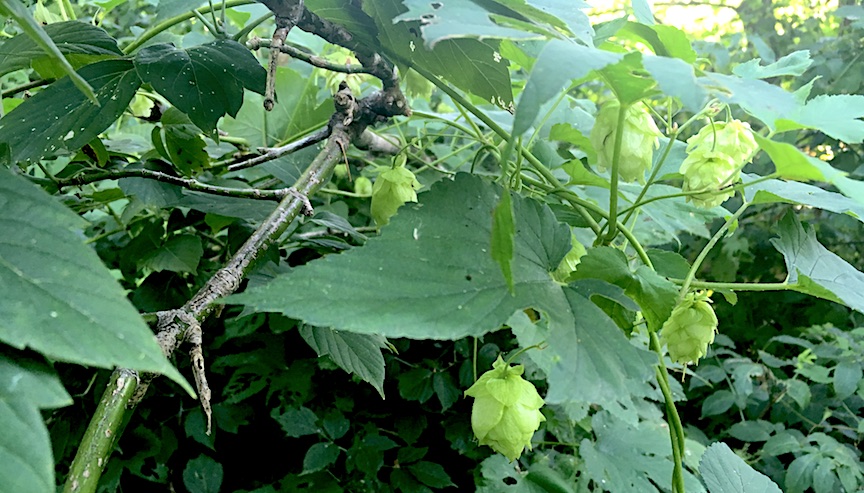
Hops are tenacious. Once established, the plants can be nearly impossible to eradicate. They'll turn feral, sending out underground runners. The spread is often prolific. At the site of Silas Allen's farm hops still grow wild.

Those hops piqued the interest of Scott Clark and Steve Sobojinski. They cultivate the hopyard in Winnebago County that supplies the fresh hops used in Big Ed's Hopyard Ale. Last spring Clark and Sobojinski planted cuttings taken from roots of the hops growing wild at Silas Allen's old farm.

The plants flourished. This year’s version of Big Ed's Hopyard Ale includes hops grown on plants from the relocated Allenville cuttings. It’s the first time in almost 140 years that hops derived from those roots have been used in a commercial beer.

A bucket of the Silas Allen hops.
The Silas Allen hops are just part of the mix. This year’s Big Ed's Hopyard Ale also includes Columbus, Cascade, Sterling, Centennial, and Nugget hops. They were picked on the morning of September 13.

Brewers picking hops at Big Ed's Hopyard.
A few hours later those hops were in the kettle at Fox River Brewing in Oshkosh. The beer went on tap yesterday; Wednesday, October 11. It’s a wonderful beer.

Big Ed's Hopyard Ale 2017
The aroma showcases the hops. They’re bright and lemony. The flavor also favors the hops with more of that citrus fruit coming through. But the hops don’t entirely dominate. This year Kevin Bowen, brewmaster at Fox River, added locally harvested honey to the wort for Big Ed’s. The honey presence is subtle, but it sets a nice counterpoint to that brisk hop flavor. The bitterness is firm and clean and not at all oppressive. At 5.8% ABV, this beer is at the outer edge of being sessionable, but two or three go down easily.

Like all fresh hop beers this one is going to be at its best when it’s at its freshest. That’s right now. This is a rare beer in the truest sense. Don’t let it slip by.

Sunday, August 21, 2016

Winnebago County Hops, 1876 and 2016

Late summer always makes me wonder what it must have been like to travel through Winnebago County in the 1870s. In those years, hops were still a cash crop here. As the month of August waned you’d have come across farm after farm with densely thatched hops fields about to be harvested.


Hop farming began early in Winnebago County. By the late 1840s, Yankee settlers to the area were already putting in hop fields. The boom years were the 1860s. But hop prices fell after the tremendous harvests in the latter half of that decade. The glut forced farmers here to eventually abandon hops for more lucrative crops such as wheat.

Here’s a snapshot of hop farming in Winnebago County, just as hop production here was ebbing. This is the total reported acreage of Winnebago farm land given over to hop cultivation in 1876. The map shows it broken down by township (don’t be thrown off by Manchester, it’s a misprint; that should actually read Winchester).


Algoma: 4 acres
Clayton: 32 acres
Neenah: 4 acres
Omro: 1 acre
Poygan: 9 acres
Rushford: 8 acres
Vinland: 59 acres
Winchester: 11 acres
Winneconne: 10.5 acres

For a grand total of 138.5 acres. That’s down 12 acres from 1875. The decline would gather momentum. By 1880, hop production in the county was reduced to just 33 acres. And with the close of the 1880s, commercial hop farming in Winnebago County came to an end.

Few remnants of our old hop culture survive. The most tangible link are the hops growing wild on what used to be the hop farm of Silas Allen in Allenville. You can see them if you walk up the WIOUWASH Trail just north of County Road G. Keep your eyes trained on the woods that border the east edge of the trail there. Growing among the trees are vining hops. This time of year you'll see the grape-like cones they produce each summer.


Commercial hop farming has yet to be revived here. In the meantime, there are plenty of us keeping the spirit of Winnebago’s hop culture alive. Gardeners in every part of the county grow hops for their own use. The most elaborate setup is Tim Pfeister’s. You can follow Tim’s progress on his Pfeister Pfarm Facebook page.

Bare Bones Brewery has gotten into the act, too. The brewery has hops growing over the pergola in the beer garden just outside its room.


I also grow them. This year’s crop is taking a bit longer than usual to develop, but they’re coming along. Here’s a picture of my plants taken Saturday morning after the rain storm.


In the middle of that mass are hops I transplanted from the old Silas Allen plot. Not surprisingly, that plant is the hardiest of the bunch. It’s pumping out the cones this year.

If Silas Allen were alive to see my urban hop yard, he’d probably scoff. At least until he got up close. I’m sure those pungent cones would bring a smile to his face. Maybe he'd even recognize their genesis.


For more on the history of hop farming in Winnebago County, visit the pages here, here, here & here.

Monday, November 11, 2013

An Update on the Allenville Hops

Allenville Hops
A couple months ago I posted about the wild hops I found growing in Allenville and how they may have gotten there. That story is HERE. When I wrote that, I had yet to brew with these hops and was uncertain about what breed they might be. But now that I’ve actually made beer with them, I know a little more.

I believe these hops belong to the Cluster family. Since they’ve been growing wild for so long, it’s possible that they’ve cross pollinated with some other wild strain, but the flavor they produced in the beer I made had the flavor components I associate with American Cluster. I used to brew with Cluster quite often and grew familiar with the hop. I find its aroma fruity and floral. Its flavor is hard to pinpoint, but I always think of it as earthy. They can be a little on the rough side, but in a good way. To me, it’s the flavor of how beer used to taste in the 1970s. Many of the beers I’ve brewed with Cluster have reminded me of the beers I would sneak off and drink when I was too young to drink legally. It’s a taste memory that’s embedded in my palate.

If the Allenville hops are, in fact, Cluster it would come as no surprise. Cluster is as close to a native hop as America has. When Silas Allen arrived in our area from New York in 1846, he was said to have brought a barrel of hop roots with him. Since Cluster was coming to dominate the hop growing regions of New York during this period, it’s very likely that the hops Allen transported were of this variety. During the 1860s and 1870s – the period when the Allenville hop farms were at their peak – Cluster was the primary hop grown in Wisconsin and becoming synonymous with American hop production in general. By the turn of the century, 80% of all hops grown in the U.S. were Cluster.

A note about the beer: I used these hops in a strong (7.9% ABV) lager brewed along the lines of a Bière de Garde. I served it at last week’s Casks & Caskets tasting and it went over pretty well. I was happy with it. I had enough of the Allenville hops to brew a second beer, so I recently made an American-style Steam Beer or California Common with what was left of the September pickings. That beer is fermenting away nicely.

When I picked these hops I also took a healthy root from the Allenville site. It looks to be in good shape and I’m hoping that next spring it will take root and produce a decent amount of growth. If all goes well, I should be able to start sharing cuttings from this plant in the spring of 2015. I'd love to see Silas Allen’s old hops revived in Oshkosh.

Tuesday, September 10, 2013

A Hop Grows in Allenville

My 2013 hop harvest is over. I pulled down almost eight pounds of hop cones over the last two
weekends. Not bad for a home grower, but it’s a pittance in comparison to the yields of the hop farmers of Winnebago County in the 1850s and 1860s. In 1855, for example, Silas Allen collected over 6,000 pounds of hops on five acres of land just north of Oshkosh. Allen’s farm was at the center of a hop growing belt of more than 20 hop yards that spanned the Town of Vinland and reached into the Towns of Winneconne and Clayton. And Allen was a prototype of the hop farmers who, by 1867, had made Wisconsin America’s largest producer of hops.

Hops Growing Wild in Town of Vinland
Silas Allen was born in 1813. He had been a hop grower in New York prior to coming to Winnebago County in 1846 and was said to have brought a barrel of hop roots on the wagon that carried he and his family west. He settled in Bald Prairie, a portion of which is now Allenville, in the Town of Vinland and began clearing land for farming. By 1853, Allen’s hop yard was in full flower.

Allen had gotten in at the right time. Wisconsin’s brewing industry was booming and the price of hops was on the rise. Allen parlayed his crop into a small fortune that enabled him to purchase surrounding tracts of land. According to his great-grandson, John Allen, the elder Allen and his son Timothy were predatory when it came to their business dealings. “They were aggressive,” John Allen says. “They always had to be the biggest. They were manipulators; legal thieves.” But Silas Allen didn’t have long to enjoy the spoils of his success. He died in July 1859 of sunstroke while harvesting hay. At the time of his death, Allen owned more than 700 acres of land in the Towns of Vinland and Clayton.

Timothy Allen took over his father’s hop yards and through the 1860s saw his family’s fortunes continue to increase. But as the decade came to a close an influx of new hop growers and the revival of hop growing in New York led to a glut of hops and a steep drop in prices. Following the crash of the hop market in 1868, the number of hop yards in the Town of Vinland began to decline. The last hop yard on the Allen farm ceased production in 1880, when the Chicago & North Western Railway tracks cut a swath 100 feet wide through it. The disruption brought an end to the Allen’s hop growing.

Allenville Hops
Hops, though, are an incredibly robust plant and they continue to flower on some of the sites of these former hop yards. This summer, I’ve spent time exploring areas in the Towns of Vinland and Clayton where hops were cultivated in the 1850s and 1860s. I’ve found a wealth of hops growing wild in both townships. These may very well be feral hops; as in hops that have survived on their own after their planned cultivation has ceased. On the site of what was the Allen farm they are especially plentiful. They grow up into trees and onto vines to heights of over 40 feet with a proliferation of cones. The hops are medium-sized and pungent with a sweet lemon aroma that’s somewhat similar to Strisselspalt, but more intense.

But will they make good beer? I’m trying to find out. I recently picked just over a half-pound of hops at the site of the Silas Allen farm and then dried them for brewing. This past weekend, I brewed a single-hop beer using these hops. If all goes well, I’ll be serving that beer at this year’s Casks and Caskets. If the hops from the Silas Allen site prove to be of good quality for brewing, my plan is to propagate them and share cuttings with other home growers in the area. We’ll see what happens. Maybe after all these years the Allenville hops are ready for a revival.

Here’s an update on the Allenville hops.