Showing posts with label Chief Oshkosh Red Lager. Show all posts

Tuesday, January 17, 2023

Since 1864...

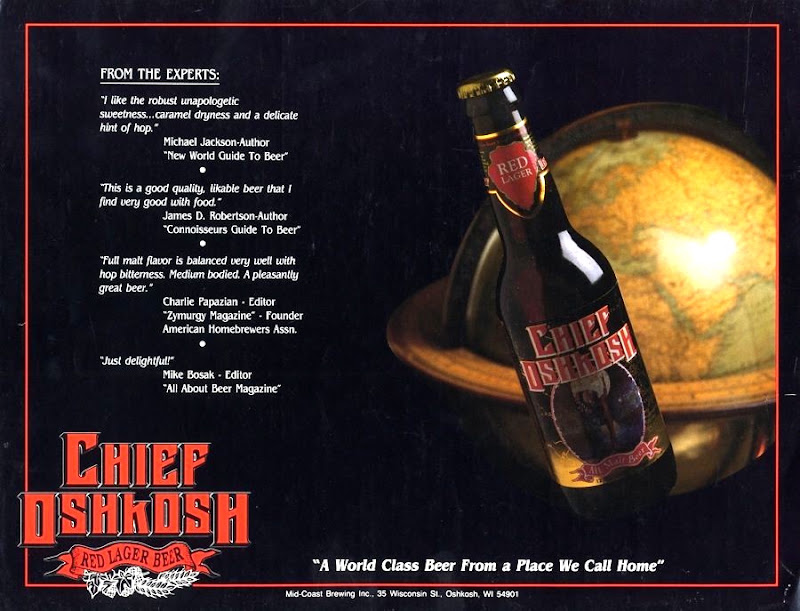
When you see brewery advertising based on history, you can bet it’s probably going to be bullshit. This one, from 1992, is full of it.


Chief Oshkosh Red Lager had absolutely no connection to the Chief Oshkosh brand produced by the Oshkosh Brewing Company. And the “Since 1864” thing is entirely off the mark. 

The first Chief Oshkosh, a non-alcoholic beer made by the Oshkosh Brewing Company, wasn’t introduced until 1928. It became an alcoholic beer at the end of Prohibition in 1933 and was discontinued altogether in 1972. 

Chief Oshkosh Red Lager was introduced in 1991 by Mid-coast Brewing, an Oshkosh-based company, that made its beer at the Stevens Point brewery. That said, it was good beer for the short time it lasted. Chief Oshkosh Red Lager came to an end in 1994.

Monday, June 8, 2020

Chief Oshkosh and Beer

It wouldn't happen today. A brewery wouldn't build its brand around a dead man with a reputation for abusing alcohol. Especially if alcohol had played a role in that man's violent death. And especially if that man was a Menominee Indian. But that's just what the Oshkosh Brewing Company did. At the time, it seemed like the most natural thing in the world. 

Chief Oshkosh

Chief Oshkosh had been dead 36 years when the Oshkosh Brewing Company put its hooks into him. Born in 1795, Oshkosh died in 1858 at Keshena from injuries he'd taken in a drunken brawl with two of his sons. That part of his story wasn't getting much play anymore when the Oshkosh Brewing Company came around. By then, the Chief had entered the realm of myth.

Oshkosh's fascination with the deceased Chief began in earnest in the early 1880s. A grassroots movement was afoot to have his remains moved from the Menominee Reservation and reinterred in Oshkosh. Decades passed before that happened. In the meantime, the Chief was being re-made into a talisman for the city that bore his name. Chief Oshkosh was showing up everywhere.

A souvenir spoon issued by the Birely & Son jewelry of Oshkosh in 1891.


Oshkosh cigar makers Derksen & Peek brought out their Chief Oshkosh cigar in the fall of 1892.

When there came to be a brewery named Oshkosh, the symbol that would identify it seemed preordained. The Oshkosh Brewing Company (OBC) was created on March 21, 1894 from the merger of three existing breweries. The final arrangements were hastily made with a few of the finishing touches left undone. Among them was the brewery's trademark. The first letterhead employed by OBC looked like something a bread factory might use.


Within a matter of weeks, though, OBC had set in place the image that would be its symbol. On April 15, 1894, the brewery began using an already familiar rendering of Chief Oshkosh that was based upon an 1855 daguerreotype. When OBC went to register the trademark, it described the image as "The representation of a North American Indian grotesquely attired, associated with the words ‘Chief Oshkosh.’"


OBC plastered that image and variations of it on any surface that could take it. Over the coming years, the Chief's visage became inescapable in Oshkosh. It hung from signs on Main Street and appeared daily in the pages of newspapers. Behind it was always the promise of beer.

Chief Oshkosh signs at Leonard Michels saloon on North Main Street, circa 1909.

Chief Oshkosh had been co-opted by a beer company. Surely there were people who didn’t like it. But their voices were not made public in any significant way. Those with a legitimate claim to the Chief's heritage had been forced out of the Oshkosh area some 40 years earlier. They’d been deposited on a reservation 70 miles to the north. The way was clear for OBC to reimagine the Chief in any way it cared to. 

Most of OBC's early advertising and promotional materials employed the Chief Oshkosh image in some manner. Often it was the focal point. It was used as an overarching symbol and not representative of any specific product of the brewery. For the first 30 years, OBC’s Chief Oshkosh remained relatively true to its original form. 


But the reverence with which OBC treated its trademark began waning as the brewery came undone during Prohibition. After the dry law took hold in 1920, OBC lurched from one year to the next narrowly avoiding dissolution. The business came under new management. It was now run by a younger generation that had come of age in Oshkosh after the Menominee population had vacated the area. The degree of separation led to more fanciful representations of the Chief. The drift was clearly on display in the 1929 label applied to a malt syrup OBC produced for homebrewers. Chief Oshkosh had never attired himself like this.


It was also during Prohibition, that the brewery first applied the name Chief Oshkosh to a specific product. In 1928, OBC introduced Chief Oshkosh Special, a non-alcoholic cereal beverage. It wasn't quite beer and its label didn’t look like any that OBC had used in the past. The original Chief Oshkosh trademark was still there, but now it played a bit part.


It wasn't just OBC that appeared to have grown weary of authenticity. In 1911, the City of Oshkosh placed a statue of Chief Oshkosh in Menominee Park. Sculpted in Italy, it depicted a young, idealized Chief with European facial features. The remains of Chief Oshkosh were reinterred at the foot of that statue in 1926. The celebration that marked the event included members of the Menominee Tribe; some of whom came to play the part expected of them. Instead of wearing the ceremonial attire of their ancestors, they dressed as if they had come off the set of a Hollywood movie. 

Menominee Park, Oshkosh.

Chief Oshkosh Day Parade, May 25, 1926.

Prohibition ended in 1933. The non-alcoholic Chief Oshkosh Special was reformulated and made into a real beer. Chief Oshkosh became the most popular beer ever produced by an Oshkosh brewery. Within a decade, the brand had subsumed the brewery. People began referring to OBC as the Chief Oshkosh brewery. But the actual Chief Oshkosh was getting phased out. His implacable gaze was replaced with cartoons and clichés.

Early 1940s.


The Chief in cans. From left to right: 1949, 1950, 1958.

Along with that, the folks at OBC had succumbed to the delusion that the hard-drinking Chief was one of their early customers. Several of OBC's promotional pieces from the 1950s mentioned that Chief Oshkosh had often visited the brewery, and on one occasion "Was persuaded to let the boys at the brewery dress him up in a coat and "Beaver" hat, and take his picture. This picture is used in our trademark." There wasn't a drip of truth to any of it. Chief Oshkosh had died nearly a decade before any of the breweries that merged to form OBC had opened. 

The 1855 daguerreotype that was the basis for the OBC trademark.

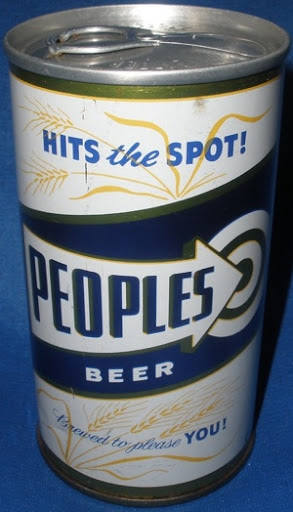
The Oshkosh Brewing Company closed in 1971, but the Chief Oshkosh brand was picked up by Peoples Brewing and survived for another year. Peoples carried on with the same sort of balderdash OBC had resorted to. 


In 1972, Peoples Brewing closed and Chief Oshkosh Beer was left for dead. The end coincided with a rising chorus of protest against the "mascotting" of American Indians and the poaching of their culture to sell things like beer. That didn’t keep Jeff Fulbright from picking up the Chief Oshkosh name and running with it.


Fulbright launched the Mid-Coast Brewing of Oshkosh in 1991. He named his flagship beer Chief Oshkosh Red Lager. Like OBC and Peoples, Fulbright used American Indian imagery that bore no relation to the individual his beer had been named after. But at the same time, Fulbright was careful to point out that his re-imagining of the Chief was meant as a tribute. Sometimes that message got lost. As part of the launch of the brand, Fulbright placed five billboards in and around Oshkosh that brought precisely the sort of attention he was hoping to avoid.


“My idea was to suggest that this was the return of Chief Oshkosh,” Fulbright said. “It's the wording (Indian Uprising) that made it edgy. Those words pissed some people off. I even got letters from a priest of some sort. But the only people who contacted me were white people. That's the sworn truth. No Native Americans complained about it.”

It wasn't the last scrap Fulbright would get into over Chief Oshkosh. In 1993, Fulbright was pulled into the fray when a Minnesota-based group attempted to ban the sale of alcoholic beverages that used American Indian names or related images as part of their brand identity. The group's efforts were eventually rebuffed, but by then Chief Oshkosh Red Lager was no longer an issue. Mid-Coast Brewing ceased operations in 1995.

The Chief was reincarnated again in the summer of 2010 when then Oshkosh Mayor Paul Esslinger put a new name on the tavern he had acquired at 216 North Main Street. 


Esslinger, a longtime collector of breweriana with a focus on memorabilia related to Chief Oshkosh Beer, planned to feature his collection in what was to become the Chief Oshkosh Saloon. The new name would reflect the tavern's motif. That never happened. Shortly before opening, Esslinger dropped the Chief Oshkosh name after concerns were expressed by members of the Menominee Indian Tribe. Instead, Esslinger's tavern became the Old Oshkosh Saloon. Today, that bar is named Screwballs.

The most enduring connection between Chief Oshkosh and beer began in 1911 when the Oshkosh Brewing Company commissioned the Northwestern Terra Cotta Company of Chicago to create an emblem for the front of its new brewery. The completed piece weighed 800 pounds and was more than five feet in width. It was the brewery's original trademark, a faithfully rendered image of Chief Oshkosh. The Chief looked down over Doty Street for the next 75 years.


In 1986, the main facility of the Oshkosh Brewing Company was demolished. Fifteen years of neglect had transformed it into a towering eyesore. The massive Chief Oshkosh emblem was spared. It was taken down and sold at auction.

The dismantling of OBC’s emblem, 1986.

Breweriana collector Paul Winter, who had grown up near the brewery, placed the winning bid of $9,240. He later sold the emblem back to the City of Oshkosh. The city mounted the emblem on the river-facing side of the Oshkosh Convention Center. It remained there until 2008 when the Convention Center was expanded and remodeled.

The emblem then moved to the Oshkosh Public Museum. It resides there in an elevated case near the museum entrance. Below it is a granite plaque inscribed with a brief history of the brewery and its enduring symbol. It’s the last stand of Chief Oshkosh.


Notes and links to further reading.

Much of what's been written about Chief Oshkosh amounts to little more than hearsay. For an accurate portrayal of his life see Scott Cross' book Like a Deer Chased by Dogs: The Life of Chief Oshkosh. Cross is the archivist at the Oshkosh Public Museum.

The Oshkosh Times of June 6, 1888, provides a good example of the city’s 1880s fascination with Chief Oshkosh. 


I didn't address the various claims made that the body reinterred in Oshkosh was not actually that of Chief Oshkosh. I’m skeptical of those claims. This document raises doubts.

The story of Mid-Coast Brewing and Chief Oshkosh Red Lager is here. The fight over the use of American Indian names attached to beer is here.


Thursday, September 20, 2018

Oshkosh Beer Seen #001: Can of the Year!

In 1992, Chief Oshkosh Red Lager won the Brewery Collectibles Club of America’s can of the Year award. Chief Oshkosh Red Lager was produced by the Mid-Coast Brewing Company of Oshkosh from 1991-1994. It was the first American craft beer packaged in cans.


There's much more on Chief Oshkosh Red Lager here.

Oshkosh Beer Seen will be an ongoing series featuring images related to beer and brewing in Oshkosh, Wisconsin.

Monday, December 8, 2014

Chief Oshkosh Red Lager and the Question of Heritage

By 1993, Chief Oshkosh Red Lager was being challenged on all fronts. Leinenkugel's had recently introduced a beer that co-opted the “Red Lager” brand and was using the muscle of its parent company, Miller Brewing, to squeeze the Oshkosh beer off store shelves.

Then came the flap over the name Chief Oshkosh. A Minnesota group had taken offense to the use of Native American names in association with alcohol products. In November 1993, the Milwaukee television station WITI/TV-6 aired a segment on its evening newscast profiling the dispute. In this video we’ll see Jeff Fulbright, president Mid-Coast Brewing, tell his side of the story.


This wasn’t the first time that Fulbright had heard objections about the name of his beer. This time, though, the opposition was more formidable. They were fighting to have the Chief Oshkosh brand invalidated in Minnesota, one of ten states where the beer was distributed. The effort was part of a larger push that centered around Crazy Horse Malt Liquor, made by Hornell Brewing. Those who opposed brewers using American Indian names got their way. In 1994, the Minnesota legislature enacted a statute banning the “misleading” use of such names in connection with alcohol.

The regulation was immediately challenged. In April 1995, Twin Cities Public Television’s NewsNight Minnesota aired a feature on the court case. This segment from the program shows Jeff Fulbright being interviewed at the Pioneer Inn. The video also shows the emblem of the Oshkosh Brewing Company when it was still affixed to an outer wall at the Convention Center.


The Minnesota statute would eventually be overturned, but by then the Chief Oshkosh name was no longer an issue. The last batch of  Chief Oshkosh Red Lager had been brewed in December 1994. Sales of the beer continued through the first half of 1995, but by year’s end Chief Oshkosh Red Lager gone.

For more on Mid-Coast Brewing and Chief Oshkosh Red Lager, visit this earlier post.

Monday, December 1, 2014

The Chief Oshkosh Red Lager Billboards

In the summer of 1991, a beer with a familiar name began appearing around Oshkosh. Chief Oshkosh Red Lager shared no direct connection to the Chief Oshkosh Beer that had been produced by the Oshkosh Brewing Company for nearly 40 years until 1971, but the well-known name made the new beer immediately recognizable to almost everyone in the Oshkosh area. For many of them, their first brush with the new Chief Oshkosh came via a series of billboards featuring a booming declaration of an “Indian Uprising.”

Click to enlarge
Chief Oshkosh Red Lager was produced by Mid-Coast Brewing from 1991 to 1994. The company was based in Oshkosh and brewed its beer on contract at the Stevens Point Brewery. Jeff Fulbright was the president and brewmaster of Mid-Coast. His duties didn’t end there. He generally did everything that needed to be done. That included developing the brewery’s advertising campaigns.

“This was the introduction,” says Fulbright. “I was trying to do a full-blown roll out and have all the media happen at once. I couldn’t afford television advertising, so these billboards were the next best option. I had an advertising company I was working with at the time, but I knew what I wanted and they executed the idea I gave them.”

His concept was blunt. Just a couple of words set in bold type alongside imagery loaded with meaning. Chief Oshkosh Red Lager was the first American craft beer sold in cans and Fulbright knew he needed to dispel the stereotype that canned beer was inferior. The centerpiece of the billboard showed a can of Chief Oshkosh rising up phoenix-like from a pile of smashed beer bottles. The broken bottles bear the labels of what were at the time premium brands: Moosehead, Special Export, Michelob, Killian’s Red, Löwenbräu, and Heineken.

“The subliminal thing here is that we have something better than bottles,” says Fulbright. “I was selling a premium beer in a can.  I was trying to convince people that premium beer could be in a can.”

The imagery was impactful, but what caused a stir were the two words, Indian Uprising. Five billboards went up in the Oshkosh area, four of them along Highway 41 and the other near downtown at the corner of N. Main and Irving. Almost immediately, Fulbright began getting complaints. “Those words pissed some people off,” says Fulbright. “These people were all upset. I even got letters from a priest of some sort. But the only people who contacted me were white people. That's the sworn truth. No Native Americans complained about it.”

Fulbright concedes, though, that the words were more provocative than he intended them to be. “My idea was to suggest that this was the return of Chief Oshkosh,” says Fulbright. “It's the wording that made it edgy. Had I thought about it more I might not have gone along with it.”

After the initial response, Fulbright sought to make his intentions clear. “I contacted the representative body for the heirs to the original Chief Oshkosh,” he says. “I was extending an olive branch and a semi-apology just to say there was nothing offensive intended. If I remember correctly, they told me there wasn't an issue and that they didn't really want to go into it.”

The issue died down soon enough, but it wouldn’t be Fulbright’s last scrape with those who took offense to the use of Native American names and imagery associated with alcohol. In 1994, another flair up would occur. If all goes well, I’ll have more on that next Monday along with some interesting video from the period. Until then, there’s much more about Chief Oshkosh Red Lager here.

Thursday, October 17, 2013

Red & Revived: Get a Taste of Chief Oshkosh Red Lager.

Homebrew Left / Original Right
I like this one a lot. This Saturday, October 19, Oshkosh homebrewer Jody Cleveland will be giving away free samples of his homebrewed version of Chief Oshkosh Red Lager. He’ll tap the keg at Oblio’s Lounge at around 10 a.m. and will keep pouring until 12:30 (or until the beer is gone, whichever comes first). To get your free taste, stop by the Society of Oshkosh Brewers stand (corners of Main and Merritt) during the Farmer’s Market and tell them you want free beer. They’ll hand you a ticket that you can take over to Oblio’s to claim your sample. Free and easy.

And it’s a damned good beer. Last night I met up with Jody and we drank from a couple different batches of Chief Oshkosh Red Lager that he’s brewed. Also in attendance was a full can of 20-year-old Chief Oshkosh Red Lager. Of course, we got into that, too. After all those years in the can, the original Chief Oshkosh Red Lager still tasted pretty good. And though the 20-year-old beer had aged some, the similarities between Jody’s beer and the original remained readily apparent. I guess that’s not too that surprising. The recipe Jody is working from is the same as that used by Jeff Fulbright when he was brewing Chief Oshkosh Red Lager back in the first-half of the 1990s (check out the recipe HERE).

Now if you can’t make in on Saturday, you can still get a taste of the good Chief. Jody will also be serving this beer at Casks & Caskets on Saturday, November 2. Go HERE to get all the news on that.

And to get the full story on Chief Oshkosh Red Lager go HERE.

But most importantly, try to make it to the Farmer’s Market on Saturday and enjoy a rare taste of a remarkable beer.

Monday, August 5, 2013

The Last Gasp of Chief Oshkosh Red Lager

The August issue of the Oshkosh SCENE is out and in it you’ll find my Oshkosh Beer Garden column (it’s also available online). This time it’s about Jeff Fulbright whose Mid-Coast Brewing Company produced Chief Oshkosh Red Lager from 1991-1994.

There is, though, one final piece of the Chief Oshkosh Red Lager story that didn’t fit into the SCENE article and hasn’t been told before. It goes like this...

By the latter half of 1994, Mid-Coast Brewing was in its death throes. A year earlier, the Miller Brewing Company had introduced Leinenkugel’s Red Lager, a beer that Fulbright describes as a “doppelgänger” to his brew. Things had gone downhill ever since. But the problem wasn’t just that the beers tasted similar. Fulbright operated Mid-Coast Brewing as a one-man show on a shoestring budget and he was being trounced by Miller’s massive marketing and distribution chain. “Almost all of my distributors were Miller based and when Leinenkugel’s introduced their Red Lager I was pushed out,” Fulbright says. As Chief Oshkosh Red Lager lost shelf space to its big-brewery double, Fulbright found himself scrambling to keep his brand alive. “I knew that unless I came up with something quick, it was going to be all over with.” he says.

What he came up with was a plan that involved another big Milwaukee brewery. Fulbright decided that he’d try to resurrect the fortunes of his brand by teaming up with a formidable brewery that needed a shot in the arm. “Pabst seemed perfect,” Fulbright says. “They had a great name, but they were old school and they were struggling. I thought I might be able to convince them to update their image with the production of a microbrew.”

It was a solid idea to be sure. By the mid-1990s, Anheuser-Busch, Coors and Miller had all begun to
tap the microbrew market. They had done so by either buying existing brands that had microbrew cachet or by creating special divisions within their companies, such as Blue Moon at Coors, that would be promoted as microbrew. “I went to them (Pabst) and said you're losing share and I’m losing my company,” Fulbright says. “I suggested we start a special division dedicated to microbrews with Chief Oshkosh Red Lager as the flagship beer. They already had some well-known and respected brands like Ballentine that could have worked well with this.”

Pabst was more than interested. “They loved the idea,” Fulbright says. “It was the right thing for them at the right time. They needed something or they were going to keep fading. They were excited about it and I tried not to show how excited I was. At this point I was down to nickels.”

So what happened? Fulbright says the continuing friction between Pabst ownership and its workers flared up again during his talks with the brewery and the plan was shelved. Fulbright didn’t have the means to wait it out. Mid-Coast Brewing had run out of money. The last batch of Chief Oshkosh Red Lager was brewed in December 1994.

But Pabst didn’t forget about the idea of getting in on the microbrew movement. In the summer of 1995, the brewery introduced both a red lager and a red ale. Red Bone Red Lager and Ballentine Twisted Red Ale were near perfect examples of how big beer often failed then - as it often does now - to understand the craft beer segment. Fulbright’s beer would have lent the brewery a measure of credibility in the microbrew market. Instead, Pabst shoved out a couple of mock microbrews. Nobody was fooled. In 1996 the Pabst brewery in Milwaukee closed.

Wednesday, January 26, 2011

Oshkosh and the Dilemma of Canned Beer

Seventy-Six years ago this week, Americans began putting beer in cans. On January 24, 1935 Krueger Brewing of Newark, New Jersey became the first American brewery to can its beer. And by the 1940s, the Oshkosh Brewing Company was doing the same. Oshkosh Brewing was the first brewery in Oshkosh to can a portion of their beer, using cans with cone shaped tops. The protruding top of the can made it possible to fill them using modified bottling equipment and thus save the expense of a separate packing line for their canned beer.

For smaller, regional brewers such as those in Oshkosh, canned beer was something of a menace. It added additional expense to their operation and made it increasingly easier for larger breweries to flood their market with beer. Canned beer maintained its freshness longer and was cheaper to distribute than bottled beer, virtually eliminating the geographical advantages the small breweries relied upon for their survival.

By the 1950s canned beer was omnipresent. The brewers of Oshkosh had to either adapt fully or go under. In 1955 the Oshkosh Brewing Company took the plunge by purchasing a new canning line and converting to the more familiar flat-top can. A year later, The Rahr Brewing Company of Oshkosh, which never made the jump to cans, went out of business. The Peoples Brewing Company of Oshkosh would be a late adopter to canning, holding out until 1963 before introducing its beer in cans. But for the brewers of Oshkosh, canned beer was a losing proposition. In the end, it represented one more competitive advantage that the large beer makers used to drive under small, local breweries like those here.

There is a bright spot to the story of canned beer in Oshkosh, though. In June of 1991, Chief Oshkosh Red Lager by the Mid-Coast Brewing Company of Oshkosh became the first American craft beer packaged in cans. The beer was years ahead of a trend that is only now coming to prominence. There are now more than 100 American craft brewers canning their beer, but when Jeff Fulbright, President of Mid-Coast brewing, started the ball rolling 20 years ago, craft beer in a can was a hard sell. “Back then, the idea that great beer doesn't come in a can hurt me,” Fulbright says.

There were, however, others who appreciated Fulbright’s effort. In 1992 The Beer Can Collectors of America chose the handsome Chief Oshkosh Red Lager can as their can of the year. The beer may be gone, but the can still looks great today.

Tuesday, December 14, 2010

Brewing Chief Oshkosh Red Lager

It’s happening again. The river and lake are choking-up with ice and the snow is mounded in every open space. To the early brewers of Oshkosh, these were heartening signs. It meant the new lager season was here. It was time to start making the cold-fermenting beers they had been trained to brew in their European homeland.

A hundred some years later, there are plenty of area homebrewers still taking their cues from the weather. When the air turns frigid, many of the old basements in Oshkosh hit temperatures in the 50 degree range, perfect for fermenting that good, old lager beer. And here’s a recipe for lager beer that ties all of it together.

Chief Oshkosh Red Lager was a modern beer that recalled the earlier days of brewing in Oshkosh. The last batch of the beer was brewed 16 years ago, in December of 1994, and it’s about time we bring it back. The beer was essentially a Vienna Lager with an interesting twist that made it quite different from the premium lagers of the period. There were no other lagers of the time making such liberal use of Belgian specialty malts, which gave the beer a distinctively rich malt flavor and red hue while maintaining a medium body.

The recipe below is the homebrew version of the beer based upon the final pilot batches Jeff Fullbright brewed at the Siebel Institute in November of 1990. If you want to go all the way with this beer, you’ll need to Krauesen it, but for those of us who don’t adhere to the Reinheitsgebot a basic carbonation of 2.0-2.5 volumes will do just fine. Let’s brew it!

Chief Oshkosh Red Lager

Boil Volume: 7 Gallons
Batch Size: 5 Gallons
Single-step infusion Mash at 152º
60 Minute Boil

OG: 1.048
FG: 1.012
IBU: 19
SRM: 11
ABV: 4.6%

Grain Bill
American Six-row Pale: 5.25 lbs (58.7%)
American Two-row Pale: 3.0 lbs (33.6%)
Belgian CaraMunich: 8 oz (5.6%)
Belgian Special B: 3 oz (2.1%)

Hops
.4 oz Willamette Pellet hops (55 Minute Boil Time)
.2 oz Czech Saaz Pellet hops (55 Minute Boil Time)
.2 oz Willamette Pellet hops (30 Minute Boil Time)
.1 oz Czech Saaz Pellet hops (30 Minute Boil Time)
.2 oz Willamette Pellet hops (At flame out)
.1 oz Czech Saaz Pellet hops (At flame out)

Yeast/Fermentation

Wyeast 2035 North American Lager Yeast
Ferment at 48º-58º
When Primary Fermentation is complete, rack to secondary and lager at 10º cooler than your average fermentation temperature for an addition two-four weeks.

Monday, August 9, 2010

The Chief Oshkosh Red Lager Story

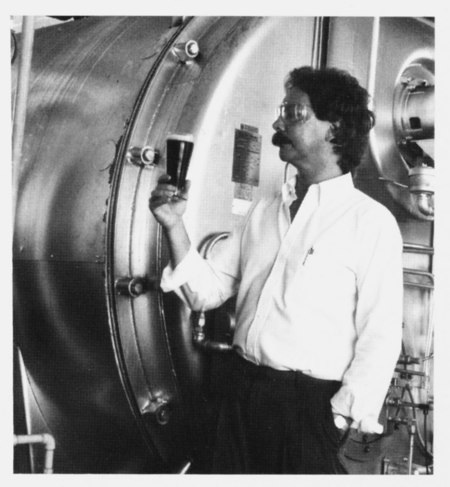
Jeff Fulbright at the Stevens Point Brewery
“Did you know one of America’s great little beers comes from Oshkosh?” That was the lead-in to a magazine advertisement from 1993 for Chief Oshkosh Red Lager. Seventeen years later the beer and the company that produced it are gone, but the man who almost single-handedly returned the name Oshkosh to beer shelves throughout the Midwest is still here and his innovations continue to influence American craft brewing. Jeff Fulbright’s beer was the first American beer to identify itself as a Red Lager, it was the first Craft Beer to be sold in cans and it was the first American beer to use Belgian Cara-Munich malt. Now, almost 20 years after Fulbright began making his beer, Red Lagers are ubiquitous, craft brewers are waking-up to the advantages of canning their beer and nearly every brew-pub and craft brewery in America makes at least some of their beer using the Belgian Malts that Fulbright helped to introduce.

Chief Oshkosh Red Lager was produced for just four years, but its roots run much deeper. As a college student at the University of Wisconsin - Oshkosh in the 1970s, Jeff Fulbright knew about the demise of Chief Oshkosh beer and had a vague notion about reviving the brand. The idea grew more substantial in the mid-80s while Fulbright was working as a restaurateur in Florida. “I saw this thing coming up,” Fulbright said. “I was a drinker of European beer and when the American micro-beer movement started I was immediately attracted to the idea of creating my own beer and selling it to the public.”

Fulbright moved back to Wisconsin and began putting together a business plan for a new brewery based in Oshkosh. As part of his research, he attended the Great American Beer Festival where he had a fortuitous encounter with Jim Koch, founder of the Boston Beer Company and brewer of Samuel Adams beer. Fulbright told Koch of his desire to open a brewery and sell an updated version of Chief Oshkosh beer. Koch’s response set the course for what would become the Mid-Coast Brewing Company of Oshkosh. Koch advised Fulbright to forget about building his own brewery. The market already had too much capacity. He told Fulbright he’d have a better shot if he made his beer at someone else's brewery. Koch also suggested that Fulbright go back to school and learn first-hand what it takes to make great beer. Fulbright took the advice to heart. He enrolled at the Siebel Institute and began his training as a brewer.

When he arrived at Siebel, Fulbright had a solid idea of the beer he wanted to make. “My favorite style of beer at the time was Oktoberfest,” Fulbright says. “I wanted to do a toned-down version of an Oktoberfest that people could drink throughout the year.” Fulbright also wanted his own stamp on the beer. He began experimenting with specialty malts from Belgium. These malts were largely unknown to American brewers at the time, but the Siebel Institute had recently begun importing them for testing. Eventually Fulbright settled on a Belgian Cara-Munich malt that gave the beer its sweet, malty character and distinctive “red” hue. Fulbright says he’d love to claim all the credit for developing the beer, but admits that he was still learning about brewing as he worked-up the recipe. Much of what he learned came from David S. Ryder, who went on to become the Brewmaster for Miller Brewing, but was then an instructor at Siebel. “Ryder was a brilliant brewer,” Fulbright says, “and he had a good idea of what I wanted to brew.” With the help of Ryder, Fulbright honed the recipe by brewing a series of 10-gallon batches. “The beer was born at Seibel,” Fulbright says.

Fulbright graduated from the Siebel Institute in 1989. Now he had to find a place to brew. The obvious choice was the old Stevens Point Brewery just 70 miles northwest of Oshkosh. In 1990 The the 133-year-old Point Brewery was fighting for its life. It struggled to maintain the relevancy of its signature lager in a complex marketplace dominated by corporate behemoths and a slew of attention grabbing upstarts making trendy micro-brews. But the brewery had an adventurous Brewmaster named John Zappa and Fulbright’s plan for making a craft beer that recalled the glory days of Wisconsin brewing appealed to him. Fulbright made his final pilot brew of Chief Oshkosh Red Lager on November 21, 1990 at Siebel and submitted the recipe to Zappa. The following spring, they began to brew.

Making Fulbright’s idea a reality wasn’t cheap and it wasn’t easy. All of his resources were funneled into the production of the beer. “At first, I had to pay for everything upfront," Fulbright says. "I spent thousands getting it started.” In May of 1991, Fulbright and Zappa began brewing the beer in 100 barrel batches, each of them learning along the way. For Fulbright, large-scale production brewing was an altogether new experience while the brewers at Point had to adapt to imported malts and hops that the brewery hadn’t used before. Fulbright says he always oversaw the brewing of his beer. “I spent a lot of time up in Point and got to know John Zappa. I always considered his ideas, but he knew this was my beer. It was my formula.”

In June of 1991 Chief Oshkosh Red Lager hit the market. The first public tasting of the beer was held on Wednesday, June 19th at the Oshkosh Hilton. About 45 people were on hand to try the new beer and the following morning the Oshkosh Northwestern ran a photograph taken at the event showing Fulbright and Zappa joining in a toast with Fulbright's brewing mentor David S. Ryder. America's first Red Lager was born.

Initially the beer was sold only in cans. Mid-Coast Brewing was strapped for cash and cans were the least expensive packaging option, but Fulbright saw it as an opportunity. Early ads for the beer make a point of the fact that it was the only American all-malt beer to be packaged this way and asserted that cans offered better protection for the beer and were more environmentally friendly. Fulbright's ad copy from the period was prescient. Fifteen years later, the idea of craft beer in cans began to catch on and brewers now typically promote their canned beer using language that closely echos Fulbright's early arguments. But Fulbright may have been a little too far ahead of his time. Canned beer had a down-scale image in 1991. Trying to convince drinkers of premium beer that cans were the best way to preserve quality was a tough sell. “The idea that great beer doesn't come in a can hurt me,” Fulbright says.

In spite of that, the beer did well. The original retailers were clustered in Winnebago, Outagamie and Fond du Lac Counties and at $3.99 a six-pack it was pitched as a high-end beer at an affordable price. Six months after the beer was introduced Fulbright told the Milwaukee Journal, “We sold in three counties what we thought we’d sell in 13.” In addition to store sales the beer went on tap in a number of bars in Oshkosh including Oblio’s, the B & B Tap and the Pioneer Inn. It wasn’t always easy getting some of the older taverns in Oshkosh to take on the beer. “I went to all the taverns in town,” Fulbright says. “I’d go in and have some old-geezer tavern owner yelling at me ‘I can’t sell that dark shit!’”

As sales increased so did the beer’s recognition. Reviews of the Red Lager were mostly favorable with several noted beer writers weighing in. Michael Jackson, author of the New World Guide to Beer and the leading beer writer of his time, praised the beer for its “unapologetic, robust sweetness” and its “delicate hint of hop.” Homebrew guru and editor of Zymurgy Magazine, Charlie Papazian called it “a pleasantly great beer” and Mike Bosak, editor of All About Beer Magazine, wrote that the beer was “just delightful.” Beer aficionados weren’t the only people taking note. A number of breweries and brew-pubs glommed onto Fulbright’s idea and within a year of Chief Oshkosh Red Lager’s introduction there were more than a dozen other Red Lagers being sold in America.
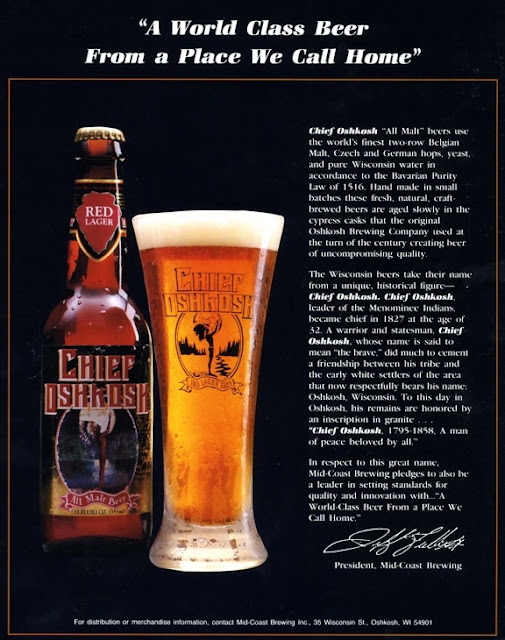
Meanwhile, Fulbright continued to push his beer. In early 1992 he struck a deal with Beer Capitol Distributing who brought the beer into Milwaukee. The beer was now being sold throughout the state and in June of 1992 became available in bottles. Fulbright used the National Micro-and Pubbrewers Conference that year to introduce his new bottle saying “The new package will properly establish the correct, quality image for this hand-crafted, all-malt beer.” With production ramped up to 2,000 barrels for the year, Fulbright had his work cut out for him. From the start, Mid-Coast Brewing was a one-man operation and Fulbright liked it that way. He did all the promotion, took care of the accounts, oversaw the brewing and negotiated his own distribution agreements. “I was a one man band,” Fulbright says. You can see his mark on everything identified with Mid-Coast Brewing. Newspaper and magazine ads for the beer were written by Fulbright and they stood in stark contrast to the promotions of other brewers. The ads were serious and wordy and usually tagged with Fulbright’s signature. The back of the cans and bottles featured a detailed description of the beer and its connection to the history of brewing in Oshkosh along with Fulbright’s invitation to try his beer. Fulbright had carved out an identity for his beer that was as much his own as that of the history his beer referenced.

By 1993 Chief Oshkosh Red Lager was poised to become one of the nation’s most well-known micro-brews. In January, Fulbright made an agreement with Western International Imports of Chicago to market his beer nationally. Fulbright said at the time, "This partnership will give Chief Oshkosh the kind of backing that should make this beer a major player in the microbeer segment.” Western International wanted a Midwestern micro-brew that they could make big and planned to position Fulbright’s beer as the Midwestern equivalent of Samuel Adams Boston Lager. They launched an ambitious campaign to distribute the beer and within months, Chief Oshkosh Red Lager became the most widely distributed beer ever to be based in Oshkosh. But the new partnership made it necessary for Fulbright to relinquish control over the distribution of his beer. The agreement allowed Western International to order beer directly from the Point brewery and Fulbright soon found it difficult to keep up with the additional expenses associated with the increased production needed to fill the orders.

It wasn't just money woes Fulbright was forced to contend with. In 1992 David S. Ryder, the Siebel instructor who had helped Fulbright develop his beer, went to work for Miller Brewing. A year later, Miller subsidiary Leinenkugel Brewing brought out a Red Lager that was extraordinarily similar to the beer Fulbright was making. "You could hardly tell the difference between the two beers," Fulbright says. Worse yet, Leinenkugel had access to Miller's massive distribution network. The squeeze was on.
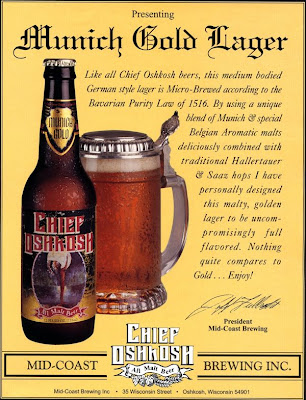
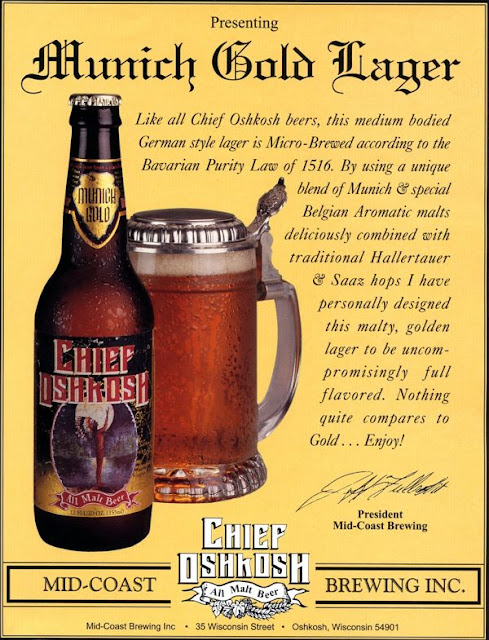
Fulbright battled back by trying to expand the Mid-Coast portfolio. He planned for a series of draught-only beers that would include an Oatmeal Stout, a Dopplebock and a Bavarian Dunkel and in late 1993 he began brewing Munich Gold, a German Helles beer. "I really liked the Munich Gold," Fulbright says. "I really thought it was a good beer and a last shot at expansion. It was a last ditch effort to keep the brand alive." And though Chief Oshkosh Red Lager continued to gain acceptance, winning a silver medal at the 1994 World Beer Championships, market pressure grew more intense. Leinenkugel's Red Lager was now being sold throughout the United States and Fulbright was finding it increasingly difficult to compete. "When Leinenkugel's moved in, my distributors lost interest in my beer," Fulbright says. "We started getting killed. It was a tsunami."
The competition proved to be too much. By late 1994 Mid-Coast Brewing had exhausted its capital and though Fulbright continued to fight, the battle was essentially over. "Basically we ran out of money," Fulbright says. "I tried to be as aggressive as possible with no money, but we were in our death throes. It was a struggle against big business. The big guy won. We didn’t stand a chance."

On December 30, 1994 the last batch of Chief Oshkosh Red Lager was brewed. It was a 200 barrel brew and sales of that beer continued on through the first half of 1995. Then it was gone. And with it went Fulbright's hope of one day building a new brewery for his beer in Oshkosh.

Still, it was an incredible experience for Fulbright and if he's bitter about how it all came out, he certainly doesn't show it. If he has a regret it appears to be this: "I only wish more people knew how much effort went into it. This thing wasn’t as simplistic as most people think it was. This wasn't just some contract beer. I stuck everything I had into it. There was real effort and real thought put into making a good beer. I gave it everything."