Showing posts with label Oshkosh Beer Recipes. Show all posts

Tuesday, April 16, 2024

Oshkosh Classics: The Story of Our City’s Beer in 12 Recipes

Here's the story of our beer culture told through recipes that span 175 years of brewing in Oshkosh.


Oshkosh Classics is a 32-page, magazine-sized booklet with full-color illustrations throughout. Beer recipes are the core of the booklet, but anyone with an interest in Oshkosh brewing history or the city’s social history will find it interesting. The story goes beyond beer. It’s about community.


Oshkosh Classics has been a long time coming. I began searching for recipes from old Oshkosh breweries about a dozen years ago. My sole intention was to replicate what were then lost Oshkosh beers. As I found recipes, I scaled them to homebrew batch size and got brewing. I wasn’t too surprised to find that some of the old recipes produced great beers. After all, people in Oshkosh once loved these beers.

Rolling another barrel of Gambrinus Brewery Beer into an Oshkosh saloon in the early 1890s. A recipe for the brewery’s black lager is included in Oshkosh Classics.

As it often is with homebrewers, I had a strong impulse to share what I was doing. It was easy finding people who understood my obsession. I’ve been a member of the Society of Oshkosh Brewers homebrew club since 2010. This kind of thing is what the SOBs are all about.

In the spring of 2023, I suggested to the club’s board that we collect these recipes into a booklet. And off we went. I spent most of this past winter writing and designing the booklet, and thanks to SOB Rob Bearwald, we were able to have it professionally bound and printed on quality paper. Our humble, little beer book turned out better than any of us could have expected.

Some SOBs checking out their copies of Oshkosh Classics. Photos courtesy of Staci Saunders.

The SOBs’ release party for Oshkosh Classics will be at Bare Bones Brewery on Saturday, April 20, beginning at noon. In addition to the booklet release, SOB members will be sharing free samples of homebrew made from recipes included in the booklet.

Here’s a bonus: that same day, Bare Bones Brewery will release Peoples Bock made from the original recipe used at Peoples Brewing of Oshkosh in the 1950s and 1960s. Peoples Bock will be available on draft and in collectible cans.


There are only 300 copies of Oshkosh Classics, and I doubt that more will be printed. The SOBs are a non-profit organization and printing something like this is quite expensive. But the club wanted to keep the price of the booklet as low as possible. So, individual copies of Oshkosh Classics will be sold for $5 when purchased directly from a club member.

If you can’t make the release party at Bare Bones, here are a couple of other options…

Saturday, April 27
I’ll have copies of Oshkosh Classics for sale at the B'Gosh It's Good Breweriana Show from noon until 4pm.

Saturday, May 4
The SOBs will host their annual Big Brew behind the The Cellar brew shop at 465 N. Washburn from 9am until noon. This is always a fun, public event with lots of brewing, and food from the Ginger German food truck. This year, we’ll have a stack of Oshkosh Classics with us.

All of us SOBs hope to see you at one of these events. Prost!

Sunday, April 25, 2021

Paine’s Lumberyard Pilsner

Long before the Fox River Brewing Company was there, the sawmill for the Paine Lumber Company held that spot on the river near the Oshkosh/Congress Avenue bridge.


Fox River Brewing opened on that parcel in 1995.

Fox River Brewing, circa 1996.

The first beer made there was named Paine’s Lumberyard Pilsner. It was brewed on Saturday, November 18, 1995. It was also the first beer made by a commercial brewery in Oshkosh in 23 years.


The brewers who made that beer were Al Bunde and Rob LoBreglio. Bunde would be the head brewer at Fox River for the next two years. LoBreglio, who had co-founded Great Dane Pub & Brewing Company in Madison, was there as a consultant.

Paine’s Lumberyard Pilsner was a part of Fox River’s core line-up until 2003. It has appeared as a seasonal offering many times since. The recipe has gone through a number of permutations; changing with every Fox River brewer putting their own slant on it.

Here's the original recipe. This first batch of Paine’s Lumberyard Pilsner went on tap at Fox River on Friday, December 15, 1995.


Paine’s Lumberyard Pilsner

Original Gravity: 1.048
Final Gravity: 1.009
ABV: 5.1
IBUs: 20-25
SRM: 5.22

Malt
93% Briess Brewers Malt 2-row
3.5% Briess Caramel Malt - 40L
3.5% Briess Carapils

Mash: 40 minutes at 157
Sparge: 95 minutes with temp rising to 171 during the sparge
Water: Untreated, City of Oshkosh municipal water.

Boil Time: 90 minutes

Hops
Czech Saaz: 90 minute boil for 12 IBUs
Czech Saaz: 10 minute boil for 6 IBUs
Czech Saaz: whirlpool addition for 4 IBUs

Yeast
Wyeast 2278 Czech Pils

Ferment at 50f for 17 days
Lower Temperature to 35 and rest for 7 days
Transfer to serving vessel.

For a deeper dive on the history of Fox River Brewing...
A full history of the brewery can be found here.
And a full history of the brewery’s beer production can be found here.

Sunday, January 10, 2021

The Story of Peoples Bock and How to Brew Your Own

We're a couple of months out from what used to be the traditional season for bock beer in Oshkosh. So now would be a good time to start brewing a bock of your own. I've got just the recipe for you.


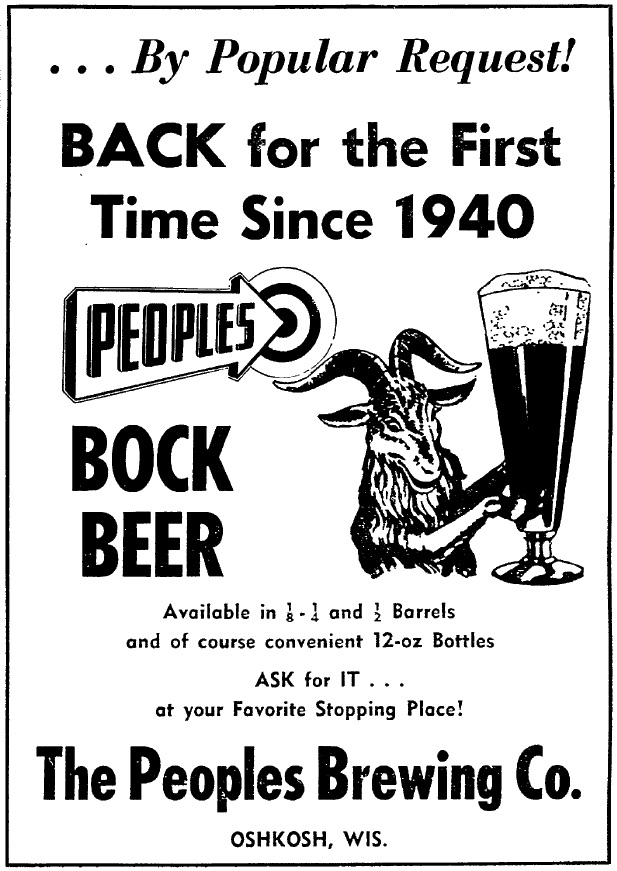
Peoples Bock was first brewed in Oshkosh in 1913 for the 1914 bock-beer season. When Prohibition arrived in 1920, Peoples Bock went on hiatus but it came back again when 3.2% ABW beer was legalized in 1933.

The low-alcohol Peoples Bock of 1933.

Full repeal of Prohibition arrived in December of 1933. The following year, Peoples returned to brewing its full-strength Bock. The post-prohibition Peoples Bock was discontinued for a period beginning in 1941. However, the brewery brought it back again in 1959 and continued brewing it until 1970. The brewery closed in 1972.

Oshkosh Daily Northwestern; February 20, 1959.

My late friend Wilhelm Kohlhoff brewed Peoples Bock every year from 1959 onward. I first met Wilhelm in September of 2018. He was 91 years old then and still had the ability to recite from memory the recipes he had brewed at Peoples more than 50 years earlier. He loved talking about beer. And we did plenty of that as we went through the old notes that he had kept from his days working at the brewery. Wilhelm passed in May of 2019.

I was thinking of Wilhelm the other day and decided now would be a good time to share one of the recipes he gave me. This is the 1960s recipe for Peoples Bock.

Peoples Bock
Pre-Boil Gravity: 1.047
Post-Boil Gravity: 1.058
Final Gravity: 1.016
Apparent Attenuation: 67%
ABV: 5.5 - 6%
IBUs: 22
SRM: 11-12

Fermentables
44% American 6-Row or 2-Row Pale Malt
22% American Munich Malt (6-10º Lovibond)
8% Caramel Munich Malt (60º Lovibond)
14% Flaked Corn
12% Brown Sugar

Hops
60 Minutes Before End of Boil: American Cluster for 11 IBUs
45 Minutes Before End of Boil: German Hallertau for 6 IBUs
30 Minutes Before End of Boil: German Hallertau for 3 IBUs
15 Minutes Before End of Boil: German Hallertau for 2 IBUs

Yeast & Fermentation
Use a clean fermenting lager strain such as SafLager W-34/70.
Pitch at 50ºf and let rise to 53ºf (see the notes below if you don’t have the ability to maintain these temperatures).

A recently opened bottle of Peoples Bock that was brewed in the late 1960s.

Process and Recipe Notes
Peoples Bock was made using a cereal mash coupled with a step mash. It’s a fairly complicated process that I’ve documented here. Don’t let that put you off. This beer can be made with a simple infusion mash at 152ºf.

In the recipe here I’ve replaced the corn grits used at Peoples with flaked corn. If you're willing to go through the pain of a cereal mash, then corn grits is the way to go. If not, flaked corn works just fine.

At Peoples, they followed a standard, cold fermentation for their lagers – fermenting at about 50ºf for 14 days before cold crashing the beer to near freezing. The bock beer was typically aged for two months; sometimes longer if they could afford to tie up their tanks. Again, don't let that stop you from brewing this. I mentioned SafLager W-34/70 in the recipe because that yeast performs well into the mid-60ºf territory. That's the yeast to go for, if you don't have the ability to ferment at those colder temperatures.

I’ve brewed this recipe a couple of times now. I prefer my bocks a little bit darker, so for my most recent batch I tweaked the original recipe by adding 1% black malt to the grist to boost the color. The flavor contribution of the black malt at this percentage is negligible. The beer turned out wonderfully.


I like to think Wilhelm would approve. Prost, my friend!

Sunday, March 17, 2019

When Wilhelm Kohlhoff Brewed Peoples Beer

Wilhelm Kohlhoff worked as a brewer at Peoples Brewing Company in Oshkosh from 1953 until 1968. This wasn't his first brewing job. Kohlhoff had come to Oshkosh from Germany where he worked at a small brewery in Stettfeld, Bavaria (more on Kohlhoff's background can be found here). The brewery in Stettfeld was nothing like what he encountered at Peoples. "Oh yeah, that was all different," Kohlhoff says shaking his head. "All different."

When Kohlhoff arrived in Oshkosh, Peoples was at its peak. The brewery's production had climbed to 35,000 barrels of beer annually. Kohlhoff became one of 41 full-time employees at Peoples. He was assigned to the brewhouse where his job was to see Peoples Beer through the first phase of production culminating in the delivery of wort to the beer cellars for fermentation.

Wilhelm Kohlhoff in the 1950s

Kohlhoff is now 91 years old. He still recalls details of the brewing process he followed at Peoples. He also still has the original, handwritten notes he made when he first went to work in the brewhouse. They form a step-by-step, minute-by-minute outline of his brew day. The notes are written in a mix of German and English and give temperatures in degrees Réaumur, a unit of measure favored by many brewers of the period.


The brewing process at Peoples was defined by the brewery itself. Built in 1913, it was a prototypical,  four-story, lager brewery with a detached bottling house. This was a gravity- or tower-style brewery. Gravity was a prime mover of solids and liquids through the system. Kohlhoff worked his way, from top to bottom, thousands of times. "Yeah, I know the whole building through and through," he says looking at a picture of the brewery that was demolished in 1974.

Peoples Brewing Company after it had closed in 1972.

Most of the raw materials that went into Peoples Beer were stored at or near the top of the brewery. They flowed down through the brewhouse being transformed along the way into wort, the sweet liquid that is fermented into beer.

The substrate was water that came from a 530-foot artesian well drilled at the brewery in 1949. "Before that, they had a well that was 300-feet deep and that was not perfect or not soft enough," Kohlhoff says. "Then they drilled another 200-feet deeper and then that water was perfect."

The water was pumped from the well up into a massive holding tank housed in a cupola above the brewhouse. From there, it was drained – as needed – into the hot-liquor tank on the fourth floor. There it would be heated prior to the start of brewing.

The cupola atop the brewery where the main water reservoir was housed. 

The recipe for Peoples Beer was classically simple. A 100-barrel batch required...
  • 3,200 pounds malted barley (73% of Grist)
  • 1,200 pounds corn grits (27% of Grist)
  • 50-65 pounds of American and German hops (0.5 to 0.625 pounds of hops per barrel)

Malted, six-row barley came from the Fleischmann Malting plant in Red Wing, Minnesota. It was sent to Oshkosh by train. A rail spur ran between the brewhouse and bottling house. The malt would go from the rail car into an elevator on the south side of the brewhouse and then up to the malt hopper on the fourth floor. The map below is from 1956 and shows the location of the rail spur that served the brewery.


The yellow highlights a rail car making a delivery to the brewery.
In the 1950s, nearly all American beer was made from a grist that included some form of either corn or rice.  At Peoples, they used corn grits and the American double-mash method, mashing the grits with 300 pounds of malt in 15 barrels of water. The malt was necessary to provide enzymes needed to convert the corn's starches into fermentable sugars. This cereal mash was performed in a steam-heated cooker fitted with rakes stirring the grist together as it slowly came to a boil. With that set in motion, Kohlhoff would head downstairs to the second floor where the primary mash tun resided.

Diagram of a typical cereal cooker.

The main mash began with an infusion of 2,900 pounds of malt in 30 barrels of hot water. The mash would settle in at 104ºF and rest at that temperature for 15 minutes. The mash tun was also fitted with a steam jacket and stirring rakes. After the rest, Kohlhoff would start the rakes and gradually raise the temperature to 140ºF for another 20-25 minutes. During this time, he would begin recirculating the wort through the mash to help draw out fermentable sugars and create a more uniform environment within the porridge-like mass of water and malt.


A mash tun similar to that used at Peoples.

About 90 minutes into the main mash, Kohlhoff would drop the now boiling contents of the cereal cooker into the main mash bringing its temperature up to 155ºF. He'd then allow the mash to rest for approximately 20 minutes before adding additional hot water and starting the lautering process. This separated the wort from the bed of spent grain and grits, which would later be taken by farmers in the area for use as livestock feed. The wort was run off through a grant, a smaller vessel that helped buffer the flow of liquid into the boil kettle.

The copper boil kettle was perched between the first and second floors of the brewhouse. It was steam-heated and had a 130-barrel capacity. Kohlhoff would add hops to the kettle as the wort was flowing into it and coming to boil. This technique, known as first-wort hopping, was a fairly common practice in American breweries before Prohibition, but much less utilized in the 1950s. Some brewers believed it helped to create a more complex hop-flavor and a less biting bitterness.


A small dose of salt (NaCl) was added to the kettle along with the first addition of hops. The salt was to help blunt bitterness while enhancing mouthfeel and the sensation of sweetness in the finished beer. They did the same thing across town at Rahr Brewing. Both breweries leaned towards the mellower, malty side with their beers. Despite that malt-driven flavor profile, hops were still a major consideration at Peoples.

When Kohlhoff speaks of hops he does so in terms of place of origin instead of breed. "We used German hops and American hops," Kohlhoff says. "Seventy percent of it was German."  That probably means Peoples was brewed with German Hallertau and American Cluster. In the 1950s, these were the most commonly derived hops from their respective countries. They were whole-flower hops stored in bales in a second-floor cold room directly behind the brewhouse.

Kohlhoff vaguely recalls that American hops were used for the first-wort addition. He doesn't remember the exact amount. He estimates it would have been about 15-20 pounds. After the wort had been boiling for an hour, a similar sized load of German hops was added. That was followed by two, smaller additions of German hops. Kohlhoff's thumbnail sketch of the hop schedule for the 105-minute boil comes out like so...
  • American Hops (~15 pounds) – First-Wort Addition.
  • German Hops (~15 pounds) –  Boiled for 45 minutes.
  • German Hops (~10 pounds) –  Boiled for 30 minutes.
  • German Hops (~10 pounds) –  Boiled for 15 minutes.

At the end of the boil, the wort was drained from the kettle and through a hop jack, a straining device to remove spent hops from the wort.

The flow of wort through the brewhouse from the cooker to the hop jack.

From the hop jack, the wort was pumped up to a collection tank on the fourth floor. From there it drained to the heat exchanger for cooling. Kohlhoff's description of the cooling process suggests Peoples used a Baudelot-type chiller with the hot wort cascading over a rack of refrigerated pipes. This quickly reduced the wort temperature to below 50ºF.

 A Baudelot-type chiller.

Kohlhoff’s job was done, but he wasn't shielded from the remainder of the process. Though the brewhouse was his primary concern, he sometimes helped out in other areas of the brewery. "Certain things you had to know, and not just be a brewer," he says.

The wort Kohlhoff made was bound for the cellars for fermentation and conditioning. The "cellars" were in the north half of the brewery on the second and third floors. The red line dividing the image below runs between the brewhouse on the right and the cellars and stock house on the left.


Peoples Beer was a lager beer. It underwent a cold, primary fermentation lasting eight to ten days at 47ºF. When Kohlhoff began working at Peoples the brewery was still in the process of replacing its old, wooden fermentation tubs with glass-lined, steel tanks. I asked him if that change impacted the flavor of the beer. Kohlhoff said, "No, I wouldn't say the flavor, it was a little more clean and a little bit different, yeah."

Kohlhoff would take his first sample of the beer near the end of fermentation. "We'd go in the cellar at 6 days or 7 days," he says. "There was a little valve on the tank where you'd take some off and see how clear it is and how it all tastes." Kohlhoff says everyone at the brewery regularly sampled the product they were making. "We always had a barrel of beer that was right there. All the guys working in the brewery were drinking that free beer."

From the fermenters, the beer would go into the aging tanks in the "Ruh" cellar for several weeks of cold conditioning (lagering). Here the beer would clear and the flavor would develop into something more refined. Kohlhoff doesn't remember the specific duration of the lagering process only that in the summer demand would sometimes have them turning out beer more rapidly than usual. Most lager breweries of this period aged their beer anywhere from three weeks to two months before packaging it.

Detail from a 1953 ad for "fully aged" Peoples Beer

After lagering, the beer was filtered and carbonated. At Peoples, they used a gas collection system to capture CO2 produced during carbonation. The CO2 was then forced back into the finished beer at 2.87-2.89 volumes, which would be at the high end of carbonation for an American lager.

The final product was pale, and medium-bodied, with a mildly sweet malt flavor. An analysis of the beer done by the J.E. Siebel Company in April 1971 may shed more light on the beer's exact properties. Though the report comes three years after Kohlhoff left Peoples, he maintains that the beer changed little if any during the intervening years. After leaving the brewery, Kohlhoff remained in Oshkosh and continued drinking Peoples Beer. He also remained in contact with former co-workers at the brewery. He believes they would have mentioned changes made to the recipe or brewing process. With that in mind, here's part of the 1971 analysis:

Clarity: Brilliant
Color: 3.4 SRM
ABV: 4.62%
IBUs: 18
Apparent Degree of Attenuation: 76.6
Real Degree of Attenuation: 62%
Original Extract: 11.34 (1.046)
Specific Gravity: 1.01035
A note attached to the report remarks, "The sample makes an exceedingly good impression in almost every respect."

Peoples Beer was packaged in kegs, bottles, and cans. The kegged beer was unpasteurized and the kegs were filled in the racking room built specifically to suit that purpose in 1948. This was on the north side of the facility directly behind the cellars and stock house. A portion of the racking and keg-washing rooms remains near the corner of East 15th and South Main streets. Kegs going into trucks for distribution to taverns were loaded off here. Peoples had a fleet of eight trucks delivering beer within a 60-mile radius of Oshkosh.


When Kohlhoff began working at Peoples, the brewery was just beginning its transition to steel kegs from wooden kegs. The wooden kegs were lined with pitch to protect the beer inside from bacteria and wild yeast that might lurk in the raw wood. Here's one of those wooden kegs of Peoples Beer in action at a 1950s house party in Oshkosh.

Photo courtesy of Dennis Hunt.

Beer for bottling and canning was delivered through a pipe running from the racking room to the bottling house. The detached bottling house was a hangover from the years before Prohibition when it was mandated by law that a bottling facility had to be distinct and separate from the brewhouse. The Peoples bottle house is the only piece of the original, 1913 construction that remains intact. It has been incorporated into the Blended Waxes building 1512 South Main.

The former bottling house of Peoples Brewing.

The Peoples bottling plant had undergone a series of substantial upgrades beginning in the 1940s. By the mid-1950s, the brewery had the capacity to fill 50,000 bottles a day. All of the bottled and canned beer was passed through a pasteurizer before being packed in cases. Oshkosh customers often purchased beer by the case off the back dock behind the bottle house.

The loading dock behind the bottling house.

The Seasonal Beers
When Kohlhoff was hired at Peoples, the brewery produced just two beers: the year-round Peoples Beer; and a winter-seasonal named Holiday Beer that was released just before Thanksgiving each year.


Kohlhoff says the recipe for Holiday Beer was similar to Peoples Beer with a couple of additions making the difference. Holiday Beer was brewed to be darker and stronger, with an ABV of just over 5.5%. About the recipe he says, "That was the same beer, but like I said we added all the special malt; it was darker, it was a brown color malt, and then what you used was brown sugar, 600 pounds of sugar in the kettle and that makes the beer a different color, too."

The addition of brown sugar surprised me. I haven't come across other references to lager brewers using it during this period. When I questioned him further, Kohlhoff said there was nothing unique about it, that it was ordinary brown sugar. The "special malt" was a dark Munich malt. Peoples often made mention of Munich malt in its advertising for Holiday Beer.

December 12, 1953; Oshkosh Daily Northwestern.

Both before and after Prohibition, Peoples had produced a bock beer that went on the market in either late-February or early-March. Peoples Bock was discontinued after the 1940 release and then reintroduced in February 1959. It appears the reintroduction had more to do with branding than anything else. Kohlhoff recalls that the recipes for Peoples Bock and Peoples Holiday Beer were identical.

February 20, 1959; Oshkosh Daily Northwestern.

The seasonal beers may have been special, but the beer that still holds a place in Kohlhoff's heart is Peoples Beer, the beer he made day in, day out for 15 years. "That was quite a job," he says. "That brewery was in number one shape. We had everything right on the clock. Everything. Peoples, that was a good beer."

Wilhelm Kohlhoff.

Monday, October 5, 2015

The Story of Rahr's Elk's Head Beer and How to Brew Your Own

Elk's Head Beer was considered by many in Oshkosh the finest beer made in the city. Some of that fondness may have been born of nostalgia. In 1956, The Rahr Brewing Company became the first of the Oshkosh breweries to close after Prohibition. People here mourned the loss of Oshkosh's last family owned brewery. When it was gone, Elk's Head beer was missed.

But the reputation of Elk's Head didn't hang on nostalgia alone. This beer was different from others brewed here. When Prohibition ended in 1933, the beers of both the Oshkosh Brewing Company and Peoples Brewing Company, became lighter in body and color as the years wore on. The Rahr's resisted that change by brewing the same beer after Prohibition as they had before it. Elk's Head was the old timers favorite.


The Birth of Elk's Head Beer
The Rahr's began releasing their beer under the Elk's Head label in the summer of 1916. Previously, the beer had been known as Rahr's Special Brew. The change followed a tumultuous period for the brewery. In 1914, the Rahr's had begun construction of a new bottling plant on the brewery's grounds. At the time, Rahr beer was being bottled at a facility owned and operated by brothers Fred and Ludwig Neumueller across the street from the brewery. But brewery owner Charlie Rahr had grown dissatisfied with the arrangement and the packaged beer coming out of the Neumueller's plant.

By 1915, the Rahr's had taken their bottling in house. The following year they renamed their beer Elk's Head. It doesn't appear that the beer itself had actually changed. Advertising from the period doesn't indicate that the recipe was reformulated or that brewing methods had been altered to produce a new type of beer. Instead, it seems that the new name was used to further distinguish the beer now bottled on premise from that bottled by the  Neumueller's.

After Prohibition began in 1920, the Rahr's continued to use the Elk's Head brand. But now it was being applied to the various sodas the brewery produced during the dry years. That ended with Prohibition's end in 1933. Rahr's beer was once again packaged under the Elk's Head label.

Though the Rahr brewery closed in 1956, the Elk's Head brand perished earlier. By 1952, the Elk's Head label was being phased out in favor of new branding. It was now being labeled as Rahr's Pale Beer, an attempt to update the perception of the beer. Again, it appears the beer inside the bottle went unchanged. Charles Rahr III, the last brewmaster at Rahr Brewing told me that Rahr beer continued to be brewed using the same recipe that had been used prior to Prohibition.

The Rahr Recipe
This recipe for Elk's Head Beer was given to me by a collector of Oshkosh memorabilia who would prefer not to be named. In 2011, I met with Charles Rahr III and showed him the recipe. He confirmed that this was the one used at the brewery to make Elk's Head Beer. Though detailed in many respects, there are still a couple of missing pieces here. I'll get to those, but first here's what is contained in the recipe. The percentages are my own.

Grain Bill
Malt (6-row): 3850 Lbs. (76.47 %)
Flakes (Corn): 1040 Lbs. (20.65 %)
Caramel Malt: 10  Lbs. (0.0019 %)
Black Malt: 9  Lbs. (0.0017 %)
Maltodextrin: 125 Lbs. (0.024 %)
Total: 5034 Lbs.

Hops
53 Lbs.

Other Materials
NaCl (Sodium chloride) 10 Lbs.
Irish Moss 4 Lbs.

Equipment
During much of the time that this beer was being produced, Rahr Brewing used a 135 barrel mash tun with a copper boil kettle corresponding in size.

Mashing
The recipe shows a two-hour mash schedule with four rests. The temperatures are written in degrees Réaumur, a scale often favored by German brewers. I've converted the temperatures to fahrenheit.

1) 108.5 °F for 60 minutes
followed by a ten minute ramp to
2) 149 °F for 10 minutes
followed by a five minute ramp to
3) 158 °F for 25 minutes
followed by a five minute ramp to
4) 169.25 °F for 15 minutes
Recirculate and run into kettle.

Boiling
The boil lasted an incredible 4 hours. It began while the wort was being collected. Runoff was completed 2.5 hours into the boil. The full-kettle boil lasted 1.5 hours.
The maltodexrin was added to the kettle as the wort was being collected, at a point when the kettle was nearly full.
The first hops were added 55 minutes before the end of the boil.
Ten minutes before the end of the boil, a second addition of hops were added along with the NaCl and Irish Moss.

What's missing here are the type of hops used and the basic brewing parameters, including wort gravities, final gravity and alcohol percentage. The The International Bittering Units scale had yet to be developed when the Rahr's were brewing this beer, so that of course is not available. None of these missing pieces though are insurmountable. There's enough information concerning the brewery and its practices to fill in these blanks with a reasonable degree of surety.

Hops: I have not seen a single instance where the Rahr's mention the use of a specific type of hop in their advertising. That's telling. The Rahr's advertised their beer fairly heavily. Their use of traditional methods and ingredients were often featured in these ads. Most breweries using European hops – including Peoples Brewing and the Oshkosh Brewing Company – made a point of advertising their use of the more expensive ingredient. The fact that the Rahrs didn't make such claims leads me to believe the brewery used American grown hops exclusively. And that effectively narrows the choice to cluster, the hop ubiquitous in American lagers when Elk's Head Beer was being produced.

As for IBUs, most pre-Prohibition lagers are estimated to have been in the 25-40 IBU range. The Rahr's use of approximately 1/2 pound of hops per barrel of beer puts them within the lower end of that spectrum. That makes sense. The use of salt to promote malt flavor along with the addition of maltodextrin indicates that Elk's Head was intended to be a malt-forward beer. That aspect of the beer is supported in much of the brewery's advertising for Elk's Head.

Gravities
The typical batch size at Rahr Brewing was just over 100 bbls. If you plug the numbers listed above into a brewing calculator using that batch size, you arrive at gravities, attenuation and alcohol levels that are commensurate with other lagers of this type made prior to Prohibition. With that in mind, here are estimates of the missing brewing parameters.

Original Gravity: 1.051
Final Gravity: 1.014
ABV: 4.82%

The Rahr Brewery

Brewing Your Own Elk's Head Beer
Of course, I wanted to brew this beer myself, so I scaled the recipe to match my home brewery. Here's what a homebrewed batch of this beer looks like. I'll list the ingredients using percentages to make it easier to tailor the recipe to individual brewing systems.

Homebrewed Elk''s Head
Specs
Original Gravity: 1.052
Final Gravity: 1.014
ABV: 4.82%
SRM: 5

Grain Bill
American - Pale 6-Row: 74.8%
Flaked Corn: 20.2%
American - Caramel / Crystal 20L:  0.2%
American - Black Malt: 0.2%
Melanoidan Malt: 2.3%
Maltodextrin: 2.3%

The tweak I've made to the malt bill (adding melanoidan malt) was done to approximate the effect of that long boil. There's just no way I'm doing a four-hour boil. I'm also not going to do a two-hour step mash. I've brewed this beer once using a more standard step mashing regimen and three times using a simple infusion mash (at 154ºF for 1 hour) followed by a batch sparge. The step mash made little, if any, impact.

Hops
Cluster Hops 6.5% AA: 55 minutes before the end of boil for 24.54 IBUs.
Cluster Hops 6.5% AA: 10 minutes before the end of boil for 9.10 IBUs.
Total IBUs: 33.64, which is maybe just a tad high, but that's how I like it! A more appropriate target would be closer to 25 IBUs.

Brewing Salts
1/2 teaspoon NaCl (per 5-gallon batch) added to wort 10 minutes before the end of boil.

Yeast
Wyeast 2035 | American Lager
This yeast supposedly originates from August Schell Brewing of New Ulm, Minnesota. It's fairly complex for a lager yeast. I like the way it works with this recipe.
At Rahr, they often used yeast sourced from the A. Gettelman Brewing Co. in Milwaukee.
I'm assuming the two yeasts would have been at least somewhat similar.

Fermentation
I use a very basic protocol when fermenting lagers. I crash to just below fermentation temperature and then pitch the yeast. Primary fermentation at 50ºf lasts approximately two weeks followed by a two day diacetyl rest at around 65ºf. This is followed by a three to four week lagering phase at 50ºf.

I've brewed this beer four times now. I love it. It's a medium-bodied, balanced beer that's full of flavor. To me it tastes "bigger" than it is. It's one of those beers that keeps me coming back to the glass.

If anybody else out there decides to give this beer a brew, I'd love to hear about it. Happy brewing!

Monday, January 13, 2014

The Story of Chief Oshkosh Beer and How to Brew It

With The Chief currently on tap at Fratellos in Oshkosh, I thought now might be a good time to look under the hood of the storied beer that inspired it. Let’s dig in.

A History of Chief Oshkosh Beer
Chief Oshkosh Lager Beer was the best selling beer ever produced in the City of Oshkosh. Over the course of its 44-year production run, the beer underwent several reformulations as its brewers strove to satisfy the changing expectations of consumers. But it started out not even being beer at all.

Chief Oshkosh Prohibition Brew
The Chief Oshkosh brand was introduced during Prohibition in 1928 as a non-alcoholic “near beer.” The recipe was developed by Felix Gertsch, brewmaster of the Oshkosh Brewing Company (OBC). According to OBC advertising, Chief Oshkosh was “a regular brew, made and aged in the old way, but the alcohol has been removed by a special vacuum process – not boiled out.” But getting people to buy the stuff was always an uphill battle. In Oshkosh during Prohibition, there was little need for those with a thirst for beer to settle for the something with a “Beer-like character” when the real thing was so readily available. The city was awash in full-strength homebrew and bootleg beer.

In 1933, the first Chief Oshkosh that could truly be called beer was released. The Cullen–Harrison Act, signed by President Franklin D. Roosevelt on March 22, 1933, subverted the Prohibition Amendment by reinterpreting the meaning of the term “intoxicating liquors.” Now brewers were able to make beer that contained alcohol levels of 3.2 percent alcohol by weight (4% ABV). Brewmaster Gertsch retooled his recipe and Chief Oshkosh Beer was born. It was a mild, pale-gold lager, made of 6-row barley, corn and hops and immediately became the brewery’s flagship brand.

After the full repeal of Prohibition on December 5, 1933, Chief Oshkosh was given another boost. Though OBC had contended it saw no reason to increase the strength of it’s beer, OBC quickly followed the lead of other brewers and increased the alcohol content of Chief Oshkosh to just over 4.5%. The beer was immediately popular and by the end of 1934, OBC had produced more than 45,000 barrels of Chief Oshkosh Beer.

Chief Oshkosh Lager Beer, circa 1940s
For the next 17 years, Chief Oshkosh would be brewed according to Gertsch’s 1934 formulation. I’ve yet to come across the brewers logs for this period, but there is enough existing information to get a fair idea of what the beer may have been like. Though  fuller in body, slightly darker and somewhat more hop-driven than the premium American lagers that exist today, the beer would immediately be recognizable to most modern beer drinkers. Capital’s Supper Club would be perhaps the most comparable of the beers that are currently available, though it too would be less substantial than the Chief Oshkosh of the 1930s and 1940s.

American beer styles had begun growing less robust even before Prohibition and the trend towards lighter beer accelerated after repeal. Chief Oshkosh Beer was swept along in the pale wave. In 1950, Chief Oshkosh was redesigned again to make the beer lighter. OBC Treasurer Lorenz “Shorty” Kuenzl described it as a “Pilsener beer that would appeal to all kinds of beer tastes in people.” Analysis of the beer by Chicago’s Siebel Labs returned this report:
The sample submitted can be judged most favorably in every respect... The product pours with a creamy, stable foam showing attractive volume and texture. The beer is clean, smooth on the palate, fairly aromatic with a bare touch of wininess, yet mild, as well as pleasingly hopped... The sample was given a very good rating in blindfold taste trials.
A 1951 Advertisement for Chief Oshkosh
The folks at Siebel weren’t the only people impressed by the new Chief. The beer’s popularity grew immensely. By 1953, OBC was regularly producing over 60,000 barrels of Chief Oshkosh Beer annually. I’ve come across numerous brewers logs, tasting notes and other materials related to the production of this version of Chief Oshkosh. These are the basis for the recipe presented below.

Chief Oshkosh Beer changed again in 1961 after David Uihlein purchased the brewery. The new recipe substituted corn syrup for corn grits and the brewery began using hop extracts. The changes didn’t go over well with Chief Oshkosh drinkers. Sales of Chief Oshkosh went into a steady and prolonged decline. By the late 1960s, the beer was a shadow of its former self. It had become an adulterated brew, sold cheap. Its reputation destroyed.

In 1971, the Oshkosh Brewing Company closed. Its brands were sold to the neighboring Peoples Brewing Company of Oshkosh. And for a brief period spanning 1971 and into 1972, Chief Oshkosh Beer was produced by Peoples Brewing. When Peoples closed in 1972, the brewing of Chief Oshkosh Beer came to an end.

Brewing Chief Oshkosh Beer
This is a homebrew version of the 1950's Chief Oshkosh Beer. This recipe is based on information that originated at the brewery.

Style: Premium American Lager
Boil Volume: 7.5 Gallons
Batch Size: 5.5 Gallons
Efficiency: 75%
Boil Gravity: 1.034
Original Gravity: 1.046
Final Gravity: 1.012
A 1971 Chief Brewed at
Peoples Brewing, Oshkosh
Alcohol By Volume: 4.52%
IBUs: 20-25
Color: 2.5-3 SRM

Grist
6-Row Pale Malt: 6.5 pounds (70%)
Flaked Corn: 2.75 pounds (30%)
Extract brewers would need to perform a mini-mash and then supplant the remaining grist with either Light or Pilsen malt extract.

Hops
.7oz Cluster boiled for 60 mins to achieve approximately 19 IBUs
.3oz Cluster boiled for 10 mins to achieve approximately 3 IBUs

Yeast
Wyeast 2035 American Lager / Average Attenuation: 75%
Ferment at 50º F

Process
Mash in at 154º F / Rest for 60 minutes
Boil for 90 minutes
At OBC, they used corn grits that they gelatinized by boiling. They also employed a step mash to break down the bullish protein content of 6-row malt. Neither method is required for the recipe presented here.

Fermentation
Primary Fermentation: 10-14 days @ 50º F
Secondary Fermentation: 4-6 weeks @ 36º F

Carbonate the beer to 2.5-3 volumes

Tuesday, March 26, 2013

The Story of Peoples Beer and How to Brew Your Own


A New Beginning
In April 1933, Peoples Brewing Company of Oshkosh celebrated its 20th Anniversary. And they were starting over. National Prohibition, which had kept them from brewing for the previous 14 years, was coming to an end. At Peoples, they decided the time was right to make a break with their more immediate past. The beers they had been producing before Prohibition, Aristo and Asterweiss, were abandoned in favor of a new brew that harkened further back to the German heritage of the brewery’s founders. Those men were now gone, but the brewery’s new flagship beer would have pleased them.

Stier’s Beer
Joseph Stier
The recipe for Peoples Beer was developed by long-time Peoples brewmaster Joseph Stier. Stier was a modern, American brewer with a penchant for making German-style brews. He was born in Chicago in 1880 and educated at the Siebel Institute, the first American facility dedicated to brewing instruction and research. Prior to becoming the brewmaster at Peoples in 1914, Stier cut his teeth in the beer business working at breweries in Chicago and Bakersfield, California. While in Bakersfield, Stier had made Lion Brew, which was advertised as “An old-fashioned German beer... made just like Lowenbrau." His first creation in Oshkosh was Peoples Holiday Brew, a rich lager accentuated with Bohemian Saaz hops. When Prohibition came to an end, Stier again turned to Europe for inspiration. The original name of the beer, Würtzer Brew, was indicative of what Stier was aiming for.

The traditional beer of the city of Würzburg in the Franconia region of Northern Bavaria was malty, full-bodied and slightly sweet with a subdued hop character. Stier’s Würtzer Brew was an American take on the style; perhaps drier and lighter in body, but still defined by its malt character. Early advertising for the beer played up its connection to the past. “The BEER WITH A RECORD,” one ad barked. “You will find in WURTZER BREW all the zest, sparkle and life of the finest of old time good beer. It’s properly aged and brewed by our master brewer who knows how.”

Joseph Stier died in 1941, but the brewers who followed in his wake at Peoples appear to have held true to the original conception of his beer. The name, though, had to go. Adolph Hitler’s coming to power in Germany coupled with the rise of Americanism in the 1930s rendered associations to the Old World less appealing. At Peoples, the fist tentative steps at altering the name of their brew began in 1935, when the labels were changed to read American Würtzer. Over the coming decade, the prominence of the word Würtzer was diminished until it finally disappeared completely. By 1945, it was known simply as Peoples Beer. And so it would remain until the brewery closed in 1972.

Drinking Peoples Beer
Drawing a bead on the flavor of a beer that’s been out of production for more than 40 years can be difficult. But in the case of Peoples Beer, enough information has survived to give us a trustworthy profile of its appearance and flavor. A typical Peoples Beer would have poured with a thick creamy head over a golden body of sparkling and very clear beer. The color was a shade darker than most of the premium lagers that are available today. The aroma would have been dominated by grainy malt backed with a light scent of sweet corn and minimal hop aroma. The flavor was mild, yet satiating with the predominate flavors supplied by six-row malt and corn. Hops were primarily used to balance the sweetness and not as a prominent flavor component. It was a highly carbonated beer that – coupled with the light sulfur notes form its yeast – would have given the beer an appreciable finishing bite. Overall, the beer received consistently high ratings from those who analyzed it. A 1971 report by
J.E. Siebel Sons’, a Chicago-based brewing research group, concisely summed up the beer in its final years noting, “The sample makes an exceedingly good impression in almost every respect.”

Brewing Peoples Beer
This is a clone recipe for Peoples Beer. Although I’ve been able to locate a brewery inventory, chemical analysis and tasting notes, I’ve yet to be able to find a recipe for the beer that was actually used in the brewhouse. That said, enough information has been found that I feel confident that this recipe can produce a beer that corresponds closely to Peoples Beer. The recipe is based upon percentages and targets, so that it can be tailored to your specific brewing system.

Brewing Targets
  • Original Gravity: 1.046
  • Final Gravity: 1.010
  • ABV - 4.7%
  • IBUs - 18
  • SRM - 3.4
Malt Bill
  • American Six-row: 72%
  • Flaked Corn: 24%
  • Munich Malt: 4% (15-20 Lovibond, lesser kilned Munich malts will result in a lighter shade of beer. If the darker Munich malts are unavailable, consider either adding a pinch of Dehusked Carafa II or else eliminating the Munich, increasing the percentage of six-row and adding CaraMunich to reach the target SRM).
Hops
  • Cluster. Use only a bittering addition and keep the IBUs in the 17-18 range. 
Yeast
  • Wyeast 2035, American Lager (supposedly sourced from August Schell Brewery of New Ulm, Minnesota).
Mashing
  • A simple infusion mash at 152ºf will suffice. At Peoples they were almost certainly doing a multi-step mash with protein and scarification rests. Personally, I’ve performed multi-step mashing with these malts and found very little, if any, benefit by doing so. Still, it’s fun to do, if you want to get a feel for how they traditionally would have done things at the brewery.
Extract Brewers
  • You’ll need to do a mini mash using six-row and corn. Then build up the remainder of your wort with Briess Golden Light Liquid Malt Extract.

And If You’re Not a Homebrewer?
You’re not entirely out of luck. There’s a good chance that a Peoples Beer clone will be served by one of the members of the Society of Oshkosh Brewers at this year's Brews n' Blues. And it’s likely that a clone of Chief Oshkosh will also be served. It may be the first time in 40 years that people here have had the opportunity to taste two of Oshkosh’s favorite beers side-by-side.