 |
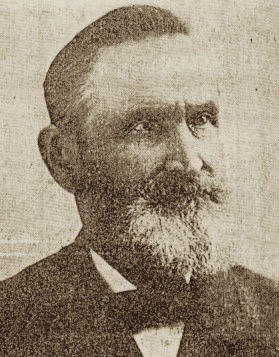
| John Glatz |
The forty-year journey of John Glatz from Baden-Württemberg, Germany to Oshkosh, Wisconsin is the story of an itinerant brewer who learned his craft in the old world, adapted it to the new world and finally found his home in a foreign city almost 5,000 miles from his place of birth. Glatz was born on December 24, 1829 in Pfullingen, a small town at the foot of the Swabian Alps in southern Germany. He began making beer at the ripe age of 14 and after serving his brewing apprenticeship, immigrated to America in 1853. That same year, Oshkosh became a city.
Upon arriving in America, Glatz went to Cincinnati. Its large German population and booming beer scene would have seemed a natural fit for an ambitious, 23-year-old brewer. But after three years of making beer there, Glatz was on the move again. He spent six months brewing in Philadelphia and then in 1857 went to Milwaukee where beer was becoming an essential element of the burgeoning city. For a time, Glatz appeared to have found his niche. He settled in as foreman of a South Side brewery and in 1861 the 32-year-old Glatz took a 19-year-old bride named Louisa Elser. The brewer from Baden had established a comfortable living. After 12 years of brewing someone else’s beer, though, Glatz wanted a brewery of his own. He found the opportunity he was looking for in Oshkosh.
In 1869 there was a new brewery in waiting at the south end of Doty Street. It had been built by Franz Wahle, who in 1857 had founded the Stevens Point Brewery. After selling the Point Brewery in 1867, Wahle moved to Oshkosh and began construction of the new brewhouse that would become the Union Brewery and the new home of the John Glatz family.
John and Louisa Glatz now had three children and shortly after moving into the brewery they were joined by Christian Elser, his wife Anna and their three children. In all probability, Elser was the older brother of Louisa Glatz, but he wasn’t just family, he was an experienced brewer, as well. The German-born Elser was 29 and prior to coming to Oshkosh had brewed at the Bavarian Brewery in Wauwatosa under the tutelage of Franz Falk, a master brewer from Bavaria. With almost 40 years of experience between them, Glatz and Elser were a significant addition to Oshkosh’s flourishing community of brewers.
When the Union Brewery went into operation in 1869 it became one of six Oshkosh breweries and within their first year Glatz and Elser produced a respectable 500 barrels of beer. The Oshkosh beer market was expanding and Glatz and Elser were poised to take a sizable portion of it, but first they’d be dealt a disastrous set-back. At 10 p.m. on a cold Friday in early December of 1871 the brewery that Wahle built caught fire. Firefighters soon arrived, but were unable to draw water. They watched as the Union Brewery burned to the ground.
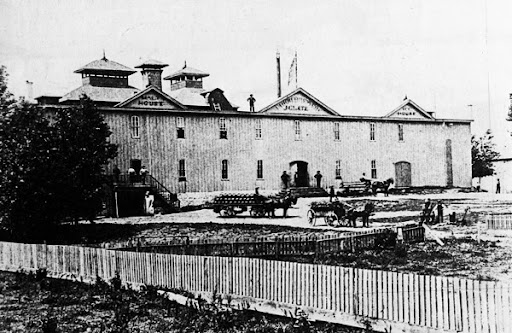 |
| The Union Brewery 1886 |
At the time of the fire Franz Wahle owned the brewery, but Glatz and Elser had insured the business for $6,000. When their claim came through in January of 1872, Glatz and Elser purchased the ruins of the brewhouse and the four acres of land surrounding it from Wahle for $5,400 - a figure that would today amount to about $135,000. And then they started all over again.
This time there would be no deterring them. In 1872 Glatz and Elser rebuilt the brewery and over the next five years more than tripled their original output. Though their methods were informed by centuries of German brewing practice, theirs was truly an Oshkosh beer made with locally grown hops and grain that Glatz himself malted at the brewery. Success came early and by 1878 they were making more beer than any other brewery in Oshkosh, producing over 1,500 barrels a year. An impressive figure considering the size of their market (Oshkosh’s population was then just 14,876) and the seasonal limitations faced by lager brewers in the years before mechanical refrigeration was commonplace. Oshkosh was quickly becoming a regional force in Wisconsin brewing and Glatz and Elser were leading the way.
Production continued to increase and in 1879 the Union Brewery surpassed its previous year’s effort by more than 100 barrels. But 1879 was also a pivotal year for the Union Brewery. In the fall of that year, Glatz and Elser dissolved their partnership and on November 7, 1879 Elser sold his interest in the brewery to Glatz for $13,000; a sum that would be worth about $288,000 today. Elser would go on to establish a meat market and beer bottling business on 18th Avenue between Doty and Oregon and Glatz kept right on brewing. He had eight employees working for him now, not including his son William, who at 17 would have certainly been old enough by his father’s standard to become immersed in the business of making beer.
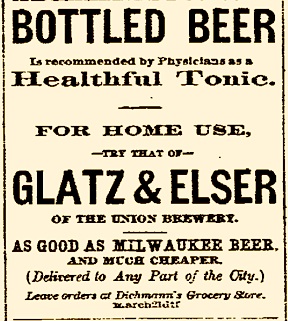
The Oshkosh beer market, though, was changing rapidly. When the Brooklyn Brewery, just up the street on Doty, burned down in 1879, August Horn and Theodore Schwalm built a larger brewery in its place that would soon outpace the production of Glatz’s plant. But more troubling than the local competition was the “foreign” beer being brought in from Milwaukee. The Milwaukee brewers, Pabst and Schlitz in particular, had capacity advantages, which allowed them to flood growing markets such as the one in Oshkosh, making it difficult for local brewers to compete. Glatz battled back. He struck a deal with William Dichmann, proprietor of the leading grocery on Main Street, to distribute his beer and dramatically increased the capacity of his small brewery, eventually plateauing at an incredible 30,000 barrels a year. Glatz also began producing a series of to-the-point advertisements that never failed to include the lines, “As good as Milwaukee beer. And much cheaper.” It was a well-aimed retort coming from a man who had spent more than 12 years of his life brewing “Milwaukee beer”.
Glatz continued on as the sole owner of the Union Brewery until 1888. On May 1st of that year, he made his 25-year-old son, William, a full partner in the business. John Glatz was now 59 years old. His brewing career was nearing its end, but not before he would influence the next stage in Oshkosh’s development as a brewing center. In 1894 Glatz merged his Union Brewery with Horn and Schwalm’s Brooklyn Brewery and Lorenz Kuenzl’s Gambrinus Brewery to form the Oshkosh Brewing Company. Glatz was named vice president of the new company. His son William, who ten years later would become president of Oshkosh Brewing, was appointed treasurer. On April 12, 1894 John and Louisa Glatz deeded their brewery to the Oshkosh Brewing Company for $78,000, an amount that would now equal just over 2 million dollars. A year later, on April 25, 1895, John Glatz died at the age of sixty five.
The Union Brewery remained operational until 1915 when it was dismantled and its production moved to the large, modern brewery built by the Oshkosh Brewing Company on Doty Street in 1911. In 1976, the site of the brewery was bought by the city of Oshkosh and re-named Glatz Park. Today there’s little there to suggest the dynamism that characterized the years when the Union Brewery was running full tilt. The park is unmarked and mostly left untended. All that is left of the brewery are the outcroppings of the lagering caves that were at the foundation of the brewhouse.
 |
| Remains of Union Brewery Caverns 1975 |
But there’s a surviving structure just to the north of the brewery lot that may have been even closer to John Glatz’s heart. In the last year of his life, Glatz built a magnificent home that stands to this day at 2405 Doty Street. The house has recently been renovated and is as beautiful as it was when Glatz lived there. A legend that has drifted down through the years is that John Glatz used the smashed beer bottles of his competitors to adorn the peaks of his home, as if making a crown for himself from the shattered bones of his rivals. If you look up under the eaves of the house you can still see the pieces of beer bottles that are embedded at the crests. If the legend is true, John Glatz’s crown remains intact.
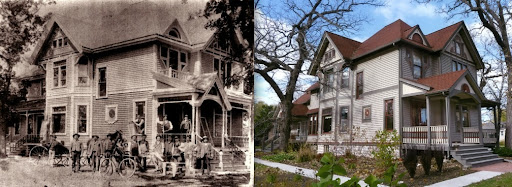 |
| The Home of John Glatz 1894 & 2010 |
Thanks to Mike and Margie Douglas for their tour and pictures of the Glatz house. Thanks, also, to Dan Radig for pictures of the Union Brewery lagering caves.


