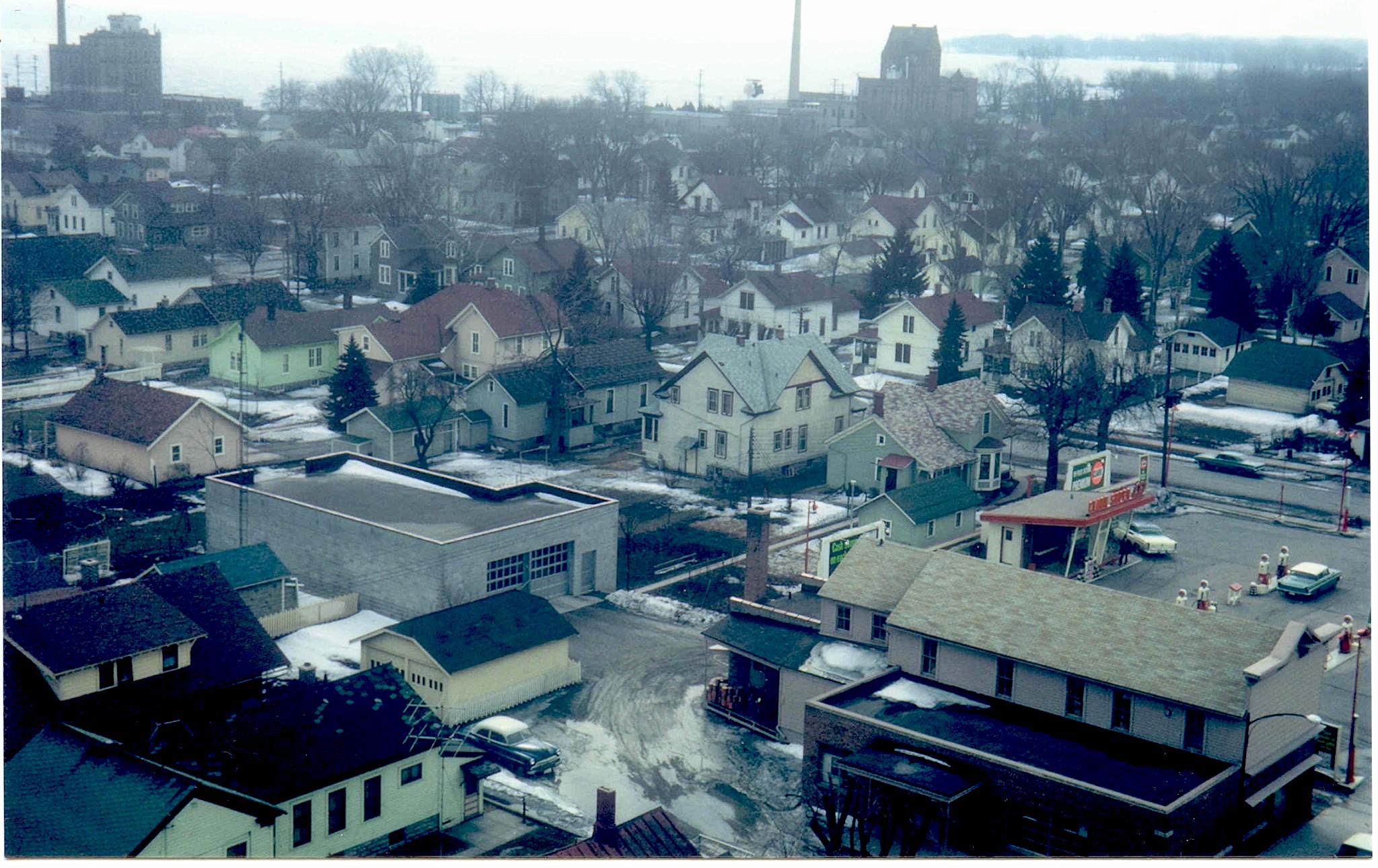
In the early 1850s, a community began forming on the south side of the Fox River in Oshkosh. Yankee settlers living on the north side of the Fox said the emplacement of the new settlement called to mind the river-sliced arrangement of Manhattan and Brooklyn. The Southsiders liked the sound of that. Brooklyn became their pet name for the neighborhood they were building.
Oshkosh's Brooklyn grew up south of the Fox River and east of Minnesota Street in the old Third Ward. By the 1860s it had developed into a thriving community with its own distinct identity.
 |
| Oshkosh’s Brooklyn, 1867. |
Many of Brooklyn's early settlers had migrated from German-speaking lands in Central Europe. They were beer-loving people who retained their native tongue and their old-world culture of pleasure. Lager-beer saloons became commonplace along their main thoroughfare, Kansas Street, now called South Main Street.
 |
| The Beglinger Brothers’ Grocery and Lager Beer Saloon at the corner of 8th and Kansas, circa 1865. |
But the Brooklyn saloons didn't serve Brooklyn-brewed beer. By the end of 1865, there had been seven breweries established in Oshkosh. All of them were on the north side of the river. Having to rely on the Northsiders for their beer irritated the independent-minded Southsiders. Brooklyn needed her own breweries. The name given to the first of them was practically pre-ordained.
The Brooklyn Brewery: 1865-1894On October 4, 1865, a Saxon-born brewer named Leonhardt Schwalm purchased four adjoining lots on the east side of Doty Street below 16th. Schwalm enlisted the help of his Bavarian-born brother-in-law, August Horn. In early 1866 their brewery was up and running.
 |
| The Brooklyn Brewery, circa 1870. The vernacular architecture was typical of Oshkosh’s early breweries. |
The Brooklyn Brewery was an immediate success, but not without its share of troubles. In 1872, a worker at the brewery fell into a vat of boiling beer and was scalded to death. A year later, the brewery's founder, Leonhardt Schwalm, died unexpectedly. And in 1879, the original Brooklyn Brewery burned to the ground.
The Horn and Schwalm families persisted. They built a new “fire-proof” brewery made of brick. It was considered the most technically advanced Wisconsin brewery outside of Milwaukee.
 |
| The rebuilt Brooklyn Brewery in the 1880s. |
The Franz Wahle / John Glatz Union Brewery: 1867–1894Franz Wahle was a German-born brewer who had helped launch the Stevens Point Brewery in 1857. Ten years later, Wahle left Stevens Point and bought a farm at the south end of Brooklyn. Naturally, he built a brewery there.
 |
| The Franz Wahle farm and brewery highlighted in red. |
In 1869, Wahle leased his brewery to John Glatz and Christian Elser. Both were German-born brewers who had been making beer in Milwaukee before coming to Oshkosh. In 1872, Glatz and Elser purchased the property from Wahle after they had accidentally burned down his brewery. They built a new brewery in its place. It was called the Union Brewery.
 |
| The Union Brewery, circa 1886. |
Elser left the Union Brewery in 1879 to establish the first independent beer bottling plant in Brooklyn on 17th Avenue near Doty. Glatz kept on making beer. By the early 1880s, Glatz's brewery was making more beer than any other brewery in Oshkosh.
The Ale Breweries of BrooklynThe 1870s saw a trio of new breweries established in Brooklyn that offered an alternative to the flood of lager beer being issued by the two southside heavyweights. The new breweries made ale.
The most popular ale in Brooklyn was White Beer, an American interpretation of the Berliner Weisse style. White Beer was exceptionally pale and effervescent, low in alcohol, and refreshingly tart. It became a Brooklyn specialty.
Leonard Schiffmann’s White Beer Brewery: Circa, 1875-1882A Prussian immigrant named Leonard Schiffmann was the first brewer of White Beer in Oshkosh. In 1875, Schiffmann purchased land at what is now 1864 Doty Street, where he built his brewery.
 |
| The former location of Schiffmann’s White Beer Brewery at 1864 Doty. |
Brooklyn's ale breweries remain an obscure lot. But in Schiffmann's case, a couple of intriguing details have been unearthed. He made his beer using a "large iron boiling kettle" that was fired by either wood or coal. The kettle was surrounded by brick in an otherwise wood-frame building.
Not surprisingly, Schiffmann was plagued by fire. In 1878, his brewery was nearly destroyed after a fire broke out near his kettle. The building was severely damaged, but Schiffmann managed to save most of the beer on hand. Here's one of Schiffmann's rescued bottles.
Schiffmann packaged his beer in stoneware bottles. The thick-walled vessels were favored by brewers of the highly-carbonated white beer. At least three of Schiffmann’s bottles have survived. The bottle shown above was found near the corner of Ceape and Main in 1962 when construction work was being done there.
Leonard Arnold Brewery: 1875–78On the heels of Leonard Schiffmann came Leonard Arnold, who established Brooklyn's most eccentric brewery in late 1875. Arnold's brewhouse was planted at what is now 1600 South Main Street.
 |
| The former location of Leonard Arnold’s brewery, 1600 South Main. |
Arnold was the first American-born brewer in Brooklyn. His beer was a reflection of that. Among his specialties were spruce beer, lemon beer, and ginger beer. He also produced vinegar, yeast, and ink. The advertisement below has Arnold hawking his various wares in the Wisconsin Telegraph, a German-language newspaper published in Oshkosh.
 |
| Wisconsin Telegraph, October 22, 1875. |
Here's my rough translation...L.G. Arnold
Manufacturer of
Vinegar, Ink and Beer
Building located at 16 Kansas Street
Post Office Box 176 - Oshkosh, WI
Orders can be left at 7 Main Street
Arnold's old brewery remained standing long after the memories of his arcane ales had faded. Vinegar was still being made there in the 1930s. This next picture is circa 1940 and shows the former Arnold Brewery. It was torn down in the 1950s.
Frederick Voelkel Brewery, late 1870sThe last of Brooklyn's ale breweries was established sometime around 1878. The brewer was Frederick Voelkel, an immigrant from Saxony. Voelkel's brewery was at the northwest corner of Doty and 17th; just across the street from the Brooklyn Brewery.
 |
| The northwest corner of Doty and 17th where Frederick Voelkel had his brewery in the 1870s. |
Voelkel's brewery produced white beer. In conjunction with his brewery, Voelkel also ran a taproom where he appears to have been pouring Brooklyn-brewed lagers in addition to his ale.
 |
| Brooklyn's ale-brewery sites. |
Brooklyn's ale breweries were short-lived. Voelkel's brewery survived less than three years. Arnold's brewery had closed by 1879. The Schiffmann Brewery, the most prominent of the three, had gone out of business by 1883.
It was lager beer that put Brooklyn on the brewing map. By the late 1870s, Brooklyn’s two lager breweries had eclipsed their northside competitors.
Brooklyn’s dominance would continue to grow. It culminated in 1894 with a merger that made the name Oshkosh practically synonymous with beer.
The Oshkosh Brewing Company: 1894-1971The Oshkosh Brewing Company was created on March 21, 1894 from the merger of Horn & Schwalm's Brooklyn Brewery, Glatz's Union Brewery, and Lorenz Kuenzl's Gambrinus Brewery. Kuenzl's brewery, located north of the Fox River on Harney Avenue, was converted into a bottling plant. The Brooklyn and Union breweries continued pumping out beer.
The Brooklyn Brewery, with its 40,000 barrel capacity, became the hub of the OBC operation and the primary brewhouse for its beer. It was where OBC's premium beers were produced, including a new high-end bottled beer named Gilt Edge.
Glatz’s Union Brewery was used as the production facility for "Standard," OBC's amber-hued lager that was on tap in almost every Oshkosh saloon.
 |
| The Glatz brewery rebranded as the Oshkosh Brewing Company. |
By the turn of the century, 75 percent of the beer sold in Oshkosh was coming out of the two OBC breweries in Brooklyn. The explosive growth necessitated the construction of a new brewery that would consolidate production. OBC's new facility was completed in 1912. The imposing, six-story brewery loomed over the 1600 block of Doty Street.
OBC's presence was felt well beyond Doty Street. The brewery grew into such a force that it was able to dictate the price of beer sold in Oshkosh. But OBC’s bullish ways didn’t sit well with local saloon keepers. They banded together and in 1913 launched their own brewery in Brooklyn.
Peoples Brewing Company: 1913-1972Peoples Brewing Company was a cooperative brewery financed by Oshkosh saloon owners and other local investors. They built a modern brewery on the east side of the 1500 block of South Main, just a stone’s throw away from OBC’s new plant.
Beer from Peoples Brewery began flowing on June 21, 1913 and quickly gained a loyal following. It sold especially well in Oshkosh saloons where bar keepers who owned stock in Peoples had a vested interest in pouring their brewery’s beer.
 |
| November 24, 1913. |
For the first time since 1894, Brooklyn had competing breweries. Year by year they grew larger. In 1956, the last of the northside breweries closed when the Rahr Brewing Company failed. Brooklyn was now the sole source of Oshkosh-brewed beer.
By the late 1950s, more than 90,000 barrels of beer was being brewed annually in Oshkosh’s Brooklyn. That beer was sold in every tavern in town and throughout much of the state.
 |
| Brooklyn with her two big breweries in the background. Peoples is on the left. The Oshkosh Brewing company is towards the right side of the frame. |
The Fall of the Brooklyn BreweriesThe downfall of brewing in Brooklyn began after each of its breweries was acquired by outside investors who had little appreciation for local beer culture. In both cases, the new owners averted their focus from the home market in hopes of reaching a larger customer base.
The Oshkosh Brewing Company was sold in 1961 to David Uihlein, a member of the family that held controlling interest in Schlitz Brewing. In 1970, Peoples was sold to a group of Milwaukee investors led by Theodore Mack, a former employee of Pabst Brewing.
 |
| David Uihlein (left) and Theodore Mack. |
Both men made critical blunders at a time when there was no room for error. Regional breweries, like those in Brooklyn, were caught in a pricing war that led to an unprecedented rash of brewery failures. Meanwhile, much larger “shipping” breweries such as Pabst and Schlitz were engaged in high-dollar marketing campaigns fostering the impression that locally brewed beer was inferior.
Neither Mack nor Uihlein were prepared to face those challenges. Neither man had run a brewery before. Their miscalculations precipitated the downfall of their respective breweries. Oshkosh Brewing Company closed in 1971. Peoples closed in 1972. For the first time since 1866, Brooklyn was without a brewery.
 |
| The abandoned Peoples brewery seen from the vantage point of the abandoned brewery of the Oshkosh Brewing Company, 1974. Photo courtesy of Dale Hunt. |
The Return of Brewing to BrooklynPeoples closed and 23 years passed before Oshkosh had a brewery again. It began on the northside with a brewery on the river: Fox River Brewing Company opened on Arboretum Drive in 1995. It was another 22 years before Brooklyn got back in the game.
On November 9, 2017, Fifth Ward Brewing Company opened its doors in the heart of the old Brooklyn at 10th and South Main.
 |
| Fifth Ward Brewing at 1009 South Main. |
Ironically, the new brewery adopted its name from one of the old northside breweries. The original Fifth Ward Brewery had been in operation on Algoma Boulevard from 1858 until 1880 when the deluge of beer coming out of Brooklyn sank it.
In 2018, a second brewery opened in Brooklyn. HighHolder Brewing Company operated from a suite behind O'Marro's Public House at 2211 Oregon Street. This one got its name from the old sixth-ward “High Holder” neighborhood adjacent to Brooklyn. Unfortunately, the brewery didn't last. HighHolder ceased production in 2020.
Pieces of the PastOshkosh’s old, northside breweries have been thoroughly erased. There's nothing left of them. But in Brooklyn, remnants of the early breweries remain.
The rebuilt Brooklyn Brewery, constructed in 1879, still stands in the 1600 block of Doty Street.
 |
| Then and now: the Brooklyn Brewery on Doty. |
A couple of doors down is the former mansion of August Horn, who ran the Brooklyn Brewery and was the first president of the Oshkosh Brewing Company. Built in 1879, it was a home befitting Brooklyn's first beer baron.
 |
| The former home of August Horn, 1602 Doty. |
At the south end of Doty is Glatz Park, named for the family that once ran a brewery on that land. There, you can still see some of the old stonework that formed part of the Union Brewery's lagering cellars.
 |
| On the eastern side of Glatz Park. |
Adjacent to Glatz Park, at the southwest corner of 24th and Doty, stands a magnificent home built in the early 1890s for John Glatz and his family.
 |
| The Glatz home at 24th and Doty. |
Further north in the 1500 block of South Main, is the old bottling house of Peoples Brewing. The brick building is surrounded by newer structures that make up the Blended Waxes Company complex.
 |
| The former bottle house of Peoples Brewing. |
At the north end of Blended Waxes complex, loading docks that had been attached to Peoples Brewery are still intact. But the rest of the brewery is gone. It was demolished in 1974. The Oshkosh Brewing Company's towering brewery was demolished in 1986.
 |
| July 1974, at the start of the Peoples demolition. |
 |
| Demolition of the Oshkosh Brewing Company in the fall of 1986. |
References to the "Brooklyn" section of Oshkosh began falling out of use in the early 1920s. But the nickname has never been entirely abandoned. The Brooklyn Grill, which closed in 2019 after 37 years at 6th and South Main, was perhaps the best known of the more recent adopters of the moniker.
You still see the old Brooklyn when you head south over the Main Street Bridge onto what used to be Kansas Street. To your right stands the Brooklyn No. 4 Fire House, built in 1868 from a design by William Waters. It remains a striking reminder that you’ve entered Oshkosh's Brooklyn.