Showing posts with label Bock Beer. Show all posts

Tuesday, April 1, 2025

Bare Bones 1895 Bock

The Oshkosh Brewing Company released its first Bock Beer 130 years ago. To commemorate the anniversary, Bare Bones Brewery will release a replica of that original Bock this Saturday at the brewery’s taproom when it opens at noon. 1895 Bock is a rich and malty, dark-amber beer that delivers a warming 6.2% ABV.


This was a beer they were eager to make. The Oshkosh Brewing Company was created on March 21, 1894, from the merger of Oshkosh’s three largest breweries: Horn & Schwalm’s Brooklyn Brewery, John Glatz and Son’s Union Brewery, and Lorenz Kuenzl’s Gambrinus Brewery. The three breweries had already produced their 1894 Bock Beers before the merger was finalized. Those Bocks were released under the pre-merger names of the individual breweries.

The day after the OBC merger was finalized, John Glatz & Son ran this notice for their Bock Beer in the Daily Northwestern. They begin by taking a shot at Pabst for its endless yammering about its award at the 1893 World’s Fair. The Glatz boys then get down to the business of sermonizing upon the high quality of their own beer; something they were never shy about.

By the end of 1894, the three breweries had settled into their new collective identity and were ready to brew some Bock. For the 1895 season, OBC brewmaster Lorenz Kuenzl created a hefty Bock that approached Doppelbock territory. It was a more potent and darker version of the Chief Oshkosh Bocks that OBC became famous for in the post-Prohibition era after 1933.


The recipe for the Bare Bones version of the 1895 Bock was drawn up by Jody Cleveland, head brewer at Bare Bones, and myself. We built the recipe using Oshkosh Brewing Company logbooks and other research into the brewery's practices during the period. No living human has ever tasted the 1895 Bock brewed by OBC, so it’s impossible to say how closely this beer resembles the original. But we’re betting it’s pretty damned close.

1895 Bock will be available on draught and in a commemorative can with a design that includes artwork from the period. Prost!


Monday, August 31, 2020

Our Bock is Oktoberfest


Where we once had this....


We now have this...


For more than a hundred years, the most anticipated seasonal beer in Oshkosh was bock beer; a malt-driven amber/brown lager that was released just once a year. Today, the most anticipated seasonal beer in Oshkosh is Oktoberfest; a malt-driven amber/brown lager that gets released just once a year.
Cap: On the left is a 1934 depiction of bock beer from Rahr Malting.
On the right is Fox River Brewing's Oktoberfest.

The two beers share more than color in common. The recipes are also similar.

The post-Prohibition bocks from Rahr Brewing of Oshkosh and the Oshkosh Brewing Company used caramel malts. At Peoples Brewing they took a somewhat different approach by adding a heavy dose of Munich malt in their bock beer. The three Oktoberfests made by Oshkosh breweries this year each included Munich malt along with some form of caramel malt in their recipes.

Not surprisingly, the resulting flavors also share some things in common. In 1961, the Oshkosh Brewing Company described its bock as having a "toasted" flavor with the taste being "quite a bit sweeter" than its standard beer. Some 50 years later, when Fox River Brewing released its Oktoberfest, the brewery’s description mentioned that "The taste is full of a bready sweet maltiness."

The strength of the older bocks and the current Oshkosh Oktoberfests are also in the same ballpark. Wilhelm Kohlhoff, a brewer at Peoples Brewing in Oshkosh during the 1950s and '60s said that Peoples Bock was in the 5.5 to 6% ABV range. That's right in line with Fox River's Foxtoberfest at 6.2% ABV; and Fifth Ward's Oktoberfest at 5.8% ABV. Bare Bones Oktoberfest at 5% ABV isn't too far off that mark, either.

That leaves one major difference between these two types of beer: the release date. Oshkosh-brewed bock was considered a spring beer, released near the end of winter. Oktoberfests, of course, are thought of as the prototypical beer of fall released at the end of summer. But just like the older bocks, the Oktoberfests have succumbed to seasonal creep.

Prior to the 1880s, Bock beer in Oshkosh would usually hit the market in April. But in the 1890s, the creep began with bock beers arriving earlier every year. By the 1910s, Oshkosh breweries were releasing bock beers as early February. Each of the brewers was trying to beat the other to the punch.

From the February 25, 1910 Oshkosh Daily Northwestern.

The same sort of creep has happened with Oktoberfests. In the 1960s, when the first Oktoberfest beers started appearing in Oshkosh, they wouldn't start pouring until mid-September. This year there were Oktoberfest beers on sale in Oshkosh in July. And all three of the Oshkosh Oktoberfests were pouring by early August. The reasons for the creep are much the same. "We're basically forced to brew these beers early," says Andrew Roth, brewmaster at Fox River. “I would prefer we could release it at the proper historical time, but if we do that we won't sell any because the market will have already been saturated by it. It's unfortunate, but there's nothing to be done about it."

I'm part of the problem. I love Oktoberfest and I start grabbing it as soon as it's available. And for me the sooner, the better. Prost!

Notes
For more on the history of bock beer in Oshkosh, click here.
For more on the history of Oktoberfest beers in Oshkosh, click here.

Thursday, March 5, 2020

Here Comes the Fourth Beer in the Oshkosh Heritage Series: The Busch Brewery's Salvator

The fourth beer in the Bare Bones Brewery Heritage Series arrives this weekend. This time we're going all the way back to 1858 when the Busch Brewery of Oshkosh released a bock beer named Salvator.


Our story begins in 1857 when German immigrants Tobias Fischer and Christian Kaehler teamed up to launch a new brewery in Oshkosh. They bought land in the old Fifth Ward and went to work digging beer cellars and building a brewhouse. By the winter of 1857, Fischer and Kaehler had the Busch Brewery up and running. It stood near the southeast corner of Algoma and Vine on land that's now part of the UW - Oshkosh campus. Not a trace of the old brewery remains.

The northwest end of the UW Oshkosh Campus, former home of the Busch Brewery.

That first winter, Fischer and Kaehler brewed a strong bock beer they named Salvator. At the time, Salvator was considered a style of beer; like Pilsner or Porter.  Some 40 years later, the Paulaner Brewery in Munich would trademark the Salvator name. But prior to that, dozens if not hundreds of breweries made a Salvator beer. The little Busch Brewery in Oshkosh was among them.

Fischer and Kaehler released their Salvator at the brewery on May 1, 1858. They announced its coming in the Oshkosh Deutsche Zeitung newspaper. Here’s their ad with a translation following it.


Salvator Bier
“Oshkosh’s beer-thirsty souls
Will soon rejoice
That above Bacchus’ majesty
Gambrinus reigns supreme!

This famous Salvator Beer, which was
brewed on the coldest day of this
winter, has now finished its lagering
period and is to be tapped at our
brewery on the coming Saturday
evening, the 1st of May.

We invite all Oshkoshers to visit us on
Saturday and the following days in our
Busch Brewery, and we promise to give them
a pleasure like never before.
Come, come all to
Fischer and Köhler.”

The Busch Brewery's Salvator would have been quite unlike the Salvator you find on grocery store shelves today. The Salvators of old began with a concentrated wort that was fermented in a manner that left plenty of residual sugar in the finished beer. It was sometimes referred to as "liquid bread." The beer was moderately strong and especially hearty; perfect for ushering out the remaining cold days of winter.

Jody Cleveland, head brewer at Bare Bones, and I knew we were taking a shot in the dark when we decided to try to replicate this one. The Busch Brewery had lasted just a couple of years. No brewing logs from it are known to have survived. But we did have a fair amount of information on how this type of beer was being brewed in 1858. We coupled that with known tendencies of Oshkosh brewers during the era that Fischer and Kaehler worked here. I'm pleased to say, the beer turned out just as we expected. You probably haven't had a lager like this one before.

Here's a look under the hood: We started with a blend of malts that included Wisconsin Munich and 6-row to emulate the sort of grist Fischer and Kaehler would have worked with. The beer was hopped with Cluster, which was almost certainly the hop of choice at the Busch Brewery. The original gravity was 1.074 (or 18 plato). The finishing gravity was 1.025 (or 6.3 plato). The result is a 6.4% ABV beer with an apparent attenuation of just 65%. Hat tip to Jody Cleveland for hitting that mark. An attenuation level like that one is tricky to obtain using modern ingredients and equipment. But it's essential if you're trying to reproduce the character of a 1800s-style Salvator.

The Busch Brewery Salvator is going to get a fairly wide release around Oshkosh in the coming days. Its first appearance will be at the Bare Bones Winter Beer Fest this Saturday, March 7. On Tuesday, March 10, a limited-edition bottle release (six-packs labeled with the 1858 advertisement seen above) will take place  at 5 pm at the Bare Bones taproom. Then on Wednesday, March 11, Jody Cleveland will be at Dublin's Irish Pub pouring Slavator from 5-7 pm as part of the Bare Bones tap take over for Oshkosh Craft Beer Week. Jody will be at Chester V's on Thursday, March 12 for another Oshkosh Craft Beer Week event starting at 6:30 pm. That event includes a wing-pairing that'll feature Salvator as part of the gustation. Meanwhile, Salvator will continue pouring at the Bare Bones taproom.

Here’s to Fischer and Kaehler. Prost!

Monday, February 17, 2020

Back in Bock

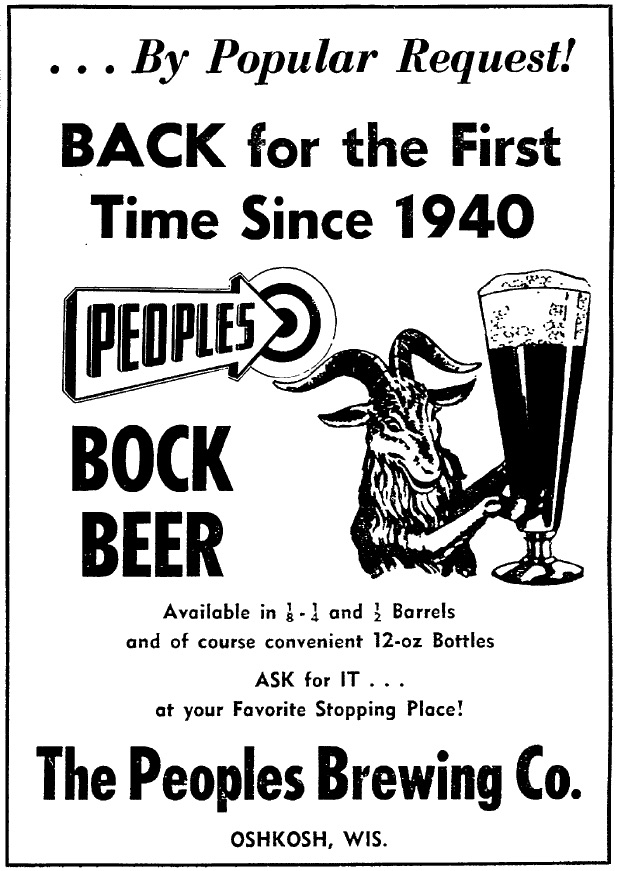
This week in 1959, Peoples Brewing reintroduced a beer that the brewery hadn't made in 19 years. It was the return of Peoples Bock Beer.


Peoples’ 1959 Bock Beer arrived 45 years to the day after the brewery had released its very first bock on February 20, 1914. That was an important beer for Peoples. The brewery had opened just eight months earlier. It was a direct outgrowth of the German immigrant community in Oshkosh. Bock was the first beer from Peoples that spoke explicitly to the heritage of those folks. The list of Oshkosh saloon keepers who put it on tap was full of names with a distinctly Germanic ring.


Most of that 1914 bock was served on draft in saloons. But Peoples also offered the beer in pint-sized bottles. You could get a dozen of them for 80 cents. That would be about $20.70 in today's money. The next year, Peoples came out with 12-ounce bottles of its bock for 90 cents a case.  Here's the label used on those 12-ounce bottles.


The bock beer season in Oshkosh usually ran from late February until mid-April. It was a celebrated event. A sign that spring was on its way. Each of the city's three breweries would bring out their own version of bock beer.


When Prohibition came in 1920 all of that was put on hold. For the next  dozen years, folks in Oshkosh had to go looking for robins to remind them that someday spring would come.

Beer became legal again on April 7, 1933; eight months before the full repeal of Prohibition. The beer produced during the interim period could contain no more than 3.2% alcohol by weight, which is 4% alcohol by volume. The bock-beer season had nearly passed, But Peoples released one anyway. It was more of a symbolic gesture than anything else. At a mere 4% ABV, Peoples’ 1933 Bock lacked the kick that veteran drinkers of bock beer were accustomed to. Perhaps that's why the goat was left off the label.

Image courtesy of Bob Bergman.

Peoples 1934 bock was back to the brewery's standard: dark and strong, rich and malty. The goat was back, too.


"Every Winter Peoples Brewing Co. brews and ages a superb Bock Beer," began the 1940 announcement. It would be another 19 years before they could say that again. After the 1940 release, Peoples stopped making its bock beer. The brewery never explained why.

The drought ended on February 20, 1959 when Peoples trotted the old goat back out.


In the 1950s and '60s, Wilhelm Kohlhoff was one of two principal brewers at Peoples. He recalled making Peoples Bock after its reintroduction. "We added all the special malt; it was darker, it was a brown color malt, and then what you used was brown sugar, 600 pounds of sugar in the kettle and that makes the beer a different color, too." Kohlhoff said.

That's a lot of sugar for a 100-barrel batch of beer. The use of sugars in American beers of this period isn't unknown, but I haven't come across another example of its use in bock beers during that time.


Peoples Bock never regained its former popularity. The last mention I've found of the beer is from 1963. Bock beers in general had fallen out of fashion. What had been an anticipated sign of spring was now a specialty brew indulged in by the older crowd. Like the people who drank it, bock beer faded away.

Unfortunately, bock hasn’t undergone a revival like some other styles have in the new era of smaller breweries. But the old goat still kicks. Within the next few weeks, Bare Bones, Fifth Ward, and HighHolder will all release a bock beer. It will be the first time in 80 years that three Oshkosh breweries will have a bock pouring in the run-up to spring. No need to look for robins this year.

Monday, February 29, 2016

Oshkosh's Annual Parade of Goats

March was traditionally the time when Oshkosh brewers brought out their bock beers. The annual arrival of stronger, darker lagers was an occasion both brewers and beer drinkers looked forward to.

Here's an ad from 1940 that shares the sense of anticipation these beers were greeted with.


Notice that mighty goat at the ready, front and center. Bock is a German-style of beer. And bock is the German word for goat. Reason enough to present a horned beast. The goat also serves as an indication of the strength of bock beer.

For decades, Oshkosh brewers remained true to the tradition of adorning their bock-beer ads and labels with goats. Here's a herd of examples  from the last century.

Let's start of with a few more from Peoples Brewing.
Here's a bottle label that Peoples used before Prohibition arrived in 1920.


And here's a Peoples' label from the period following the end of Prohibition in 1933.


Jumping ahead a few decades, here's the label Peoples was putting on its bottles of bock in the 1960s.


Now over to Rahr Brewing of Oshkosh. This is a label for Rahr's Bock Beer, circa 1917


In 1938, advertising for Rahr's bock featured this anthropomorphized goat wearing a nice shirt and tapping a beer.


Here's a Rahr label from right about that same time.


A lot of the labels seen here were stock labels used by numerous, regional breweries. Other than the brewery name, the labels were identical. Here's a couple examples of Wisconsin bocks with the same label as Rahr's.


Can you imagine if Fox River Brewing in Oshkosh was using the same label on its beer as O'so Brewing in Plover? It's unthinkable in the modern age of branding. Then again, beer was a far more local product in the years before and just after Prohibition than it is today. Thankfully we seem to be returning to that. But I doubt we'll see brewers sharing labels again (though Bare Bones Brewery in Oshkosh does share a bottle labeller with other breweries in Northeast Wisconsin).

Moving on...  The Oshkosh Brewing Company always had an eye for design. This poster for their bock beer is one of my favorites. It's a lusty looking goat we have here.


Here's another stock label. This was appearing on bottles of OBC's bock in the 1940s.


These were the caps crowning those bottles of OBC bock beer.
Here comes a nice OBC tap handle. I believe this is from the 1960s.

One more. Here's a sign for OBC's bock beer that marries Native American imagery with that old German goat. Welcome to the new world.


With the closing of Oshkosh's production breweries in the early 1970s, bottles of Oshkosh-brewed beer with goats on them disappeared. Now that we have a couple of breweries packaging beer again, the revival of this tradition is due for renewal.

For more about the history of bock beer in Oshkosh, check this out.