Showing posts with label Forgotten Oshkosh Beer. Show all posts

Sunday, November 13, 2022

Badger Brew: A Lost Oshkosh Beer

Badger Brew wasn’t intended to be a memorable beer. On the contrary, it was an efficient beer for erasing memories. Badger Brew was produced fast, cheap, and without any pretense. This was a lager for those with an eye towards price and a forgiving sense of taste.
A case of Badger Brew.

The first batch of Badger Brew was released on September 4, 1954, by Effinger Brewing in Baraboo. Effinger was taking a stab at the budget beer market. The targets were mid-sized Wisconsin cities like Janesville, Manitowoc, Sheboygan, and Oshkosh.

he Effinger Brewing Company of Baraboo in the early 1960s.

Badger Brew was usually the cheapest beer on the shelf. You could get a case of it for as little as $1.98. Shockingly cheap compared to something like Hamm’s or Pabst, which sold for about $3.50 a case.

The bottle label for Effinger's Badger Brew. The beer was never packaged in cans.

There was never much of a budget for promotion. Newspaper ads would lead with played-out hokum: "Refreshingly light." Or pointless drivel: "From Baraboo's oldest industry." But the bottom line was always consistent: "Beer to meet your budget." It was all about the price.

It wasn’t enough to save Effinger Brewing. The company lost money year after year until Effinger finally failed in February 1966.

How low can you go? Cases of Badger Brew were sold-off at closeout prices after Effinger went out of business. Sheboygan Press, August 12, 1966.

Along came the Oshkosh Brewing Company. OBC agreed to purchase the Badger Brew brand in March 1966. The deal was sealed a month later. Fred Effinger packed up Badger Brew and sent it to Oshkosh, bottle caps and all.

Click to enlarge.

OBC continued pushing Badger Brew down the same path that had been cut by Effinger. Though the price had lifted slightly, Badger Brew remained the cheapest of the cheap. Had the beer changed now that it was flowing out of OBC's tanks? Probably. Did anyone care? Probably not. The flavor was never the point.
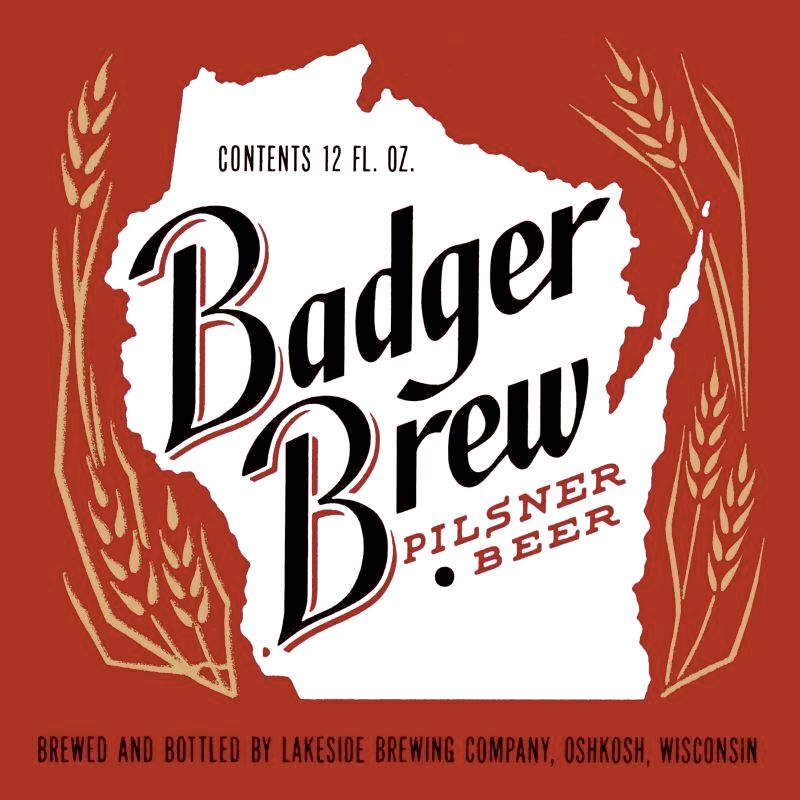
The Oshkosh version of Badger Brew listed Lakeside Brewing Company as the producer on the label. In reality, it was an OBC beer.

Badger Brew was no savior for OBC, either. The Oshkosh Brewing Company failed in October 1971. But once again, Badger Brew survived.

After OBC collapsed, its neighboring brewery came by to pick through the rubble. Peoples Brewing of Oshkosh salvaged the Badger Brew brand in early November 1971. By the end of the year Peoples was making its own version of the beer. The Badger Brew never stopped flowing.

Theodore Mack (left) of Peoples Brewing and Harold Kriz of the defunct Oshkosh Brewing Company during their announcement that the OBC brands – including Badger Brew – had been sold to Peoples. Oshkosh Daily Northwestern; November 5, 1971.

Grant Peterson worked as a delivery driver for Peoples Brewing. He recalls hauling cases of Badger Brew to country taverns around Oshkosh.

“We didn't really have a cheap seller before that. All these old farmer taverns loved it because it was so cheap. A case sold for 95 cents wholesale to the taverns. Those farmers wanted a cold bottle of beer and they didn't want to pay a lot for it. And really, you drink six of them and you're going to get just as drunk as if you drink six of these,” Peterson says hoisting a Miller High Life.

In 1972, the curse of Badger Brew struck again. Peoples Brewing Company failed. This time, nobody came to the rescue. Badger Brew was dead.

It wasn’t a sudden death. Cases of expiring Badger Brew lingered on beer depot shelves well into 1973. And the price was still $1.98 a case. Just like it was almost 20 years earlier.


End Note
I've long suspected that the Badger Brew produced by the Oshkosh Brewing Company was actually Chief Oshkosh Beer with just a different label wrapped around it. You can check into that here.

Monday, November 9, 2020

Asterweiss, the Bottled Beer de Luxe

Here's another long, lost Oshkosh beer that no living person has tasted. It's Asterweiss from the Peoples Brewing Company of Oshkosh...


Peoples Brewing opened in June 1913 with two beers in its portfolio. First, there was Standard, the brewery's unpasteurized budget lager. It was packaged in brown, pint bottles and wooden kegs. Standard was what you'd get if you put a nickel on the bar and ordered a schooner of Peoples in one of the 25 or so Oshkosh saloons that served it in the summer of 1913. There were folks here who drank Standard by the gallon. In fact, Peoples encouraged that sort of consumption. The initial advertising for Standard noted that it was "a beer that you can indulge in quite freely without sensing any distasteful after effects." Bring out the funnel.


And then there was Asterweiss. This was not a beer to be guzzled. Here we have the high-toned stuff.


This was a classic, American-style pilsner. Asterweiss was brewed with artesian water and Bohemian hops. The grain bill was made up of Wisconsin-grown barley malt and it almost certainly had some corn in it. About 95% of American Pilsners made during this period did. At 4.5% ABV, it was a fully-aged lager with a light, golden color. Peoples described its appearance as "Clear, sparkling, bright."

Asterweiss was packaged in clear bottles that were pasteurized at the end of the bottling line. Each bottle was then individually wrapped in tissue paper. The brewery called it “The Bottled Beer de Luxe.” The presentation was meant to be an indication of its quality.

Oshkosh Daily Northwestern; April 29, 1916.

The fancy trapping didn't come cheap. At $1.40 for a case of 12-ounce bottles, Asterweiss was among the most expensive beers sold in Oshkosh. In today’s money that $1.40 would be worth about $37.30; or about $9.25 a six-pack. That's a little more than we pay for most craft beer six-packs sold here today.

In 1916, Peoples copyrighted the Asterweiss brand.


And shortly after that, things went bad. With the First World War weighing on the minds of many Americans, some people began looking askance at American breweries using Germanic branding for their beer. Weiss is the German word for white. Peoples bowed to the pressure. Asterweiss became Asterwite.


It got worse. In 1920 Prohibition came and Asterwite stopped being a beer altogether. But the brand didn't die. Peoples went on flogging Asterwite as a non-alcoholic, near beer. The once-mighty Asterweiss beer had been neutered, reduced to a mere "Beverage."

Prohibition-era Asterwite containing less than 1/2 of 1% Alcohol by Volume.

The Asterweiss brand finally died sometime around 1926, during the absolute depths of Prohibition. And it was left for dead when real beer returned in 1933. Lovely Asterweiss was consigned to the dustbin of brewing history. Now, only the collectors remember. These days, an Asterweiss tray like the one below can go for as high as $700.
Notes
I mentioned that Asterweiss almost certainly had some corn in its grist. A lot of people really have the wrong idea about the use of corn in American beer. I explored that in this post.

A Peoples’ beer named Aristo became the companion to Asterweiss in the brewery's portfolio. There's more on Aristo here.

Monday, August 28, 2017

Forgotten Oshkosh Beers: Schoen's Old Lager

Here's one nobody remembers. Schoen's Old Lager Beer. Brewed and bottled by The Peoples Brewing Co. Oshkosh Wisconsin.


Schoen's Old Lager wasn't native to Oshkosh. How it arrived here is something of a mystery. Here's what I know...

Schoen's Old Lager was named for Louis Schoen, born in  Bavaria in 1876. He came to the United States in 1892. Schoen went to La Crosse. He became brewmaster at G. Heileman Brewing.

Louis Schoen
Schoen was an old-world sort of brewer. He insisted his lager be aged nine weeks before it left the brewery. His exactitude was acceptable before Prohibition hit in 1920. But when the dry years were over, Schoen's meticulousness became problematic.

When Prohibition ended in 1933, G. Heileman Brewing came roaring out of the gate. It would grow to become the largest Wisconsin brewery outside of Milwaukee. That growth wasn't compatible with Schoen's ethos. At Heileman, they couldn't wait nine weeks for a batch of beer to be finished. Schoen had to go. They canned him at G. Heileman in 1934.

Schoen went to Wausau. In 1934, he helped launch Wausau Brewing Co. There he produced Louis Schoen's Old Lager Beer. It wasn't just his name on the label. His picture was there, too.


Louis Schoen died in 1965. By that time, the beer with his name on it was already in the hands of others.

Wausau Brewing Co. had closed in 1961. Its brands were immediately scooped up by Rhinelander Brewing Co. Rhinelander began producing its version Schoen's Old Lager Beer. You can bet your life they weren't aging it nine weeks in Rhinelander.


In 1967, Rhinelander Brewing Co. bit the dust. The Rhinelander labels were purchased by Huber Brewing of Monroe. But Schoen's Old Lager didn't end up in Monroe.

Here's a label said to be from 1972. What the hell was Schoen's doing in Eau Claire?


And why was this beer ever in Oshkosh? And when? I'm guessing it landed in Oshkosh sometime after the fall of Rhinelander Brewing Co. in 1967.

If that's the case, it wasn't here long. When Peoples Brewing was sold in 1970, the brewery's portfolio made no mention of Schoen's Old Lager Beer. I wonder, though, if the omission was an oversite.

Peoples Brewing closed in 1972. It seems a little too coincidental that Schoen's Old Lager Beer would surface that same year in Eau Claire. But that's sometimes how it goes with these vampire brands. Strange things happen when a beer won't stay dead.


Monday, June 19, 2017

Forgotten Oshkosh Beers: Aristo

Another beer nobody remembers. But there was a time when this was on many lips around here. It's Aristo, of the Peoples Brewing Company of Oshkosh.


The label was fancier than the beer behind it. Aristo was the budget beer in Peoples' line-up.  It was introduced in the spring of 1914. You could buy it at the brewery for 80 cents a case (about $14 in today's money). It was among the cheapest beers then available in Oshkosh.

Peoples offered few specifics about Aristo. I strongly suspect, though, that it was the same as Peoples' keg beer. But pasteurized, bottled and given a flashier banner. If that is the case, Aristo would have been an amber-hued lager. A friendly, comfortable beer. People here loved it. Or maybe they just loved the price.

Early on Peoples advertised the hell out of Aristo. They liked to harp on the idea of it being "Just the thing for the family—that is why we call it our "family beer."' You'd think they were marketing an elixir, the way they talked the stuff up. Lot's of breweries were spewing nonsense like this in 1914.

Oshkosh Daily Northwestern, May 16, 1914.

At Peoples they could be touchy about the reputation of their beer. They had good reason to be sensitive. Before Peoples opened in 1913, the Oshkosh Brewing Company had undertaken a smear campaign against them. OBC had intimated that Peoples was launched to make cheap beer for drunks. That was hardly the case. But the slur couldn't be ignored. When Aristo came out, Peoples made a point of addressing the beer's budget price.

"Do not think because the price is low that it is of poor quality, we know that this beer will take so well with the family, that we can sell it cheaper."

I'm sure nobody really cared about any of that bunk. Oshkosh always had a soft spot for cheap beer. Especially when it was locally made.  Aristo was a hit.

Oshkosh Daily Northwestern, June 11, 1914.
Sadly, these tales often end the same. With Prohibition. Peoples ceased production of the real Aristo when the first of the dry laws hit in 1919. But the brand wasn't dead, yet.

In the summer of 1919, Peoples released two non-alcoholic, beer-like beverages. One was named Bravo. The other Aristo.

Oshkosh Daily Northwestern, July 26, 1919.
And Aristo's doom was cemented. Without its kick, Aristo flopped. The brand faded into oblivion. When Prohibition ended in 1933, Aristo was left for dead. The cheap beer with the fancy name was never brewed again.

Monday, May 22, 2017

Gilt Edge, a Forgotten Oshkosh Beer

Gilt Edge Beer marked a turning point for the Oshkosh Brewing Company. Introduced in 1900, the brand was designed to raise the profile of the brewery.


Since its inception in 1894, OBC had made its reputation on German-style keg beers sold in saloons. Gilt Edge was a deviation. This was to be an overtly modern beer. An American beer.

Gilt Edge was a light, pale lager. It was just over 4% ABV. It was sold only in bottles. The packaging was elegant. The bottles were clear. They were sealed with a porcelain stopper on a wire hinge. A yellow ribbon was tied at the neck of each bottle.


The intention was to produce a beer that could stand on the same shelf as the pricier, nationally distributed brands. Beers like Pabst Blue Ribbon, Budweiser, and Miller's Buffet. Bottled beers sold in upscale restaurants and posh bars on Main St.

Gilt Edge became OBC’s most expensive beer. The target audience was young. American born. The affluent offspring of German and Bohemian immigrants.

Gilt Edge drinkers in the early 1900s.

By 1905, the marketing of Gilt Edge had taken an absurd turn. Like many breweries at that time, OBC often promoted its beer as if it were a health drink. With Gilt Edge, the brewery amplified that rhetoric.  At times, the claims bordered on parody. OBC suggested that Gilt Edge was non-intoxicating. That it was a stimulant. A tonic. A special kind of medicine to revive invalids.

1907. "She will build up rapidly if you will give her a glass of beer three times a day."

Nobody bought that. And fewer were buying Gilt Edge. The brand lasted until 1913. By then, the porcelain stoppers had been replaced with tin caps. Those yellow ribbons were long gone. The dainty beer with the fancy name was jettisoned as the brewery winnowed its lineup.

But at OBC, they never forgot. After Gilt Edge went out of production, the brewery established a real estate company to manage its saloon properties. The directors of OBC named their new company Gilt Edge.