Pabst, known then as Phillip Best Brewing Company, sunk its claws into Oshkosh in the mid-1870s. The brewery’s president, Captain Frederick Pabst, had transformed the Best brewery into the nation’s largest by 1874. Some of that Best beer was pouring in Oshkosh.
The beer was being peddled in Oshkosh by a Doty Street vinegar maker named John Young. Captain Pabst had hired Young to be his Oshkosh agent. Young distributed the Milwaukee beer from his vinegar plant located between Doty and S. Main, just south of 18th. Here’s an 1876 ad for Best and Young.

In 1889, Captain Pabst made it official: he took his deceased father-in-law’s name off the brewery and put his own there. Shortly after, Pabst hired Lorenz Thenee to be his new Oshkosh agent.
Lorenz Thenee was a German immigrant who got his start selling beer in Oshkosh as an agent for the Falk, Jung & Borchert Brewing Company of Milwaukee. After the Falk, Jung & Borchert brewery burned then merged with Pabst, Thenee went to work for the Captain.
He did exceptionally well. Buoyed by the success of his new agent, Pabst dug in deeper, establishing a distribution center at the southwest corner of what is now Pearl and Commerce streets. In 1896, Pabst went all in on Oshkosh.
 |
| Oshkosh Daily Northwestern of February 27, 1896 |
The block Pabst had grabbed is the triangular plot bordered by Pearl, Jackson, and Division streets. Here’s an aerial view of that property with a yellow tint.

Three months after acquiring the land, construction was underway. The architect was William Waters. He designed a Victorian Gothic style building that would house the Pabst bottling plant and refrigerated warehouse. Here’s how it looked shortly after its completion.

Waters had been instructed to design something that would be a recognizable piece of the Pabst empire. The Oshkosh branch, looked like the Milwaukee brewery in miniature. Here’s a portion of Pabst’s Milwaukee brewery from the same period. Waters certainly hit his target.

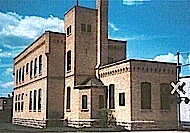
As I mentioned in the beginning, the marks Pabst made on Oshkosh were lasting. The old Pabst branch still stands on Division Street. It still looks good.

Here’s a bottle that was once filled with beer at the Pabst’s Oshkosh branch in the late 1890s.

A year after the Oshkosh branch was completed, Pabst was building again. This time it was a handsome saloon named the Pabst Exchange at the corner of 6th and Ohio streets. The Daily Northwestern commented that it looked like a castle. Notice how similar the design is to the property on Division.

Here’s a more recent photo of the old Pabst Exchange. A lot of people around here remember it as Beaner’s Shot & Beer.

For a time, Pabst appeared to be unstoppable. But the Milwaukee brewery was, in fact, far too bullish on Oshkosh.
While Pabst was staking its claim, the Oshkosh Brewing Company was mustering its retaliation. The rise of the OBC would thwart the Pabst incursion here. As OBC ascended in the early 1900s, the presence of Pabst in Oshkosh declined. The point was driven home in 1914, when OBC took over ownership of the showcase saloon at 6th and Ohio.
The Pabst branch on Division Street discontinued its bottling operations in the early 1900s. Pabst maintained the property as a warehouse and distribution center until Prohibition arrived in 1920. Pabst sold its Division Street property in 1925.
Blue Ribbon Beer poured again in Oshkosh when Prohibition ended in 1933. But by then, Pabst's Oshkosh castles had been taken by others.