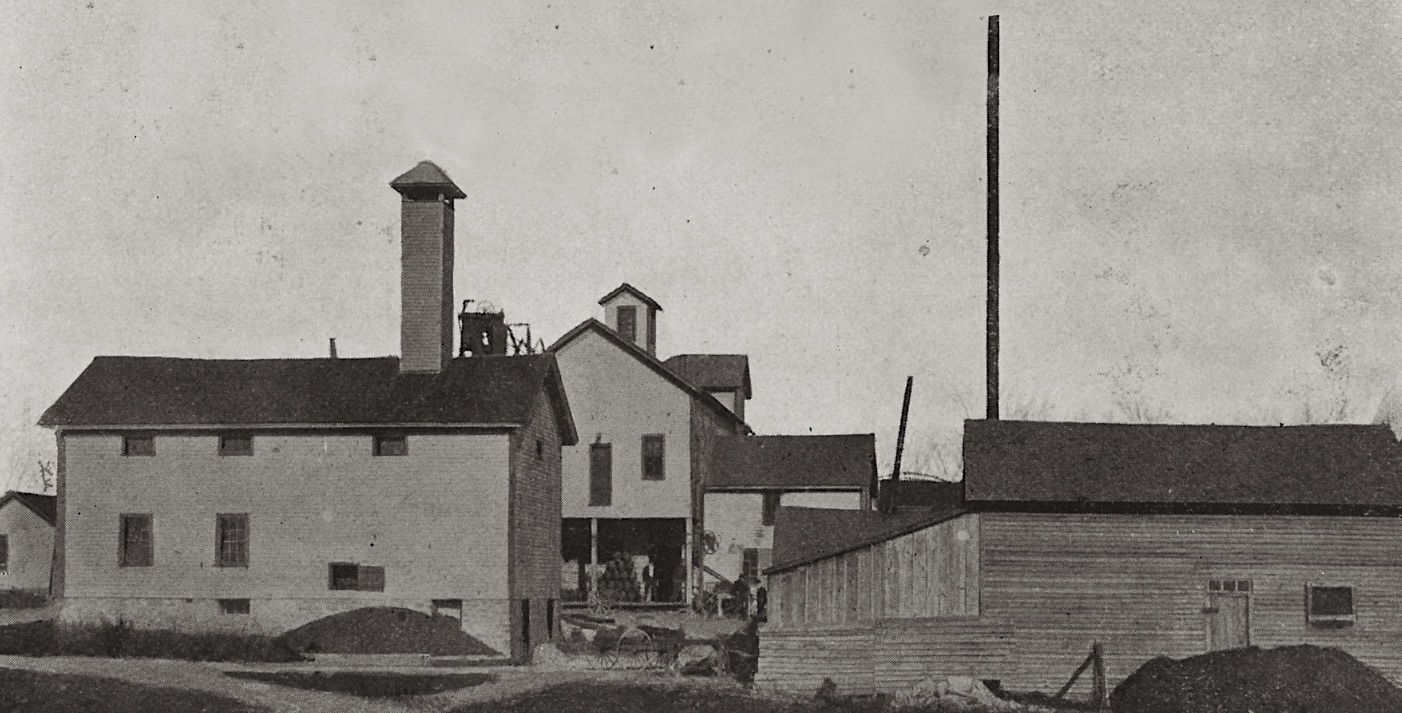
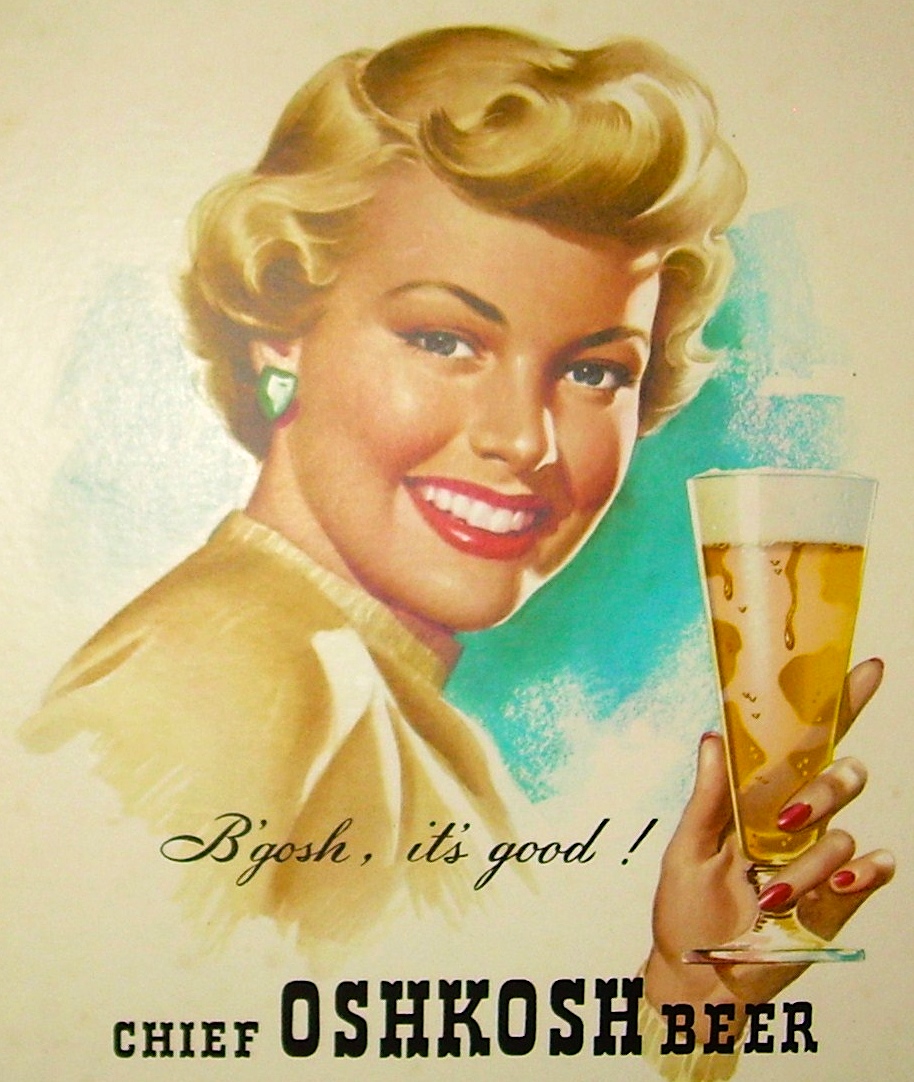
The Oshkosh Brewing Company remains the largest brewery this city has ever had. At its peak in the late 1950s, OBC produced over 60,000 barrels of beer annually. To put that in perspective, last year’s combined production of the three breweries currently operating in Oshkosh was less than 3,000 barrels. OBC was one of Wisconsin’s great, regional breweries.
 |
| Schlitz Hall at the corner of Washington and State was one of several properties owned by Schlitz in Oshkosh. |
At the same time, Oshkosh was home to four breweries. The local breweries had controlled the city's beer market for decades. But that control began slipping away after the larger, “shipping” breweries established a presence here.
The smallest of the four Oshkosh breweries was the Rahr Brewing Company at the foot of Rahr Avenue.
 |
| Rahr Brewing Company. |
Next in size was the Gambrinus Brewery on Harney Avenue.
 |
| Kuenzl's Gambrinus Brewery |
The John Glatz and Son Union Brewery at the foot of Doty Street was the second largest of the four breweries.
 |
| Glatz and Son's Union Brewery. |
The largest Oshkosh brewery was Horn & Schwalm’s Brooklyn Brewery on the east side of Doty Street south of 16th Avenue.
 |
| Horn & Schwalm’s Brooklyn Brewery. |
By 1893, the “foreign” competition had grown so intense that the Oshkosh breweries planned for a merger in hopes of reasserting control over the local market. The Rahr Brewing Company, determined to maintain its independence, bowed out of the discussions. On March 21, 1894, the Gambrinus, Glatz and Son, and Horn & Schwalm breweries merged to form the Oshkosh Brewing Company.
 |
| A composite rendering of the three breweries of the Oshkosh Brewing Company. The proximity shown here is an artistic fantasy. The three facilities were in separate locations. |
1894-1899: All Together NowOBC continued to operate the three breweries that had existed prior to the merger. Lager beer production was split between the Horn & Schwalm and Glatz breweries. The Gambrinus Brewery was converted into a bottling plant, and was later used for the production of Berliner Weisse.
 |
| The former Glatz and Son Brewery rebranded as the Oshkosh Brewing Company. |
An image of Chief Oshkosh was adopted as the brewery’s trademark. The illustration was based upon an 1855 daguerreotype of the Menominee leader. Oshkosh died in 1858.
Through the 1890s, OBC produced a wide-range of beers that reflected the European heritage of its founding breweries. Among the early OBC brews were a Bohemian-style Pilsner, a Vienna-style lager, and a dark, “Culmbacher” type bier. The brewery’s most popular beer was its Stock Lager dispensed from wooden kegs. This was a deep, amber brew sold at most Oshkosh saloons for five cents a mug.
 |
| The brewery’s line-up for winter of 1895. Oshkosh Labor Advocate, January 25, 1895. |
OBC sourced nearly all of the barley and corn for its beer from local farmers. The barley was converted into brewer’s malt at the malting facilities within the Horn & Schwalm and Glatz breweries. By the close of the 1890s, OBC was producing almost 16,000 barrels of beer annually from locally-grown cereal grains.
1900-1920: Years of TriumphThe Oshkosh Brewing Company succeeded in overcoming its larger competitors. By 1900, OBC was the source for 75 percent of all beer sold in the City of Oshkosh. The brewery’s thundering, horse-drawn beer wagons were a common sight here. OBC employed five teams delivering beer to every part of the city and much of the surrounding area.
In the early 1900s, OBC began acquiring saloon properties and converting them into tied-houses that sold no beer other than that brewed by the Oshkosh Brewing Company. A number of those OBC taverns remain, including Nigl’s and Jeff’s on Rugby. The well known Witzke Tavern at the corner of 17th and Oregon was built by OBC in 1902.
 |
| Witzke’s, early 1900s. |
By 1910, OBC was producing 30,000 barrels of beer annually. The rising output tested the limits of the brewery's aging facilities. OBC began construction of a new brewery in 1911. When completed in 1912, it was described as "one of the most modern and up-to-date establishments in the entire middle west.” It was built adjacent to the former Horn & Schwalm Brewery on the east side of Doty Street. The facility was six stories at its peak. The red-brick brewery became a southside landmark.
 |
| A new brewery and a new mode of delivery. This photo, circa 1915, shows the brewery at a time when it was transitioning from horse-drawn wagons to motorized vehicles. |
The variety of beer offered by OBC contracted as the brewery expanded. Pale, light-bodied lager became the norm during the first two decades of the 1900s. The lighter beers appealed to a younger generation of drinkers. Just as Oshkosh's foreign-born population was giving way to their American-born offspring, these pale beers supplanted the traditional, European-styles of lager beer that had been favored in Oshkosh since the 1850s. Gilt Edge was OBC’s premium, pale beer during the early 1900s. Here are a couple of advertising pieces for Gilt Edge that indicate the sort of audience the brewery was pursuing.
 |
| Gilt Edge drinkers in the early 1900s. |
The most dramatic change in the brewery's beer was yet to come. OBC began preparing for the inevitable as the country blundered its way towards National Prohibition. The brewery’s first non-alcoholic beer, named PEP, was released in 1919. PEP enjoyed a brief phase of popularity after Prohibition arrived in 1920. It was purchased in volume by “beer doctors” who would "needle" the non-intoxicating beer with moonshine, giving it the PEP promised by the advertising.
1920-1932: Curse of the Dry Years With the dawn of Prohibition in 1920, Oshkosh Brewing was forced to find alternate revenue streams to keep the business afloat. At OBC they were up for just about anything.
Among the more curious ventures was the Oshkosh Colytic Egg and Storage Company. The less than successful enterprise saw part of the brewery converted into a facility for pasteurizing and processing eggs. Another section of the brewery was leased to local farmers for grain storage. And then there was root beer. OBC made rivers of root beer during Prohibition.
But the heart of the brewery remained dedicated to something closer to beer. OBC continued to produce non-alcoholic beer throughout the dry years. The label below was used during the 1920s for the beer-like Oshkosh Beverage. It weighed in at a dispirited one-half of one percent alcohol by volume.
In 1928, OBC introduced its Chief Oshkosh brand. The first iteration of Chief Oshkosh was a non-alcoholic beer.
The “near” beers floundered as Prohibition dragged on. By the early 1920s, the City of Oshkosh was inundated with real beer produced by wildcat breweries and homebrewers. OBC served that market by supplying the black-market brewers with pre-hopped malt syrups that could be used to produce real beer. Malt syrup was key to the brewery's survival and continued being produced by OBC until beer was legalized in 1933.
1933-1940: Beer is BackAt midnight on Friday, April 7th, 1933, the steam whistle atop the Oshkosh Brewing Company let out a long cry of relief. Beer was legal again, though Prohibition had yet to be repealed. But the signing of the Cullen–Harrison Act subverted the intentions of the dry law by declaring that beer containing 4% alcohol by volume or less was too mild to intoxicate and, thereby, not subject to the strictures of the 18th Amendment. OBC was back in business.
The brewery rushed the initial run of 4% ABV Chief Oshkosh Beer onto the market in bottles bearing a hastily designed and printed label. Nothing fancy, just the facts.
Prohibition was fully repealed eight months later on December 6, 1933. At OBC they responded by kicking up the strength of Chief Oshkosh to 4.5% ABV. The stronger Chief was an immediate hit. By 1934, OBC’s annual production had spiked to over 45,000 barrels.
 |
| A Chief Oshkosh Beer lighted sign, Circa 1935. |
More and more of OBC’s beer was being packaged in bottles. Since the founding of the brewery, the majority of its beer had been sold in wooden kegs at saloons. But Prohibition had changed America’s drinking habits. Increasingly, people were drinking beer served out of their ice boxes and refrigerators at home. Over the next decade, bottled beer sales would surpass the sales of OBC’s keg beer.
Beer was back, but the 1930s remained difficult. Oshkosh was devastated by the Great Depression of the 1930s. The city’s population decreased for the first time. Oshkosh lost 40% of its manufacturing jobs and overall unemployment was estimated to be near 50%. The bleak economy led to stagnating beer sales. By the end of the 1930s, OBC’s production slumped to pre-Prohibition levels.
 |
| OBC, circa 1940. |
1940s: Wartime BeerThe economy slowly rebounded and a new set of troubles arose. Rationing became a way of life after America entered World War II in December 1941. Shortages of everything from grain to bottle caps forced brewers to get by with less of what they needed to produce and transport beer. The brewery began to rely heavily on quart and half-gallon “picnic-size” bottles to reduce the number of caps needed to package beer.
The war ended in 1945, but the after-effects lingered. OBC was rationing its beer well into 1946.
 |
| Oshkosh Daily Northwestern; May 15, 1946. |
At the close of the decade, the brewery had regained its footing and was looking to the future. In June of 1949, OBC became the first Oshkosh brewery to package its beer in cans. The 1949 canned version of Chief Oshkosh Beer came in a silver crowntainer.
1950s: A Brewery at its PeakAt mid-century, OBC hit its stride. The 1950s began with the reformulation of the Chief Oshkosh Beer recipe. Sales Director Lorenz “Shorty” Kuenzl described it as a “Pilsener beer that would appeal to all kinds of beer tastes in people.”
 |
| Lorenz “Shorty” Kuenzl at his office desk drinking a glass of 1950s Chief Oshkosh. |
Kuenzl was right. Sales of the new Chief Oshkosh Beer rose rapidly; from less than 40,000 barrels in 1949 to more than 58,000 barrels in 1953. It would become the best selling, most widely distributed beer ever produced by an Oshkosh brewery.
OBC celebrated its 90th anniversary in 1956, despite having been launched just 62 years earlier. Nobody seemed to notice the discrepancy. Afterall, there was plenty of free beer to be had. Beginning on May 22, 1956, the brewery invited the entire city to the brewery for a look around, a bite to eat, and a few beers on the house. Thirsty Oshkoshers turned out in droves.
 |
| Party at the brewery, 1956. |
In 1957, there were 42 breweries operating in Wisconsin. OBC was the 10th largest, producing 57,541 barrels of beer. The brewery’s peak came in 1959 when its production rose to 63,165 barrels. The regional powerhouse from Oshkosh appeared unstoppable.
 |
| During the brewery’s peak years, OBC’s delivery fleet traveled throughout the state. |
1960-1986: The Fall of OBC
In the 1960s, the American brewing landscape was remade. A wave of consolidation saw the industry being taken over by massive corporations such as Anheuser-Busch, Schlitz, Miller, and Pabst. Regional breweries like the Oshkosh Brewing Company were being squeezed out. Yet some of the smaller players survived. OBC with its robust growth, appeared uniquely poised to endure the culling. But there was one thing missing: the family-run business had run out of family.
 |
| Standing from left to right, OBC treasurer Earl Horn, president Arthur Schwalm, and secretary Lorenz “Shorty” Kuenzl. |
OBC was still directed by members of the Horn, Kuenzl, and Schwalm families. Those families had been at the helm since the inception. But the next generation of Horns and Schwalms, who together held the controlling shares of the brewery’s stock, wanted no part of the beer business. In August 1961, the two families sold their stake in the Oshkosh Brewing Company. The buyer was a man from Milwaukee named David Uihlein.
 |
| David V. Uihlein |
David Uihlein was no ordinary man from Milwaukee. His family owned the controlling interest in Schlitz Brewing. Schlitz was then the second largest brewery in the nation. Uihlein’s vision for OBC had nothing to do with overseeing its continued success. He had purchased the brewery with the intention of selling it to Schlitz; at a handsome profit, presumably. That plan fell apart when Schlitz president Robert Uihlein rejected his cousin’s offer. David Uihlein was left stranded in Oshkosh with a brewery he didn’t want.
 |
| OBC Brewmaster Wilbur Strottman (left) and David Uihlein in the OBC brewhouse. |
Initially at least, Uihlein seemed interested in making the best of his unenviable situation. He invested in new equipment, initiated an aggressive marketing campaign, and tried to expand the brewery’s distribution. But those efforts were accompanied by crucial errors. The most glaring was his change to the recipe for Chief Oshkosh Beer. Uihlein’s version of Chief Oshkosh was cheaper to brew. But the reformulated beer fell out of favor with long-time drinkers of “Oshkosh.” Sales plummeted.
 |
| Reformulated and redesigned. Chief Oshkosh cans from the Uihlein era. |
Under Uihlein, OBC expanded its portfolio in an attempt to reverse the slide. In 1966, the brewery purchased the brand rights to three beers that had been left for dead by failed breweries: Badger Brew from Effinger Brewing in Baraboo, Liebrau of Two Rivers Brewing, and Rahr’s of Green Bay.
The resuscitated beers didn't help. OBC's losses continued piling up. By the end of 1969, annual production had fallen to just 34,000 barrels; a 40% drop since Uihlein had taken ownership. David Uihlein sold his stake in OBC in 1969. He returned to Milwaukee where he took a seat on the board of directors of Schlitz. There he helped guide Schlitz to its ultimate demise.
 |
| Harold Kriz, who had been with the brewery since 1952, became president of OBC upon Uihlein’s departure in 1969. |
OBC was purchased by a coalition of Oshkosh residents and brewery employees doing business as Hometown Brewery, Inc. But there was little left to redeem. Chief Oshkosh was now a bargain-bin beer. The brewery that produced it had fallen into disrepair. The last batch of Chief Oshkosh was brewed on September 9, 1971. The following month, the Oshkosh Brewing Company announced its closing.
In November 1971, the brands of the Oshkosh Brewing Company were purchased by Peoples Brewing Company of Oshkosh. Chief Oshkosh Beer was brewed at Peoples until that brewery closed in 1972.
In 1986, the Oshkosh Brewing Company’s towering brewhouse was demolished after years of neglect.
The Chief Oshkosh emblem that was attached to the face of the brewery now resides at the Oshkosh Public Museum. The 800-pound, terra cotta piece went on permanent display at the museum in 2009.
Further ReadingAnd if that wasn’t enough… Here is a selection of links leading to articles that go deeper on aspects of the Oshkosh Brewing Company's history covered in this post.
The Formation of a Brewery In the late 1880s, Oshkosh became a distribution hub for some of America's largest breweries.On March 21, 1894, the Gambrinus, Glatz and Son, and Horn & Schwalm breweries merged to form the Oshkosh Brewing Company.1894-1899: All TogetherAn image of Chief Oshkosh was adopted as the brewery’s trademark.
Through the 1890s, OBC produced a wide-range of beers that reflected the European heritage of its founding breweries.1900-1920: Years of TriumphThe Oshkosh Brewing Company succeeded in overcoming its larger competitors.The brewery’s first non-alcoholic beer, named PEP.It was purchased in volume by “beer doctors” who would "needle" the non-intoxicating beer with moonshine.1920-1932: The Curse of the Dry YearsIn 1928, OBC introduced its Chief Oshkosh brand. The first iteration of Chief Oshkosh was a non-alcoholic beer.By the early 1920s, the City of Oshkosh was inundated with real beer produced by
wildcat breweries and
homebrewers.
1933-1940: Beer is Back!At midnight Friday, April 7th, 1933, the steam whistle atop the Oshkosh Brewing Company let out a long cry of relief.The 1940s: Wartime BeerIn June of 1949, OBC became the first Oshkosh brewery to package its beer in cans.The 1950s: A Brewery at its PeakThe new Chief Oshkosh Beer.OBC celebrated its 90th anniversary in 1956, despite having been launched just 62 years earlier.The 1960-1986: The Fall of OBC In August 1961, the two families sold their stake in the Oshkosh Brewing Company.Under Uihlein, OBC expanded its portfolio in an attempt to reverse the slide.OBC was purchased by a coalition of Oshkosh residents and brewery employees doing business as Hometown Brewery, Inc.In November 1971, the brands of the Oshkosh Brewing Company were purchased by Peoples Brewing Company of Oshkosh.In 1986, the Oshkosh Brewing Company’s once majestic brewhouse was demolished.The emblem bearing the image of Chief Oshkosh is now at the Oshkosh Public Museum.