Showing posts with label Horn and Schwalm Brewery. Show all posts

Tuesday, March 1, 2022

Oshkosh Underground

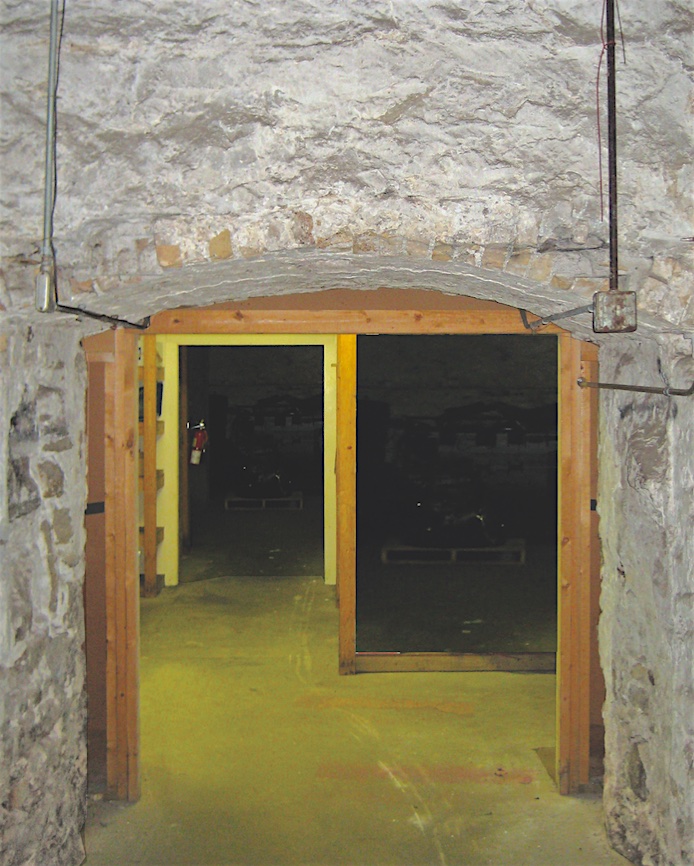
In the late 1860s, there were at least six sets of subterranean beer caves in Oshkosh. Here's the only set of those caves that hasn't been filled in. This picture was taken in 2012.


That's beneath the old Horn and Schwalm Brewery on the east side of Doty Street just south of 16th. If you could go back 150 years, you would have seen that cave packed with barrels full of lager beer in various stages of maturation and blocks of ice cut from Lake Winnebago to keep it cold.

Construction of the Horn and Schwalm caves began in 1865. Here's how it looks down there today.


The Horn and Schwalm Brewery.
The top photo is from the 1880s.
The bottom photo was taken last summer.

Just down the street there once was another set of elaborate caves beneath the Glatz Brewery. They've been filled in, but you can get a look at them here.

Monday, January 21, 2019

Beer Gone Bad

In 1888, Horn and Schwalm’s Brooklyn Brewery was the largest brewery in Oshkosh. That big facility on Doty Street was pumping out nearly 10,000 barrels of beer annually.

Horn and Schwalm’s Brooklyn Brewery.
The Brooklyn Brewery sat 100 yards from the shore of Lake Winnebago. That was a convenient place to be. Horn and Schwalm used their lakeside location to distribute beer on ships traveling the Winnebago waterways.


The beer they sent out on those ships was packaged in wooden kegs. They’d seal the insides of those kegs with molten pitch. When the pitch cooled it formed an antiseptic coating over the interior of the barrel, which helped prevent bacteria lurking in the wood from spoiling the beer. Here's one of those barrels from Horn and Schwalm’s Brooklyn Brewery.


Despite all the care, sometimes the beer in those barrels went bad anyway. Here's an instance of that happening as reported by the Oshkosh Daily Northwestern on April 4, 1888.

Floated Them to Shore
Capt. Bangs endeavored to land with the K.M. Hutchinson yesterday near Horn & Schwalm's brewery to unload a number of kegs of beer returned from a northern point as sour. The steamer became stuck and the captain was obliged to dump the kegs overboard and float them to shore.

The K.M. Hutchinson docked in Oshkosh, 1887.

Wooden kegs of sour beer being tossed off that boat and floating to shore on the south side of Oshkosh. I would have loved to have seen that.

The occurrence was a minor setback for Horn and Schwalm. The brewery continued its explosive growth into the 1890s when it merged with two other Oshkosh breweries to form the Oshkosh Brewing Company.

The K.M. Hutchinson didn't fare as well. It was once described as "the strangest vessel that ever plied the Fox and Wolf Rivers." The ship sank several times before catching fire in 1895 and burning down on a sandbar between Lake Poygan and Lake Winneconne.

Emelius Prawl Bangs, former captain of the K.M. Hutchinson (from Oshkosh Down Under).
After his ship was destroyed, E.P. Bangs needed a job. He wound up spending the summer on the south side running the horse carousel at EWECO Park. A single season of that was enough for Bangs. When summer ended, he launched Bangs Rapid Transit Company. He had one horse and one wagon.

Bangs Rapid Transit in front of the Oshkosh Public Library (from Oshkosh Down Under).

Bangs had better luck carting his freight on land. His transit company, which became E. P. Bangs Trucking, operated in Oshkosh until 1981. Bangs was long gone by then. He died in 1930 at the age of 75. They still called him Captain. Bangs is buried in Riverside Cemetery.


For more on E.P. Bangs and his transit company, check out Julie Krysiak Johnson’s excellent book Oshkosh Down Under.

Monday, July 24, 2017

Brewers Behaving Badly: The 300-Pound Krall

Now for a dash of local color. Our tale is ripped from the pages of the Oshkosh Daily Northwestern of Wednesday, January 16, 1878.

Let’s set the stage. We’re visiting Horn & Schwalm’s Brooklyn Brewery on the east side of Doty St. just south of 16th Ave. At the time, the brewery appeared as you see it below. Here we go...


A police court drama was enacted in Justice Sarau's office yesterday.

C. F. Rogers, a farmer, took a load of barley to Horn's brewery to sell, and got into an altercation with Horn's foreman, a stout, 300-pound German named Krall, who pounced upon Mr. Rogers and pounded him somewhat.

Rogers had Krall arrested, and the latter was fined $2 and costs.

Krall was inconsolable and immediately had Rogers arrested for calling him names.

Rogers in turn was fined $2 and costs, which made the 300-pounder happy, and thus the matter ended.

Sparring outside of the Horn & Schwalm Brewery, 1885.

Monday, November 7, 2016

Pieces of a Brewery

I want to expand on something I mentioned in last Monday’s post that involved this picture.


That’s a lithograph produced for the Oshkosh Brewing Company at the turn of the century. But as I said last week, the brewery looked nothing like this. This print shows an amalgamation of OBC’s three separate brewing facilities. Each was located in a different part of town.

Let’s break this down. First, here’s the piece of the picture that represents the OBC facility located at what is now 1235-1239 Harney Ave. Prior to the formation of OBC in 1893, this was Lorenz Kuenzl’s Gambrinus Brewery.


It’s difficult to see, but the sign on the building with the flag flying over it says “Bottling Dept.” At this point OBC was bottling its beer here. That building had been used as an ice house when the Gambrinus Brewery was in operation.

As you’ll see, the artist took a few liberties with the subject. Here’s the real thing.


Now we head to the south side of town. They used to have a pet name for it: Brooklyn. I wish that were still an Oshkosh colloquialism. Anyway, at the end of Doty Street, in what is now the 2400 block, stood one of OBC's two brewhouses. This was formerly John Glatz and Son’s Union Brewery.


And here’s what that piece of OBC actually looked like.


Just up the road from the old Glatz Brewery was OBC’s other brewhouse. This was once known as Horn and Schwalm’s Brooklyn Brewery. Here’s the part of the lithograph showing that brewery. It was located in what is now the 1600 block of Doty Street.


Notice that it has “Established 1865” on the gable atop the malt house. That’s one of the few times OBC got its starting date right. That’s the date when Leonhardt Schwalm launched the Brooklyn Brewery, the oldest of the three breweries that merged to form OBC.

Here’s what the old Brooklyn Brewery really looked like.


Part of that brewery still stands. It’s the only piece of this picture that remains. This is what it looks like today.


The color lithograph wasn’t the first stab OBC took at painting itself larger than life. Here’s a drawing of the brewery from 1898. This one is even more delusional.


OBC certainly wasn’t unique in doing this sort of thing. At a time when photography was less common, brewery images were most often rendered by hand. And more often than not the artists aggrandized their subject. Here’s another example. This is a late-1800s drawing of the Glatz Brewery. The artist added a third floor to it.


And here’s an 1891 ad with a drawing of the Brooklyn Brewery. Again, an extra floor was added.


One last photo. Unfortunately, I don’t know when this was taken. I’m guessing it was shot somewhere around 1905-1910. This the former Glatz Brewery after it had been rebranded as the Oshkosh Brewing Company. These days it’s the home of Glatz Park. They don’t build ‘em like this anymore…


Monday, June 27, 2016

High Times & Horror at Horn & Schwalm’s

In the late 1800s, no brewery in Oshkosh received more attention than Horn & Schwalm’s Brooklyn Brewery. It seemed something was always happening there. Newspapers in Oshkosh were all over it, publishing stories about the brewery that ran the gamut from the absurd to the tragic.

The best aspect these stories is the way they avoid conventional brewery trope. They’re not about beer production or business. They’re about people. They’re rare intimations of what daily life may have been like at Oshkosh breweries of this period.


I want to share a few of these stories. We’ll start light and end in a very dark place. Here’s one about a horse...

Oshkosh Daily Northwestern, Monday March 24, 1890
A couple things about that story: This occurred at a time when Oshkoshers were bickering about Sunday beer sales and the non-enforcement of Blue Laws. Not a word is mentioned in the story about the brewery selling kegs of beer on a Sunday night. But I’ll bet that’s the first thing the prudes in town clucked about after they read the article on Monday.

That keg of beer is also worth noting. Remember, this was a time when bottled beer was an extravagance. Most folks drinking beer at home were doing just like Burkhardt Krieger. They were bringing their beer home in kegs, often purchasing it directly from the brewery. They didn’t have kegerators either. What they were drinking was gravity flow, cask lager. I’ll bet it was delicious.

Here’s one of those kegs from Horn & Schwalm’s Brewery. The keg Krieger’s horse made off with would have looked just like this one. You can’t see it from this angle, but “Horn & Schwalm” is branded into the wood on the top side of the barrel seen here.


Here’s a story that's positively bucolic. The newspaper I found it in was in rough shape, so I’ll transcribe it.

A Novel Sight
A novel sight attracted the attention of the passer by in the vicinity of the Brooklyn Brewery yesterday forenoon. It was no less than 26 wheelbarrows filled with grain and manned by 26 stalwart women that caused the usual listless pedestrian to gaze with considerable interest at the usual go-as-you-please race with grain for the sweepstakes. The women were those of the neighborhood wheeling malt and the refuse of the brewery for their pigs.
  - Oshkosh Daily Northwestern, Friday, September 28, 1883

Too bad you’re not allowed to keep pigs in town anymore. I’d like to have a pig. Back then on Doty Street there were plenty of families keeping a porker or two.

By the way, Oshkosh breweries still dole out their spent grain as animal feed. Both Bare Bones Brewery and Fox River Brewing have arrangements with local farmers who use the brewhouse leftovers as livestock feed.

I have to include this next one because it’s about one of my favorite subjects….


TRAMPS
They Have Been Congregating in Oshkosh Recently by the Hundreds
Tramps have been infesting this city in unusually large numbers for the past few days. Monday night twelve were lodged in the city lock-up and the patrol wagon is kept busy bringing the vagrants in from the suburbs. The residents of the outskirts are the principal sufferers. Out where the police are not so apt to reach them the vagrants are more bold and insolent. One of the favorite resorts fro tramps is Horn & Schwalm’s brewery. They fairly haunt the place in the hope of begging beer from some of the employees about the place. Usually they are let off by being ordered off the place or if they are too persistent one of the large brewers brings his boot into play.
    - Oshkosh Daily Northwestern, Wednesday, December 31, 1890

A boot in the ass! On New Year’s Eve, no less. Oshkosh was beset with tramps all through the late 1800s. The city tried a number novel solutions to stem the transient tide. For example, in the 1880s Oshkosh cops were paid a bonus of 37 cents (about $6.50 in today’s money) for each tramp they collared. That didn’t help.

They finally hit upon a solution. A workhouse was established near 17th and Knapp. Tramps pinched in Oshkosh were sent there to pass their time breaking rocks. By the turn of the century, word had spread among the wandering tribe that Oshkosh was no longer hospitable. Problem solved.

Here’s an interesting tidbit. One of the people who played a role in the establishment of the workhouse was Fred C. Horn, a member of the same family that owned the Horn & Schwalm Brewery. I guess kicking ass stopped being fun after a while.

OK, I warned you we were headed for a dark place. Here we are. Abandon all hope, this one is utterly bleak.  Here’s a story that hints at just how different the lives of these people were from our own. Prepare for some old-school nihilism.

Dead Infant Found
The body of a dead infant was found last Thursday near Schwalm’s Brewery on the south side. One arm and one leg were eaten off evidently by dogs. The body was turned over by the Poor Commissioner and buried without an inquest or further investigation as it was concluded that formal proceedings would be useless expense.
 - Oshkosh Daily Northwestern, Monday, October 4, 1875

Let that sink in.... A dead baby found half eaten by dogs and nobody cares to investigate it.

Imagine the uproar that would ensue if it happened today. It would be national news instead of a 9-line blurb consigned to an inside page of a local paper. No doubt there’s more to this story. The rest of it was taken to the graves of those involved. Maybe that’s for the best.


Monday, June 20, 2016

Boiled Alive!

Here’s a tragic tale. I first came across this about five years ago. It made my stomach turn then. Same thing now. I’ve touched on this incident a couple times before, but never posted the entire, gruesome episode. Well, here it is...

We’re back at Horn & Schwalm’s Brooklyn Brewery located at what is now the 1600 block of Doty St.


On the Friday evening of February 2, 1872, a young brewer named Leonard Schiffmann was finishing up a long brew day when things went horribly wrong…

BOILED ALIVE
A Man Falls into a Vat of Boiling Beer
On Friday, a young man named Leonard Schiffman [sic], employed in Schwalm’s Brewery, Third Ward, met with one of those horrible accidents which occasionally startle the community and make us wonder at the carelessness of human nature.

A large vat, seven or eight feet deep had just been filled with hot beer which had just been drawn off from out of the kettles where it had been boiling. A plank lay across the top and Schiffman attempted to cross it. The room was dark and in groping his way across, poor Schiffman slipped and fell into the seething hell beneath him. Fortunately he grasped the plank and saved himself from a descent which would have ended his career at once. As it was, he descended into the boiling liquid as far as his waist, and then, after struggling for several minutes, during which his lower limbs were in the boiling beer, he succeeded in extricating himself, with the assistance that his agonizing screams soon brought to his aid. Dr. C. and F.H. Lind were at once sent for and they did what was possible for his relief.

His flesh is boiled and his recovery is very doubtful. The physicians think that the amputations of one or both limbs may be necessary, and even in that event he may not recover.
  - Oshkosh Weekly Northwestern, February 8, 1872

A double amputation in 1872 would have been as torturous as his plunge into the boiling liquid. He was spared that additional agony. Three days after his accident, Schiffmann died on Tuesday, February 13, 1872. I haven’t located his exact birth date, but he would have been about 22 years old at the time of his death.

Some background on young Schiffmann: He was born about 1850 in Prussia and immigrated to America with his parents and siblings sometime prior to the Civil War. The family had reached Oshkosh by 1865.

Early on, Schiffmann worked here as a carpenter while living above his father’s saloon on the east side of what is now the 400 block of N. Main.

But the Schiffmann’s were brewers. In addition to the saloon, his father operated a Weissbier brewery in Oshkosh, first on N. Main and later on Doty. And Leonard’s older brother Andrew appears to have preceded him into the Horn & Schwalm brewhouse.

Leonard Schiffmann took up the brewing trade just months prior to his death. The 1872-1873 Oshkosh City Directory lists his occupation as “saw filer and carpenter.” That directory was being compiled about the same time Schiffmann was changing careers. A move in the direction of a very bad end.

Monday, June 6, 2016

Fire at the Brooklyn Brewery!

Saturday Evening, March 29, 1879...
Brewers at Horn & Schwalm’s Brooklyn Brewery are nearing the end of a long brew day. Suddenly, fire breaks out near the boil kettle. The brewers respond quickly.  They’ve been through this before. With pails of water, they wash down the flames before the fire can spread. Catastrophe averted. This time.

Fire was a constant concern at the Brooklyn Brewery. The wood-frame building was not even 15 years old, but it looked much older. Its vernacular architecture was out of step with the production facility it was being used as. In 1878, Horn & Schwalm had produced 1,366 barrels of beer. Walking by, you wouldn't guess the place capable of it.

Horn & Schwalm's Original Brooklyn Brewery
Lit by candles and fueled by wood and coal, the the Brooklyn Brewery was an accident waiting to happen. A few hours after the Saturday-night fire in the brewhouse had been doused, the waiting ended. The brewery went up in flames.

BREWERY BURNED
Total Destruction of Horn & Schwalm’s Brewery
About five o’clock Sunday morning the brewery on Doty street just south of 16th which is owned by A. Horn and Leonard Schwalm’s estate was totally destroyed by fire… about four o’clock the building was discovered by neighbors in a mass of flames. Two or three employees slept in the brewery and they barely had time to escape… The brewery itself was totally consumed together with a large amount of stock both in grain and beer.
 - Oshkosh Daily Northwestern, March 31, 1879

Bad enough, but it could have been much worse. Until recently, the Horn and Schwalm families had been living above the brewery. But with the the business and its output growing, both families had moved to separate dwellings nearby. They had homes, but their brewery was gone.

The impact was devastating. The fire destroyed nearly $500,000 (in today’s money) worth of equipment, beer and property. Insurance covered half the loss. The Horn and Schwalm families bore the rest. But there was no compensating for the loss of future business.

The Brooklyn Brewery headed into the summer of 1879 without a product. Beer has always been a somewhat seasonal commodity, but that was especially so in the late 1800s. The brewery relied on brisk sales during the warm months to fund the winter brewing season of its cool-fermenting lager beer. In the summer of 1879, the Brooklyn Brewery had no beer to sell.

Instead of peddling beer, they went to work building a new brewery. By July it was taking shape. This one was nothing like the rustic, wooden brewery they had lost.

New Brewery Building 
The brewery of Horn & Schwalm on Doty street near the city limits, which was burned last winter, is being rebuilt on quite an extensive scale. The building is now up as far as the second story. It is of solid brick with massive stone foundation, and is being built as nearly fire proof as possible, all the rooms being arched in brick and with little wood about them. The main building is 45 by 60 feet, and will be three stories high, which, with the half underground basement, makes a building practically four stories high. All the modern improvements are being put into it, and when completed it will be the largest and finest brewery in the state outside Milwaukee. Later in the season immense ice houses and other additions will be built. The brewery will be in full operation in about a month.
 - Oshkosh Daily Northwestern, July 15, 1879

Here’s a look at the completed brewery. The wooden structure with the cupola was the malt house. The brick brewery is to the right.


This was a brewery built to last. And it has. The malt house is gone, but brewhouse that was the core of the Brooklyn Brewery still stands. It’s the oldest intact brewery structure in Oshkosh. Here’s how it looks today.


Below the original brewhouse, you can still see the aging cellars with their “rooms being arched in brick.” Here’s a look.


This part of the Horn & Schwalm story ends well. The new Brooklyn Brewery soon surpassed its south side rival, the John Glatz & Son Brewery, to become the most productive brewery in the city. By the time Horn & Schwalm merged their operation with that of Glatz and Kuenzl to form the Oshkosh Brewing Company in 1894, the Brooklyn Brewery had become Winnebago County’s leading brewery.

Monday, May 2, 2016

The End of the Dancing Days

This agreement made and entered into this 15th day of May 1893 by and between J. Glatz and Son, a partnership, party of the first part, Horn and Schwalm, a partnership, party of the second part and Lorenz Kuenzl party of the third part, all being brewers and wholesale dealers in beer in the City of Oshkosh …. agree as follows… 

So begins the last ditch effort of Oshkosh’s three largest brewers to save their own hides. By the spring of 1893, Oshkosh’s breweries had lost their lock on the local beer trade. The city was swamped with beer sent in by some of America’s largest breweries (for more on that see this, this and this). The local brewers were in a panic.  
Faced with the dread prospect of having to compete with breweries that dwarfed them, three of the four Oshkosh breweries scrambled to contrive a united front against the onslaught. The old rivals were now allies. Together, they created a binding agreement to prevent each of them from undercutting the others.

From left to right, Oshkosh brewery owners John Glatz, Lorenz Kuenzl, and August Horn
The lone hold out was Rahr Brewing. Rahr was the smallest brewery in town, but its numerous tied-house saloons helped to buffer competition. The Glatz, Horn & Schwalm, and Kuenzl breweries had no rampart. And little trust in one another. The agreement the brewery owners hammered out was restrictive, rigid, and doomed to fail. The dancing days were over. Literally.

The agreement of 1893 had three main provisions.
  1. The price of beer would be fixed at $7.20 a barrel after discounts were applied (the actual list price was hiked to $8 a barrel).
  2. The brewers and their delivery men would be limited as to the amount of money they could spend at saloons “treating” customers when delivering beer or making collections.
  3. The brewers would not be allowed to spend money at “dancing parties” held at saloons.
That last restriction sounds innocuous, but those “dancing parties” were hardly innocent affairs. More on that later. First the beer.

At the time of this agreement, beer was selling for $6.40 a barrel. Jacking your price by 80 cents a barrel when you’re facing a pack of competitors ready and willing to sell cheaper isn’t going to endear you to your customers. This part of the pact dissolved almost immediately.

The limits on treating customer’s wasn’t going to increase their popularity either. It was expected that a brewer buy a round for the congregation when he visited a saloon. It was an Oshkosh tradition, one that would last well into the 1950s. The brewers couldn’t have picked a worse time to turn stingy.

Oshkosh was at the cusp of the brutal depression that followed the Panic of 1893. Unemployment was high and growing worse. New construction was headed for a screeching halt that triggered local woodworking plants to shed workers.

It didn’t help that at this same time, the men who owned Oshkosh's breweries had taken up residence in splendid homes that made a show of their wealth. Here’s a couple examples of their opulent digs.


This is where August Horn, president of Horn & Schwalm’s Brooklyn Brewery, lived at what is now 1662 Doty Street.


Just down the road, the mansion of Glatz Brewery president, John Glatz was being built. That home is still there, too. It's at 2405 Doty St.

Finally, we come to those dancing parties. This is impossible to confirm, but I suspect this part of the agreement is a veiled allusion to paying for prostitutes.

In the 1890s, saloons were almost exclusively the domain of men. And that’s just the way most saloon keepers meant to keep it. But at the same time, they knew that bringing in women who put out was good for business. Thus was born the dancing party, wherein ladies of a certain vocation were welcomed in to provide carnal entertainment.

Some considered it a spectacular problem. The pages of the Oshkosh Northwestern were littered with references to such parties and the inability of the mayor or police to reign them in. Here’s a typical Northwestern screed from the era that alludes to illicit dance parties taking place at the Getchius saloon, located upon the grounds of what is now West Algoma Park.

The institution over which Mr. Getchius presides was originally an ordinary saloon, but the rural aspect of its surroundings apparently infused the proprietor with the idea that his enterprise would reap a reward if he built an addition to the building where he could hold those "select dancing parties" so popular in the vicinity of Devil's bluff and other parts of Oshkosh. The proximity of residences to his place of business had no terror for Mr. Getchius, and during the summer season of '89 he erected the dance hall where, for months thereafter, the feet of lewd women and tougher men knocked out time to the tunes of a cracked orchestra.
    – Oshkosh Daily Northwestern, February 27, 1890

Fun! Were the brewers here actually helping to finance the flesh trade in Oshkosh? It appears that may have been the case.

Overall, the agreement of 1893 was a poorly aimed stab at trying to bring back the salad days for Oshkosh’s breweries. The attempt wasn't even remotely successful.

A year later, Glatz, Kuenzl, and  Horn & Schwalm took a more drastic measure. They merged their three breweries to form the Oshkosh Brewing Company. This tactic worked.

By 1900, the Oshkosh Brewing Company attained utter domination of the Oshkosh beer market. But this city would never again have the multitude of breweries that existed prior to those big breweries coming to town and forcing the hands of our local brewers.

Monday, November 9, 2015

Then and Now: Horn & Schwalm's Brooklyn Brewery

Here we have a couple of pictures of the same building. We'll be looking east from Doty St. just south of W. 16th Ave. The first shot isn't dated, but appears to have been taken in the late 1880s when it was Horn & Schwalm's Brooklyn Brewery. The picture immediately below it was taken yesterday afternoon. It's now the home of School Stationers Corporation. Built in 1879, this is the oldest intact brewing structure in Oshkosh.


Over the years I've somehow managed to sidestep posting anything here resembling a thorough overview of this brewery. Time to fix that. Here's a chronology of the lead-up and significant events related to Horn & Schwalm's Brooklyn Brewery.

1851
A 25-year-old German brewer named Leonhardt Schwalm emigrates from his native Saxony. He settles in Winnebago County in the Town of Nekimi.

1852
At the age of 17, August Horn emigrates from Bavaria with his parents Gottlieb and Barbara Horn. The family establishes a farm south of Oshkosh in the Town of Black Wolf.

1858
Schwalm opens a saloon on the south side of Oshkosh in the old 3rd Ward (the precise location remains unknown). An early advertisement for the saloon announces that Schwalm is serving “Excellent Lagerbier,” which he had “Attentively” made.

1862
Schwalm leases the Lake Brewery from Anton Andrea. He produces beer there until 1865.

1865
October: Schwalm purchases four lots south of what is now W. 16th Ave. between Doty and S. Main St. He begins planning his brewery in Oshkosh. It will become the first full-sized production brewery in Oshkosh to be located south of the river.

November: Leonhardt Schwalm purchases the Butte des Morts Brewery from his brother Louis Schwalm.

December: Schwalm sells the Butte des Morts Brewery to Frederick Bogk.

1866
The Schwalm Brewery on the south side of Oshkosh is producing and selling lager beer. There are now six breweries operating in Oshkosh.

The Original Schwalm Brewery

Schwalm sells half his interest in the brewery to August Horn. The two are related by marriage. The brewery is known early on as the Schwalm and Horn Brewery.

August Horn

1870
More than twenty people often reside at at the brewery, including the 15 children of the Horn and Schwalm families. The staff of brewery workers share living quarters with the two families.

1872
Brewery worker Leonard Schiffmann dies after falling into a deep vat of boiling wort at the brewery.

1873
Leonhardt Schwalm dies unexpectedly. He is 45 years old. His cause of death isn't revealed in the reports of his passing. The Schwalm family remains involved in the brewery's operations.

1878
The brewery has come to be known as Horn & Schwalm's Brooklyn Brewery. It is the second largest of the six breweries operating in Oshkosh producing 1,366 barrels of beer. The Glatz Brewery is the largest producing 1,530 barrels of beer.

A sign at the entrance to Charles Raasch's Main St. Saloon in Oshkosh advertising Horn and Schwalm's beer

1879
The brewery and its store of beer are destroyed by fire. Horn & Schwalm post no production for the year. Following the fire, a new brewery is built at the same location. Constructed of brick, the brewery is 45 x 65 feet with three stories above ground and a large beer cellar below. It has an annual capacity of 3,500 barrels. It is described as the best-equipped brewery in Wisconsin outside of Milwaukee.

The stone-arch entrance to the beer cellars is still intact

A fire insurance map of the 1879 brewery

Leonhardt Schwalm's 21-year-old son, Theodore Schwalm, becomes co-proprietor of Horn & Schwalm's Brooklyn Brewery.


1883
Theodore Schwalm is placed under Guardianship due to his excessive drinking. He is 25 years old.

1885
The Brooklyn Brewery helps to launch Oshkosh’s Anti-Prohibition Association.

A tornado hits the brewery. The brewery's barn and several of its outbuilding are destroyed. The brick brewery built six years earlier goes unharmed.

Aftermath of the 1885 tornado

1888
Theodore Schwalm dies. Death is attributed to his damaged liver. His widow, Sophia Schwalm, becomes the brewery's co-proprietor with August Horn.

Theodore Schwalm

Horn & Schwalm's Brooklyn Brewery begins a period of rapid expansion. Production increases to approximately 10,000 barrels annually.

1891
Expansion of the brewery continues. Capacity is increased to 20,000 barrels.
The Brooklyn Brewery becomes the first brewery in Oshkosh to use mechanical refrigeration.
This is now the the largest brewery in Oshkosh. Its beer is being exported to counties in the surrounding area.

1893
The panic of 1893 coupled with increased competition from Milwaukee breweries wreaks havoc for Oshkosh brewers. Horn & Schwalm enters into an agreement with the Glatz Brewery and Kuenzl's Gambrinus Brewery to fix prices on beer sold in Oshkosh. During this period, such price fixing schemes are legal.

1894
Horn & Schwalm's Brooklyn Brewery merges with the Glatz Brewery and Kuenzl's Gambrinus Brewery to form the Oshkosh Brewing Company. August Horn is named the brewery's first president.

Can you pick out the Brooklyn Brewery within this image?

1894-Today
After the 1894 merger, this facility continued in operation. It transitioned into a bottling plant and offices following the construction of a new brewery on the property in 1912. After the closure of the Oshkosh Brewing Company in 1970, ownership of the property changed several times before being purchased by Robert Stauffer in 1986. The property is currently owned by Robert Stauffer, Jr.

Want more? In the past, I've posted a number of stories relating to Horn & Schwalm on this blog. You can find those here.

Monday, November 17, 2014

Then and Now: The Oshkosh Brewing Company

Click the image for a better view.

The top photo shows the Oshkosh Brewing Company, ca 1915.
The photo beneath it was taken yesterday at the same location: the east side of Doty St. south of 16th Ave.

The tall building in the forefront was the brewery of the Oshkosh Brewing Company. Construction of the brewery began in 1911 and was completed in 1912. The Oshkosh Brewing Company closed in 1971. The brewery was demolished in 1986.

The building in the background was built in 1879. A portion of that building remains. It had formerly been Horn and Schwalm’s Brooklyn Brewery. It became part of the Oshkosh Brewing Company when the business was incorporated in 1894. After completion of the new brewery in 1912, the older building was converted into a bottling plant and offices.

For more on the Oshkosh Brewing Company and the history of beer and brewing in Oshkosh, visit the Oshkosh Beer Timeline.