Showing posts with label Wildcat Breweries. Show all posts
Showing posts with label Wildcat Breweries. Show all posts
Sunday, October 17, 2021
Wildcat Breweries of Oshkosh | Librarian Learns
Prohibition was the law in the 1920s, but in Oshkosh the beer never stopped flowing. It was made by wildcat breweries in almost every part of the city. Here’s a video Michael McArthur of the Oshkosh Public Library and I made where we check out a few of Oshkosh’s wildcat brewery sites.


Sunday, April 12, 2020
Rounding Up the Wildcats
Here's one of the great ironies of Prohibition in Oshkosh: when beer was legal in 1919, there were three breweries in this city. When brewing was illegal, from 1920 to 1933, Oshkosh had no fewer than a dozen breweries. And there were almost certainly many more. These were secretive, outlaw operations. We’ll never know how many there may have been.

I've been able to confirm the locations of 12 Oshkosh wildcat breweries that produced real beer during the dry years. I've made an interactive map that shows the location of each of them. Most of the entries on the map also include a link leading to the backstory of each brewery. For the full view of the map, CLICK HERE and take a tour of our city’s hidden history.

I've been able to confirm the locations of 12 Oshkosh wildcat breweries that produced real beer during the dry years. I've made an interactive map that shows the location of each of them. Most of the entries on the map also include a link leading to the backstory of each brewery. For the full view of the map, CLICK HERE and take a tour of our city’s hidden history.
Tuesday, April 7, 2020
Brewing Wildcat Beer in Oshkosh
Oshkosh didn't quit its beer habit when Prohibition hit in 1920. After the city's established breweries ceased production a swarm of illegal breweries emerged. They were called wildcat breweries. They flooded Oshkosh with beer.
The wildcats operated in ways that were similar to that of their licensed predecessors. They brewed, they kegged, they bottled, and they distributed. Their beer was sold, albeit illegally, in the same places that had previously taken their beer from Peoples Brewing, Rahr Brewing, or the Oshkosh Brewing Company.
The federal raids that occurred on Oshkosh's wildcats led to court cases and newspaper reporting that shed light on the inner workings of these breweries. More revealing, yet, is a 1980 interview with former Oshkosh bootleggers Cyril (last name withheld) and Ed "Slim" Suda. Cyril and Slim were brewers of wildcat beer in Oshkosh.
"There were breweries all over town," Slim said. "A lot of them were small places. Some were in the basements of homes."
But this wasn’t homebrewing as we know it today. These breweries made beer on a commercial scale. When the brewery in the basement of the Safford family home on Kentucky Avenue was raided in 1930, Federal agents found more than 2,000 gallons of finished beer on hand. Enough to fill almost 900 cases of beer.
Producing that much beer in the basement of a home like that one would have been impossible if not for the assistance of breweries that had been established before Prohibition. Those breweries could no longer legally make beer. But they could produce and sell wort.
Wort is the sugary, liquid precursor to beer made from a mash of water and malted barley. It gets dosed with hops and then boiled prior to being fermented into beer. The production of wort in volume required a set of skills, equipment, and real estate most wildcat brewers had little hope of attaining. But there was no need for that. Not when there were so many strapped legal breweries in the immediate vicinity happy to provide all the wort you could ever want.
So, the first step in the brewing process for the wildcats was a visit to one of those suffering, law-abiding breweries to purchase a thousand gallons or so of wort. "We done business in Waupun with Arnold Peterson," Slim said. "Butch Youngwirth (head of another wildcat brewing outfit in Oshkosh) done business over in New London with Knapstein."
Both the Waupun Brewing Company and the Knapstein Brewing Company were being used as wort manufacturing facilities in the service of bootleggers.
"You had to bring it back and dump it in the working tank and add yeast to it and let it work out," Cyril said. The "working tank" was the fermentation vessel where the wort, inoculated with yeast, fermented into beer. The size of these tanks varied depending upon the location of the brewery.
In the home-based basement breweries, the working tanks tended to be smaller and more numerous. Some were made of wood and lined with pitch. Others were earthenware crocks. In these breweries, 50-gallon tanks were often employed.
Larger tanks were used in the breweries that could accommodate them, such as those located on farms or in outbuildings. The working tanks at these breweries typically had a capacity of 10 barrels or more. Large enough to produce approximately 130 cases of beer per batch.
"Most of those breweries had four tanks, some of them five tanks," Cyril said. These were open vessels made of wood. "You'd get the tanks soaked and tight and then you could go right in business," Slim said. "We'd make five batches a week. That would be the top."
"Sometimes it worked faster than others," Cyril said. "You had to wait until it had worked off or else you couldn't get it in the bottle. It would blow the bottle up." It didn't always go according to plan. "A batch might spoil," Slim said. "You could get bacteria in it and it would go sour on you. You had to let her down the sewer then."
In the basement breweries, the aroma of so much beer fermenting in a confined space would have been overwhelming. "They'd have a vent going out the chimney," Cyril said. "The atmosphere took most of the smell."
Where everyone in the neighborhood could enjoy it. These breweries were hardly inconspicuous. But for the most part, they were accepted in Oshkosh. "You couldn't have stayed in business two weeks if the officials would have taken their job the way they were supposed to," Slim said. "But that was out of their line. They didn't care as long as you didn't bother anybody. You were giving the people something that they wanted. They wanted it themselves."
After fermentation, the beer was filtered and transferred to either another set of tanks or barrels for carbonation. "They had carbonating stones they run it through there and they carbonate it," Cyril said. "They didn't catch the regular gas off of the fermenting beer. They had no way of doing that."
Bottled beer required extra steps. "We had to wash all the bottles by hand in them days," Cyril said. "And they had an old steam boiler they used to pasteurize it with. They run that up the smokestack so they didn't see no smoke coming off of the steamer."
Slim recalled a bottling operation they had set up in a home-based brewery in Oshkosh. " I had the pasteurizer in the basement," he said. "Battis made the boiler so you could get it into the basement through the door. We'd pasteurize 125-130 cases of beer at a time. It got hotter than hell down there. After we moved out of there this thing dried up and everything opened up. The old hardwood maple flooring opened up. There was cracks all over in the house from all that steam from pasteurizing beer."

From the brewery, the beer was delivered to scores of nearby saloons that had been rebranded as "soft drink" parlors when Prohibition began. In 1931, federal investigator Frank Buckley said he counted 120 such places in Oshkosh. How many of them sold wildcat beer? "About 100 percent sold it," Cyril said. "If you didn't, you couldn't stay in business."
The wildcat breweries made their deliveries much like their licensed counterparts had before Prohibition. "You didn't hide it," Cyril said. "You put it out in the shed and they rolled it in and tapped it. And they always had some near-beer tapped beside it. All the breweries, they all made near beer... Peoples, Oshkosh, Rahr."
Slim said some taverns had special taps designed to accommodate both the real and near beer. "They had a faucet, you push it one way and the real beer came out and if you brought it back the other way, over center, the near beer came out. Same faucet."
That sense of pretense infiltrated the ranks of those commissioned to enforce the dry law. "Mostly it was the feds you had to contend with," Slim said. "But even if you got raided they were pretty good about it. They'd break some of the bottles. They'd knock the bungs out of the kegs and let it run out, so you lost all of that, but you could help yourself. All you wanted to drink, you know. They'd let you take a pitcher and drink it if you wanted it. They wanted you to go back in business again, the way it looked. They could have destroyed the whole outfit if they wanted it. They could have taken a torch and cut it up and put you out of business. It seemed like they wanted you to stay in business, so they'd have a job."

In 1933, Prohibition ended and they all lost their jobs. Federal officials were concerned that the wildcat breweries would be an ongoing concern. It proved not to be so. Oshkosh's underground beer industry perished almost immediately upon repeal. Legal beer accomplished what Prohibition never could: it put an end to the wildcats.
 |
| 601 South Main Street in Oshkosh, former site of a wildcat brewery. |
The wildcats operated in ways that were similar to that of their licensed predecessors. They brewed, they kegged, they bottled, and they distributed. Their beer was sold, albeit illegally, in the same places that had previously taken their beer from Peoples Brewing, Rahr Brewing, or the Oshkosh Brewing Company.
The federal raids that occurred on Oshkosh's wildcats led to court cases and newspaper reporting that shed light on the inner workings of these breweries. More revealing, yet, is a 1980 interview with former Oshkosh bootleggers Cyril (last name withheld) and Ed "Slim" Suda. Cyril and Slim were brewers of wildcat beer in Oshkosh.
 |
| Ed “Slim” Suda. |
"There were breweries all over town," Slim said. "A lot of them were small places. Some were in the basements of homes."
But this wasn’t homebrewing as we know it today. These breweries made beer on a commercial scale. When the brewery in the basement of the Safford family home on Kentucky Avenue was raided in 1930, Federal agents found more than 2,000 gallons of finished beer on hand. Enough to fill almost 900 cases of beer.
 |
| The former home of the Safford’s wildcat brewery at 1627 Kentucky Ave. in Oshkosh. |
Producing that much beer in the basement of a home like that one would have been impossible if not for the assistance of breweries that had been established before Prohibition. Those breweries could no longer legally make beer. But they could produce and sell wort.
Wort is the sugary, liquid precursor to beer made from a mash of water and malted barley. It gets dosed with hops and then boiled prior to being fermented into beer. The production of wort in volume required a set of skills, equipment, and real estate most wildcat brewers had little hope of attaining. But there was no need for that. Not when there were so many strapped legal breweries in the immediate vicinity happy to provide all the wort you could ever want.
So, the first step in the brewing process for the wildcats was a visit to one of those suffering, law-abiding breweries to purchase a thousand gallons or so of wort. "We done business in Waupun with Arnold Peterson," Slim said. "Butch Youngwirth (head of another wildcat brewing outfit in Oshkosh) done business over in New London with Knapstein."
Both the Waupun Brewing Company and the Knapstein Brewing Company were being used as wort manufacturing facilities in the service of bootleggers.
 |
| The Waupun Malt Company, formerly the Waupun Brewing Co. |
"You had to bring it back and dump it in the working tank and add yeast to it and let it work out," Cyril said. The "working tank" was the fermentation vessel where the wort, inoculated with yeast, fermented into beer. The size of these tanks varied depending upon the location of the brewery.
In the home-based basement breweries, the working tanks tended to be smaller and more numerous. Some were made of wood and lined with pitch. Others were earthenware crocks. In these breweries, 50-gallon tanks were often employed.
 |
| A typical sort of fermentation tank used in basement breweries. |
Larger tanks were used in the breweries that could accommodate them, such as those located on farms or in outbuildings. The working tanks at these breweries typically had a capacity of 10 barrels or more. Large enough to produce approximately 130 cases of beer per batch.
"Most of those breweries had four tanks, some of them five tanks," Cyril said. These were open vessels made of wood. "You'd get the tanks soaked and tight and then you could go right in business," Slim said. "We'd make five batches a week. That would be the top."
"Sometimes it worked faster than others," Cyril said. "You had to wait until it had worked off or else you couldn't get it in the bottle. It would blow the bottle up." It didn't always go according to plan. "A batch might spoil," Slim said. "You could get bacteria in it and it would go sour on you. You had to let her down the sewer then."
In the basement breweries, the aroma of so much beer fermenting in a confined space would have been overwhelming. "They'd have a vent going out the chimney," Cyril said. "The atmosphere took most of the smell."
Where everyone in the neighborhood could enjoy it. These breweries were hardly inconspicuous. But for the most part, they were accepted in Oshkosh. "You couldn't have stayed in business two weeks if the officials would have taken their job the way they were supposed to," Slim said. "But that was out of their line. They didn't care as long as you didn't bother anybody. You were giving the people something that they wanted. They wanted it themselves."
After fermentation, the beer was filtered and transferred to either another set of tanks or barrels for carbonation. "They had carbonating stones they run it through there and they carbonate it," Cyril said. "They didn't catch the regular gas off of the fermenting beer. They had no way of doing that."
Bottled beer required extra steps. "We had to wash all the bottles by hand in them days," Cyril said. "And they had an old steam boiler they used to pasteurize it with. They run that up the smokestack so they didn't see no smoke coming off of the steamer."
Slim recalled a bottling operation they had set up in a home-based brewery in Oshkosh. " I had the pasteurizer in the basement," he said. "Battis made the boiler so you could get it into the basement through the door. We'd pasteurize 125-130 cases of beer at a time. It got hotter than hell down there. After we moved out of there this thing dried up and everything opened up. The old hardwood maple flooring opened up. There was cracks all over in the house from all that steam from pasteurizing beer."

From the brewery, the beer was delivered to scores of nearby saloons that had been rebranded as "soft drink" parlors when Prohibition began. In 1931, federal investigator Frank Buckley said he counted 120 such places in Oshkosh. How many of them sold wildcat beer? "About 100 percent sold it," Cyril said. "If you didn't, you couldn't stay in business."
The wildcat breweries made their deliveries much like their licensed counterparts had before Prohibition. "You didn't hide it," Cyril said. "You put it out in the shed and they rolled it in and tapped it. And they always had some near-beer tapped beside it. All the breweries, they all made near beer... Peoples, Oshkosh, Rahr."
 |
| The first iteration of Chief Oshkosh was a non-alcoholic “near” beer produced during Prohibition. |
Slim said some taverns had special taps designed to accommodate both the real and near beer. "They had a faucet, you push it one way and the real beer came out and if you brought it back the other way, over center, the near beer came out. Same faucet."
That sense of pretense infiltrated the ranks of those commissioned to enforce the dry law. "Mostly it was the feds you had to contend with," Slim said. "But even if you got raided they were pretty good about it. They'd break some of the bottles. They'd knock the bungs out of the kegs and let it run out, so you lost all of that, but you could help yourself. All you wanted to drink, you know. They'd let you take a pitcher and drink it if you wanted it. They wanted you to go back in business again, the way it looked. They could have destroyed the whole outfit if they wanted it. They could have taken a torch and cut it up and put you out of business. It seemed like they wanted you to stay in business, so they'd have a job."

In 1933, Prohibition ended and they all lost their jobs. Federal officials were concerned that the wildcat breweries would be an ongoing concern. It proved not to be so. Oshkosh's underground beer industry perished almost immediately upon repeal. Legal beer accomplished what Prohibition never could: it put an end to the wildcats.
 |
| Oshkosh Daily Northwestern, March 22, 1933. |
Thursday, April 2, 2020
Slim Suda's Chicago Run
Here's a brief follow up to Monday's post about Oshkosh bootlegger Edmund “Slim” Suda. The video below contains an audio track of Slim telling the story of a 1928 trip he made to Chicago to purchase moonshine from one of the Chicago syndicates. This is Slim in his own words...
Monday, March 30, 2020
Slim Suda, an Oshkosh Bootlegger
Looking back on it, Slim seemed destined to become a bootlegger. He fit the profile to a T. He was first-generation American. He had grown up in a working-class neighborhood on the south side in the old Sixth Ward between the river and Ninth Avenue. Before he got into bootlegging, he'd had a clean record and a regular job. Edmund “Slim” Suda had all the traits of the prototypical Oshkosh bootlegger.
Part 1: A Son of the South Side
Slim was born in Oshkosh in 1903. His mother, Jennie, had emigrated from Bohemia in 1886. Slim's father, Joseph, was born here, but his parents had also come from Bohemia. The year after Slim’s birth, Joseph bought a vacant piece of land at the corner of 4th and Knapp. He financed the purchase with money he borrowed from his brother-in-law, saloon owner Herman Steckbauer. Joseph launched a saloon of his own at the 4th and Knapp property. It's where Slim grew up. The building still stands at 301 Knapp Street.
Joseph Suda's saloon ran in tandem with an attached grocery. It was a common arrangement in Oshkosh, especially on the south side. The Suda family lived in the flat above the two businesses. Joseph tended the bar. Jennie took care of the kids and helped run the store. Slim was their second child; their first boy. He appeared poised to take over the business one day. Slim was smart and amiable. At 16, he had enrolled in the Oshkosh Business College. Then 1920 came. And all that the Sudas had built began to crumble.
First, it was Prohibition. The goal of the dry law was to crush the saloon trade. Joseph Suda's reaction was like that of most other Oshkosh saloon owners. He took a license to sell "non-intoxicating liquors" and started calling his bar a soft drink parlor. It almost certainly was never that. In all likelihood, the Suda saloon had become a speakeasy. It would have been Slim's introduction to the business of illegal liquor.
Then on May 13, 1920, Jennie died. She was just 44-years old and left eight children. The youngest of them, her daughter Florence, was not even two-years-old. Joseph was shattered. When the census taker came along a month after his wife's death, Joseph listed Jennie among the residents of his home. Less than two years later, Joseph died. He was 46. His obituary said that "The death of his wife in May of 1920 was believed responsible for a general breakdown of his health. "
Slim and his older sister Mary were now heads of the household. Mary had recently married Anthony Ebersberger. He had moved in with the Suda family prior to Joseph's death. Ebersberger worked as a lineman for the City of Oshkosh until June 4, 1923, when he fell from a telephone pole and suffered a massive head injury. He died the following day.
Later that month, Slim and Mary sold the Suda's home and business to family friend John Drexler. Herman Steckbauer, the saloon owner who had loaned Joseph the money to get started, helped facilitate the deal to get them out of there. Slim and Mary moved the family into a house a few blocks away at what is now 1018 Knapp. Two months later, Mary gave birth to a son she named Anthony, after the boy's dead father.
There were nine of them in that home on Knapp. Mary, a widow at 22, was the oldest. Slim was 19. The rest of them were minors. Five of the kids were under the age of 10. They would grow up in that home. Slim lived there for the rest of his life. The house is still there.
Slim had left school. He needed to make money to help support the family. He got a job as a machinist at Universal Products just down the street from where the Suda's former home, saloon, and grocery had been. He probably passed by the place most days on his way to and from work. The saloon was still open. John Drexler with his "soft drinks" license was selling booze there. The Sixth Ward was awash in bootleg beer and liquor. There was good money in it. That wasn't lost on Slim.
Part 2: The Life of a Bootlegger
In 1980, newspaper reporter Myles Strasser interviewed three men who had been connected to bootlegging in Oshkosh. The interview formed the basis of an article about Prohibition that was written by Strasser and published in the Oshkosh Northwestern on November 13, 1980.
Leroy Youngwirth, who then owned Leroy's Bar on Knapp Street, was the only one of the three men interviewed by Strasser whose participation didn't insist upon anonymity. Youngwirth was the son of Butch Youngwirth, who had led one of the largest wildcat brewing operations in Oshkosh. The other two men were later referred to in Strasser's article as Tom and Dick.
Thankfully, Strasser recorded almost an hour's worth of the interview. I obtained a copy of that recording about two years ago. I've listened to it dozens of times since then. Both of the "anonymous" men leave a string of telling clues over the course of the conversation. The quotes in Strasser's article that were attributed to Tom are mostly from Slim Suda. Those attributed to Dick were mostly from a man whose first name is Cyril, but whose last name I haven't been able to confirm.
Strasser begins by asking why and how Cyril and Slim got involved in bootlegging. Cyril immediately replies, "We got involved with that because there was no jobs no place. That was in the depression days. 1929 or 30 in there someplace. And 30 bucks a week was what we were gettin' for working. And that was a lot of money in those days. Everybody else was scrounging around trying to get a dollar here and there. So that's how we started in there. Anyplace was a job."
Slim doesn’t bother to answer Strasser’s question. How could he? How would he have ever explained that 55 years ago he was in his early 20s and needed money to support his brothers and sisters because their parents had just died? Or about his sister and her dead husband and their baby. Or how they sold off the family home and business and were trying somehow to make a new life for themselves. Unlike Cyril, Slim wasn't out of work when he got into bootlegging. He confides later in the interview, "I was working in a machine shop during the day and at night I was peddling."
Slim got into bootlegging around 1926 delivering beer for Elmer Steinhilber. Slim and “Steinie” had a lot in common. They were about the same age and had grown up in the same Sixth-Ward neighborhood. Steinhilber’s parents were German immigrants. Before the bootlegging business took off, he had been helping his father, Otto, run the United Cigar Store on Main Street.
Steinhilber’s wildcat brewing operation was already one of the largest in Oshkosh by the time Slim got involved. "I went to work for him before he was handling alcohol," Slim said. "He was just handling beer. When I first started out I was just an operator. I worked on a commission and a salary. I got my flat salary of $35 a week and I got a dollar on every barrel of beer and I got a dime on every case of beer."
The weekly salary of $35 would be worth about $510 today. And then there was the commission. Slim was making good money and almost certainly more from bootlegging than he did from his day job in the machine shop. But it was a gamble. If he had been arrested and jailed, it would have dealt another major blow to a family that was in no condition to take another hit. Slim wasn't blind to the risk.
"If you got caught, you lost your car or truck and got three-to-five months in the House of Corrections and a fine of probably a thousand dollars," Slim said. That would have sunk the Suda family.
The risk was reduced by paying off Prohibition enforcement officials. "These lawyers would take care of us," Slim said. "You paid the first of the month and they distributed the money out. They'd say, 'We'll give you 90% protection. We won't guarantee 100.' But that other 10% could ruin you."
Slim said the money went to state and federal agents. "I'm not talking about city officials," he said. "The local police, they seemed to never bother the breweries. They were OK. They all drank it. But there was this one guy (a local official, Slim was unwilling to name) who had more goddamned guts than a government mule. He'd call you up and say, 'I haven't moved yet, I'm still living in the same place.' He wanted a quarter-barrel of beer and a can of alcohol. But there was no money handed out."
The lack of local enforcement led to an explosion of wildcat breweries in Oshkosh. Slim said he knew of seven or eight operations based here. They had their breweries planted in basements of homes, saloons, and on farms. He said there were two large outfits. The one was run by Steinhilber. The other by Butch Youngwirth.
"He was our competitor," Slim said. “When I started, the agreement was made that we'd make the kegged beer and buy the bottled beer from them (Butch Youngwirth’s group). Then something happened along the line there. First thing you know, they were making kegged beer and we were making bottled beer. Everybody went for themselves.”
The atmosphere was competitive but never grew fierce. "There was no murders or anything like that," Slim said. "We always got along. We didn't try to outdo one another. If your brewery got knocked off (raided) and you needed some beer, you'd go to your competitor and you'd buy beer. When Butch got knocked off they'd come to us and buy some."
But Slim told another story illustrating how dubious the camaraderie could be. "We had a place where we stored our beer out in the country and I sent my kid brother out there to pick up a load. I says, 'Take three halves over to so and so.' I was in bed yet. I'd had a rough night. He finally came back and he said, 'Slim, there's nothing out there.' I said, 'What are you talking about?' I jumped in a pair of britches and a pair of shoes and out we went. It was an inside job. We had about a dozen cases or so out there that were spoiled; that turned sour on us because it wasn't pasteurized right. We had that set aside and we had 200 and some cases of good beer and some 30 halves out there. They took all the good stuff and left the sour stuff there. It was an inside job. The guy finally committed suicide you know."
By 1928, Slim was making enough money bootlegging to leave his day job at the machine shop. When people asked him what he did for a living, he'd say that he worked at the frog farm that Steinhilber had purchased on Josslyn Street near Campbell Creek.
Actually, Slim had become a partner in the Steinhilber bootlegging outfit. He said that the group’s principals were himself, Steinhilber, and an Oshkosh butcher named Bruno Siewert. At the time, Siewert was also involved in what was almost certainly a speakeasy named the Green Parrot, an aging dive located on what is now Division Street (formerly Light Street).
The base of operations for the Steinhilber outfit was a speakeasy at the southwest corner of 9th and Knapp that came to be called the Böhmerwald (German for Bohemian Forest). It was an old saloon run then by Ted Miller, who also worked for the Steinhilber outfit. Miller was cut from the same cloth as the others. He was first-generation American and hailed from the old Sixth Ward.
"I remember when we got knocked off on the farm and Ted Miller wound up with the pigs," Slim recalled with a wry laugh. "The place was knocked off and he runs out and hid himself amongst the pigs in the pigpen. They never found Ted. He was out there with the pigs." Miller wouldn't always be so lucky to find pigs that would hide him. He would later get arrested and serve jail time for selling alcohol. Miller was one of at least three men from the Steinhilber outfit who served jail time as a result of their bootlegging.
Slim managed to avoid arrest. And by the end of the decade, the operation had grown well beyond Oshkosh. The Steinhilber outfit was also into whiskey by then. Slim said they took their hard liquor out as far as Billings, Montana. He said they were distributing their beer throughout the Fox Valley and into northern Wisconsin. "The farthest we ever hauled beer was into Somerset, Wisconsin," Slim said. "And from there it was distributed to the Twin Cities; they'd come over and get it. That was almost a 300-mile haul"
By 1930, Slim's outlaw existence had become normalized. It was just another job. But with Oshkosh hit hard by the Great Depression, he was getting by better than most of his neighbors. The Suda family, except for Slim’s brother Joe, was still living together at the house on Knapp Street. Florence, the youngest of the Suda children, was now 11 years old.
In the summer of 1931, Slim eloped. Edmund Suda and Edna Baker were married in Waukegan, Illinois on July 23. Edna was 31. She was the daughter of an Oshkosh blacksmith. Slim was about to turn 27. When they returned to Oshkosh, Edna moved in with the Suda clan at the Knapp Street house.
The Suda’s appeared to be a fairly typical Oshkosh family. But the contrast between Slim's home and work life remained stark. He recalled a run he made to Chicago to pick up a load of whiskey from one of the outfits there.
“I had a white shirt on and Oshkosh B'Gosh overalls and down I go,” he said. “The closer to Chicago I got, the scareder I got. Every day you'd pick up the paper and they'd be bumping somebody off down there. I was thinking, Jesus, I don't know if I should go through with this. But if I turned around I'd be the laughing stock of Oshkosh among the bootleggers. So I finally said, to hell with her. I had to go to the Morrison Hotel to meet this guy. I knew these guys. They all had gats (guns). They were tough bastards. I could hardly talk, I was scareder than hell. I left there with 100 gallons of alcohol. I paid $1,800 for it. When I hit Wisconsin, was I tickled!"
Slim remained a bootlegger until the ratification of the 21st Amendment in 1933 shut all the outfits down. The law that had closed his father’s saloon thirteen years earlier had finally been rescinded. Oshkosh's three breweries surged back into production. Black-market beer was made redundant.
When it was over, Slim, like a lot of the former bootleggers, went to work in a tavern. He took a job tending bar at the Dutch Grill on North Main. It was a former speakeasy that had gone legal upon repeal.
After a few years of working the bar, Slim went back to the trade he had learned before getting into bootlegging. In 1937, he took a job as a machinist at U.S. Motors in Oshkosh. He worked there for more than 40 years. He joined the Knights of Columbus. He regularly helped out as an usher at Sacred Heart Church. His bootlegging days were behind him.

Slim never denied his past. "There were many tales about Uncle Slim running shine," says Becky Wegener Yurk. Her mother, Florence, was Slim's sister. "He was quite the guy. One of the most kind, gentle giants you’d ever care to know."
Edmund "Slim" Suda died in Oshkosh on July 24, 1986. He was 82 years old. He's buried in Sacred Heart Cemetery.

 |
| Edmund “Slim” Suda. |
Part 1: A Son of the South Side
Slim was born in Oshkosh in 1903. His mother, Jennie, had emigrated from Bohemia in 1886. Slim's father, Joseph, was born here, but his parents had also come from Bohemia. The year after Slim’s birth, Joseph bought a vacant piece of land at the corner of 4th and Knapp. He financed the purchase with money he borrowed from his brother-in-law, saloon owner Herman Steckbauer. Joseph launched a saloon of his own at the 4th and Knapp property. It's where Slim grew up. The building still stands at 301 Knapp Street.
 |
| 301 Knapp Street, Oshkosh. |
Joseph Suda's saloon ran in tandem with an attached grocery. It was a common arrangement in Oshkosh, especially on the south side. The Suda family lived in the flat above the two businesses. Joseph tended the bar. Jennie took care of the kids and helped run the store. Slim was their second child; their first boy. He appeared poised to take over the business one day. Slim was smart and amiable. At 16, he had enrolled in the Oshkosh Business College. Then 1920 came. And all that the Sudas had built began to crumble.
First, it was Prohibition. The goal of the dry law was to crush the saloon trade. Joseph Suda's reaction was like that of most other Oshkosh saloon owners. He took a license to sell "non-intoxicating liquors" and started calling his bar a soft drink parlor. It almost certainly was never that. In all likelihood, the Suda saloon had become a speakeasy. It would have been Slim's introduction to the business of illegal liquor.
Then on May 13, 1920, Jennie died. She was just 44-years old and left eight children. The youngest of them, her daughter Florence, was not even two-years-old. Joseph was shattered. When the census taker came along a month after his wife's death, Joseph listed Jennie among the residents of his home. Less than two years later, Joseph died. He was 46. His obituary said that "The death of his wife in May of 1920 was believed responsible for a general breakdown of his health. "
Slim and his older sister Mary were now heads of the household. Mary had recently married Anthony Ebersberger. He had moved in with the Suda family prior to Joseph's death. Ebersberger worked as a lineman for the City of Oshkosh until June 4, 1923, when he fell from a telephone pole and suffered a massive head injury. He died the following day.
Later that month, Slim and Mary sold the Suda's home and business to family friend John Drexler. Herman Steckbauer, the saloon owner who had loaned Joseph the money to get started, helped facilitate the deal to get them out of there. Slim and Mary moved the family into a house a few blocks away at what is now 1018 Knapp. Two months later, Mary gave birth to a son she named Anthony, after the boy's dead father.
There were nine of them in that home on Knapp. Mary, a widow at 22, was the oldest. Slim was 19. The rest of them were minors. Five of the kids were under the age of 10. They would grow up in that home. Slim lived there for the rest of his life. The house is still there.
 |
| 1018 Knapp Street, Oshkosh. |
Slim had left school. He needed to make money to help support the family. He got a job as a machinist at Universal Products just down the street from where the Suda's former home, saloon, and grocery had been. He probably passed by the place most days on his way to and from work. The saloon was still open. John Drexler with his "soft drinks" license was selling booze there. The Sixth Ward was awash in bootleg beer and liquor. There was good money in it. That wasn't lost on Slim.
Part 2: The Life of a Bootlegger
In 1980, newspaper reporter Myles Strasser interviewed three men who had been connected to bootlegging in Oshkosh. The interview formed the basis of an article about Prohibition that was written by Strasser and published in the Oshkosh Northwestern on November 13, 1980.
Leroy Youngwirth, who then owned Leroy's Bar on Knapp Street, was the only one of the three men interviewed by Strasser whose participation didn't insist upon anonymity. Youngwirth was the son of Butch Youngwirth, who had led one of the largest wildcat brewing operations in Oshkosh. The other two men were later referred to in Strasser's article as Tom and Dick.
Thankfully, Strasser recorded almost an hour's worth of the interview. I obtained a copy of that recording about two years ago. I've listened to it dozens of times since then. Both of the "anonymous" men leave a string of telling clues over the course of the conversation. The quotes in Strasser's article that were attributed to Tom are mostly from Slim Suda. Those attributed to Dick were mostly from a man whose first name is Cyril, but whose last name I haven't been able to confirm.
Strasser begins by asking why and how Cyril and Slim got involved in bootlegging. Cyril immediately replies, "We got involved with that because there was no jobs no place. That was in the depression days. 1929 or 30 in there someplace. And 30 bucks a week was what we were gettin' for working. And that was a lot of money in those days. Everybody else was scrounging around trying to get a dollar here and there. So that's how we started in there. Anyplace was a job."
Slim doesn’t bother to answer Strasser’s question. How could he? How would he have ever explained that 55 years ago he was in his early 20s and needed money to support his brothers and sisters because their parents had just died? Or about his sister and her dead husband and their baby. Or how they sold off the family home and business and were trying somehow to make a new life for themselves. Unlike Cyril, Slim wasn't out of work when he got into bootlegging. He confides later in the interview, "I was working in a machine shop during the day and at night I was peddling."
Slim got into bootlegging around 1926 delivering beer for Elmer Steinhilber. Slim and “Steinie” had a lot in common. They were about the same age and had grown up in the same Sixth-Ward neighborhood. Steinhilber’s parents were German immigrants. Before the bootlegging business took off, he had been helping his father, Otto, run the United Cigar Store on Main Street.
 |
| Elmer Steinhilber |
Steinhilber’s wildcat brewing operation was already one of the largest in Oshkosh by the time Slim got involved. "I went to work for him before he was handling alcohol," Slim said. "He was just handling beer. When I first started out I was just an operator. I worked on a commission and a salary. I got my flat salary of $35 a week and I got a dollar on every barrel of beer and I got a dime on every case of beer."
The weekly salary of $35 would be worth about $510 today. And then there was the commission. Slim was making good money and almost certainly more from bootlegging than he did from his day job in the machine shop. But it was a gamble. If he had been arrested and jailed, it would have dealt another major blow to a family that was in no condition to take another hit. Slim wasn't blind to the risk.
"If you got caught, you lost your car or truck and got three-to-five months in the House of Corrections and a fine of probably a thousand dollars," Slim said. That would have sunk the Suda family.
The risk was reduced by paying off Prohibition enforcement officials. "These lawyers would take care of us," Slim said. "You paid the first of the month and they distributed the money out. They'd say, 'We'll give you 90% protection. We won't guarantee 100.' But that other 10% could ruin you."
Slim said the money went to state and federal agents. "I'm not talking about city officials," he said. "The local police, they seemed to never bother the breweries. They were OK. They all drank it. But there was this one guy (a local official, Slim was unwilling to name) who had more goddamned guts than a government mule. He'd call you up and say, 'I haven't moved yet, I'm still living in the same place.' He wanted a quarter-barrel of beer and a can of alcohol. But there was no money handed out."
The lack of local enforcement led to an explosion of wildcat breweries in Oshkosh. Slim said he knew of seven or eight operations based here. They had their breweries planted in basements of homes, saloons, and on farms. He said there were two large outfits. The one was run by Steinhilber. The other by Butch Youngwirth.
 |
| Frank "Butch" Youngwirth |
"He was our competitor," Slim said. “When I started, the agreement was made that we'd make the kegged beer and buy the bottled beer from them (Butch Youngwirth’s group). Then something happened along the line there. First thing you know, they were making kegged beer and we were making bottled beer. Everybody went for themselves.”
The atmosphere was competitive but never grew fierce. "There was no murders or anything like that," Slim said. "We always got along. We didn't try to outdo one another. If your brewery got knocked off (raided) and you needed some beer, you'd go to your competitor and you'd buy beer. When Butch got knocked off they'd come to us and buy some."
But Slim told another story illustrating how dubious the camaraderie could be. "We had a place where we stored our beer out in the country and I sent my kid brother out there to pick up a load. I says, 'Take three halves over to so and so.' I was in bed yet. I'd had a rough night. He finally came back and he said, 'Slim, there's nothing out there.' I said, 'What are you talking about?' I jumped in a pair of britches and a pair of shoes and out we went. It was an inside job. We had about a dozen cases or so out there that were spoiled; that turned sour on us because it wasn't pasteurized right. We had that set aside and we had 200 and some cases of good beer and some 30 halves out there. They took all the good stuff and left the sour stuff there. It was an inside job. The guy finally committed suicide you know."
By 1928, Slim was making enough money bootlegging to leave his day job at the machine shop. When people asked him what he did for a living, he'd say that he worked at the frog farm that Steinhilber had purchased on Josslyn Street near Campbell Creek.
 |
| And ad for Steinhilber's frog farm from the February 1970 Journal of the National Association of Biology Teachers. |
Actually, Slim had become a partner in the Steinhilber bootlegging outfit. He said that the group’s principals were himself, Steinhilber, and an Oshkosh butcher named Bruno Siewert. At the time, Siewert was also involved in what was almost certainly a speakeasy named the Green Parrot, an aging dive located on what is now Division Street (formerly Light Street).
The base of operations for the Steinhilber outfit was a speakeasy at the southwest corner of 9th and Knapp that came to be called the Böhmerwald (German for Bohemian Forest). It was an old saloon run then by Ted Miller, who also worked for the Steinhilber outfit. Miller was cut from the same cloth as the others. He was first-generation American and hailed from the old Sixth Ward.
 |
| The bar at the Böhmerwald. |
"I remember when we got knocked off on the farm and Ted Miller wound up with the pigs," Slim recalled with a wry laugh. "The place was knocked off and he runs out and hid himself amongst the pigs in the pigpen. They never found Ted. He was out there with the pigs." Miller wouldn't always be so lucky to find pigs that would hide him. He would later get arrested and serve jail time for selling alcohol. Miller was one of at least three men from the Steinhilber outfit who served jail time as a result of their bootlegging.
Slim managed to avoid arrest. And by the end of the decade, the operation had grown well beyond Oshkosh. The Steinhilber outfit was also into whiskey by then. Slim said they took their hard liquor out as far as Billings, Montana. He said they were distributing their beer throughout the Fox Valley and into northern Wisconsin. "The farthest we ever hauled beer was into Somerset, Wisconsin," Slim said. "And from there it was distributed to the Twin Cities; they'd come over and get it. That was almost a 300-mile haul"
By 1930, Slim's outlaw existence had become normalized. It was just another job. But with Oshkosh hit hard by the Great Depression, he was getting by better than most of his neighbors. The Suda family, except for Slim’s brother Joe, was still living together at the house on Knapp Street. Florence, the youngest of the Suda children, was now 11 years old.
In the summer of 1931, Slim eloped. Edmund Suda and Edna Baker were married in Waukegan, Illinois on July 23. Edna was 31. She was the daughter of an Oshkosh blacksmith. Slim was about to turn 27. When they returned to Oshkosh, Edna moved in with the Suda clan at the Knapp Street house.
 |
| Slim and Edna. |
The Suda’s appeared to be a fairly typical Oshkosh family. But the contrast between Slim's home and work life remained stark. He recalled a run he made to Chicago to pick up a load of whiskey from one of the outfits there.
“I had a white shirt on and Oshkosh B'Gosh overalls and down I go,” he said. “The closer to Chicago I got, the scareder I got. Every day you'd pick up the paper and they'd be bumping somebody off down there. I was thinking, Jesus, I don't know if I should go through with this. But if I turned around I'd be the laughing stock of Oshkosh among the bootleggers. So I finally said, to hell with her. I had to go to the Morrison Hotel to meet this guy. I knew these guys. They all had gats (guns). They were tough bastards. I could hardly talk, I was scareder than hell. I left there with 100 gallons of alcohol. I paid $1,800 for it. When I hit Wisconsin, was I tickled!"
Slim remained a bootlegger until the ratification of the 21st Amendment in 1933 shut all the outfits down. The law that had closed his father’s saloon thirteen years earlier had finally been rescinded. Oshkosh's three breweries surged back into production. Black-market beer was made redundant.
When it was over, Slim, like a lot of the former bootleggers, went to work in a tavern. He took a job tending bar at the Dutch Grill on North Main. It was a former speakeasy that had gone legal upon repeal.
 |
| The Dutch Grill was located at the southwest corner of North Main and Ceape. It later became the Wharf Tavern. |
After a few years of working the bar, Slim went back to the trade he had learned before getting into bootlegging. In 1937, he took a job as a machinist at U.S. Motors in Oshkosh. He worked there for more than 40 years. He joined the Knights of Columbus. He regularly helped out as an usher at Sacred Heart Church. His bootlegging days were behind him.

Slim never denied his past. "There were many tales about Uncle Slim running shine," says Becky Wegener Yurk. Her mother, Florence, was Slim's sister. "He was quite the guy. One of the most kind, gentle giants you’d ever care to know."
 |
| Slim is at the far right with Edna in front. Three of his sisters are also seen here with their husbands. In the front row from left to right are Lucille, Josephine, and Florence. |

Here's a follow up to Slim's story: Audio of Slim telling a tale from his bootlegging days.
Special thanks to Becky Wegener Yurk and Dan Radig for the help they provided with this post.
Monday, September 16, 2019
Butch: The Life of an Oshkosh Bootlegger
"There were any number of wildcats in Oshkosh,” Cyril said. “But there were two big operations. Butch Youngwirth ran one of them. He was quite a guy."
Cyril worked as a driver during Prohibition transporting bootleg alcohol in and out of Oshkosh. The wildcats he spoke of were breweries that produced beer during the dry years. Cyril knew Butch Youngwirth well. And there's no doubt that Butch was quite a guy.
His full name was Frank Joseph Youngwirth. He was born on August 7, 1892, in Marshfield, Wisconsin. His parents were immigrants from Bohemia who had come to America in the late 1880s. The family moved to Oshkosh when Butch was still a boy. Frank and Albina Youngwirth would have 18 children in all. Butch was their oldest.
He grew up on the south side in a house on 6th between Idaho and Knapp streets. There was a saloon at one end of the block and a church at the other. His father was a laborer who also sometimes worked as a bartender at Joseph Nigl's saloon at 9th and Ohio. The Youngwirths were part of a growing population called Highholders – a tight-knit community of working-class Bohemian and Bavarian immigrants living south of the Fox River in Oshkosh’s 6th and 13th wards.
Butch wasn't much for school. He quit before he had turned 15. He took a job in a lumber yard. He was 20 and still living at home when he married Henrietta “Hattie” Smith in 1913. Hattie was a few months older than Butch and, like him, she was first-generation American.
The newlyweds moved to the other side of town. They rented a small house on a V-shaped lot at the northwest corner of Pearl and Jackson. It wasn't much. Butch got a job working at a machine shop on Oregon. Hattie stayed home and had babies. Their first was named Harold. He was born 10 months after they had married. Almost every year after, there was another baby on the way. Over the next seven years, Hattie gave birth to six more children.
The Youngwirths were scraping by. Butch couldn't seem to settle into anything. He bounced from job to job and the family went from one rented home to the next. They eventually moved back to the 6th Ward and into a rented house on 5th Street. It was practically in the back yard of the house where Butch had grown up. He was working as a roofer when apparently he decided he’d had enough of this kind of living.
In October 1921, Hattie gave birth to George, their fifth son. He would be the last of their seven children. A few months later, Butch took a lease on a soda parlor at the northeast corner of 6th and Ohio. Soda parlors were unheard of in Oshkosh until Prohibition began in 1920. Now there were almost a hundred of them. They had been saloons before the dry law went into effect. Butch's place was one of those that made the switch.
There had been a bar there since about 1877 when the property was purchased by John Luck who converted the building into a grocery store/saloon. They had been selling liquor there ever since. The Oshkosh Brewing Company bought the saloon in 1906 and ran it as a tied house until Prohibition hit. In May 1922, the brewery sold the property to a woodworker named John Mauritz who, in turn, leased the building to Butch. Butch got a license to sell soft drinks and went into business for himself.
Butch had no interest in selling soda water. There was no money in that. Like nearly all of Oshkosh's new soda parlors, Butch's place operated as a speakeasy. It wasn’t long before he attracted the attention of the police. On August 7, 1922, Butch Youngwirth celebrated his 30th birthday. A week later, he was arrested on a charge of selling bootleg liquor at his soda parlor. He had picked the wrong time to launch a speakeasy.
Since the start of Prohibition, Oshkosh police had shown little interest in enforcing the dry law. That changed – temporarily at least – after the July 29, 1922 death of Marie Repp. The 19-year-old Repp, had drowned in Sawyer Creek after attending a dancing and drinking party held at a former saloon on what is now Oshkosh Avenue. Her death brought on a public outcry for the police to do something about the tide of bootleg booze flowing through the city. Butch was caught up in the ensuing dragnet.
On the night of August 14, 1922, Butch's speakeasy was raided by Oshkosh Police Chief Arthur Gabbert. Gabbert walked in to find a young girl with a glass of booze in front of her. Butch was arrested and fined. It was the one and only time he would be arrested on a liquor violation during Prohibition.
The incident did nothing to change his mind about the new path he was on. Butch would go on operating his speakeasy at 6th and Ohio until at least 1926. And as late as 1930, he was still sometimes telling people who didn't know him that he made his living running a soft drink parlor. Everybody who knew him knew better.
It's unknown exactly when Butch transitioned from retailing alcohol to producing it. It's likely, however, that by 1924 he had already begun making his first forays into beer production. Butch was a brewer. Beer was the only drink he made. In Oshkosh, like much of Wisconsin, beer remained the alcoholic beverage of choice throughout the dry years.
The city grew rife with wildcat breweries. They sprung up in nearly every part of town. There were a number of organizations behind these breweries. "There was quite a few, little small ones," said the former bootlegger named Cyril. "Maybe 7 or 8 of them, I'd say, at least."
There were two organizations, though, that operated on a larger scale. Butch built his outfit into one of them. The other had its headquarters at the southwest corner of 9th and Knapp at a tavern that came to be known as the Böhmerwald.
An Oshkosh bootlegger named Slim was among those involved in the Böhmerwald group. “When I started, the agreement was made that we'd make the kegged beer and buy the bottled beer from them (Butch’s group),” Slim said. “Then something happened along the line there. First thing you know, they were making kegged beer and we were making bottled beer.”
These were not simple, homebrewing set-ups. These were commercial, albeit illegal, breweries in the truest sense. Some had bottling lines and pasteurized their beer. Others sold beer by the keg into saloons and private clubs. Some employed salesmen and delivery drivers and had production levels that surpass those of the craft breweries we have today.
One such brewery that Butch kept was located at 1325 Oregon. It operated in tandem with a speakeasy run by Mary Kollross at that same address. Mary's brother Eddie Kollross was part of Butch's outfit. When that brewery was raided by federal agents in 1930, they discovered more than 160 barrels of finished beer on hand and a four-head bottling machine.
The risk of a brewery being raided was ever-present. For Butch, that risk was more financial than existential. "He’d pay the guy who owned the land to keep the brewery there, and also to take the rap if they got caught," Cyril said. "If they got sent to the House of Corrections in Milwaukee, Butch would pay him well for the time he spent there. I think about a hundred bucks a week."
Meanwhile, the beer kept on flowing. "He had quite a few places in town where he could be back in business in 24 hours if the feds came in and busted things up," Cyril said. "He only had one going at a time, but the others were always ready." Butch's oldest son Harold said that at one point his father had seven breweries; some in production others in waiting.
Butch wasn't averse to getting his family involved. One of his breweries was in the basement of the home where his sister Mollie lived at 826 West 6th Avenue. Her husband, Hubert "Hub" Molitor, was later arrested when he was caught working at what appears to have been another of Butch's breweries located on a farm on 20th Ave. When that brewery was raided in 1931, more than 350 barrels of fermenting beer were found on the premises. Federal agents described it as "a most elaborate plant... filled with large vats."
The tall, thin young man who married Hattie Smith in 1913 had become a person he could scarcely have imagined a decade earlier. In the latter half of the 1920s, Butch's illicit operation flourished and he made no bones about who was boss. "He was an honest man," Cyril said, "but I'll tell you, you towed the mark when you worked for him. He was as honest as you could find, but he was big too, and he was about as wide as he was tall."
Butch was 6'3" and weighed about 250 pounds. His physical presence was central to the persona he adopted. "The guy was so intimidating," said his grandson Wayne Youngwirth. "He had hands that were just massive and he could be such a prick. He always wore this big ring. That thing was the size of a super-bowl ring. He'd sit there and turn it around on his finger when he talked to you."
"You remember old Bruno Siewert?" Cyril said. "He was a great big, heavy butcher. He was about as big as Butch. Well I’ll tell you, I walked into a tavern one time and Bruno Siewert was there drunk and so was Butch; he had a good shine on. And Bruno Siewert picked up a half-barrel full of beer, you know it was one of them wooden kegs and they were heavy. He put it on his shoulder and walked back and forth across the barroom with it. He set it down and said 'I'll give a hundred dollars to anybody here that can do that.' Butch gets up and says, 'Well, you just lost yourself a hundred dollars.'"
It was all part of the show. By the end of the 1920s, he had made himself notorious. "Butch was the most well known because he was always out and about drinking and gambling," Cyril said. "Geez, he was a wild man. Everybody knew him. I remember him and his buddies driving around in their Buicks every Monday to make their collections at the saloons. When they got all the money, they’d go over to this place, sit in a booth and put the money in a big pile in front of them. Then they'd start counting it. But they never bothered to count the singles. Just the big stuff. The singles they put off to the side."
That same scene was played out in the Youngwirth home. Butch's youngest son, George, recalled beer peddlers coming to the house at two or three in the morning to drop off money they had collected. The dining table would be heaped with cash. "I remember Butch made $38,000 one year and $40,000 the next," Cyril said. "That was a lot of money in those days."
It certainly was. And what Butch didn’t gamble away he kept mostly for himself. At the time, modern homes in Oshkosh were selling for less than $5,000. But Butch was keeping Hattie and their seven children in a $25 a month rental (since demolished) at 8th and Knapp. Butch wasn't spending much time there.
In the spring of 1925, Butch who was then 32, impregnated a 20-year-old woman who lived nearby his family’s home. Her name was Caroline Nachtmann and she lived with her parents at 1048 West 7th Avenue. She remained there after the birth of her daughter, Phyllis Ann Nachtmann, on December 17, 1925. Caroline's relationship with Butch was ongoing. It's not known when Hattie learned of it or of the daughter Butch had fathered. But their marriage deteriorated in the years that followed.
His relationship with Hattie wasn't the only thing coming to an end. By 1931, there was little doubt that Prohibition would be repealed. The return of legal beer was assured after Franklin D. Roosevelt was elected president in 1932. That spelled doom for the bootleggers. Butch’s business was wiped out when beer was legalized in April 1933. He wasn’t caught unprepared.
In 1930, Butch and Eddie Kollross bought a saloon formerly owned by Pabst Brewing. The building was near the northeast corner of Wisconsin and Pearl. There had been a speakeasy there during the early years of Prohibition. In August 1932, Butch bought out Eddie's stake in the property. And in 1933, after beer became legal again, he re-named the bar Butch's Tavern. He joined the Bartender's Union. He went legit.
It was not a smooth period of transition. In 1932, he'd crashed his car into a vehicle on 4th Street. The occupant of the other car, Theodore Staerkel, was injured in the collision. Butch drove off. He was arrested the following morning and charged with drunk driving and leaving the scene of an accident. Staerkel wanted charges pressed, but a week later changed his mind to the dismay of the district attorney. Butch got off with a $100 fine.
Then in 1934, Butch and Hattie's oldest daughter, Dorothy, died at their home following a tonsillectomy. She was 18 years old. Butch and Hattie divorced not long after. The kids stayed with her. Hattie later moved the family into a modest home she purchased at the corner of 10th and Knapp. Butch moved into an apartment above his tavern on Wisconsin. His oldest son, Harold, went to work for him tending bar.
The former bootlegger settled into an existence more mundane than the one he had grown accustomed to. He had managed to put some money into real estate and stocks, but as the years went on almost all of that was sold off to pay for his gambling and the price of maintaining a reputation that had become central to the identity he liked to project.
"In taverns, he was always buying drinks and trying to be the big-time operator," recalls his grandson Wayne Youngwirth. "He was always throwing money around." Butch wouldn't talk about bootlegging, but as Wayne came of age he began to learn bits and pieces of the story. And there was a certain privilege that came with being his grandson. Wayne said, "By the time I was 15, my brother and me were going into bars and everybody knew we were Butch's grandsons. These older guys would say 'Get Butch's grandson one.' No one ever gave us any shit."
But the downside was fierce. "Grandpa was such a mean son of a bitch," Wayne said. "I could tell you story after story about him. He never was a family guy, but he would come over every Sunday for dinner. My dad helped him out all the time, but Butch would never do a damned thing to help him. None of his boys liked to talk about him because of all of the shit he pulled when they were growing up. He’d come home in the middle of the night screaming and hollering, all bombed, and then there were the mistresses and all of that. They knew everything, they saw it. My dad forgave him all the time for the bullshit he pulled. I never could understand that."
Hattie died in 1957 at the age of 65. She was buried in Lake View Memorial Park next to the grave of her daughter Dorothy. Butch was still seeing Caroline Nachtmann. For years she worked at Diamond Match, just down the street from his tavern. She still lived in the house at 1048 West 7th Avenue where she had raised their daughter. The house had become hers after the death of her mother in 1954. Caroline Nachtmann committed suicide in that house in 1965. She tied an electric cord around her neck and hung herself from a sewage pipe in the basement. Her body was discovered later that day by Phyllis, the daughter Butch had fathered.
Butch sold his tavern to his son Harold in 1963. He retired the following year at the age of 72. A year after that, Harold sold the bar to the Wisconsin Board of Regents. They tore it down. Butch moved into a small apartment attached to the tavern owned by his son Leroy at 7th and Knapp.
"Grandpa, as he got older, was burning through everything he had," Wayne said. "Leroy built that apartment for him. My mom, who hated him, always had to take meals over. He didn’t go out much anymore."
On April 27, 1973, Butch was admitted to Mercy Medical Center. He never left. Butch died there on May 2, 1973. Frank Joseph Youngwirth was 80 years old.
"My dad called me and told me Grandpa passed away," Wayne said. “I had already heard it from Leroy. There was a lot of bitterness there. The kids all got together and I'll never forget it. I was sitting there and I knew it was going to get heated. Leroy got up and said, 'Where are we going to put him?' Then Clarence got up and said. 'That fucker is not going to be buried next to my mother. That fucker can rot in hell.' It was vicious. He was buried at Sacred Heart Cemetery next to his mistress. I helped carry that son of a bitch right there to his grave."
Cyril worked as a driver during Prohibition transporting bootleg alcohol in and out of Oshkosh. The wildcats he spoke of were breweries that produced beer during the dry years. Cyril knew Butch Youngwirth well. And there's no doubt that Butch was quite a guy.
His full name was Frank Joseph Youngwirth. He was born on August 7, 1892, in Marshfield, Wisconsin. His parents were immigrants from Bohemia who had come to America in the late 1880s. The family moved to Oshkosh when Butch was still a boy. Frank and Albina Youngwirth would have 18 children in all. Butch was their oldest.
 |
| The Frank and Albina Youngwirth family, circa 1910. Young Butch stands tall in the center of the back row. |
He grew up on the south side in a house on 6th between Idaho and Knapp streets. There was a saloon at one end of the block and a church at the other. His father was a laborer who also sometimes worked as a bartender at Joseph Nigl's saloon at 9th and Ohio. The Youngwirths were part of a growing population called Highholders – a tight-knit community of working-class Bohemian and Bavarian immigrants living south of the Fox River in Oshkosh’s 6th and 13th wards.
 |
| Butch Youngwirth's boyhood home at 906 West 6th Avenue. |
Butch wasn't much for school. He quit before he had turned 15. He took a job in a lumber yard. He was 20 and still living at home when he married Henrietta “Hattie” Smith in 1913. Hattie was a few months older than Butch and, like him, she was first-generation American.
 |
| Butch and Hattie on their wedding day, April 2, 1913. |
The newlyweds moved to the other side of town. They rented a small house on a V-shaped lot at the northwest corner of Pearl and Jackson. It wasn't much. Butch got a job working at a machine shop on Oregon. Hattie stayed home and had babies. Their first was named Harold. He was born 10 months after they had married. Almost every year after, there was another baby on the way. Over the next seven years, Hattie gave birth to six more children.
 |
| Hattie and Butch, circa 1918, with their four children (left to right) Norman, Dorothy, Clarence, and Harold. |
The Youngwirths were scraping by. Butch couldn't seem to settle into anything. He bounced from job to job and the family went from one rented home to the next. They eventually moved back to the 6th Ward and into a rented house on 5th Street. It was practically in the back yard of the house where Butch had grown up. He was working as a roofer when apparently he decided he’d had enough of this kind of living.
In October 1921, Hattie gave birth to George, their fifth son. He would be the last of their seven children. A few months later, Butch took a lease on a soda parlor at the northeast corner of 6th and Ohio. Soda parlors were unheard of in Oshkosh until Prohibition began in 1920. Now there were almost a hundred of them. They had been saloons before the dry law went into effect. Butch's place was one of those that made the switch.
 |
| 556 West 6th Avenue, the former home of Butch's speakeasy. |
There had been a bar there since about 1877 when the property was purchased by John Luck who converted the building into a grocery store/saloon. They had been selling liquor there ever since. The Oshkosh Brewing Company bought the saloon in 1906 and ran it as a tied house until Prohibition hit. In May 1922, the brewery sold the property to a woodworker named John Mauritz who, in turn, leased the building to Butch. Butch got a license to sell soft drinks and went into business for himself.
Butch had no interest in selling soda water. There was no money in that. Like nearly all of Oshkosh's new soda parlors, Butch's place operated as a speakeasy. It wasn’t long before he attracted the attention of the police. On August 7, 1922, Butch Youngwirth celebrated his 30th birthday. A week later, he was arrested on a charge of selling bootleg liquor at his soda parlor. He had picked the wrong time to launch a speakeasy.
Since the start of Prohibition, Oshkosh police had shown little interest in enforcing the dry law. That changed – temporarily at least – after the July 29, 1922 death of Marie Repp. The 19-year-old Repp, had drowned in Sawyer Creek after attending a dancing and drinking party held at a former saloon on what is now Oshkosh Avenue. Her death brought on a public outcry for the police to do something about the tide of bootleg booze flowing through the city. Butch was caught up in the ensuing dragnet.
On the night of August 14, 1922, Butch's speakeasy was raided by Oshkosh Police Chief Arthur Gabbert. Gabbert walked in to find a young girl with a glass of booze in front of her. Butch was arrested and fined. It was the one and only time he would be arrested on a liquor violation during Prohibition.
The incident did nothing to change his mind about the new path he was on. Butch would go on operating his speakeasy at 6th and Ohio until at least 1926. And as late as 1930, he was still sometimes telling people who didn't know him that he made his living running a soft drink parlor. Everybody who knew him knew better.
 |
| This photo, circa 1925, is believed to have been taken inside Butch's speakeasy at 6th and Ohio. Butch stands behind the bar. The lack of signs or advertising for anything relating to alcohol is in stark contrast to the four men with mugs of beer standing at the bar. |
It's unknown exactly when Butch transitioned from retailing alcohol to producing it. It's likely, however, that by 1924 he had already begun making his first forays into beer production. Butch was a brewer. Beer was the only drink he made. In Oshkosh, like much of Wisconsin, beer remained the alcoholic beverage of choice throughout the dry years.
The city grew rife with wildcat breweries. They sprung up in nearly every part of town. There were a number of organizations behind these breweries. "There was quite a few, little small ones," said the former bootlegger named Cyril. "Maybe 7 or 8 of them, I'd say, at least."
There were two organizations, though, that operated on a larger scale. Butch built his outfit into one of them. The other had its headquarters at the southwest corner of 9th and Knapp at a tavern that came to be known as the Böhmerwald.
 |
| What would become the Böhmerwald Tavern in the early 1900s. |
An Oshkosh bootlegger named Slim was among those involved in the Böhmerwald group. “When I started, the agreement was made that we'd make the kegged beer and buy the bottled beer from them (Butch’s group),” Slim said. “Then something happened along the line there. First thing you know, they were making kegged beer and we were making bottled beer.”
These were not simple, homebrewing set-ups. These were commercial, albeit illegal, breweries in the truest sense. Some had bottling lines and pasteurized their beer. Others sold beer by the keg into saloons and private clubs. Some employed salesmen and delivery drivers and had production levels that surpass those of the craft breweries we have today.
One such brewery that Butch kept was located at 1325 Oregon. It operated in tandem with a speakeasy run by Mary Kollross at that same address. Mary's brother Eddie Kollross was part of Butch's outfit. When that brewery was raided by federal agents in 1930, they discovered more than 160 barrels of finished beer on hand and a four-head bottling machine.
 |
| The middle building with white siding at 1325 Oregon Street was the location of one of Butch’s breweries. |
The risk of a brewery being raided was ever-present. For Butch, that risk was more financial than existential. "He’d pay the guy who owned the land to keep the brewery there, and also to take the rap if they got caught," Cyril said. "If they got sent to the House of Corrections in Milwaukee, Butch would pay him well for the time he spent there. I think about a hundred bucks a week."
Meanwhile, the beer kept on flowing. "He had quite a few places in town where he could be back in business in 24 hours if the feds came in and busted things up," Cyril said. "He only had one going at a time, but the others were always ready." Butch's oldest son Harold said that at one point his father had seven breweries; some in production others in waiting.
Butch wasn't averse to getting his family involved. One of his breweries was in the basement of the home where his sister Mollie lived at 826 West 6th Avenue. Her husband, Hubert "Hub" Molitor, was later arrested when he was caught working at what appears to have been another of Butch's breweries located on a farm on 20th Ave. When that brewery was raided in 1931, more than 350 barrels of fermenting beer were found on the premises. Federal agents described it as "a most elaborate plant... filled with large vats."
 |
| The Oshkosh Daily Northwestern headline from August 26, 1931, after the raid on what was, in all probability, one of Butch’s breweries. |
The tall, thin young man who married Hattie Smith in 1913 had become a person he could scarcely have imagined a decade earlier. In the latter half of the 1920s, Butch's illicit operation flourished and he made no bones about who was boss. "He was an honest man," Cyril said, "but I'll tell you, you towed the mark when you worked for him. He was as honest as you could find, but he was big too, and he was about as wide as he was tall."
Butch was 6'3" and weighed about 250 pounds. His physical presence was central to the persona he adopted. "The guy was so intimidating," said his grandson Wayne Youngwirth. "He had hands that were just massive and he could be such a prick. He always wore this big ring. That thing was the size of a super-bowl ring. He'd sit there and turn it around on his finger when he talked to you."
"You remember old Bruno Siewert?" Cyril said. "He was a great big, heavy butcher. He was about as big as Butch. Well I’ll tell you, I walked into a tavern one time and Bruno Siewert was there drunk and so was Butch; he had a good shine on. And Bruno Siewert picked up a half-barrel full of beer, you know it was one of them wooden kegs and they were heavy. He put it on his shoulder and walked back and forth across the barroom with it. He set it down and said 'I'll give a hundred dollars to anybody here that can do that.' Butch gets up and says, 'Well, you just lost yourself a hundred dollars.'"
It was all part of the show. By the end of the 1920s, he had made himself notorious. "Butch was the most well known because he was always out and about drinking and gambling," Cyril said. "Geez, he was a wild man. Everybody knew him. I remember him and his buddies driving around in their Buicks every Monday to make their collections at the saloons. When they got all the money, they’d go over to this place, sit in a booth and put the money in a big pile in front of them. Then they'd start counting it. But they never bothered to count the singles. Just the big stuff. The singles they put off to the side."
That same scene was played out in the Youngwirth home. Butch's youngest son, George, recalled beer peddlers coming to the house at two or three in the morning to drop off money they had collected. The dining table would be heaped with cash. "I remember Butch made $38,000 one year and $40,000 the next," Cyril said. "That was a lot of money in those days."
It certainly was. And what Butch didn’t gamble away he kept mostly for himself. At the time, modern homes in Oshkosh were selling for less than $5,000. But Butch was keeping Hattie and their seven children in a $25 a month rental (since demolished) at 8th and Knapp. Butch wasn't spending much time there.
In the spring of 1925, Butch who was then 32, impregnated a 20-year-old woman who lived nearby his family’s home. Her name was Caroline Nachtmann and she lived with her parents at 1048 West 7th Avenue. She remained there after the birth of her daughter, Phyllis Ann Nachtmann, on December 17, 1925. Caroline's relationship with Butch was ongoing. It's not known when Hattie learned of it or of the daughter Butch had fathered. But their marriage deteriorated in the years that followed.
His relationship with Hattie wasn't the only thing coming to an end. By 1931, there was little doubt that Prohibition would be repealed. The return of legal beer was assured after Franklin D. Roosevelt was elected president in 1932. That spelled doom for the bootleggers. Butch’s business was wiped out when beer was legalized in April 1933. He wasn’t caught unprepared.
In 1930, Butch and Eddie Kollross bought a saloon formerly owned by Pabst Brewing. The building was near the northeast corner of Wisconsin and Pearl. There had been a speakeasy there during the early years of Prohibition. In August 1932, Butch bought out Eddie's stake in the property. And in 1933, after beer became legal again, he re-named the bar Butch's Tavern. He joined the Bartender's Union. He went legit.
 |
| Butch's post-Prohibition business card. |
It was not a smooth period of transition. In 1932, he'd crashed his car into a vehicle on 4th Street. The occupant of the other car, Theodore Staerkel, was injured in the collision. Butch drove off. He was arrested the following morning and charged with drunk driving and leaving the scene of an accident. Staerkel wanted charges pressed, but a week later changed his mind to the dismay of the district attorney. Butch got off with a $100 fine.
Then in 1934, Butch and Hattie's oldest daughter, Dorothy, died at their home following a tonsillectomy. She was 18 years old. Butch and Hattie divorced not long after. The kids stayed with her. Hattie later moved the family into a modest home she purchased at the corner of 10th and Knapp. Butch moved into an apartment above his tavern on Wisconsin. His oldest son, Harold, went to work for him tending bar.
 |
| Butch with his parents in the early 1940s. |
The former bootlegger settled into an existence more mundane than the one he had grown accustomed to. He had managed to put some money into real estate and stocks, but as the years went on almost all of that was sold off to pay for his gambling and the price of maintaining a reputation that had become central to the identity he liked to project.
"In taverns, he was always buying drinks and trying to be the big-time operator," recalls his grandson Wayne Youngwirth. "He was always throwing money around." Butch wouldn't talk about bootlegging, but as Wayne came of age he began to learn bits and pieces of the story. And there was a certain privilege that came with being his grandson. Wayne said, "By the time I was 15, my brother and me were going into bars and everybody knew we were Butch's grandsons. These older guys would say 'Get Butch's grandson one.' No one ever gave us any shit."
But the downside was fierce. "Grandpa was such a mean son of a bitch," Wayne said. "I could tell you story after story about him. He never was a family guy, but he would come over every Sunday for dinner. My dad helped him out all the time, but Butch would never do a damned thing to help him. None of his boys liked to talk about him because of all of the shit he pulled when they were growing up. He’d come home in the middle of the night screaming and hollering, all bombed, and then there were the mistresses and all of that. They knew everything, they saw it. My dad forgave him all the time for the bullshit he pulled. I never could understand that."
Hattie died in 1957 at the age of 65. She was buried in Lake View Memorial Park next to the grave of her daughter Dorothy. Butch was still seeing Caroline Nachtmann. For years she worked at Diamond Match, just down the street from his tavern. She still lived in the house at 1048 West 7th Avenue where she had raised their daughter. The house had become hers after the death of her mother in 1954. Caroline Nachtmann committed suicide in that house in 1965. She tied an electric cord around her neck and hung herself from a sewage pipe in the basement. Her body was discovered later that day by Phyllis, the daughter Butch had fathered.
Butch sold his tavern to his son Harold in 1963. He retired the following year at the age of 72. A year after that, Harold sold the bar to the Wisconsin Board of Regents. They tore it down. Butch moved into a small apartment attached to the tavern owned by his son Leroy at 7th and Knapp.
 |
| Leroy’s Bar at 701 Knapp Street. The adjoining building at 703 Knapp is the apartment where Butch resided during the final years of his life. |
"Grandpa, as he got older, was burning through everything he had," Wayne said. "Leroy built that apartment for him. My mom, who hated him, always had to take meals over. He didn’t go out much anymore."
On April 27, 1973, Butch was admitted to Mercy Medical Center. He never left. Butch died there on May 2, 1973. Frank Joseph Youngwirth was 80 years old.
"My dad called me and told me Grandpa passed away," Wayne said. “I had already heard it from Leroy. There was a lot of bitterness there. The kids all got together and I'll never forget it. I was sitting there and I knew it was going to get heated. Leroy got up and said, 'Where are we going to put him?' Then Clarence got up and said. 'That fucker is not going to be buried next to my mother. That fucker can rot in hell.' It was vicious. He was buried at Sacred Heart Cemetery next to his mistress. I helped carry that son of a bitch right there to his grave."
 |
| Butch’s headstone in Sacred Heart Cemetery. The statue of the Madonna seen behind it stands beside the grave of Caroline Nachtmann. |
Thursday, May 30, 2019
A Wildcat on Wisconsin Street
Another long-lost Oshkosh brewery emerges from the swamp of Prohibition... This city was teeming with "wildcat" breweries during that terrible time (1920-1933) when brewing was illegal in the United States. Covert breweries were tucked away in every part of town, from the southside to the Nordheim.
This latest find was most definitely tucked. The photo below shows the area around Wisconsin Street as it approaches the Fox River. The little, red arrow on the right points to the spot where a wildcat brewery was making beer in the summer of 1930.

You couldn't ask for a better spot to put an illegal brewing operation. That part of Oshkosh was packed with factories, warehouses, and lumber yards. They were making everything from sausage to carpet over there. Plenty of noise. The air filled with an array of industrial stink to mask the odors of brewing. Lots of traffic and a passing stream of thirsty workers ready for a few beers when the shift ended.
Below is a map with an overview of the area. This is from 1949 but the details were much the same when the brewery was there. Again, the red arrow shows the location of the brewery.

The problem with this wildcat is that there's almost nothing known about the brewery itself. That's not too unusual with these places. They were secretive enterprises for good reason. What we do know comes from court reporting saying that the brewery was found to have “considerable apparatus” and that both beer and hard liquor were seized when it was raided by Prohibition agents in the summer of 1930.
Despite the scant specifics, there are some interesting “knowns” about this place and the people caught running it.
The head of the operation was Joseph Widzinski. He was born in Posen, Germany in 1903. His family was Polish. They left for America in 1904 after Posen instituted “Germanization” legislation to make life miserable for the Polish-speaking people living there.
Widzinski was two-years-old when the family arrived in Oshkosh. They settled on Graham Avenue in the "Volga" section of the old 12th Ward by the Congress Avenue Bridge. Many of the residents there spoke Russian. Widzinski grew up speaking Polish. He was schooled in Oshkosh and quit after the 8th grade. He got a job as a delivery boy for a butcher shop.
Widzinski was 27 when he went behind the bar at what was then 59 Wisconsin Avenue. There had been a saloon at that site since at least 1893. When Prohibition hit, it became a soft drink parlor, but in name only. It was actually a speakeasy that had been busted by the Feds for selling booze in 1923. Prior to Widzinski getting there in 1930, he was working for a butcher shop across the street from the bar. It appears this was to be his first go-round in the bootleg beer business.
Widzinski hired a bartender who had a bit more experience. Henry Troxell had previously run a roadhouse just south of Oshkosh where he was almost certainly dealing in alcohol. He had been arrested for drunk driving after leaving there one night in 1929. But neither Widzinski nor Troxell had any experience making beer on a commercial scale. The guy who owned their building sure did.
Widzinski's landlord was Carl Rahr, the head brewer for the Rahr Brewing Company of Oshkosh. The Rahr family bought the Wisconsin Street property in 1906 and held the saloon as a tied house until Prohibition shut their brewery down. Now Carl Rahr was using his brewery to make root beer and things of that ilk.
But the Rahr's still owned the saloons that had been tied to the family brewery. Aside from the Widzinski brewery, there are at least four other instances of Rahr properties in Oshkosh being hit with liquor violations during the dry years. The Rahr family was never implicated in any of the busts, but it's hard to believe they were unaware of what their tenants were up to.
On January 23, 1931, Joseph Widzinski and Henry Troxell were taken to Milwaukee where they had the book thrown at them. Widzinski was given a six-month jail sentence and fined $300 (about $4,500 in today's money). Troxell got 60 days in jail. Severe penalties for first-time offenders. The punishment suggests their brewing operation was substantial.
After getting out of jail, Widzinski and Troxell parted company. Troxell took over the property at 59 Wisconsin and re-named it The Avenue Buffett. It became a legal bar again after Prohibition ended in 1933. In its final years, it was the Titan Tap. The property was purchased by the University of Wisconsin in 1967 and torn down shortly thereafter. It's now a parking lot for the University of Wisconsin – Oshkosh.
Widzinski's jail time didn’t put him off the bar business. In 1934, he opened the Badger Tavern across the street from where he'd had his brewery.
That too is now gone. Towards the end of its run in the 1990s it was The Library and then Rosie's Bar. Here's how it looked in 1998.
That part of Oshkosh has been cleaned up and cleared out. It might look a little nicer, but it's not half as much fun.
This latest find was most definitely tucked. The photo below shows the area around Wisconsin Street as it approaches the Fox River. The little, red arrow on the right points to the spot where a wildcat brewery was making beer in the summer of 1930.

You couldn't ask for a better spot to put an illegal brewing operation. That part of Oshkosh was packed with factories, warehouses, and lumber yards. They were making everything from sausage to carpet over there. Plenty of noise. The air filled with an array of industrial stink to mask the odors of brewing. Lots of traffic and a passing stream of thirsty workers ready for a few beers when the shift ended.
Below is a map with an overview of the area. This is from 1949 but the details were much the same when the brewery was there. Again, the red arrow shows the location of the brewery.

The problem with this wildcat is that there's almost nothing known about the brewery itself. That's not too unusual with these places. They were secretive enterprises for good reason. What we do know comes from court reporting saying that the brewery was found to have “considerable apparatus” and that both beer and hard liquor were seized when it was raided by Prohibition agents in the summer of 1930.
Despite the scant specifics, there are some interesting “knowns” about this place and the people caught running it.
The head of the operation was Joseph Widzinski. He was born in Posen, Germany in 1903. His family was Polish. They left for America in 1904 after Posen instituted “Germanization” legislation to make life miserable for the Polish-speaking people living there.
Widzinski was two-years-old when the family arrived in Oshkosh. They settled on Graham Avenue in the "Volga" section of the old 12th Ward by the Congress Avenue Bridge. Many of the residents there spoke Russian. Widzinski grew up speaking Polish. He was schooled in Oshkosh and quit after the 8th grade. He got a job as a delivery boy for a butcher shop.
Widzinski was 27 when he went behind the bar at what was then 59 Wisconsin Avenue. There had been a saloon at that site since at least 1893. When Prohibition hit, it became a soft drink parlor, but in name only. It was actually a speakeasy that had been busted by the Feds for selling booze in 1923. Prior to Widzinski getting there in 1930, he was working for a butcher shop across the street from the bar. It appears this was to be his first go-round in the bootleg beer business.
Widzinski hired a bartender who had a bit more experience. Henry Troxell had previously run a roadhouse just south of Oshkosh where he was almost certainly dealing in alcohol. He had been arrested for drunk driving after leaving there one night in 1929. But neither Widzinski nor Troxell had any experience making beer on a commercial scale. The guy who owned their building sure did.
Widzinski's landlord was Carl Rahr, the head brewer for the Rahr Brewing Company of Oshkosh. The Rahr family bought the Wisconsin Street property in 1906 and held the saloon as a tied house until Prohibition shut their brewery down. Now Carl Rahr was using his brewery to make root beer and things of that ilk.
But the Rahr's still owned the saloons that had been tied to the family brewery. Aside from the Widzinski brewery, there are at least four other instances of Rahr properties in Oshkosh being hit with liquor violations during the dry years. The Rahr family was never implicated in any of the busts, but it's hard to believe they were unaware of what their tenants were up to.
On January 23, 1931, Joseph Widzinski and Henry Troxell were taken to Milwaukee where they had the book thrown at them. Widzinski was given a six-month jail sentence and fined $300 (about $4,500 in today's money). Troxell got 60 days in jail. Severe penalties for first-time offenders. The punishment suggests their brewing operation was substantial.
After getting out of jail, Widzinski and Troxell parted company. Troxell took over the property at 59 Wisconsin and re-named it The Avenue Buffett. It became a legal bar again after Prohibition ended in 1933. In its final years, it was the Titan Tap. The property was purchased by the University of Wisconsin in 1967 and torn down shortly thereafter. It's now a parking lot for the University of Wisconsin – Oshkosh.
Widzinski's jail time didn’t put him off the bar business. In 1934, he opened the Badger Tavern across the street from where he'd had his brewery.
 |
| Joseph Widzinski's Badger Tavern |
That too is now gone. Towards the end of its run in the 1990s it was The Library and then Rosie's Bar. Here's how it looked in 1998.
 |
| Widzinski’s former tavern with the blue and white exterior facing Wisconsin Street. |
That part of Oshkosh has been cleaned up and cleared out. It might look a little nicer, but it's not half as much fun.
 |
| A red dot at the location of the former brewery. |
Monday, July 10, 2017
Mary's Place
From cops to crooks, Prohibition was widely ignored in Oshkosh. Breaking the dry law became a habit here. But few were so bold about it as Mary Kollross. She had a brewery and speakeasy on Oregon Street, the Southside’s main artery.
There had been a saloon at what is now 1325 Oregon since at least 1880. The first bar there was run by Edward Koplitz, a former brewer for Horn and Schwalm’s Brooklyn Brewery. Koplitz died in 1897. A series of tavern keepers followed in his wake.
When Prohibition arrived in 1920, the saloon morphed into a soda parlor. At least that’s what the license said. In reality it probably operated as a speakeasy. If not, that changed when Mary Kollross entered the picture.
Mary Kollross was born in 1889. She was raised on 14th Street, just around the corner from the saloon. The old place always just a glance away.
Her life was anything but easy. Mary’s parents were disabled and unable work. Mary and her siblings supported the family. After the eighth grade, she left school. Mary took a series of menial jobs. Sometimes she toiled in lumber mills. She never married. She lived in the family home until the family fell apart.
Mary’s father died in 1911. Her mother passed in 1924. With that came sweeping change. Mary took what money she had and bought the speakeasy on Oregon St.
Mary Kollross was 36 when she purchased the saloon in 1925. She had had never worked in a legal saloon, much less a speakeasy. That didn't mean she wasn’t familiar with Oshkosh’s illegal liquor trade.
Mary’s brother Joseph Kollross had run a speakeasy named The Tunnel Cafe on Main St. He’d been arrested there in 1922 for selling moonshine. Another brother, Eddie, also had ties to Oshkosh bootleggers and speakeasies. Mary Kollross knew what she was getting into.
When Mary took over the saloon, her brother Joseph came along with her. Early on, the business was under his name. That became a theme during the dry years. Though she was the owner, Mary usually kept a man fronting the operation. Perhaps she thought it necessary for appearance's sake. Or maybe she was attempting to diminish her own risk. There was plenty of risk.
In 1928, her saloon was raided by Prohibition agents. Mary’s brother Eddie Kollross took the fall for that one. In 1930, it happened again. This time, Albert Gomoll went down. Hard.
Albert Gomoll lived in Oshkosh all his life. Born in 1876, he was the son of German immigrants. He quit school after the fifth grade. Gomoll went to work in the lumber mills. He was still there in 1930, in the Gould lumberyard. Gomoll was 54 years old when he quit all that. He went to work for Mary Kollross.
By the time Gomoll arrived, the Kollross place had developed into something more than a speakeasy. There was now a brewery attached to it. It was an elaborate operation housed in a building – most likely the abandoned ice house – adjacent to the saloon. The ice house had been built in the 1880s when Koplitz still ran the place. It was an ideal space for a brewery.
By 1930, the Kollross brewery was among the largest illegal breweries in the area. It was a fully equipped production and packaging facility with a four-head bottling line. In today’s money, the equipment alone would have been worth approximately $100,000.
Considering Mary Kollross’ background, it’s difficult to see how she could have arranged such a brewery. The same goes for Albert Gomoll. Nothing in his past suggests he was capable of organizing or operating a brewery of this size. They wouldn't have had to look far for help.
There were dozens of ex-brewery workers living on the south side of Oshkosh. They’d been made redundant by Prohibition. Perhaps Mary Kollross tapped into that knowledge pool. In any case, the Kollross brewery was thriving. At least until February 14, 1930. On that Friday night it all came crashing down.
Federal agents from Milwaukee had come to town. As usual, the local cops had been kept in the dark. An undercover fed slipped into the Kollross bar. He asked to purchase liquor. Albert Gomoll obliged. With that, the raid was on. The feds seized whiskey, gin and beer. They arrested Gomoll. They headed for the brewery.
The Feds crashed through the doors of the brewhouse. Inside they found a large store of beer ready for packaging. In addition to the bottling equipment were scores of empty kegs ready to be filled. Just outside the brewery, they discovered an automobile loaded with packaged beer for delivery.
As the agents were busting up the equipment, a phone rang in the brewery. One of the Feds answered it. The voice on the other end wanted two kegs of beer right away. The cop told him to come and get it. Another call came in. And another. Each time the caller was told the beer was ready and waiting for them.
“Then the customers arrived in person,” reported the Daily Northwestern. “One after another they opened the door, viewed the havoc wrought by the agents and fled.” None were taken by the trap.
In all, some 5,000 gallons of finished beer was drained onto the ground. That’s more than 160 barrels of beer. Today, I doubt there’s a brewery within 30 miles of here with that much beer on hand. The illegal Kollross brewery was pumping out as much beer as any of our current, legal breweries.
As usual, all we know of this brewery comes from the event that shut it down. Which doesn't reveal much beyond that moment. The rest of the story is lost. But we know who took the fall.
It took almost a year for Albert Gomoll’s case to come to trial. He wound up in federal court in Milwaukee. The judge spared him nothing. Gomoll got six months in the house of correction and a $250 fine (about $4,000 in today’s money). His bootlegging days were over.
Mary Kollross kept right on going. Her “soft drink” parlor never lost its license despite its liquor violations. That what it was like in Oshkosh in 1931.
With Gomoll off in jail, Kollross set up an arrangement with a man named Leander Huse to run the bar. Huse had recently lost his job as a fireman on the Chicago & Northwestern railroad. Like Gomoll, Huse had no prior experience running a tavern of any kind. He soon made a fatal mistake.
On February 27, 1932, the 29-year-old Huse was tending the Kollross bar. He was drinking. Huse took a shot of liquor then reached for a bottle of soda to wash it down. He mistakenly grabbed a bottle filled with cleaning fluid. Down the hatch. It took him 12 days to die.
That was the end of Mary Kollross keeping a man at the front of the house. Times had changed. Prohibition permanently altered public drinking customs in Oshkosh. The pre-Prohibition saloon had been a man’s domain. Speakeasies were coed affairs. Mary made the most of it.
When Prohibition ended in 1933, Mary went legit. She renamed the bar the Marble Tavern, Mary Kollross proprietor.
It eventually came to be known simply as Mary’s Tavern. Kollross remained the mainstay behind the bar there until she retired 1957. The tavern continued on until 1964 when Mary Kollross died. She was 74 years old.
Kollross still owned the tavern at the time of her death. Four months after she died, the saloon was sold to Herbert L. Pollnow, owner of Acee Ducee, the neighboring tavern. Pollnow leased the building to a hair stylist. For the first time in more than 80 years there wasn’t a saloon at 1325 Oregon. And there hasn’t been one since.
Mary Kollross’ speakeasy and brewery were soon forgotten. But the building that was home to the old saloon still stands. It’s another of those places in Oshkosh with a concealed history. It offers no hint of its torrid past.
 |
| The middle building with white siding was once the saloon of Mary Kollross at 1325 Oregon St. |
There had been a saloon at what is now 1325 Oregon since at least 1880. The first bar there was run by Edward Koplitz, a former brewer for Horn and Schwalm’s Brooklyn Brewery. Koplitz died in 1897. A series of tavern keepers followed in his wake.
 |
| 1917, when the saloon was owned by Louis Heinzl. |
Mary Kollross was born in 1889. She was raised on 14th Street, just around the corner from the saloon. The old place always just a glance away.
 |
| 1903 map showing the Kollross family home in relation to the saloon. |
Her life was anything but easy. Mary’s parents were disabled and unable work. Mary and her siblings supported the family. After the eighth grade, she left school. Mary took a series of menial jobs. Sometimes she toiled in lumber mills. She never married. She lived in the family home until the family fell apart.
Mary’s father died in 1911. Her mother passed in 1924. With that came sweeping change. Mary took what money she had and bought the speakeasy on Oregon St.
Mary Kollross was 36 when she purchased the saloon in 1925. She had had never worked in a legal saloon, much less a speakeasy. That didn't mean she wasn’t familiar with Oshkosh’s illegal liquor trade.
Mary’s brother Joseph Kollross had run a speakeasy named The Tunnel Cafe on Main St. He’d been arrested there in 1922 for selling moonshine. Another brother, Eddie, also had ties to Oshkosh bootleggers and speakeasies. Mary Kollross knew what she was getting into.
When Mary took over the saloon, her brother Joseph came along with her. Early on, the business was under his name. That became a theme during the dry years. Though she was the owner, Mary usually kept a man fronting the operation. Perhaps she thought it necessary for appearance's sake. Or maybe she was attempting to diminish her own risk. There was plenty of risk.
In 1928, her saloon was raided by Prohibition agents. Mary’s brother Eddie Kollross took the fall for that one. In 1930, it happened again. This time, Albert Gomoll went down. Hard.
Albert Gomoll lived in Oshkosh all his life. Born in 1876, he was the son of German immigrants. He quit school after the fifth grade. Gomoll went to work in the lumber mills. He was still there in 1930, in the Gould lumberyard. Gomoll was 54 years old when he quit all that. He went to work for Mary Kollross.
By the time Gomoll arrived, the Kollross place had developed into something more than a speakeasy. There was now a brewery attached to it. It was an elaborate operation housed in a building – most likely the abandoned ice house – adjacent to the saloon. The ice house had been built in the 1880s when Koplitz still ran the place. It was an ideal space for a brewery.
 |
| 1885 map showing the saloon and ice house. |
Considering Mary Kollross’ background, it’s difficult to see how she could have arranged such a brewery. The same goes for Albert Gomoll. Nothing in his past suggests he was capable of organizing or operating a brewery of this size. They wouldn't have had to look far for help.
There were dozens of ex-brewery workers living on the south side of Oshkosh. They’d been made redundant by Prohibition. Perhaps Mary Kollross tapped into that knowledge pool. In any case, the Kollross brewery was thriving. At least until February 14, 1930. On that Friday night it all came crashing down.
Federal agents from Milwaukee had come to town. As usual, the local cops had been kept in the dark. An undercover fed slipped into the Kollross bar. He asked to purchase liquor. Albert Gomoll obliged. With that, the raid was on. The feds seized whiskey, gin and beer. They arrested Gomoll. They headed for the brewery.
The Feds crashed through the doors of the brewhouse. Inside they found a large store of beer ready for packaging. In addition to the bottling equipment were scores of empty kegs ready to be filled. Just outside the brewery, they discovered an automobile loaded with packaged beer for delivery.
As the agents were busting up the equipment, a phone rang in the brewery. One of the Feds answered it. The voice on the other end wanted two kegs of beer right away. The cop told him to come and get it. Another call came in. And another. Each time the caller was told the beer was ready and waiting for them.
“Then the customers arrived in person,” reported the Daily Northwestern. “One after another they opened the door, viewed the havoc wrought by the agents and fled.” None were taken by the trap.
In all, some 5,000 gallons of finished beer was drained onto the ground. That’s more than 160 barrels of beer. Today, I doubt there’s a brewery within 30 miles of here with that much beer on hand. The illegal Kollross brewery was pumping out as much beer as any of our current, legal breweries.
As usual, all we know of this brewery comes from the event that shut it down. Which doesn't reveal much beyond that moment. The rest of the story is lost. But we know who took the fall.
It took almost a year for Albert Gomoll’s case to come to trial. He wound up in federal court in Milwaukee. The judge spared him nothing. Gomoll got six months in the house of correction and a $250 fine (about $4,000 in today’s money). His bootlegging days were over.
Mary Kollross kept right on going. Her “soft drink” parlor never lost its license despite its liquor violations. That what it was like in Oshkosh in 1931.
 |
| Oshkosh Daily Northwestern, July 7, 1931. The old street, 1320 Oregon, is now 1325 Oregon. |
With Gomoll off in jail, Kollross set up an arrangement with a man named Leander Huse to run the bar. Huse had recently lost his job as a fireman on the Chicago & Northwestern railroad. Like Gomoll, Huse had no prior experience running a tavern of any kind. He soon made a fatal mistake.
On February 27, 1932, the 29-year-old Huse was tending the Kollross bar. He was drinking. Huse took a shot of liquor then reached for a bottle of soda to wash it down. He mistakenly grabbed a bottle filled with cleaning fluid. Down the hatch. It took him 12 days to die.
That was the end of Mary Kollross keeping a man at the front of the house. Times had changed. Prohibition permanently altered public drinking customs in Oshkosh. The pre-Prohibition saloon had been a man’s domain. Speakeasies were coed affairs. Mary made the most of it.
When Prohibition ended in 1933, Mary went legit. She renamed the bar the Marble Tavern, Mary Kollross proprietor.
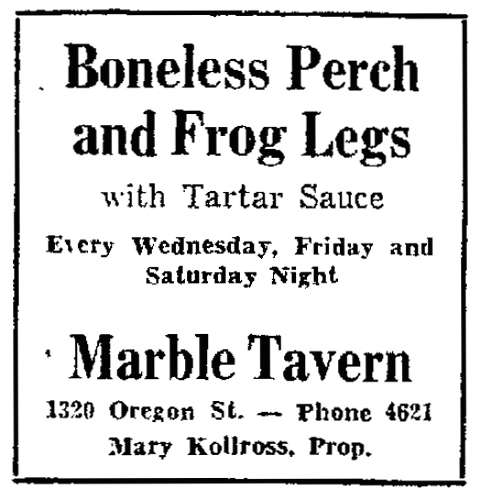 |
| Oshkosh Daily Northwestern, November 24, 1934. |
It eventually came to be known simply as Mary’s Tavern. Kollross remained the mainstay behind the bar there until she retired 1957. The tavern continued on until 1964 when Mary Kollross died. She was 74 years old.
Kollross still owned the tavern at the time of her death. Four months after she died, the saloon was sold to Herbert L. Pollnow, owner of Acee Ducee, the neighboring tavern. Pollnow leased the building to a hair stylist. For the first time in more than 80 years there wasn’t a saloon at 1325 Oregon. And there hasn’t been one since.
Mary Kollross’ speakeasy and brewery were soon forgotten. But the building that was home to the old saloon still stands. It’s another of those places in Oshkosh with a concealed history. It offers no hint of its torrid past.
Subscribe to:
Posts (Atom)


