Showing posts with label First Breweries of Oshkosh. Show all posts

Monday, July 27, 2015

The Subscribers Having Erected a Brewery in the Village of Oshkosh

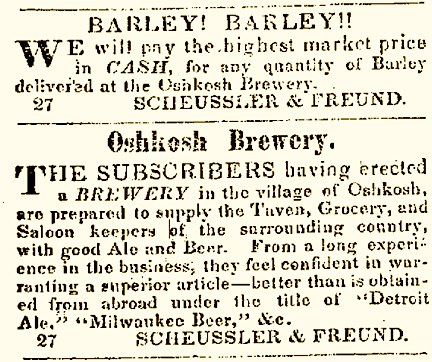
Here’s the oldest newspaper ad that I’ve come across for an Oshkosh brewery. This appeared in the Oshkosh True Democrat on September 6, 1850. It’s for the Oshkosh Brewery of Joseph Schussler and John Freund, which was located on what is now Bay Shore Drive. If you click the image it will enlarge, making it an easier read. Note, the spelling of Schussler’s name in the ad differs from the spelling he typically used. I’ll stick with his standard spelling here.

The fact that Schussler and Freund are calling on local farmers to sell them barley indicates they were doing their own malting. That’s typical of the era. Malting was then largely considered part of the brewing process and not a separate endeavor independent of the brewery. Notice, also, that they’re only looking for barley. Corn wasn’t widely used in American brewing until the 1870s. Schussler, the brewmaster of this operation, was brewing an all-malt beer.

And what about hops? By 1850, there were already hop growers farming in Winnebago County. It would have made sense for Schussler to select his hops from the local stock. Rail lines had yet to reach Oshkosh in 1850. Bringing in bulky bales of hops from other parts of the state by horse and wagon would have been a more expensive, less reliable option. More than likely, the beer that came out of this brewery would have been a local beer in the truest sense.

It’s interesting that the Oshkosh Brewery was producing ale as well as beer, which in this case would have meant lager. Schussler came to be known as a lager brewer, but in 1850 the Oshkosh Brewery needed to compete with the ale from Detroit that had been coming into Oshkosh for more than a year. Schussler and Freund succeeded in taking over that part of the market. Detroit ale gradually receded from Oshkosh. The Milwaukee beer kept right on coming, though.

When this ad appeared there were fewer than 500 breweries in America. Oshkosh, with a population of 1,392, had two of them (the other being the Konrad brewery). That fact leads me to doubt that this is the first ad either of them placed in a newspaper. According to History, Winnebago County, Wisconsin Volume I (1908), Schussler and Freund began running ads in the True Democrat in 1849, the year the paper was launched. I’m not convinced that’s correct. I’ve dug through those papers and I’ve yet to find an earlier ad for this brewery. Maybe I need to look harder.

Here’s an odd, little side note: the Oshkosh True Democrat was an ardent supporter of the temperance movement. The paper’s co-owner and editor, James Densmore, was a unique guy. One account describes him this way: “Densmore had a huge muscular body, a bold red face and an aggressive, argumentative spirit.” Sounds like a fun guy. He was also instrumental in the creation of the first commercially successful typewriter, a vegetarian, and liked to rant about the evils of alcohol.

When it came to taking money from people selling alcohol, though, Densmore tended to look the other way. The True Democrat was larded with notices for saloons, liquor dealers and beer. Densmore may have been opposed to alcohol, but paying the bills came first. Those boozy ads helped to keep Densmore’s fledgling paper afloat.

Visit this page for more on the history of the Oshkosh Brewery.

Monday, June 2, 2014

The Disorderly Brewery on Bayshore Drive

An 1885 Insurance Map of the Oshkosh Brewery
Back to 1880 and the little Oshkosh Brewery on Bayshore Dr. (then known as River Street). Our old friend George Loescher is there and he’s about to run into some trouble.

The first edition of Loescher’s Oshkosh Brewery was built in 1853. Its location was approximately 150’ west of Eveline St. on the south side of Bayshore Dr. But at the close of the 1870s, Loescher moved his brewery up the street to the north east corner of Frankfort and Bayshore. By 1880, Loescher had his new brewery up and running. The German-born brewer, however, was no longer a young man. Loescher was 61 years old and eyeing his exit from the brewhouse. In the summer of 1880, he found his out.

On August 7, 1880, Loescher sold his brewery to John Walter and Bernard Ruety. That’s where the trouble begins. Soon after the sale, the Daily Northwestern reported that things were going bad at the Oshkosh Brewery.

Sudden Disappearance
John Walter, of the firm of Ruety & Walter, proprietors of the brewery in the Second Ward, has been missing since last Friday and no trace of him can be found. The only explanation now entertained for his unexpected absence is that he has absconded. Ruety & Walter bought out Loescher's brewery some three months ago, and since running the brewery have quarreled among themselves, each trying to sell out to the other. A few days ago they mortgaged the personal property in the brewery for $300 and Ruety now claims that Walter has run away with the $300 and all the money he could collect from saloon keepers to whom the firm has sold beer.
-- Oshkosh Daily Northwestern; October 26, 1880

Juicy stuff thanks to the mysterious Mr. Walter. We may have encountered this fellow before, a couple blocks away at the Gambrinus Brewery on Harney Ave.

The Gambrinus Brewery began as a partnership between Lorenz Kuenzl and his brother-in-law named John Walter. But in May 1880, Kuenzl and Walter dissolved their partnership with Kuenzl taking control of the brewery. Three months later, we find a John Walter going into partnership at the Oshkosh Brewery. Is this the same man? I haven’t been able to confirm that it is. The trail of John Walter seems to go cold after 1880. The Northwestern article may explain why this is. If you had absconded with what today would be worth over $7,000, it would  be best to keep a rather low profile. Maybe this is why I can't seem to draw a bead on John Walter’s later years.

I’m not the first person to be frustrated by a slippery John Walter. George Loescher had no better luck tracking him down than I have. Bernard Ruety admitted defeat and deeded his interest in the Oshkosh Brewery back to Loescher in November 1880, but John Walter was nowhere to be found and his name clouded the title to the property for years to come. It would take until 1887 to have the matter fully resolved. By that time, George Loescher had been dead almost three years.

Loescher’s sons kept the Oshkosh Brewery limping along for a few more years, but by 1890 the gig was up. The disorderly little brewery on Bayshore Dr. was closed for good.

The backstory on Loescher’s Oshkosh Brewery can be found HERE and HERE.

Monday, April 4, 2011

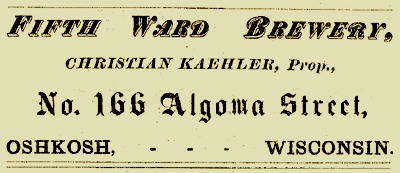
First Breweries of Oshkosh: Part 5 - The Fifth Ward Brewery

In the mid-1850s Oshkosh was coming into its own. What had been a backwater wilderness 20 years earlier was now a thriving city with more than 4,000 people and a burgeoning reputation for liquid indulgence. Beer was a central component in the lives of many who had come to Oshkosh and though the city already had two breweries, there was more than enough demand to support another. It was exactly the sort of place Tobias Fischer and August Weist were looking for.

Both Fischer and Weist were born in Germany and trained as brewers in their homeland before leaving for America. It appears Fischer was the driving force in the partnership. Fischer was 46 years old when he left Germany in 1854 and when he reached Oshkosh two years later he had the resources needed to finance the launch of the brewery. But when it came to the brewing aspect of the operation, Weist was certainly Fischer’s equal. Weist was a certified Brewmaster having served a full apprenticeship in Hirschberg, Germany undertaken at the age of 15. He came to America in 1856 and just eight days after his 27th birthday in October of that year, he and Fischer purchased a single acre of land at what is now the south west corner of High and New York Avenues. The developing and under-served north side of Oshkosh now had a brewery of its own, albeit one that would prove to be provisional.

Fischer and Weist were barely settled in when another young brewer named Christian Kaehler landed on the north end of town. Kaehler, who was born in Oldenburg, Germany in 1833, had emigrated to America in 1853 and may have come to Oshkosh at the behest of Tobias Fischer. If Fischer hadn’t invited Kaehler to Oshkosh, the two certainly didn’t waste any time finding common ground. In August of 1857, August Weist left Oshkosh for Princeton where he would establish the Tiger Brewery. A month later Fischer threw his lot in with Kaehler. The two consolidated their operations and in September of 1857 purchased land at what is now the south east corner of Algoma Boulevard and Vine Avenue. Here they established what came to be known as the Fifth Ward Brewery.

But Fischer’s partnership with Kaehler was as short lived as his collaboration with Weist. In February of 1858 Fischer began pulling out of Oshkosh. Over the course of the year, he sold his holdings to Kaehler and then left to brew beer in St. Louis, which then had the largest number of breweries in North America. Kaehler, meanwhile, was now 25 years old and had the Fifth Ward Brewery all to himself.

The Fifth Ward Brewery would be the last of the Oshkosh breweries to be established prior to 1860 and though it held its own for almost 25 years, the operation appears to have been wedded to the past. Kaehler had learned to brew at a time when the German brewing regimen had gone unchanged for several centuries, but with the coming of the 1860s, advances in brewing science and technology were revolutionizing commercial brewing. Kaehler, however, seemed to have little interest in reaping the benefits of such developments. The growth of the Fifth Ward Brewery would remain stunted over the years as its production lagged far behind that of other Oshkosh breweries. And in comparison to the encroaching breweries of Milwaukee, Kaehler’s output was minuscule. By 1879 the Fifth Ward Brewery was producing less than 200 barrels of beer a year, and though it was an increase over the brewery’s previous output, it was still less than half of what was being produced by Rahr Brewing, Oshkosh’s next smallest brewery.

Small as it was, the brewery seemed to hold a special place in the memories of early Oshkosh residents. Some fifty years after it closed, Kaehler's brewery became a topic at a gathering of “old settlers” held by the Winnebago County Archeological and Historical Society. They described the brewery as consisting of several buildings, some of which were sunk low into the ground. This would have been in keeping with a typical set-up for a lager brewer such as Kaehler who relied upon cooler temperatures to ferment and age his beer. The panel recalled that Kaehler’s entire plant was surrounded by a high, board fence and erroneously remembered it as being just one of two breweries then in Oshkosh. In fact, there were six Oshkosh breweries in operation during the period. That the group could only recall the largest and smallest breweries of the era says more about Kaehler’s position in the community than it does about the state of Oshkosh brewing during that time.

Though Kaehler’s brewery was modest, by the 1870s he had managed to parley his earnings into a larger success. As early as 1866 Kaehler began buying vacant parcels of land that surrounded his brewery. As the northern end of Algoma Boulevard became a destination point for the newly affluent, Kaehler found himself holding a portfolio of highly coveted deeds. Throughout the 1870s Kaehler subdivided and sold off the properties at a handsome profit and with the coming of the 1880s it appears the brewery had became something of an afterthought for him.

By 1882 Kaehler’s Fifth Ward Brewery had ceased production and the following year Kaehler used his new wealth to purchase land on an island off the coast of Washington. There he finished his days as a gentleman farmer.

The north side of Oshkosh would remain without a brewery for more than 100 years, until 1995 when the Fox River Brewing Company established its first brewpub just two blocks north of the Kaehler site.

What was once the Kaehler brewery is now a green space that falls within the grounds of the University of Wisconsin - Oshkosh. The land is crossed by a footpath and legend has it that if you stroll through the area on a cool autumn night when the breeze is light you can still draw the heady aroma of fermenting lager yeast... if you’re carrying a vial of it with you.

Monday, March 28, 2011

First Breweries of Oshkosh: Part 4 - From Konrad to Kuenzl, the Evolution of the Lake Brewery

1858 Map of Oshkosh Showing Location of Lake Brewery
The long-forgotten cradle of Oshkosh brewing is now occupied by an unassuming ranch-style home just south of Ceape Avenue at 74 Lake Street. Here is where a German immigrant named Jacob Konrad, who purchased the land in July of 1849, established Oshkosh’s first commercial brewery. And though Konrad would leave Oshkosh by the mid-1850s, the incredible lineage of his brewery would extend to 1972 and the closing of Oshkosh’s last full-scale, production brewery.

The earliest days of what came to be known as the Lake Brewery have been obscured by time, but the picture begins to clear in 1854 when Jacob Konrad sold his brewery to a lively German émigré named Anton Andrea. Born in Frankfurt in 1822 and educated in Switzerland, Andrea became a Major in the Hungarian Hussars and  was forced to fight against his native country when Hungary revolted against Austrian rule in 1848. Andrea turned fugitive, fled to Turkey and made his way to Constantinople where he embarked on a ship bound for America. In 1849 he arrived in Oshkosh.

Andrea’s 30 years in Oshkosh would prove to be as picaresque as his life in Europe. He was elected to the first Oshkosh City Council in 1853, made and lost several fortunes, was burned out on six occasions, and at one time or another sold everything from groceries to clothes to liquor to real-estate. Ironically, the one thing Andrea may not have done was brew beer. Andrea didn’t come from brewing background and unlike the Oshkosh brewmasters of the period, he didn’t live at the brewery. The 1857 Oshkosh city directory shows two other brewers, Casper Haberbusch and Louis Keller, working at the Lake Brewery during the time it was under Andrea’s name, indicating that this may have been the first brewery in Oshkosh where the beer was made by someone other than the man who owned the brewhouse.

What is certain is that by 1862 Andrea’s role at the brewery was tangential at best. That year, Andrea leased the Lake Brewery to a 35-year-old brewer trained in Saxony named Leonhardt Schwalm. Schwalm’s tenure at the brewery was even more brief than that of his predecessors. In September of 1865 his lease on the Lake Brewery expired and in October Schwalm bought a parcel of land on Doty Street where he and August Horn established Horn and Schwalm’s Brooklyn Brewery. Incidentally, that same tract would later be home to the Oshkosh Brewing Company.

Meanwhile, a new brewer had occupied the Lake Brewery. Immediately upon Schwalm’s removal, the brewery was taken over by a 30-year-old German-born butcher from Stevens Point named Gottlieb Ecke. With the backing of a short-term business partner named Edward Becker, Ecke assumed control of the brewery in September of 1865 and a month later purchased it outright from Andrea. Along with the purchase of the brewery, Ecke also acquired from Andrea several lots west of the brewery on Harney Avenue. Ecke was looking to the future.

An inventory of the brewery from 1865 reveals a dated facility geared to meet the the needs of an earlier era. Not only had brewing methods rapidly progressed in the intervening years, Oshkosh had as well. The Lake Brewery came into being at a time when Oshkosh’s population barely exceeded 2,000 people. By the end of the 1860s Oshkosh had over 12,000 residents and if Ecke was going to keep pace, he’d need an updated, more efficient brewhouse.

In 1868 Ecke began setting up a new brewery a block west of the original Lake Brewery on the additional lands he had purchased from Anton Andrea. The brewery was located in the area that now falls within the addresses of 1239-1247 Harney Avenue and was fully operational by 1869. Unfortunately, death would soon intervene. Just two years after the completion of his brewery, Gottlieb Ecke died on a Sunday night in November of 1871. He was 37 years old. Oddly, the circumstances of Ecke’s death went unreported in the three Oshkosh newspapers then in publication. The only notice of his passing appeared in the Oshkosh Times, which printed a two-line obituary that failed to even include his full name, listing him simply as G. Ecke.

Ecke left behind a wife, four young children and a mountain of debt taken to finance construction of the new brewery. A brewery which appears to have remained idle for the next year. Unable to keep the business running, Charlotte Ecke, the widow of Gottlieb Ecke, was forced to sign over possession of the brewery to her late husband’s principle creditor in March of 1874.

Lorenz Kuenzl
If there was any good that came from the rapid dissolution of the Ecke brewery, it was that the man who assumed Ecke’s place in the brewhouse would prove to be the most accomplished of the early Oshkosh brewers. Lorenz Kuenzl was born in Bohemia (now the Czech Republic) in 1845 where, at an early age, he became an adept in the art and science of brewing beer. Kuenzl came to America in 1871 and made his way to Stevens Point where the 31-year-old brewer married a 21-year-old Barbara Walter. Kuenzl was probably in Oshkosh by the close of 1874 and the following year took over the Ecke brewery with the help of his brother-in-law, John Walter. 

The Oshkosh brewing scene of the mid-1870s was an embarrassment of riches. In 1875 there were six breweries in Oshkosh, four of them north of the river, and though the population of Oshkosh was rapidly gaining, a brewery looking to carve a niche for itself needed something special. Lorenz Kuenzl fit the bill.

Kuenzl christened his enterprise the Gambrinus Brewery in honor of King Gambrinus, the patron saint of brewers, and quickly established a reputation as a maker of quality beer. Although the Gambrinus Brewery would soon be outpaced in terms of production by the rapidly expanding Oshkosh breweries south of the Fox River, no other Oshkosh brewery could claim the variety of beer that Kuenzl produced. Kuenzl targeted his output to that segment of the Oshkosh populace longing for the lagers of their German homeland. Among the beers in the Gambrinus line-up were a malty Vienna lager; a Bohemian lager that emphasized hops; and a full-bodied, dark lager familiar to the Kulmbach region of Bavaria. Kuenzl knew his audience and confined the lion’s share of his advertising for the Gambrinus Brewery to the Wisconsin Telegraph, Oshkosh’s German language newspaper. The ads were simple and direct with Kuenzl’s name featured prominently beneath that of his brewery followed by a brief list of the current brews. Obviously, Kuenzl was addressing people well acquainted with stylistic differences among beers. No further explanation was required.

Though his ability as a brewer may have been a match for the quality he desired, Kuenzl’s funds were apparently not the equal of either. Kuenzl and Walter lacked the capital to purchase the brewery outright so instead leased the property from Henry Timm, a carpenter living at what is now 621 Ceape Avenue. Timm was a friend of the Ecke family and had purchased the brewery immediately after Charlotte Ecke had lost it to foreclosure. The relationship between Kuenzl and his landlord would prove to be sometimes contentious, but the atmosphere inside the brewery was familial, to say the least. Along with his brother-in-law John Walter, Keunzl’s brother Andrew also worked at the brewery and in 1879 Gottlieb Ecke’s now 16 year-old son, Otto, went to work alongside the Gambrinus crew in the brewhouse his father had built.

With the start of a new decade, though, things at the brewery began to change. In May of 1880, Kuenzl and John Walter dissolved their partnership, but more significantly, Kuenzl now found himself facing a competitive disadvantage. Although the Gambrinus Brewery was relatively new, its capacity was dwarfed by two new brewhouses on the South Side of Oshkosh. Both John Glatz’s Union Brewery and the Brooklyn Brewery of Horn & Schwalm had recently been rebuilt and each was capable of producing three times the quantity of beer Kuenzl could make. Worse yet was the new threat posed by the enormous breweries of Milwaukee now sending train cars full of beer into Oshkosh in an attempt to claim the market for their own.

As other small Oshkosh breweries began to fade, Kuenzl somehow managed to hold on. Although limited by the constraints of his brewery, Kuenzl continued brew to his own standards and in 1883, under threat of eviction, raised enough capital to purchase the brewery from Henry Timm. Lorenz Kuenzl had finally made The Gambrinus Brewery his own.

For the next 11 years things remained just that way. Then came 1894. Battered by a disastrous economic slump and their relentless adversaries from Milwaukee, Oshkosh’s three leading brewers - Horn & Schwalm, John Glatz, and Lorenz Kuenzl - joined forces to form the Oshkosh Brewing Company. The conglomeration would result in the largest, best-known brewery Oshkosh would ever know. Although, Kuenzl’s brewery was by far the smallest of the three, his influence on the new company would be disproportionate to his share of the firm’s assets. Kuenzl was named superintendent of the Oshkosh Brewing Company and it’s clear from the early roster of beers it produced that Lorenz Kuenzl was responsible for establishing the new company’s brewing regimen.

With the formation of the Oshkosh Brewing Company, the Gambrinus Brewery was converted into a bottling facility. Three years later, Lorenz Kuenzl died at the age of fifty-three due to complications of edema. Following the construction of the Oshkosh Brewing Company’s new brewery in 1911, The Gambrinus Brewery was dismantled and the surrounding property sold as residential lots.

What began as Oshkosh’s first brewery on Lake Street and later evolved into the breweries of Ecke and Kuenzl helped form the basis for what became Oshkosh’s premier brewery. When the Oshkosh Brewing Company folded in 1971, its signature brands were assumed by the Peoples Brewing Company, the last of Oshkosh’s large-scale breweries. A lineage that joins 123 years of brewing history in our city had reached its conclusion.

Monday, March 21, 2011

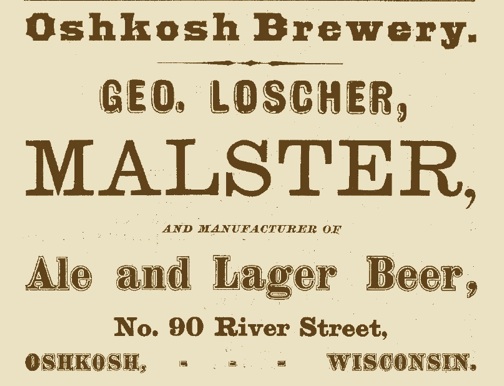
First Breweries of Oshkosh: Part 3 - George Loescher’s Oshkosh Brewery

By 1852 the village of Oshkosh was rising fast. There were now approximately 3,000 people living in the area that was soon to declare itself the City of Oshkosh and among the swell was a habitually thirsty assortment of wood workers who needed a brewer to meet their needs. Enter George Loescher.

George Loescher (sometimes spelled Loscher) was born in Bavaria in 1819. There’s scant record of his life in Europe, but it’s likely that Loescher was trained as a brewer from an early age. Both he and his brother Frederick established breweries shortly after emigrating to America and Loescher’s advertised proficiency as a maltster indicates that he was versed in the German brewing tradition prior to his arrival here.

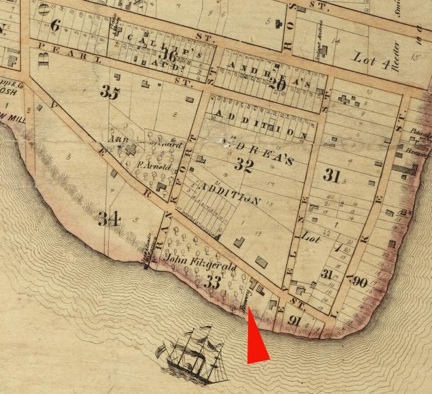
1858 Map Showing Location Of the Oshkosh Brewery
It appears George Loescher came to America in 1851 and in September of 1852 he and Frederick Loescher purchased a modest parcel of land on Lake Winnebago where they established their new brewery. The brewery was located on the south side of Bay Shore Drive west of Eveline Street among land currently addressed as 1253 and 1283 Bay Shore Drive. It was the second brewery here to be named the Oshkosh Brewery and that name, along with the brewery’s location and time of its inception, raises a number of questions. In the summer of 1852 and just a block west of the Loescher’s Oshkosh Brewery, the Oshkosh Brewery of Joseph Schussler was nearing its end. Whether the Loescher’s appropriated anything more than the name of their brewery from Schussler isn’t clear, but the possibility that there was a more substantial connection between the two breweries remains.

In any case, George and Frederick Loescher’s new Oshkosh Brewery was probably up and running by the end of 1852, but it wouldn’t remain a brotherly operation for long. In August of 1853 Frederick Loescher moved to Menasha where he launched a brewery of his own and the following December sold his stake in the Oshkosh Brewery to his brother George.

What little information has survived from the period indicates that George Loescher was a versatile brewer. His background in Germany predicates that Loescher was trained as a lager brewer, but in the early years of the Oshkosh Brewery Loescher produced ales, as well as lagers. His adaptability served him well. Production and storage of cool-fermenting lager beer would have been next to impossible during Oshkosh’s sweltering summer months in the years before mechanical refrigeration was a viable option. Ales, which can be fermented at cellar temperatures, enabled Loescher to brew year round and had the added benefit of appealing to Oshkosh residents who had come from the East Coast and England and were accustomed to drinking porters and stouts. Loescher’s neighborhood in particular was a mix of English and German immigrants and meeting their expectations was no doubt essential to his success. The longevity of Loescher’s brewery bears this out. Each of the two brewers that had preceded him in Oshkosh were out of business within five years of their start. George Loscher’s Oshkosh Brewery produced beer for 38 years.

The era Loescher inhabited was a volatile one. Oshkosh was growing and changing rapidly and Loescher evolved with it. His success enabled him to buy up tracts of land surrounding the brewery and Loescher, who would prove to be something of a wheeler-dealer, seems to have had little reticence about mortgaging his holdings to the hilt. In 1859, he put the brewery in his wife’s name, perhaps employing the vagaries of Wisconsin’s marital property laws as a shield against his creditors, and continued adding to his holdings.

The Loescher family was moving up. George and Regina Loescher had lived at their brewery for 18 years, but after 1870 they and their seven children relocated to a new house across the street. The move was emblematic of Loescher’s success as he became the first Oshkosh brewer to live in a house separate from his brewery. But Loescher wasn’t the only brewer in Oshkosh doing well. By 1870 there were six breweries here and the most robust among them were on the other side of the Fox River. Horn and Schwalm’s Brooklyn Brewery and the Union Brewery of John Glatz were the first breweries located on the south side of Oshkosh and both were off to quick starts that threatened to leave their north-side competition in the dust.

Loescher may have been struggling with more than just the competition. His brewery was now the oldest in Oshkosh and by the late 1870s would have appeared antiquated in comparison to the brewhouses of his rivals. Loescher may have even ceased brewing for a time as the decade came to an end. The Oshkosh city directory of 1879 does not list the Oshkosh Brewery as active and surveys of brewing capacity in Oshkosh from 1878 and 1879 omit Loescher’s brewery, altogether.

Loescher wasn’t finished, yet, though. He began construction of a new brewery on property he had purchased 15 years earlier at what is now the north east corner of Frankfort Street and Bay Shore Drive. The new Oshkosh Brewery was fully operational by 1880, but it may have been too little too late. In the intervening years, the south-side breweries had expanded their capacity three-fold and were coming to dominate the market. Loscher was now in his 60s and nearing his end. In 1884, just four years after the completion of his new brewery, George Loescher died at the age of 65.

Following the death of George Loescher, the Oshkosh Brewery remained active for several more years. Loescher’s son William had assumed control of brewing operations, but the best days of the brewery were well behind it. William Loescher moved into the brewery and, sometimes helped by his brother Fred, but just as often going it alone, ushered the brewery into a new era that was less than hospitable for small operations such as his. It wasn’t just the south-side competition he had to contend with. Now Oshkosh was being targeted by Milwaukee breweries that could produce in a day what would take Loescher a year to brew. The Oshkosh Brewery didn’t stand a chance. By 1890 the brewhouse had gone dark.

After the close of the Oshkosh Brewery, William Loescher would work for Lorenz Kuenzl at the Gambrinus Brewery for a time, but soon left brewing behind him. There was one last flicker of hope for the Oshkosh Brewery, though. in 1898 a majority of Oshkosh’s saloon operators began toying with the idea of starting a brewery of their own to circumvent the taxes levied against the barreled beer they purchased for tap sales. Their plan was to re-equip Loescher’s Oshkosh Brewery and hire a brewer to make beer for them. Unfortunately, the scheme never came to fruition and the Oshkosh Brewery was dismantled. Today the quiet, upscale neighborhood along the lake that was once home to the Oshkosh Brewery betrays not a hint of its beer-soaked past.

Monday, March 7, 2011

First Breweries of Oshkosh: Part 2 - Joseph Schussler’s Oshkosh Brewery

In 1850 there were 431 breweries in the United States. Two of those were in Oshkosh.

In November of 1849 Joseph Schussler began setting up Oshkosh’s second brewery after purchasing more than an acre of land from Henry A. Gallup, an early Oshkosh settler. The plot was located on the south side of what is now Bay Shore Drive in the approximate area currently under the address of 1031 Bay Shore Drive.

Oshkosh Democrat September 6, 1850
By all indications, Schussler had ambitious plans for his new brewery. Shortly after purchasing the property from Gallup, Schussler and his business partner, John Freund, placed a series of advertisements in the Oshkosh Democrat announcing that they had “Erected a BREWERY in the village of Oshkosh” and were “prepared to supply the Tavern, Grocery, and Saloon keepers of the surrounding country with good Ale and Beer”. The advertisements end on a note that would be echoed by Oshkosh brewers for the next 120 years with Schussler and Freund promising that their beer was better than that “obtained from abroad under the title of ‘Detroit Ale’ or ‘Milwaukee Beer’”. Already the specter of Milwaukee lager was haunting the brewers of Oshkosh. Small-town anxiety aside, Schussler and Freund charged they were “confident in warranting a superior article”. 

Schussler had every right to feel confident. He had arrived in Oshkosh with an impressive set of skills. Born in Baden, Germany in 1819 he was trained as a brewer and cooper (barrel maker) in his homeland before coming to America. Prior to his arrival in Oshkosh at the age of 30, Schussler had worked for several years as a brewer in Milwaukee and eventually came to be known for his ability as a brewmaster and his singular approach to beer making. It was reported that “His brewing method is different from others, and known only to himself.”

Early on it appears that Schussler’s Oshkosh Brewery was a success. By the summer of 1850 local businesses were advertising that they carried Oshkosh Beer and Schussler’s notices in the paper stating that he and Freund would pay the highest market prices for any quantity of barley indicate the beer had gained a following. But it seems that Schussler’s early success didn’t hold.

At the close of 1850 Schussler’s business partner, John Freund,  appears to have encountered financial difficulties apart from the brewery. And on January 1, 1851 Schussler and Freund dissolved their partnership. Schussler acquired a new partner for the brewery, Francis Tillmans, and in June of 1851 took a second mortgage against the property. If Schussler was trying to leverage his holdings to finance his brewery, the strategy didn’t work. In June of 1852 Schussler signed his assets over to his creditors. The Oshkosh Brewery of Joseph Schussler would not be heard from again.

Schussler’s involvement with beer in Oshkosh doesn’t end there, though. He stayed on in Oshkosh, moving over to Wisconsin Street and putting his coopering skills to work to earn his living. It appears, though, that in 1860 he had returned to brewing beer in Oshkosh. In the census of 1860 Schussler, once again, identifies himself as a brewer. Where or what he was brewing is not revealed. There were three breweries operating in Oshkosh at this point. Schussler could have been pitching-in at any of them.

In 1861 Schussler’s story takes a tragic and somewhat odd turn. Following in his father’s footsteps, Schussler’s 12 year-old son August had gone to work at the Frey Brewery in Fond du Lac. On January 18, 1861 August Schussler was tending a machine probably used for milling grain at the brewery when he fell into the machinery and was instantly crushed to death. Within months of August Schussler’s death, Joseph Schussler moved his family to Fond du Lac and went to work at the brewery where his son had been killed.

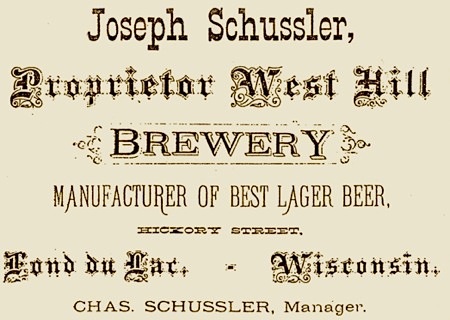
1875 Advertisment for Schussler's Fond du Lac Brewery
Schussler remained at the Frey Brewery until 1865 and then returned to barrel making for several years before establishing his second brewery in 1872. That year Schussler opened the West Hill Brewery on Hickory Street in Fond du Lac. This time, things worked out better. The West Hill Brewery met with wide acceptance in Fond du Lac and by 1878 Schussler was brewing over 1,000 barrels of beer a year, an output that rivaled the larger breweries of Oshkosh. Schussler continued brewing into his 70s and in 1890 turned the brewery over to his sons. Soon thereafter, however, the West Hill Brewery faltered. Though Schussler would live to see the turn of the century, his Fond du Lac brewery folded in 1892. The beer career of Oshkosh’s second brewmaster had come to a close.

Wednesday, March 2, 2011

First Breweries of Oshkosh: Part 1 - The Jacob Konrad Brewery

March is going to be old-brewery month at the Oshkosh Beer Blog. Over the coming weeks there will be stories here about the first breweries to establish operations in Oshkosh. These breweries, for the most part, have been forgotten, yet they played an essential role in the development of our city. These were the brewers who initiated Oshkosh’s beer culture and laid the groundwork for what would become one of the vital brewing centers of the Midwest.

By today’s standard, these earliest of Oshkosh breweries would be considered pre-modern. For them, brewing was part mystery and part art with little in the way of science to trouble the process. They knew they needed yeast to make beer, but they had no idea why or how it worked. Pasteurization had yet to be developed and the age of Pilsner beer had yet to arrive.

Most of these early brewers were German immigrants trying to make the cool-fermenting lagers of their homeland at a time when mechanical refrigeration was nowhere to be found. So they cooled their beer with blocks of ice carved out of Lake Winnebago or the Fox River. The result was a strictly local product with grain and hops grown at neighboring farms. Welcome to the world of the mid-1800s and beer in Oshkosh.


The first commercial brewery within what is now the City of Oshkosh has been escaping notice for more than 160 years. And judging by its short life-span, it may have been escaping notice even while it existed. Our first brewer’s name was Jacob Konrad. He was born in Prussia in 1823 and arrived in Oshkosh in 1849. The exact date that Konrad began brewing beer for sale here is not recorded, but since Konrad’s life seems to have revolved around making and serving beer, it’s probably safe to assume he was fermenting something soon after his arrival.

By the close of the 1840s, though, we know that Konrad’s brewing operation was expanding. In July of 1849, he leased property on the east side of Lake Street along the shore of Lake Winnebago and by the end of the year, Konrad was successful enough to make his living brewing beer. But just barely. In 1850 Konrad estimated the worth of his brewery to be $500 or the equivalent of what today would be about $14,000. It was a small brewery in a small town. And it didn’t last long. It appears that by the time Oshkosh became a city in 1853, Konrad was ready to move on. Maybe he wasn’t fond of the fourth article in the city charter, which allowed for the city to license and tax anyone “dealing in spirituous, fermented or vinous liquors”.

After leaving Oshkosh, Konrad settled in Weyauwega where he continued to brew beer and later established a distillery. In the last years of his life, Jacob Konrad ran a saloon in Sniderville, about 35 miles north of Oshkosh. Perhaps, Oshkosh’s first brewmaster was serving Oshkosh beer, once again.