Showing posts with label Chief Oshkosh Beer. Show all posts

Sunday, March 16, 2025

Peoples and the Chief

The Oshkosh Brewing Company closed in 1971. The brewery quickly sold its brands – including Chief Oshkosh – to its neighbor across the street, Peoples Brewing Company. These two display ads were issued by Peoples shortly after the sale.

If you’d like to read more about Chief Oshkosh Beer going to Peoples follow this link.

Monday, June 8, 2020

Chief Oshkosh and Beer

It wouldn't happen today. A brewery wouldn't build its brand around a dead man with a reputation for abusing alcohol. Especially if alcohol had played a role in that man's violent death. And especially if that man was a Menominee Indian. But that's just what the Oshkosh Brewing Company did. At the time, it seemed like the most natural thing in the world. 

Chief Oshkosh

Chief Oshkosh had been dead 36 years when the Oshkosh Brewing Company put its hooks into him. Born in 1795, Oshkosh died in 1858 at Keshena from injuries he'd taken in a drunken brawl with two of his sons. That part of his story wasn't getting much play anymore when the Oshkosh Brewing Company came around. By then, the Chief had entered the realm of myth.

Oshkosh's fascination with the deceased Chief began in earnest in the early 1880s. A grassroots movement was afoot to have his remains moved from the Menominee Reservation and reinterred in Oshkosh. Decades passed before that happened. In the meantime, the Chief was being re-made into a talisman for the city that bore his name. Chief Oshkosh was showing up everywhere.

A souvenir spoon issued by the Birely & Son jewelry of Oshkosh in 1891.


Oshkosh cigar makers Derksen & Peek brought out their Chief Oshkosh cigar in the fall of 1892.

When there came to be a brewery named Oshkosh, the symbol that would identify it seemed preordained. The Oshkosh Brewing Company (OBC) was created on March 21, 1894 from the merger of three existing breweries. The final arrangements were hastily made with a few of the finishing touches left undone. Among them was the brewery's trademark. The first letterhead employed by OBC looked like something a bread factory might use.


Within a matter of weeks, though, OBC had set in place the image that would be its symbol. On April 15, 1894, the brewery began using an already familiar rendering of Chief Oshkosh that was based upon an 1855 daguerreotype. When OBC went to register the trademark, it described the image as "The representation of a North American Indian grotesquely attired, associated with the words ‘Chief Oshkosh.’"


OBC plastered that image and variations of it on any surface that could take it. Over the coming years, the Chief's visage became inescapable in Oshkosh. It hung from signs on Main Street and appeared daily in the pages of newspapers. Behind it was always the promise of beer.

Chief Oshkosh signs at Leonard Michels saloon on North Main Street, circa 1909.

Chief Oshkosh had been co-opted by a beer company. Surely there were people who didn’t like it. But their voices were not made public in any significant way. Those with a legitimate claim to the Chief's heritage had been forced out of the Oshkosh area some 40 years earlier. They’d been deposited on a reservation 70 miles to the north. The way was clear for OBC to reimagine the Chief in any way it cared to. 

Most of OBC's early advertising and promotional materials employed the Chief Oshkosh image in some manner. Often it was the focal point. It was used as an overarching symbol and not representative of any specific product of the brewery. For the first 30 years, OBC’s Chief Oshkosh remained relatively true to its original form. 


But the reverence with which OBC treated its trademark began waning as the brewery came undone during Prohibition. After the dry law took hold in 1920, OBC lurched from one year to the next narrowly avoiding dissolution. The business came under new management. It was now run by a younger generation that had come of age in Oshkosh after the Menominee population had vacated the area. The degree of separation led to more fanciful representations of the Chief. The drift was clearly on display in the 1929 label applied to a malt syrup OBC produced for homebrewers. Chief Oshkosh had never attired himself like this.


It was also during Prohibition, that the brewery first applied the name Chief Oshkosh to a specific product. In 1928, OBC introduced Chief Oshkosh Special, a non-alcoholic cereal beverage. It wasn't quite beer and its label didn’t look like any that OBC had used in the past. The original Chief Oshkosh trademark was still there, but now it played a bit part.


It wasn't just OBC that appeared to have grown weary of authenticity. In 1911, the City of Oshkosh placed a statue of Chief Oshkosh in Menominee Park. Sculpted in Italy, it depicted a young, idealized Chief with European facial features. The remains of Chief Oshkosh were reinterred at the foot of that statue in 1926. The celebration that marked the event included members of the Menominee Tribe; some of whom came to play the part expected of them. Instead of wearing the ceremonial attire of their ancestors, they dressed as if they had come off the set of a Hollywood movie. 

Menominee Park, Oshkosh.

Chief Oshkosh Day Parade, May 25, 1926.

Prohibition ended in 1933. The non-alcoholic Chief Oshkosh Special was reformulated and made into a real beer. Chief Oshkosh became the most popular beer ever produced by an Oshkosh brewery. Within a decade, the brand had subsumed the brewery. People began referring to OBC as the Chief Oshkosh brewery. But the actual Chief Oshkosh was getting phased out. His implacable gaze was replaced with cartoons and clichés.

Early 1940s.


The Chief in cans. From left to right: 1949, 1950, 1958.

Along with that, the folks at OBC had succumbed to the delusion that the hard-drinking Chief was one of their early customers. Several of OBC's promotional pieces from the 1950s mentioned that Chief Oshkosh had often visited the brewery, and on one occasion "Was persuaded to let the boys at the brewery dress him up in a coat and "Beaver" hat, and take his picture. This picture is used in our trademark." There wasn't a drip of truth to any of it. Chief Oshkosh had died nearly a decade before any of the breweries that merged to form OBC had opened. 

The 1855 daguerreotype that was the basis for the OBC trademark.

The Oshkosh Brewing Company closed in 1971, but the Chief Oshkosh brand was picked up by Peoples Brewing and survived for another year. Peoples carried on with the same sort of balderdash OBC had resorted to. 


In 1972, Peoples Brewing closed and Chief Oshkosh Beer was left for dead. The end coincided with a rising chorus of protest against the "mascotting" of American Indians and the poaching of their culture to sell things like beer. That didn’t keep Jeff Fulbright from picking up the Chief Oshkosh name and running with it.


Fulbright launched the Mid-Coast Brewing of Oshkosh in 1991. He named his flagship beer Chief Oshkosh Red Lager. Like OBC and Peoples, Fulbright used American Indian imagery that bore no relation to the individual his beer had been named after. But at the same time, Fulbright was careful to point out that his re-imagining of the Chief was meant as a tribute. Sometimes that message got lost. As part of the launch of the brand, Fulbright placed five billboards in and around Oshkosh that brought precisely the sort of attention he was hoping to avoid.


“My idea was to suggest that this was the return of Chief Oshkosh,” Fulbright said. “It's the wording (Indian Uprising) that made it edgy. Those words pissed some people off. I even got letters from a priest of some sort. But the only people who contacted me were white people. That's the sworn truth. No Native Americans complained about it.”

It wasn't the last scrap Fulbright would get into over Chief Oshkosh. In 1993, Fulbright was pulled into the fray when a Minnesota-based group attempted to ban the sale of alcoholic beverages that used American Indian names or related images as part of their brand identity. The group's efforts were eventually rebuffed, but by then Chief Oshkosh Red Lager was no longer an issue. Mid-Coast Brewing ceased operations in 1995.

The Chief was reincarnated again in the summer of 2010 when then Oshkosh Mayor Paul Esslinger put a new name on the tavern he had acquired at 216 North Main Street. 


Esslinger, a longtime collector of breweriana with a focus on memorabilia related to Chief Oshkosh Beer, planned to feature his collection in what was to become the Chief Oshkosh Saloon. The new name would reflect the tavern's motif. That never happened. Shortly before opening, Esslinger dropped the Chief Oshkosh name after concerns were expressed by members of the Menominee Indian Tribe. Instead, Esslinger's tavern became the Old Oshkosh Saloon. Today, that bar is named Screwballs.

The most enduring connection between Chief Oshkosh and beer began in 1911 when the Oshkosh Brewing Company commissioned the Northwestern Terra Cotta Company of Chicago to create an emblem for the front of its new brewery. The completed piece weighed 800 pounds and was more than five feet in width. It was the brewery's original trademark, a faithfully rendered image of Chief Oshkosh. The Chief looked down over Doty Street for the next 75 years.


In 1986, the main facility of the Oshkosh Brewing Company was demolished. Fifteen years of neglect had transformed it into a towering eyesore. The massive Chief Oshkosh emblem was spared. It was taken down and sold at auction.

The dismantling of OBC’s emblem, 1986.

Breweriana collector Paul Winter, who had grown up near the brewery, placed the winning bid of $9,240. He later sold the emblem back to the City of Oshkosh. The city mounted the emblem on the river-facing side of the Oshkosh Convention Center. It remained there until 2008 when the Convention Center was expanded and remodeled.

The emblem then moved to the Oshkosh Public Museum. It resides there in an elevated case near the museum entrance. Below it is a granite plaque inscribed with a brief history of the brewery and its enduring symbol. It’s the last stand of Chief Oshkosh.


Notes and links to further reading.

Much of what's been written about Chief Oshkosh amounts to little more than hearsay. For an accurate portrayal of his life see Scott Cross' book Like a Deer Chased by Dogs: The Life of Chief Oshkosh. Cross is the archivist at the Oshkosh Public Museum.

The Oshkosh Times of June 6, 1888, provides a good example of the city’s 1880s fascination with Chief Oshkosh. 


I didn't address the various claims made that the body reinterred in Oshkosh was not actually that of Chief Oshkosh. I’m skeptical of those claims. This document raises doubts.

The story of Mid-Coast Brewing and Chief Oshkosh Red Lager is here. The fight over the use of American Indian names attached to beer is here.


Tuesday, November 19, 2019

Oshkosh Lager Beer Cans, Then and Now

Here are a couple of cans of Oshkosh-brewed lagers separated by about 60 years.


The can on the left is from the late 1950s. The can on the right was filled at Bare Bones last Friday, November 15.

The 1950s Oshkosh Brewing Company can is made of heavy gauge steel with a flat top. You needed a church key to get any beer out of it. The label is printed on the metal. It weighs about three ounces. The Bare Bones can has a shrink-wrapped label and is made of aluminum. It weighs less than an ounce and has a stay-tab opening.


The version of the Chief Oshkosh can shown at the top was introduced in the spring of 1958. It was designed by Robert Sidney Dickens of Chicago. Dickens was a highly sought after package designer with clients such as Blatz, Hamms, Coca-Cola, and Quaker Oats. It was an expensive project for OBC. Dickens' charged $5,700; or about $50,000 in today's money.

Robert Sidney Dickens

The Bare Bones can was designed by Jody Cleveland, the head brewer at Bare Bones. Cleveland used the Dickens design as his model, updating it to give it a somewhat more contemporary feel.


The beer put inside those two cans is about as similar as the packaging would suggest. The recipe for Oshkosh Lager is based on the Chief Oshkosh Beer recipe from the 1950s. Cleveland made some slight adjustments to the recipe to make it more in line with current tastes.

Oshkosh Lager was introduced in February of this year. It was packaged in cans for the first time in May. That was a small run of hand-labeled cans filled on the brewery's countertop, crowler filler.


This time it was a much larger run of 27 cases packaged on a mobile canning unit. Canned six-packs from this run of Oshkosh Lager are now available at the Bare Bones Tap Room. Maybe next time, they'll box them like those 1950s sixers of Chief Oshkosh. But I wouldn't count on that.


Monday, July 22, 2019

Another "First" for Chief Oshkosh

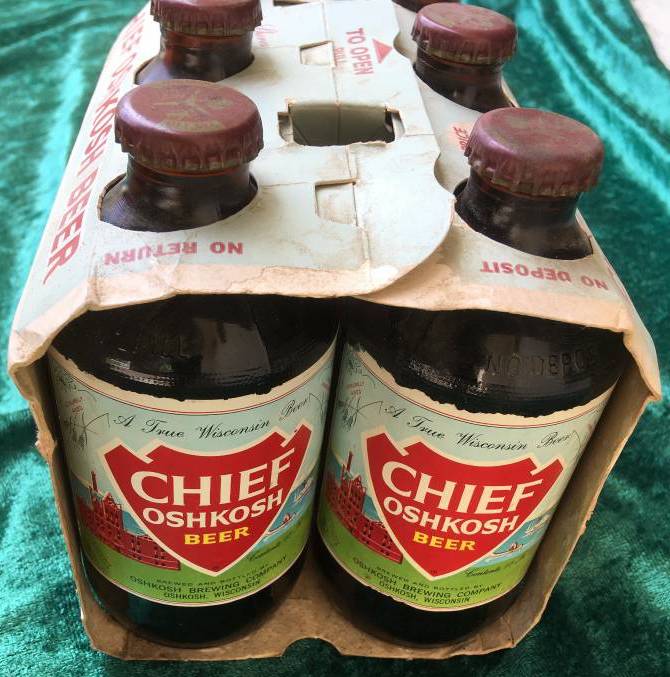
On this day in 1963, the Oshkosh Brewing Company introduced 8-packs of what it was calling the glass can, a 12-ounce stubby bottle of beer. OBC claimed it was the first Wisconsin brewery to offer this style of non-returnable bottle beer in 8-packs. Everybody else had 6-packs. The 8-packs sold for about $1.25. A case of returnable bottles of Chief Oshkosh went for $2.49 at that time.


These bottles are circa 1967.

A 1968 display.

Oshkosh Daily Northwestern, July 20, 1963.

Tuesday, October 31, 2017

Peoples v. Chief, 1957


In 1957, Oshkosh’s two breweries owned this city’s beer market. Combined, Oshkosh Brewing and Peoples Brewing produced nearly 90,000 barrels of beer. The people of Oshkosh were dedicated to that beer. Other brands were available. They languished. Most folks here drank either Chief Oshkosh or Peoples.

December 1957.
In the glass, the two beers looked much the same. Each was pale-gold. Flavorwise, they were quite different. Peoples was a malt-driven beer. Lightly bitter, it was the sweeter of the two. Chief Oshkosh leaned heavier on hops. It was crisp and bitter. A true American pilsner.


The two beers were identically priced. Both were available everywhere in town. You might expect the difference in flavor to have been the deciding factor in determining who drank what. It ran deeper than that. The choice tended to cleave along socioeconomic lines. Who you were and where you drank often determined what you drank. In Oshkosh, your beer was part of your identity.

 Summer 1957.
This all gets drawn into focus by an extensive survey commissioned by the Oshkosh Brewing Company (OBC). In 1956, OBC hired the Chicago marketing research firm A.J. Wood & Company to conduct an extensive analysis of the Oshkosh beer market. Wood & Co. visited 5,091 homes in the Oshkosh area to ask people about their beer drinking habits. The survey results were delivered to OBC in April 1957.

The survey focused heavily on flavor. This was probably what most interested OBC. In 1956, the brewery had tinkered with its recipe for Chief Oshkosh. The beer was made even more hop-forward and bitter. OBC sought to draw a bead on what local consumers were making of the change. What the brewery got went well beyond a simple taste test. The result was the most comprehensive picture of beer drinking in Oshkosh for any single period.

The first thing that jumps out is the focus on local beer. A solid 75% of the respondents identified either Peoples or Chief Oshkosh as their favorite beer. The remaining 25% were devoted to a host of other beers including Blatz, Hamm’s, Kingsbury, Miller, Old Style, Pabst, and Schlitz. None of those beers had more than a 5% share of the market.

When it came to bottled beer, Chief Oshkosh had the edge with 41% going for Chief Oshkosh and 34% for Peoples. The numbers flipped when it came to draft beer: 41% preferred Peoples, 35% liked Chief Oshkosh. How heavily those people drank also came into play.

The authors of the survey summed it up this way, “Chief Oshkosh’s position is substantially weaker among heavier drinkers than lighter drinkers. Among light drinkers, Chief Oshkosh enjoys a significant lead over Peoples – 45% versus 33%. In contrast, among heavy drinkers, the two brands rank about equal – 38% and 37% respectively.”

Light drinkers were identified as those having had fewer than four beers in the previous two weeks. Heavy drinkers were people who drank 16 or more beers in that same time frame.

Drilling down further, the authors noted, “Peoples is somewhat overbalanced toward the working classes, while Chief Oshkosh shows greater strength among white collar people and the relatively higher income groups."

So, if you were a blue-collar worker who drank their beer in a tavern you were probably drinking Peoples. If you wore a suit to work and drank a beer from a bottle every now and then, you were likely to be a Chief Oshkosh drinker.

For the folks at OBC this had to be somewhat concerning. Especially in light of what the brewery was spending on advertising. Chief Oshkosh was the most heavily marketed beer in this area. It was advertised on TV, radio, and in print. Peoples, on the other hand, spent next to nothing on all that. They’d place a newspaper ad from time to time. That was about it.


The truly bad news for OBC came in the response to the new, hoppier Chief Oshkosh. Chief Oshkosh was the beer identified by drinkers as having the “sharpest taste.” That translated into a less appealing beer. The survey authors wrote...

“Chief Oshkosh’s lower product appeal in relations to Peoples can be attributed to the fact that drinkers consider the product to be somewhat stronger and more bitter than Peoples – an indication that recent changes have gone too far in this direction. This is particularly true of the draft beer.”

This certainly caught the eye of OBC president Arthur Schwalm. He scrawled notes across this page on his copy of the survey.


... this is a problem for a brewmaster.” That brewmaster was Wilbur Strottman, whose name Schwalm wrote on the survey. The other name, Siebel Co., is a reference to J.E. Siebel and Sons of Chicago, which did lab testing of OBC’s beer.

The response from drinkers that Chief Oshkosh had become too bitter was especially pronounced among people who drank the beer on draft. That’s not at all surprising. It was the same beer, but each was treated differently. The bottled beer was pasteurized and handled without refrigeration. For example…


The hops are bound to fade in beer treated that way. The kegged Chief Oshkosh wasn’t pasteurized. And it was stored at serving temperature. The flavors were better preserved. The bitterness would have been just as the brewer intended. Damn, I wish I could have tasted that beer.

There’s something interesting buried in this. People responding to the bitterness of Chief Oshkosh tended to conflate it with strength. They assumed Chief Oshkosh was stronger than Peoples. Nope. Peoples Beer was 4.6% ABV. Chief Oshkosh was 4.5%.

Looking at this 60 years later, it’s hard to appreciate how much has changed. Some for the better. Some not. Here’s the part that hit home for me. In 1957, it was like this...


All that was gone 15 years later. Oshkosh Brewing closed in 1971. Peoples shut down in 1972.

We have two breweries again in Oshkosh. Soon we’ll have a couple more. But it’s nothing like it used to be. Tastes have changed. So has the beer. And there’s so much less of it being made. Last year the two Oshkosh breweries produced close to 2,000 barrels combined. That’s about 88,000 fewer barrels than produced in 1957. It’s unlikely we’ll ever see anything like that again.

Oshkosh Brewing Company, May 1956.

Monday, July 17, 2017

A Beer By Any Other Name...

Spring, 1966. You grab a bottle of Chief Oshkosh. Out comes the churchkey. You apply it to this…


A year later, the Chief Oshkosh crown looked like this...


The inserted symbolism wasn’t meant to be cryptic. This new cap was about expediency. It was used on four different brands produced by the Oshkosh Brewing Company. We’ll get to that in a moment. First, some necessary background.

In 1966, the Oshkosh Brewing Company (OBC) went on a buying spree. It scooped up three defunct brands: Badger Brew of Baraboo, Liebrau of Two Rivers, and Rahr’s of Green Bay. Notice how the cap above is a blend of the labels below.


By late 1966, those left-for-dead brews had been revived. They were being produced by OBC in Oshkosh. To make things easier, OBC changed its bottle cap. The same cap could be used for each beer.

What distinguished the beers were their unique labels. Makes sense. Afterall, they were different beers, right? Well, maybe not.

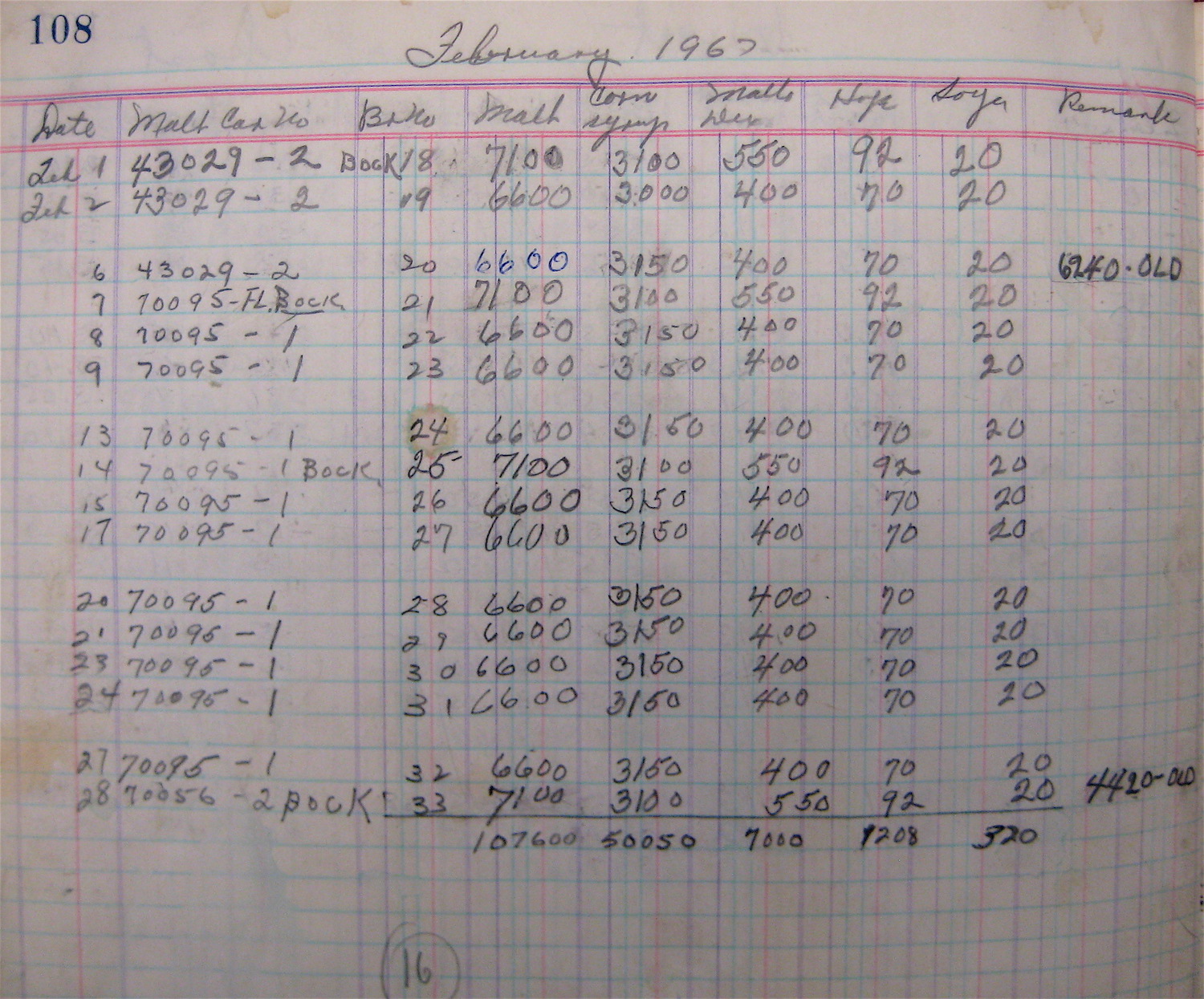
I’ve been going through old brewing logs from OBC. Specifically, the years 1967 and 1968 when these brands were in production in Oshkosh. Looking at the logs, you’d never guess OBC was producing a number of different beers.

The logs show no variation. Aside from OBC’s seasonal beers – Bock and Holiday Brew –  the composition of each beer is identical. The same malts and adjuncts. The same hops. The same yeast. The same ratios. Here’s an example (click to enlarge it).


That’s the brewer's log from February 1967. This was when OBC was filling orders for the brands it had recently acquired. Yet, aside from the four bock beers brewed that month, the 12 other batches are indistinguishable. This log is typical. All of them from the period are like this. It leads me to suspect OBC was brewing one beer and putting four different labels on it.

I can’t say for certain OBC was playing this kind of game. But I also can’t find a shred of evidence from the brewing logs suggesting they weren’t. I suspect this sort of thing may have been occurring at a lot of breweries in the late 1960s.

The industry was contracting rapidly. The brands of belly-up breweries were being scavenged. The G. Heileman Brewery in La Crosse became notorious for collecting labels from the wreckage. Heileman produced beer under a dozen different labels during this time. Almost all were pale lager. There was piddling difference among them. How many would notice if there were no difference at all?

In 1971, the Oshkosh Brewing Company failed. Its brands were acquired by the neighboring Peoples Brewing Company. Peoples brewmaster Howard Ruff told the Daily Northwestern he would match as closely as he could the beers produced by OBC.

Had Ruff seen those brewer’s logs when he said that? His job may have turned out to be easier than he first expected.


Monday, October 24, 2016

When Peoples Brewing Made Chief Oshkosh Beer

If William Glatz wasn’t dead, he’d have been livid.

Glatz was president of Oshkosh Brewing Company from 1904 until his death in 1928. He presided over the brewery as it came to utterly dominate the Oshkosh beer market.

Glatz wasn’t shy about using his power. His domineering ways led to a backlash among Oshkosh’s saloon keepers. They revolted by launching Peoples Brewing Company of Oshkosh in 1913. Glatz resented that anyone should challenge his sovereignty. He couldn’t have imagined that one day it would come to this...


The picture that ran in the Oshkosh Daily Northwestern on November 5, 1971 epitomized everything William Glatz dreaded. The great brewery his father helped launch had been overtaken by the upstarts.

On Monday, October 18, 1971, the last bottles of Chief Oshkosh beer brewed by OBC came off the bottling line. The following day rumors began circulating that the brewery was closing. At OBC they would neither confirm nor deny the rampant speculation.

A Daily Northwestern reporter went looking for answers at the brewery across the street from OBC. Peoples Brewing Company president Theodore Mack was no more forthcoming than his counterparts at OBC. “I think they’ve got something doing over there,” Mack told the reporter, “but I don’t know what it is.”

Mack knew exactly what was “doing over there.” He had the inside track on OBC’s impending closure. Mack had already negotiated the purchase of OBC’s Chief Oshkosh, Rahr’s, and Badger Brew brands. By the end of November, Peoples’ version of Chief Oshkosh Beer was in production.

Peoples’ brewmaster Howard Ruff said he’d do his best to clone the OBC brew. "Each beer has its character and all beer is a little different, but we will try to match as closely as possible the beers that were produced by the other firm before the purchase," he said.

That bit of news may not have elicited the intended response. By 1971 the reputation of Chief Oshkosh Beer was thoroughly tarnished. That didn’t matter. Peoples forged ahead.

At the close of 1971, the first ads began to appear for Chief Oshkosh Beer made by Peoples Brewing. The can in the ads still bore the imprint of Oshkosh Brewing Company.


Here’s William Glatz’s nightmare in living color. A can of Chief Oshkosh “Brewed & Filled” by Peoples.


Glatz’s nightmare passed quickly. Less than a year after acquisition of the Chief Oshkosh brand, Peoples Brewing collapsed under the burden of its debt load. By October 1972 rumors were swirling in Oshkosh of Peoples’ imminent demise. When asked if the rumors were true, Mack would neither confirm nor deny. He’d go on being evasive. It didn’t matter. The question was answered soon enough.

On November 3, 1972 production employees at Peoples Brewing were permanently laid off. The beer in holding tanks waiting to be packaged was dumped. It was over. Chief Oshkosh was gone for good.