Showing posts with label Fire!. Show all posts

Monday, June 6, 2016

Fire at the Brooklyn Brewery!

Saturday Evening, March 29, 1879...
Brewers at Horn & Schwalm’s Brooklyn Brewery are nearing the end of a long brew day. Suddenly, fire breaks out near the boil kettle. The brewers respond quickly.  They’ve been through this before. With pails of water, they wash down the flames before the fire can spread. Catastrophe averted. This time.

Fire was a constant concern at the Brooklyn Brewery. The wood-frame building was not even 15 years old, but it looked much older. Its vernacular architecture was out of step with the production facility it was being used as. In 1878, Horn & Schwalm had produced 1,366 barrels of beer. Walking by, you wouldn't guess the place capable of it.

Horn & Schwalm's Original Brooklyn Brewery
Lit by candles and fueled by wood and coal, the the Brooklyn Brewery was an accident waiting to happen. A few hours after the Saturday-night fire in the brewhouse had been doused, the waiting ended. The brewery went up in flames.

BREWERY BURNED
Total Destruction of Horn & Schwalm’s Brewery
About five o’clock Sunday morning the brewery on Doty street just south of 16th which is owned by A. Horn and Leonard Schwalm’s estate was totally destroyed by fire… about four o’clock the building was discovered by neighbors in a mass of flames. Two or three employees slept in the brewery and they barely had time to escape… The brewery itself was totally consumed together with a large amount of stock both in grain and beer.
 - Oshkosh Daily Northwestern, March 31, 1879

Bad enough, but it could have been much worse. Until recently, the Horn and Schwalm families had been living above the brewery. But with the the business and its output growing, both families had moved to separate dwellings nearby. They had homes, but their brewery was gone.

The impact was devastating. The fire destroyed nearly $500,000 (in today’s money) worth of equipment, beer and property. Insurance covered half the loss. The Horn and Schwalm families bore the rest. But there was no compensating for the loss of future business.

The Brooklyn Brewery headed into the summer of 1879 without a product. Beer has always been a somewhat seasonal commodity, but that was especially so in the late 1800s. The brewery relied on brisk sales during the warm months to fund the winter brewing season of its cool-fermenting lager beer. In the summer of 1879, the Brooklyn Brewery had no beer to sell.

Instead of peddling beer, they went to work building a new brewery. By July it was taking shape. This one was nothing like the rustic, wooden brewery they had lost.

New Brewery Building 
The brewery of Horn & Schwalm on Doty street near the city limits, which was burned last winter, is being rebuilt on quite an extensive scale. The building is now up as far as the second story. It is of solid brick with massive stone foundation, and is being built as nearly fire proof as possible, all the rooms being arched in brick and with little wood about them. The main building is 45 by 60 feet, and will be three stories high, which, with the half underground basement, makes a building practically four stories high. All the modern improvements are being put into it, and when completed it will be the largest and finest brewery in the state outside Milwaukee. Later in the season immense ice houses and other additions will be built. The brewery will be in full operation in about a month.
 - Oshkosh Daily Northwestern, July 15, 1879

Here’s a look at the completed brewery. The wooden structure with the cupola was the malt house. The brick brewery is to the right.


This was a brewery built to last. And it has. The malt house is gone, but brewhouse that was the core of the Brooklyn Brewery still stands. It’s the oldest intact brewery structure in Oshkosh. Here’s how it looks today.


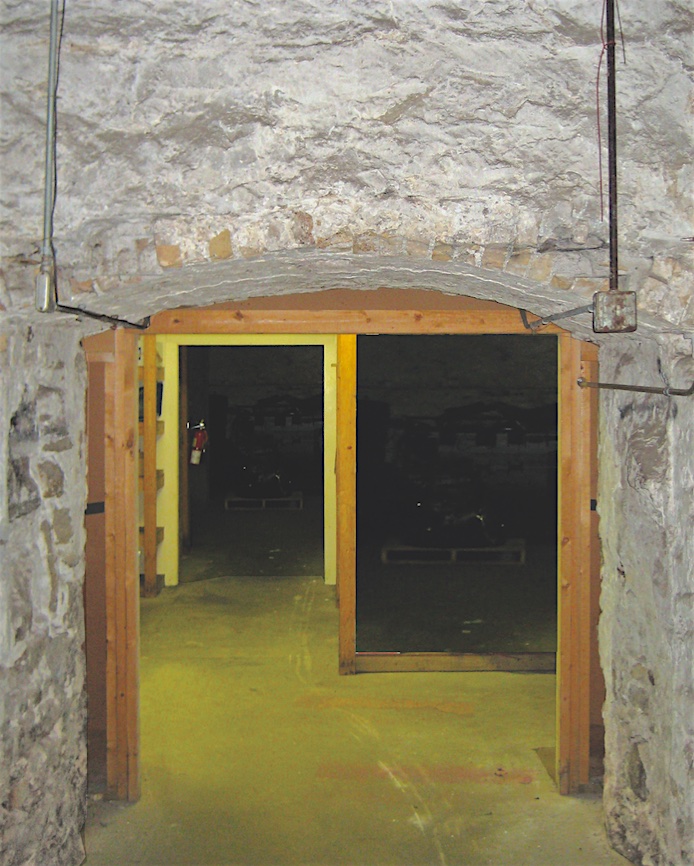
Below the original brewhouse, you can still see the aging cellars with their “rooms being arched in brick.” Here’s a look.

This part of the Horn & Schwalm story ends well. The new Brooklyn Brewery soon surpassed its south side rival, the John Glatz & Son Brewery, to become the most productive brewery in the city. By the time Horn & Schwalm merged their operation with that of Glatz and Kuenzl to form the Oshkosh Brewing Company in 1894, the Brooklyn Brewery had become Winnebago County’s leading brewery.

Monday, May 23, 2016

Fire at the Oshkosh Brewery!

Before we dive down today’s rabbit hole, let’s clear something up. The Oshkosh Brewery mentioned in the title of this post is not to be confused with the Oshkosh Brewing Company.

The Oshkosh Brewery was located near the east end of what is now named Bay Shore Drive. It was launched by brothers George and Frederick Loescher in 1852. This was years before anyone dreamed of starting that similarly named and much larger brewery on Doty Street.

One more thing to clarify: Loescher’s name is consistently misspelled in all sorts of publications from the period covered in this post. We’ll see a number of variants here, but they’re all referencing the same man. Here’s a prime example from an 1868 city directory.

OK, before we begin sifting its ashes, let’s pinpoint where Loescher’s Oshkosh Brewery stood. First a map from 1858. Look for the red circle….


Here’s a recent aerial view of that same area. The white oval represents the location of the brewery.


Time to get on with the pathos. Here’s the Oshkosh Daily Northwestern to tell us of the terrible Sunday morning of April 28, 1878.

Oshkosh Daily Northwestern, April 29, 1878

The Sunday morning fire appears to have brought an end to brewing beer at that particular location. But I’ve stumbled across a couple of post-fire references to the brewery that I’m dying to share. Here goes….

The Webbed-Feet People of Sodom
A couple days after the Oshkosh Brewery went up in smoke, a reporter from the Fond du Lac Commonwealth was sent here to get the lay of the land. The fantastic letter he sent back to Fond du Lac was later picked up and published by the Northwestern. The Fond du Lac hack wasn’t prepared for what he found in Oshkosh. Here are a few of my favorite cuts from his report.

Oshkosh, April 30 (1878) – A Wicked City. This is a hard town to write about, because if you tell the truth you have to write hard things... Three years ago Sunday, Oshkosh was nearly consumed by a fire started by Spaulding & Peck’s mill. To commemorate the third anniversary, a brewery burned Sunday night… Immediately back of the Beckwith House is a man who administers Turkish baths, and he told me nearly all citizens of Oshkosh who have lived here five or more years are web-footed… Many people in this city eat fish with neither salt or pepper, but with their fingers… Yes, Oshkosh is the Sodom of the Northwest.

The other post-fire reference to Loescher’s old brewery is even better. Or worse depending upon how you view these things. I’m calling this one...

The Reinhard Digression
Godfried Reinhardt was born in 1799 in Schönburg, Germany. On the Wednesday morning of September 4, 1878, his lifeless body was found floating in the Fox River just west of Loescher’s recently ruined brewery. A coroner’s jury was hastily convened. Its verdict: suicide.

The inquest into Reinhardt’s death stated that at about 2 p.m. Reinhardt had wandered off from his home at what is now Parkway Avenue. He was in a glum mood and had no apparent destination in mind. That evening the Northwestern published a story subtitled, “Undoubtedly a Case of Suicide.” The paper reported that Reinhardt frequently said he was tired of living and wished he could die.

Reinhardt’s family didn’t buy it. Upset with the rush to label their father’s death a suicide, Reinhardt’s three adult children dug deeper. They discovered their father knew exactly where he was headed that afternoon. And it wasn’t for the bottom of the river.

Two days after Reinhardt’s death, the Northwestern reported the family’s findings: “It has since been ascertained that Mr. Reinhardt, late in the afternoon, strolled down to Luscher’s brewery in the Second ward, and did not leave there until dark.”

Now, I think it’s safe to assume that Reinhardt hadn’t strolled over to Loescher’s to spend several hours staring at the burnt remains of a brewery. So what in hell was he doing there? Perhaps, he passed the afternoon and early evening there drinking beer.

If you recall, the article about the brewery fire mentioned that, “The only portion of the building not wholly burned is a small portion over the cellar where the tubs and some of the stock was kept.”

It’s known that Loescher operated a tap room in conjunction with his brewery. “Over the cellar where… some of the stock was kept” sounds like the perfect spot for a beer bar. I suspect, Reinhardt was there until he’d had his fill and then wandered off into the dark to his watery death.

Born Again
Reinhardt wasn’t resurrected, but the Oshkosh Brewery was. George Loescher built a new brewery, just across and down the street from the old one. It was up and running by 1880. Here you can see their proximity.


I like nothing more than to end a blog post with a gravestone. Beats hell out a punctuation mark. This one goes out in memory of Godfried Reinhardt. May the earth be light on him. Prost!


Monday, May 16, 2016

Fire at the Union Brewery!

There were a few things Oshkosh was known for in the latter half of the 19th Century: Lumber mills. Mayhem. Saloons. Mass destruction by conflagration... Like other businesses that went up here, breweries had a habit of burning down. I haven’t posted much about Oshkosh’s brewery fires. Time to address that. We’ll start on the south side where brewers John Glatz and Christian Elser burned down a brewery that wasn’t even theirs to burn...

Burning the Union Brewery
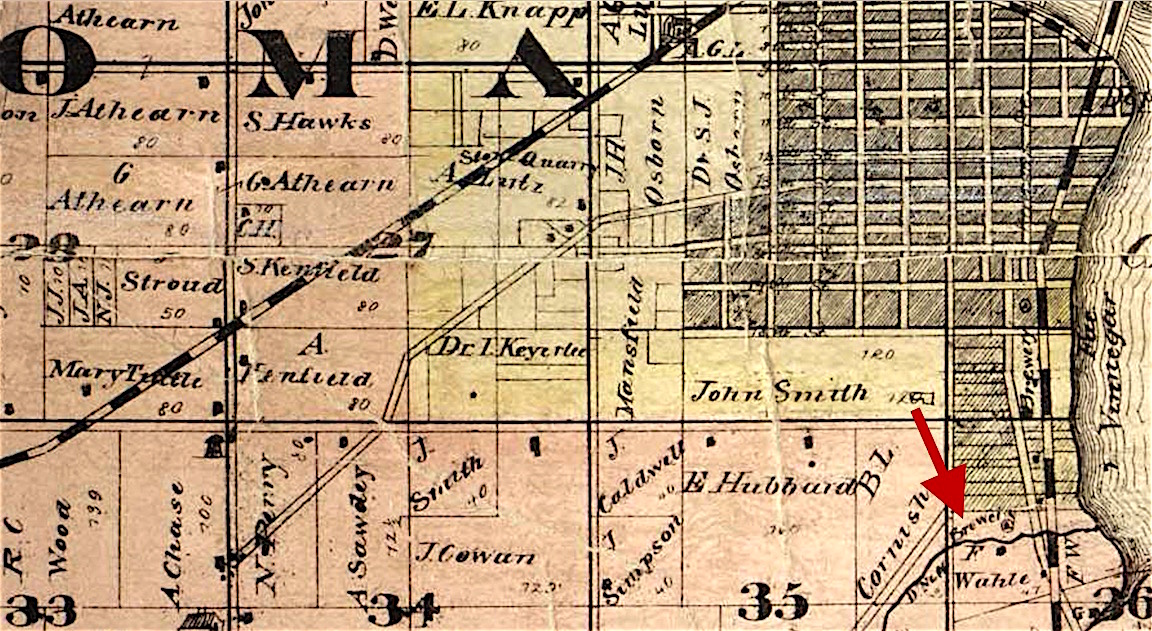
In 1867 German-born brewmaster Franz Wahle moved to Oshkosh from Stevens Point, where he’d had a hand in establishing what is now known as Stevens Point Brewery. Upon leaving Point, Wahle purchased a 52-acre farm and its stock on the southern border of Oshkosh in what was then the Algoma Township. Here’s a map from 1873, showing the location of the Wahle farm with the brewery at the northern edge of the property. The red arrow points the way.


Two years after arriving here, Wahle leased his brewery to a couple of German-born brewers who had most recently been plying their trade in Milwaukee. John Glatz and Christian Elser took over Wahle’s brewery in September 1869. They re-named it Glatz and Elser’s Union Brewery. All was well until the Friday night of December 15, 1871.


Destruction of a Brewery
About ten o'clock on Friday evening the Union Brewery owned by Franz Wahle and leased by Glatz & Elser took fire and then burned to the ground. The steamers were promptly on the ground, but for lack of water were unable to do much.
- Oshkosh Weekly Northwestern, December 21, 1871

What an especially bad time to burn your brewery. Here’s why: Glatz and Elser produced cool-fermenting lager beer. For such brewers, a productive winter was crucial. The slow, cool fermentation lager beer requires meant that the peak of their brewing activity occurred during the cold months. It was also the time of year when they harvested tons of natural ice from Lake Winnebago for cooling their elaborate system of caves where they conditioned their beer. The Friday-night fire crippled the Union Brewery for the coming year.

For Glatz and Elser, getting things back in order wasn’t easy. The brewery they had just destroyed was not insured. They had also lost their entire stock of beer. A little over half of that loss was covered by insurance.

The two were left in dire financial straits. These were not rich men. Combined, Glatz and Elser had fewer assets than any other brewers in Oshkosh. Yet, they managed to rebound.

Less than a month after the fire, Glatz and Elser used their insurance money to help finance their purchase of the northernmost four acres of the Wahle property. The brewery had been valued at $6,000 (about $120,000 in today’s money). Glatz and Elser paid Wahle about $110,000 in today’s money. But what they bought was now vacant land.

A quick digression: I love the ornate lettering on the deeds that were recorded back then. Here’s the top portion of the deed transferring the property from the Wahles to Glatz and Elser.


Glatz and Elser took a series of loans to finance the rebuilding of the Union Brewery. It all worked out. By the end of the 1870s, the Union Brewery was producing more beer than any other brewery in Winnebago County. Here’s the brewery they built in the aftermath of the fire.

The Union Brewery is long gone, but you can still walk the grounds where it once stood. A part of that property is now Glatz Nature Park. It’s open to the public and you can see remains there of the brewery’s stone foundation. You ought to go visit.