Showing posts with label Oshkosh Taverns. Show all posts

Sunday, October 23, 2022

Open Season on Ostertag

There was a time when Sebastian Ostertag was plagued by bullets. More on that in a moment. First, let's meet this guy.

Johann Sebastian Ostertag

He was born in Württemberg, Germany in 1839. He was eight when he migrated with his family to a farm in the Town of Nekimi. Ostertag left the farm in 1861 and joined the Oshkosh Rifles. He was off to fight in the Civil War.

Three months later, Ostertag took a bullet to his right thigh at the First Battle of Bull Run. He got hit again at the Second Battle of Bull Run in 1862. This time, Johnny Reb clipped his right hip.

The Union Army in retreat after the disastrous Second Battle of Bull Run.

The mutilated Ostertag was sent home to heal up. Back in Oshkosh, he got well and got married. Then he returned to his unit. Ostertag now belonged to the Iron Brigade.

The Iron Brigade at the Battle of Gettysburg in 1863.

At Gettysburg Ostertag was perforated again. He got shot in the face. The bullet entered his left cheek and drove deep into his head, coming to rest behind his right eye. The battlefield doctors wrote him off for dead. But he was still squirming a week later. They finally sent Ostertag to Satterlee Hospital in West Philadelphia where the bullet was extracted. He survived that ordeal, too. The fateful bullet now resides at the Oshkosh Public Museum.

Ostertag convalescing in his "Union Blues" and his head wrapped in bandages.

He got back on his feet and came home to Oshkosh. After a short stint with the railroad, he opened a lager beer saloon and grocery on the west side of what is now South Main Street.

An 1867 drawing with an arrow pointing the way to the front door of what would become Ostertag's saloon and grocery. The view shows the west side of what is now South Main Street (Kansas Street then) between 7th and 8th Avenues. Ostertag's grocery was on the ground floor. His lager beer saloon was above it.

There isn't a trace of that place left.

The empty 700 block on the west side of South Main Street.

Ostertag involved himself with all sorts of endeavors in Oshkosh. Aside from the saloon and grocery, he ran a hardware store, and a farm, and was a Southside alderman. His pugnacity never left him. In 1885, the five-foot-eight-inch Ostertag was charged with assault and battery after he attacked an Oshkosh blacksmith for reasons unknown.


Ostertag retired in 1904 and built a home for himself and his wife at what is now 515 Pleasant Street. His old home is still there.

515 Pleasant Street.

Ostertag died in that house in 1930. He was 90 years old. Johann Sebastian Ostertag is buried in Riverside Cemetery. His grave lies in the shadow of a monument to the Grand Army of the Republic.


Wednesday, September 29, 2021

Adam Carlson, Ruby Owl, and a Decade of Craft Beer in Oshkosh

For a decade now, Adam Carlson has been putting his stamp on the Oshkosh beer scene. You've known his influence if you've ever purchased beer at Gardina's Kitchen & Bar or The Ruby Owl Tap Room; each located on North Main Street in Oshkosh. In addition to being part owner and manager of Ruby Owl, Carlson curates the beer line-up for both venues. The taplists at these places tend to stand apart from what you'll find in other taprooms in town. That's because Carlson is not your typical, Oshkosh beer purveyor.

Adam Carlson

Carlson came to beer from the wine world. His drinks career began in 2010 as bar manager for what was then called Gardina's Wine Bar & Cafe. There, his nascent interest in craft beer got the better of him. It led to Gardina's installing a draft-beer system that Carlson filled with an ever-rotating cast of hard-to-obtain specialty ales. “The focus from day one was to be all craft all the time,” Carlson says. The success of the endeavor led to the opening of the beer-centric Ruby Owl in 2016.

Since then, Ruby Owl has become the benchmark bar for craft beer in Oshkosh. When Ruby Owl was launched five years ago, craft beer here was still something of a niche product. It went mainstream in the interim. And with that has come a new type of consumer.

"The snobby seriousness attached to the early days of craft beer has fallen," Carlson says. "We see a lot of people now that just want to enjoy a beverage and if that beverage happens to be beer, well that's great. But they're not involved in the minutia or the provenance. They just want something that's going to taste really good, something that might even transcend beer."

Which has led to Carlson pouring beers of a sort that would have been unimaginable a decade ago. "There's now a lot of overlap with things like hard seltzer and cocktails," he says. "The distributors will come to us with beers that are so packed full of fruit purees, and milk sugars, and those sorts of adjuncts that they barely qualify as beer. That's not to denigrate those things, but if you're a beer purist, that's not going to appeal to you."

The point, he says, is to draw from a larger pool of consumers. "The breweries are marketing these beers to compete in other categories. In a way, that's brilliant. We see where it's engaging a segment of the market that in years past would not have been at all interested in traditional beer."

"I can see a similar arc with wine, where it was a trend started by vinophiles and it picked up steam and hit the mainstream and you had an explosion of mass-marketed wine. It's not traditionally acceptable to do to wine what is being done to beer, but similarly to beer, these are wines made to attract that mainstream consumer who just wants something fruity and fun to drink."

Carlson isn't judgmental about the direction the market has taken. "To point these things out is not an indictment of anything," he says. "It's not that a brewery is wrong for making something like a marshmallow pina colada sour. It's just the cycle of things." The current cycle may not end anytime soon, but Carlson is noticing that some consumers appear to have grown weary of it.

"We're seeing more people coming in looking for lagers and for some bitterness in their IPAs," he says. “We’re also seeing more people who want less alcohol. Eventually you come to the realization that it's as much about the people you're with as the beer, and that you'd rather have two or three 4.5 percent beers instead of one super-high alcohol beer. There's a growing demand for well-made beer that doesn't have anything to hide. It's reverting back to something that's clean and crisp and refreshing."

That's a segment that Carlson likes to encourage. "A lot of what I put on tap is driven by what I want to drink," he says. "There are a number of breweries I'm loyal to that make consistently good beer. Breweries like Lakefront, New Glarus, Lazy Monk. I find myself coming back to their beers. They may not be flashy, but everything is always well made and their prices are fair. Those aren't the breweries that are going to set us apart, but I always like to have them in the mix."

All of which hasn't made Carlson's job any easier. Curating a tap list that can satisfy such diverse expectations has grown increasingly challenging. "When I started, the options were so limited," he says. "But now there are so many vendors, distributors, and salespeople out there vying for your draft lines, and vying for your time, that it's become dizzying. Everything is moving at such a hyper-speed that it's kind of crazy. It's never been like this before."

A slightly different version of this story appears in today's Oshkosh Herald.

Thursday, May 20, 2021

Red Ram Redux

Here's a story that could only have happened in Oshkosh...


Drew Roth, the head brewer at Fox River Brewing, found those cards while he was sifting through the attic of his garage. He got in touch with me and asked if I'd ever heard of the Red Ram. I had. Just a couple of days earlier, I also had been sifting around down in a rabbit hole that was connected to the Red Ram tavern. I'll share what I found there in a moment.

In the meantime, Drew decided that Red Ram would be a good name for the bock beer he had recently brewed. That beer was released at Fox River this afternoon. We have a long history with bock beer in Oshkosh and this one fits beautifully into that lineage. It's an excellent beer. The Red Ram lives again.

Life at 103 High
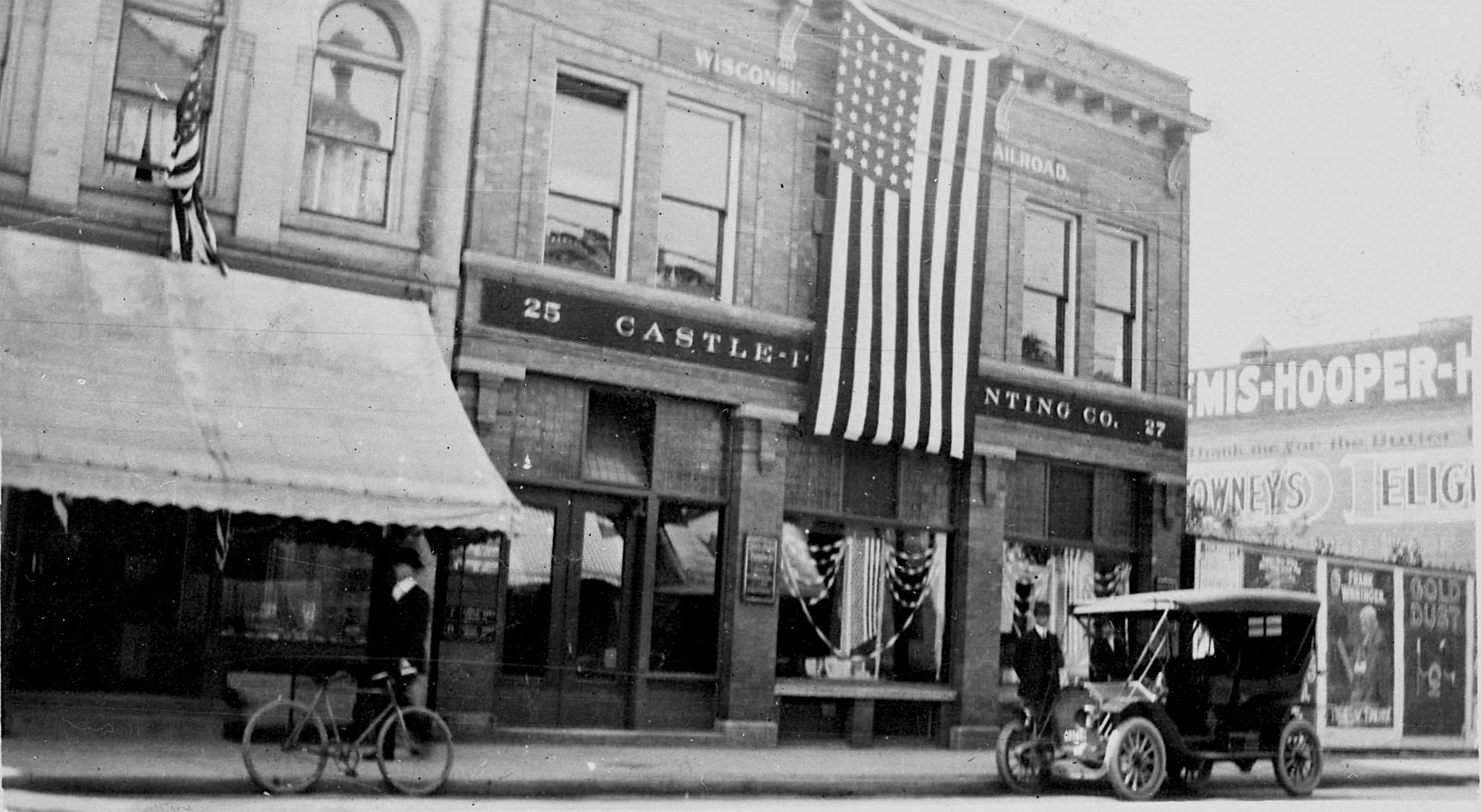
The Red Ram was located at 103 High Avenue in a building that went up in 1909. Originally, it was the home of Castle-Pierce Printing.

Castle-Pierce Printing in the early 1920s.

Castle-Pierce moved out of there in 1965. The fun begins. The first tavern license for 103 High was taken in 1968 by Charles Green, an insurance agent living in Neenah. Initially, the City of Oshkosh was less than eager to see Green go in there. He was co-owner of an infamous strip club named the Speak Easy on Omro Road. City officials had concerns about what Green might attempt with the old Castle-Pierce place. Would he have Helen from Hurley whirling on High?

Helen from Hurley appearing at the Speak Easy in February 1968.
When not performing, she was known as Mrs. Helen McKellip, aged 28 of Menasha.

Helen was a no-show. In fact, nothing much happened at 103 High until 1969 when plans for The Red Ram began to materialize. The man behind that plan was Green Bay Packer legend Jerry "The Zipper" Kramer.


The freshly retired Kramer was launching a chain of Red Ram bars and restaurants. There were Kramer-backed Red Rams in Chicago, in Denver, in Ames, Iowa... and as of April 1970, there was a Red Ram at 103 High in Oshkosh. It became the 15th Red Ram in the nation.

Outside the Red Ram, March 1970.

The Red Ram's Rathskeller had an alternate entrance through an underground areaway at the corner of Market and High. That areaway dates back to at least 1886. It's still there and one of the last of its kind in Oshkosh. You can see it in the picture below. Look to the left for the steps leading down.

103 High, where the Red Ram was located, is the Brown building on the right.

The Red Ram kicked the bucket the year after it opened. Out went the Ram and in crawled The Universal Turtle.
November, 1971.

The Turtle was the brainchild of John Hall, who had grown up in Oshkosh. His family had been in the hospitality business for years. John Hall's mother, Jeanne Hall, was the manager of the Athearn Hotel in Oshkosh in the 1950s. 

Here's a bit of a detour, but I like this next picture too much not to share it. The photo below shows Jeanne Hall in 1956 behind the wheel of the new Packard Caribbean convertible she was awarded by Server Magazine for her work at the Athearn.


OK, back to the Turtle Club. It was modeled after Turtles in Los Angeles and Seattle. In addition to the bar, the Oshkosh Turtle featured live entertainment. Among the early attractions were Johnny Diamond and his "fire" show; and Miss Nude Universe 1970, Sandi Shane.


The Turtle laid an egg. It closed in 1972. Then came the Paddock Club, which also promptly failed. Finally, there arrived a bar and restaurant with some staying power. A lot of Oshkoshers can recall Baxter's Beef & Pizza Company. Baxter's opened in January 1975.

1977.

The bar at Baxter’s. Photo courtesy of Dan Radig.

April, 1984.

Baxter's bit the dust in 1984. Its failure inspired another round of unsuccessful bars and restaurants at 103 High. There was Carlos Giovanni's Restaurant, Bravo's Bar & Restaurant, Steve's On High... with each passing year the place looked less inviting. The building sat vacant at the start of the 1990s.


The fun was done. In 1992, David Sparr's law office went in. Sparr and company have been there ever since.

103 High Ave.

Inside 103 High.

The building at 103 High is now part of the North Main Street Historic District and is listed on the Wisconsin Register of Historic Places. That’s fine, but in Oshkosh we have another way to memorialize these things. It comes full circle in a glass of beer. Prost to the Red Ram.

Red Ram Copper Bock at Fox River Brewing, Oshkosh.


Monday, December 9, 2019

The Loudest Speakeasy in Oshkosh

Put yourself in Fred Rahr’s shoes. It’s 1920 and for the past 20 years you’ve been running a popular saloon on Main Street in Oshkosh. Before you got into that, you worked in the family brewery. But now Prohibition is here. Suddenly, what you and your kin have always done has been made illegal. What would you do?

If you’re Fred Rahr, the answer is obvious. He flouted Prohibition at every turn. No other saloon keeper in Oshkosh breached the dry law as often or with as much tenacity as Fred Rahr did.

Fred Rahr's Tavern with an Elk's Head Beer sign in the 1940s.

Before the Storm
The Rahr family had been in the beer business for as far back as any of them could remember. For generations, the Rahr's had operated a brewery in Wesel, an ancient brewing city on the river Rhine in the north of Germany.

Fred Rahr's father, August, settled in Oshkosh in 1865. August and his brother Charles bought land on the shore of Lake Winnebago and built a brewery. Fred Rahr was born in Oshkosh in 1872. He grew up on Rahr Alley (now Rahr Ave.) working in that brewery.

In 1884, August and Charles Rahr divided the family business. August took over the beer bottling side of the operation. Charles maintained the brewery proper. Fred Rahr completed the ninth grade then quit school and went back with his uncle Charles at the brewery. He lived in Charles Rahr's home while working as a brewer in what was then being called The City Brewery.

The Rahr Brewing Company as it looked when Fred Rahr worked there.
The inset photo shows Charles Rahr's home where Fred Rahr lived while working at the brewery.

In 1899, Fred Rahr left his job at the brewery to go into business with "Little Joe" Thalhofer, a longtime Oshkosh barman. Thalhofer was running a saloon on the east side of Main between the river and Ceape. He'd been in there since 1893. It was a three-story, brick building that had gone up in the late 1860s. It was just up from the Revere House hotel.

Looking north from the Main Street Bridge in 1875.
The arrow is over what would become the Thalhofer and Rahr Saloon at what was then 20 Main.
In the foreground at the right is the Revere House.

Little Joe Thalhofer died in 1902. His brother Albert took his place at the bar and for the next 17 years the Rahr and Thaholfer saloon thrived at the gateway to downtown Oshkosh.

Keeping Little Joe's memory alive. From the 1912 Oshkosh City Directory.

In 1919, Albert Thalhofer quit the saloon business. He was looking to the future. The onset of Prohibition was imminent. For Fred Rahr, there was no other way. When the dry law took hold, Rahr took out a license to sell soft drinks so he could keep the doors open. He sold booze on the sly.

Rahr wasn’t alone in refusing to submit. More than 80 former saloon keepers in Oshkosh were testing the waters to see whether such a foolish law could even be enforced. The first year went their way. City police showed no interest in arresting people on liquor violations. As always, Oshkosh ran wide open.

But it wasn't long before the mutiny caught the attention of state and federal officials. Fred Rahr's decade of disorder was about to begin.

1921: Oshkosh on Notice
National Prohibition arrived on January 17, 1920. It was only a matter of months before Oshkosh was well known as a place where liquor still flowed freely. The feds decided something had to be done about it. On the Friday evening of August 26, 1921, Prohibition enforcement agents made a coordinated raid on the city. They went straight for Fred Rahr's place.

Oshkosh Daily Northwestern, August 27, 1921.

The feds met resistance at just one of the dozen places they raided that night. When they burst through the door at 20 Main, Fred Rahr bolted towards the open safe where he kept a stock of moonshine. But before he could get there, he "scuffled" with federal agents. Rahr was thrown to the floor and subdued, and then arrested.

Rahr didn't go down easy. Though they had caught him red-handed, he fought the charge for the next six months. He was finally convicted and fined on February 16, 1922. That was not a good week for Fred Rahr. Just a day earlier, he had been arrested once again.

1922: Big Booze Raid
Fred Rahr’s name hit the pages of the Daily Northwestern again on February 16, 1922. This time he appeared under the headline, OSHKOSH CENTER OF BIG BOOZE RAID AND THIRTEEN ARE PUT UNDER ARREST.

Federal agents had been casing the city for days in advance of the raid. That they were able to make only 13 arrests was a testament to the underground network that had been established among Oshkosh’s bootleggers and speakeasy operators in the six months since the previous invasion. Once the raids were underway word began spreading that the feds were in town. At one of their stops, an agent intercepted the alarm call: “This is Heinie,” said the voice at the other end of the wire. “The Prohibition men are in town – you better be careful.”

Rahr’s call didn’t come in time. When the feds arrived he was caught holding a pint of moonshine. That should have put him out of business. But again, he fought the charge and this time somehow managed to beat it.

If Fred Rahr was experiencing any apprehension about his ongoing criminal pursuits he certainly wasn’t showing it. Since 1900, he’d been paying rent on the towering building that housed his saloon. Now, just five months after his second bust, he purchased the property. The job was risky, but the money was good. Rahr was living large, Roaring-Twenties style.

Circa 1923. The arrow is over Fred Rahr's Bar.

1926: The One and Only
Aside from his frequent court dates, Fred Rahr managed to spend the four years between February 1922 and February 1926 relatively free from the harassment of booze cops. The old ways prevailed at the south end of North Main Street. Rahr and his barroom neighbors operated as if Prohibition was merely a suggestion. The latest addition to the mix was directly across North Main Street. A woman from Green Bay had moved in there and opened a homebrew shop for those who thought they could make better beer than what the local bootleggers provided.

The sodden enclave was disrupted on a winter’s morning in February 1926.

“A squad of state prohibition officers invaded Oshkosh this morning and between 6 and 7 o’clock visited some nine or ten soft drink establishments. Oshkosh apparently is an arid desert, for only one man was brought in.”
     –Oshkosh Daily Northwestern February 2, 1926

For Fred Rahr there was no humor in the reporter’s sarcasm. He’d had a pitcher filled with moonshine sitting on the bar when the agents came in. Rahr immediately tossed the liquor into a sink. But the smell of booze lingered on the glass. That was enough to get him arrested and dragged back into court.

But again, Rahr escaped punishment. He hired Attorney Frank B. Keefe to represent him. Keefe had plenty of influence in Winnebago County and was gearing up to run for District Attorney. Rahr wasn’t the only dry-law violator that Keefe took on as a client in the runup to the election. Perhaps that wasn’t a coincidence. Keefe may have considered it a way to curry favor with a certain class of voters. In the end, Rahr went free and Keefe was voted in as the county’s new District Attorney. A year later, Keefe would find out what it was like to be on Rahr's bad side.

Frank Bateman Keefe

1927: I'll Choke it Down Your Throat
It was around 9 p.m. on a Tuesday in early August when Albert Kieckhafer ambled into Rahr’s speakeasy looking for a drink. Harry Witzel, who'd been bartending at the Rahr place for years, was working that night. Witzel sold Kieckhafer two glasses of moonshine for 50 cents. When Kieckhafer left he was good and drunk. Kieckhafer was known to be a nasty drunk.

He stumbled across Main Street and into the Waffle Shop restaurant and began busting up furniture and smashing plates. He was brawling with the owner when the cops arrived. The following afternoon, Kieckhafer appeared before the judge. He pleaded guilty to all of it. The judge asked him where he’d gotten the alcohol. The cops headed straight over to Rahr’s place and arrested Harry Witzel.

Harry Witzel adhered to the Rahr method of defense: deny everything. When he got his day in court, the prosecutor was none other than Rahr's old ally, the recently elected District Attorney, Frank B. Keefe. The trial was a fiasco.

Rahr hired Earl Finch to represent Witzel. Finch took the fight straight to Keefe; mocking and goading the district attorney. Keefe lost his cool when Finch pointed out the D.A.'s double-dealings where Prohibition was concerned. "That's a lie!" Keefe screamed leaping to his feet and thrusting towards Finch. "It's a lie and I'll choke it down your throat." The judge had him restrained.

Keefe eventually regained his composure and Witzel was found guilty. Finch called for a mistrial on grounds that the jury was composed entirely of Ku Klux Klan members. Witzel had endured enough of this. He paid his $300 fine and went back to work at Rahr’s bar.

After four, separate dry-law violations, you would think Rahr would have had his license pulled. Not in Oshkosh. But even here there was a limit to what could be tolerated. And Rahr was about to finally reach that limit.


1929: Bad Night for the Boy Wonder
Al Gullickson was in his twenties and they were still calling him the boy wonder. How annoying. He was born in Oslo, Norway in 1907. His musical genius was recognized early. Gullickson's parents dragged him across Europe to have his raw talent shaped by masters in Berlin and Paris. By the time he was 10, he was touring the continent displaying his freakish abilities on the harp, piano, and accordion. When he turned 12, they hauled him to America.

The Gullicksons settled in Milwaukee and young Al entered show business. He toured the Orpheum Theatre Circuit with Rudy Vallee's troupe. Impish Al was a triple threat. He danced, he sang, he played the accordion. People adored him, especially the ladies. Gullickson claimed women of all ages, even "mothers and matrons" were throwing themselves at him. What was a boy to do?

But when the Boy Wonder stopped being a boy, people stopped being amused by his antics. At the age of 16, his showbiz career fizzled. Gullickson wound up in Oshkosh employed as a demonstrator for the Barton Organ Company.

Al Gullickson, The Boy Wonder.

In 1929, Gullickson was 22 and working the organ at the Fischer Theater on Main Street. After the Friday-night show of March 1, 1929, he packed his 16-year-old girlfriend, Marguerite Reimer, into his car and they went off in search of a drink. They stopped at Fred Rahr's place. Gullickson came out with a quart of booze. The couple then headed for the Peacock Restaurant just up the street. They ordered a bottle of Canada Dry and began mixing drinks.

At the Peacock, their party grew. It was still going, albeit without Gullickson, the following morning. At 3 a.m., he was sleeping it off while Marguerite Reimer was behind the wheel of his car cruising the southside with two of the young men they’d been partying with. Both of those men had their skull crushed and died after Reimer flipped the car near the corner of 17th and Minnesota. Marguerite Reimer walked away with a couple of small cuts on her pretty, little face.

Marguerite Reimer

The tragic story went bleeding across the pages of the Daily Northwestern for the next month. Reimer was portrayed as the out-of-control rich girl destined for horrible things. The Boy Wonder was the dissolute rake fueling her delinquency. Gunning for both of them was none other than District Attorney Frank B. Keefe. He dispatched each of their cases in short order.

Marguerite Reimer was declared incorrigible and sentenced to a five-year hitch at a Catholic reform school for girls in Green Bay. They reformed her all right. Soon after her release, Reimer converted to the Bahá'í Faith. She spent the remainder of her life preaching the "Greater Covenant" of universal justice, unity, and the equality of all people.

Gullickson was convicted of transportation of liquor and encouraging the delinquency of a minor. Keefe was dismayed when the judge let The Boy Wonder off with fines totaling just $440.55. He was being lenient he said because of Gullickson's "youth and musical promise." But Gullickson was never to reclaim his adolescent glory. His swan dive into obscurity continued.


With those two out of the way, Keefe drew his bead on Fred Rahr. If the city wouldn’t shut Rahr down, Keefe said he would. He reached out to the feds imploring them to padlock Rahr's speakeasy. Rahr claimed he wasn't responsible for this latest transgression. He said he had leased the bar out to a couple of bootleggers. The logic behind that defense went to the grave with Fred Rahr. Still, it took almost eight months for Keefe to convince officials to put a padlock on 20 Main. It took Rahr about as long to get that lock taken off.

1931: Dead Drunk
It's amazing that, despite his lengthy list of offenses, Fred Rahr avoided a jail sentence. Even more stunning is that year after year, he managed to get the city to renew his license to operate his unruly establishment. Keefe's intervention made little difference.

In November 1930, Rahr went to city hall and asked again to be issued a new license. Understandably, there was trepidation among Oshkosh officials. But then Councilman Henry Hagene said he was for it. Oshkosh Mayor Taylor G. Brown also consented. With that, Rahr's application went sailing through. The lock came off. Fred Rahr was back in business. And in no time, it was business as usual.

The south end of North Main remained awash in illicit booze. Rahr may have been the most prolific violator, but he had plenty of company. Among that cohort was a speakeasy doing business one door south of Rahr’s. In 1931, that bar was run by veteran Oshkosh saloon operator Fred Schneider.

Schneider was a hard case. He would show his mettle by drinking a customer under the table. On the night of Wednesday, October 7, 1931, Harvey Walter walked in. Schneider challenged him to a drinking contest. It lasted four hours and Schneider won. Walter was carried out of the bar and dumped at his home on Ohio Street. His family found his dead body the next morning.

Later that day, after the police had gotten the story, Schneider's speakeasy was raided. Fred Rahr was standing in the doorway of his place laughing as the cops went rushing by. For once it wasn't him. Rahr should have kept to himself. His laughing so aggravated the police that they raided his bar. They found him holding. Rahr ended up with a $200 fine. He was lucky it was just the Oshkosh cops. They went easy on him. But the lurid story – the drinking contest and Rahr’s laughing response – made headlines across the state. A week later, federal agents came pouring into town.

1931: Barroom Blitz
On October 17, 1931, federal agents staged their largest raid on Oshkosh. There had been rumblings for weeks that something like this was coming. But there were always rumors like that floating around. This time the hearsay materialized in the form of 68 agents who simultaneously raided 29 of Oshkosh's better known "malt houses." At the end of the night, there were 40 new residents in the county jail. Fred Rahr was among them.

Rahr posted a $1,000 bond, walked out, and was later fined. But that wasn't the hard part. After 11 years of running an illegal liquor dispensary and seven arrests on dry-law violations, the City of Oshkosh pulled the license Fred Rahr had been "granted for the sale of non-intoxicating liquors." Rahr's Bar was officially closed... for almost three weeks.

After the dust settled, Hugo Behling went to city hall and asked for an application for the same sort of license Rahr had been stripped of. Behling told them it was for the place at 20 Main. Better known as Fred Rahr's Bar. Behling was no stranger to Rahr. Along with his wife and two sons, he was living in Fred Rahr's home on Rahr Avenue. Now he'd also be inhabiting Rahr's building on Main Street. That's what the license implied anyway.

Built in 1906, Fred Rahr's former home still stands on Rahr Avenue.

At city hall, they knew what Rahr was up to. It was a common dodge. They had to make it at least smell proper. They had Behling file an affidavit stating that he was not working on behalf of or in partnership with anyone who had been refused a license or whose license has been canceled. Whatever. Nobody was going to keep Fred Rahr out of there.

And they never caught him again. In 1933, time ran out on the dry law. The 18th Amendment was repealed. What Fred Rahr had been doing all his life went back to being legal. The license he was granted in December of 1933 gave him the right to sell "strong, spirituous, ardent, malt or intoxicating drinks or liquors." No more ducking and dodging, no more feds, and no more court dates. Rahr’s Elk’s Head Beer was back on tap. Happy days were here again.

Another World
Fred Rahr stayed behind that bar for 12 more years. He served the family beer there right up to the end.

Rahr retired in 1945. A couple of weeks before his 74th birthday he sold the building and business to Max Schmiedeke. A year later, Schmiedeke sold it to Jack Zuelke, who had a number of different partners in the business over the years including Ray Parsons and Frank Gutsmeidl. It was no longer a Rahr bar. They painted a big Chief Oshkosh Beer sign over the old Rahr’s Beer sign. At times it was called Jack and Ray's Bar, and at other times it was Jack and Frank's Bar. In the end, when the bar closed in 1965, it was just Jack's Bar.

Jack and Ray's Bar with the Chief Oshkosh Beer sign in 1950s.

Fred Rahr died in the spring of 1951. He was 79 years old. The brewery that his father helped launch in 1865 closed in 1956. Fred Rahr was one of the last of the old-timers who had come of age in and around that brewery.

The building that housed Fred Rahr's saloon was sold to the City of Oshkosh in the summer of 1981. It was knocked down to make room for the Oshkosh Convention Center. It’s a whole other world.


Tuesday, August 20, 2019

Happy John’s Happy Tap

Here's a quirky cul de sac of Oshkosh beer history. We're going back to 1907 when Oshkosh saloon keeper "Happy" John Wawrzinski came up with a better way of pouring kegged beer.

Wawrzinski ran Happy John’s Algoma Liquor House and Sample Room at the southwest corner of Oshkosh Avenue and Sawyer streets. The best picture I have of the place is from the early 1950s when it was Gordy's Bar. Here you go...


All that is long gone. It was wiped away by the City of Oshkosh after it purchased the property in 1974. The city knocked it down, paved it over, and made the land part of the street.

Let’s get back to that happier time with Happy John in 1907. Wawrzinski was serving up the Oshkosh Brewing Company's beer when he hatched an idea for a beer tap that would pour less foam and more beer.

The “novel construction” of the Wawrzinski tap prevented pressure within the beer keg from entering into the tap line. And that helped to eliminate excessive foaming when pouring a mug of nickel beer (the going rate at all Oshkosh saloons in 1907). It was also supposed to help keep contaminants in the tap from entering into the keg and spoiling the beer. Sounds great.

It was a complicated piece of work. Here is the design Wawrzinski submitted when he applied for a patent on his improved beer tap.

“Be it known that I, John Wawrzinski, residing in Oshkosh, in the county of Winnebago and State of Wisconsin, have invented new and useful Improvements in Beer-Taps.”

Wawrzinski's application was filed on April 12, 1907, by Benedict, Morsell, and Caldwell; a Milwaukee law firm specializing in patents, trademarks, and copyrights. On February 18, 1908, Wawrzinski was granted US Patent 879604 A. His patent expired in 1925. By that time, he was no longer pouring the Oshkosh Brewing Company's beer. OBC had halted production. Prohibition was on.

One of these days I need to get something posted here about the history of Wawrzinski’s saloon. It was quite the place in its day. A beer palace! I'll get to it... some day.

Tuesday, August 14, 2018

Getting Cozy on Main Street, 1902


Fancy beer bars are hardly a new phenomenon on Main Street in Oshkosh. Here's one that was pouring the good stuff back in 1902. Enter the Little Cozy Sample Room…


The Little Cozy was located at what is now 216 N. Main Street. The building still stands. City records show it was constructed in 1900. I suspect it's actually a little older than that. It's now home to Screwballs Sports Pub.  The red arrow points the way in.


As you walked in you'd see the bar. In back was a sitting area where you could enjoy a drink, act civilized, and hawk loogies into spittoons.


Flying spit aside, this was a class joint. "A Specialty of High Grade Goods only..." This ad is from 1902.


The property's inner space was split down the middle. The sample room occupied the south half. The north half held a dining room. The picture below was taken in the dining area. Apparently, the mucus didn't flow as freely on this side of the wall.


Bert Gough and George Miller opened The Little Cozy in 1901. Both were the offspring of German immigrants. Bert Gough was 33 and born in LaCrosse. He'd been in the saloon business in Oshkosh for years. When The Little Cozy opened, Gough took up residence in a room above the bar.

George Miller was 25 and born in Fond du Lac. He was still a boy when his father died. After that, the family moved up here. He was living with his widowed mother. Maggie, over on Broad Street and working in a hotel when he and Gough launched The Little Cozy. This was his first stint managing a bar.

The Miller-Gough partnership didn't last. Gough was a transient saloonist moving from place to place. A couple years was all he lasted at The Little Cozy. Miller took on a new partner, John Larie; another veteran Oshkosh saloon man. Miller and Larie beefed things up, saying in 1905 that "They have entirely transformed The Little Cozy and have gone to much expense and spared no effort... The Little Cozy is new from one end to the other."

This was a fascinating period for Oshkosh gastronomy. Below we have the full Little Cozy menu.  This was published in the Oshkosh Daily Northwestern on October 28, 1905.  Click the image to enlarge it or do a right-click download for an even better view.


Digging down into the wine list, we find beer. On the restaurant side, there was no beer on tap, only bottled beer. This was typical of restaurants trying to project an upscale image. Bottled beer was comparatively rare. Draft beer was the norm. Bottled beer was a luxury item and presented in a haze of folderal about it being purer than the kegged stuff.

Oshkosh Daily Northwestern, July 21, 1906.

Customers paid dearly for that bit of bullshit. Here's The Little Cozy's bottle list.


Budweiser, Pabst, and Schlitz may not impress you today, but in 1905 this was premium beer. And at 15 cents a pint, it was three times what you'd pay for that same beer on draught. Oshkosh Select was brewed by the Oshkosh Brewing Company. It was one of five beers the brewery produced during this period. Select was OBC’s premium bottled beer.

Oshkosh Daily Northwestern, August 7, 1907
The beer that grabs me on that list is White Label Bass Ale served up in pints and 7-ounce nips. This was a beer with little resemblance to the Bass Ale available these days. White Label Bass was brewed in  Burton on Trent, England and bottled in the U.S. by Thomas McMullen & Co. of New York. The White Label Bass Ale served in Oshkosh was pale amber, 7.25% ABV, and, in comparison to other beers on that list, hopped to the gills.


The Little Cozy did quite well. Nonetheless, Miller and Larie parted company in 1908. Miller then partnered with Byron Luther, the brother of his wife Enda. In 1910, they expanded into the property one door north, the former Greenwood Inn. Now with rooms to let alongside the restaurant and sample room, the operation was no longer little or cozy. In 1910, Miller and Luther rechristened the business as the Brunswick Hotel and Cafe. It was styled as a European Hotel specializing in German cuisine.


The sample-room days were coming to an end. In 1913, Miller closed the saloon and put the Brunswick Barbershop in its place. With Prohibition a looming threat, it probably seemed like the sensible thing to do. It would be 90 years before there was another tavern at 216 N. Main.

Miller left Oshkosh in 1919. He moved to Los Angeles where he continued in the hotel business. He died there in 1957 at the age of 81.


Meanwhile back in Oshkosh, the old Little Cozy was all but forgotten. The space was inhabited by a series of meat markets, dress, and dry-goods stores. The building was purchased by the Oshkosh Brewing Company in 1927 which held it until 1963. For much of that time, the property was leased to the Montgomery Wards Catalog Store. Ho Hum.

North Main Street, 1950
Finally, in 2003 there was a bar there again when Screwballs Sports Club opened. The Chief Oshkosh Saloon was there for a brief time in 2010, which gave way to the Old Oshkosh Saloon for a couple years, before it became Screwballs once again. And so it remains. You can still get Budweiser at Screwballs, but that good Bass Ale and Oshkosh Select are long gone.  It’s a whole different world.