Showing posts with label Gambrinus Brewery. Show all posts

Monday, October 14, 2019

The Return of Kuenzl’s Kulmbacher

The second beer in the Oshkosh Heritage Series will be tapped Tuesday, October 15, at 5 pm at Bare Bones Brewery. This time, Jody Cleveland of Bare Bones and I have revived a pitch-black lager beer that was an Oshkosh mainstay in the 1880s. It's the Gambrinus Brewery's Kulmbacher Beer.

An ad featuring the Gambrinus Brewery's Kulmbacher beer from the 1888-1889 Wisconsin State Gazetteer.

Lorenz Kuenzl was the owner and brewmaster of the Gambrinus Brewery in Oshkosh from 1875 until 1894. We based our recipe and methods for recreating his Kulmbacher upon an 1893 inventory of ingredients and equipment used at the Gambrinus Brewery. We coupled that with documentation of brewing practices employed in the making of Kulmbacher-style beers during the period when Kuenzl was brewing his Kulmbacher in Oshkosh.

The Gambrinus Brewery on Harney Ave. in Oshkosh.
 Lorenz Kuenzl is seen leaning on the fence in white sleeves and hat.
Our recreation of Kuenzl's Kulmbacher was brewed on August 24, 2019, at Bare Bones on the brewery's pilot system. It was our only option. Like most modern, commercial brewing systems, the 15-barrel brewery at Bare Bones is not designed for 19th-century brewing practices. The pilot system allowed us to use the manual, traditional methods we wanted to employ.

The wort was made using a modified, Franconian-style decoction mash as documented in 1865. We coupled that with an arcane technique known as hop roasting. It was a practice once favored by brewers of Kulmbacher beers. This had us taking a portion of the thin mash (dunnmaisch) and boiling it with the whole-cone Cluster hops we used for the beer. As you might expect, the aroma that comes off the kettle at this point is fairly staggering.

Hop roasting at Bare Bones.

"The Kulmbacher, which owes its singular flavor to the peculiar treatment of the hops."
   – Chicago Daily Tribune, January 30, 1881.

This is not, however, a hoppy beer. There is a firm bitterness, but it's balanced by the beer's malt-rich profile derived from the decoction mash. This is the first time in well over 100 years that a commercial brewery in Oshkosh has used any form of decoction mash to create a beer.

And there hasn't been a Kulmbacher brewed commercially in Oshkosh since the Oshkosh Brewing Company stopped producing its version in the latter half of the 1890s. By then, the popularity of the style faded here. I think it's about time we give it another shot. Hope to see you at Bare Bones for the tapping.

Monday, July 31, 2017

Lorenz Kuenzl in Stevens Point

Back when I was working on the Breweries of Oshkosh, I kept digging around trying to figure out what Lorenz Kuenzl was up to before he came to Oshkosh to take over the brewery on Harney Ave. I knew he had been in Stevens Point. I figured he probably worked as a brewer there. But I could never find confirmation of it. Until now...
August Lutz spent several days in Oshkosh last week visiting his old friend Lawrence Kenstzl, who for two years was employed in Andrew Lutz's brewery in this city as head brewer. Mr. Kenstzl now has a brewery of his own in Oshkosh and is doing well.
– Stevens Point Journal; July 26, 1884
The butchered spelling of Kuenzl's name is creative. No wonder I couldn’t find this. Here’s a picture of the Lutz Brewery as it looked when Lorenz Kuenzl was its brewmaster. By the way, the old Lutz Brewery is now the Stevens Point Brewery.


After finding the 1884 article, I did a little more digging. Turns out Kuenzl’s wife, Barbara, was related to the Lutz family. Here’s a picture of Lorenz and Barbara Kuenzl with their children. This would have been taken in Oshkosh in the early 1880s.


The Lorenz Kuenzl link to Stevens Point adds a second, direct connection between the Stevens Point Brewery and brewing in Oshkosh. The other, as I wrote here in June, is that the Point Brewery was launched by Franz Wahle, who later moved to Oshkosh and established what became the Glatz Brewery.

Here’s something else. In 2011, I was on a mission. I asked the same question to dozens of Oshkosh natives old enough to have drunk Chief Oshkosh or Peoples Beer. I’d ask if there was a current beer that reminded them of either of those Oshkosh beers. I got all kinds of answers. Only one response occurred with consistency. Point Special Lager reminded people of Chief Oshkosh.

Let’s follow that thread back. During the early 1870s, Lorenz Kuenzl was the brewmaster for what became the Stevens Point Brewery. Kuenzl moved to Oshkosh in late 1874. He launched the Gambrinus Brewery here in 1875. Kuenzl’s brewery merged with two others in Oshkosh to form the Oshkosh Brewing Company. Kuenzl became OBC’s first brewmaster. OBC was the maker of Chief Oshkosh Beer.

Kuenzl was dead by the time Chief Oshkosh came out. I can’t help wondering, though, if his influence was still there when Chief was being brewed. He had, after all, laid the groundwork for the brewery’s beers. Is this the original source of the flavor similarity between Chief Oshkosh and Points Special Lager? Rampant speculation, I know. But for me that’s part of the fun of this stuff.

Should you feel moved in the near future to pick up a pack of Point Special Lager, you’ll find it in commemorative packaging. Point is celebrating its 160th anniversary this year. The current Special Lager can is wrapped in artwork used in the early 1900s. That’s when Gustav Kuenzel was running Point Brewery. His name is on the commemorative can.


In addition to their similarly spelled last names, Lorenz Kuenzl and Gustav Kuenzel were both born in Bohemia. Lorenz in 1845. Gustave in 1869. Both also trained as brewers in Bohemia. I’ll bet if you traced their bloodlines back far enough you’d find they merge at some point. Somebody else will have to figure that one out.

Lorenz Kuenzl came to America in 1871. He was in Stevens Point soon after. He moved to Oshkosh in late 1874 and never left. Lorenz Kuenzl died here in 1897.


Gustav Kuenzel took a more circuitous path. He came to America in 1890. He went to Milwaukee, working in breweries there before moving on to Stevens Point. He bought the Point brewery from Andrew Lutz on July 8, 1897.

In 1902, Gustav sold the Point Brewery and bought a brewery in Hastings, Minnesota. He was there until Prohibition. Then he moved to Canada where he could continue making beer. When Prohibition ended, Gustav came back to the states. He ended his career at the Dahlke Brewing Company in Westfield, Wisconsin. He died in 1937. Now that is a life!

Here’s a wonderful picture of Gustav Kuenzel at the Dahlke brewery. You have to love a brewer who drinks from a brass mug. You may notice he’s missing the index finger on his left hand. He lost it in a brewing accident.


The Stevens Point Brewery survived. The Oshkosh breweries didn’t. The Point Brewery never lost its focus on its local market. The last of the Oshkosh breweries – OBC and Peoples – turned from their home market as they strove to increase distribution regionally. It didn't work. In the end, that’s what killed them.

Monday, November 7, 2016

Pieces of a Brewery

I want to expand on something I mentioned in last Monday’s post that involved this picture.


That’s a lithograph produced for the Oshkosh Brewing Company at the turn of the century. But as I said last week, the brewery looked nothing like this. This print shows an amalgamation of OBC’s three separate brewing facilities. Each was located in a different part of town.

Let’s break this down. First, here’s the piece of the picture that represents the OBC facility located at what is now 1235-1239 Harney Ave. Prior to the formation of OBC in 1893, this was Lorenz Kuenzl’s Gambrinus Brewery.


It’s difficult to see, but the sign on the building with the flag flying over it says “Bottling Dept.” At this point OBC was bottling its beer here. That building had been used as an ice house when the Gambrinus Brewery was in operation.

As you’ll see, the artist took a few liberties with the subject. Here’s the real thing.


Now we head to the south side of town. They used to have a pet name for it: Brooklyn. I wish that were still an Oshkosh colloquialism. Anyway, at the end of Doty Street, in what is now the 2400 block, stood one of OBC's two brewhouses. This was formerly John Glatz and Son’s Union Brewery.


And here’s what that piece of OBC actually looked like.


Just up the road from the old Glatz Brewery was OBC’s other brewhouse. This was once known as Horn and Schwalm’s Brooklyn Brewery. Here’s the part of the lithograph showing that brewery. It was located in what is now the 1600 block of Doty Street.


Notice that it has “Established 1865” on the gable atop the malt house. That’s one of the few times OBC got its starting date right. That’s the date when Leonhardt Schwalm launched the Brooklyn Brewery, the oldest of the three breweries that merged to form OBC.

Here’s what the old Brooklyn Brewery really looked like.


Part of that brewery still stands. It’s the only piece of this picture that remains. This is what it looks like today.


The color lithograph wasn’t the first stab OBC took at painting itself larger than life. Here’s a drawing of the brewery from 1898. This one is even more delusional.


OBC certainly wasn’t unique in doing this sort of thing. At a time when photography was less common, brewery images were most often rendered by hand. And more often than not the artists aggrandized their subject. Here’s another example. This is a late-1800s drawing of the Glatz Brewery. The artist added a third floor to it.


And here’s an 1891 ad with a drawing of the Brooklyn Brewery. Again, an extra floor was added.


One last photo. Unfortunately, I don’t know when this was taken. I’m guessing it was shot somewhere around 1905-1910. This the former Glatz Brewery after it had been rebranded as the Oshkosh Brewing Company. These days it’s the home of Glatz Park. They don’t build ‘em like this anymore…


Monday, August 15, 2016

Gambrinus Rising

After last week’s depressing post about the demise of the Gambrinus Brewery it occurred to me that, symbolically at least, the flag of that old brewery is still flying. To explain, I’ll need to start by showing you a picture.

Here’s the Gambrinus Brewery, circa 1893. Look towards the tip of the arrow atop the brewery’s cupola.


Let’s zoom in on that….


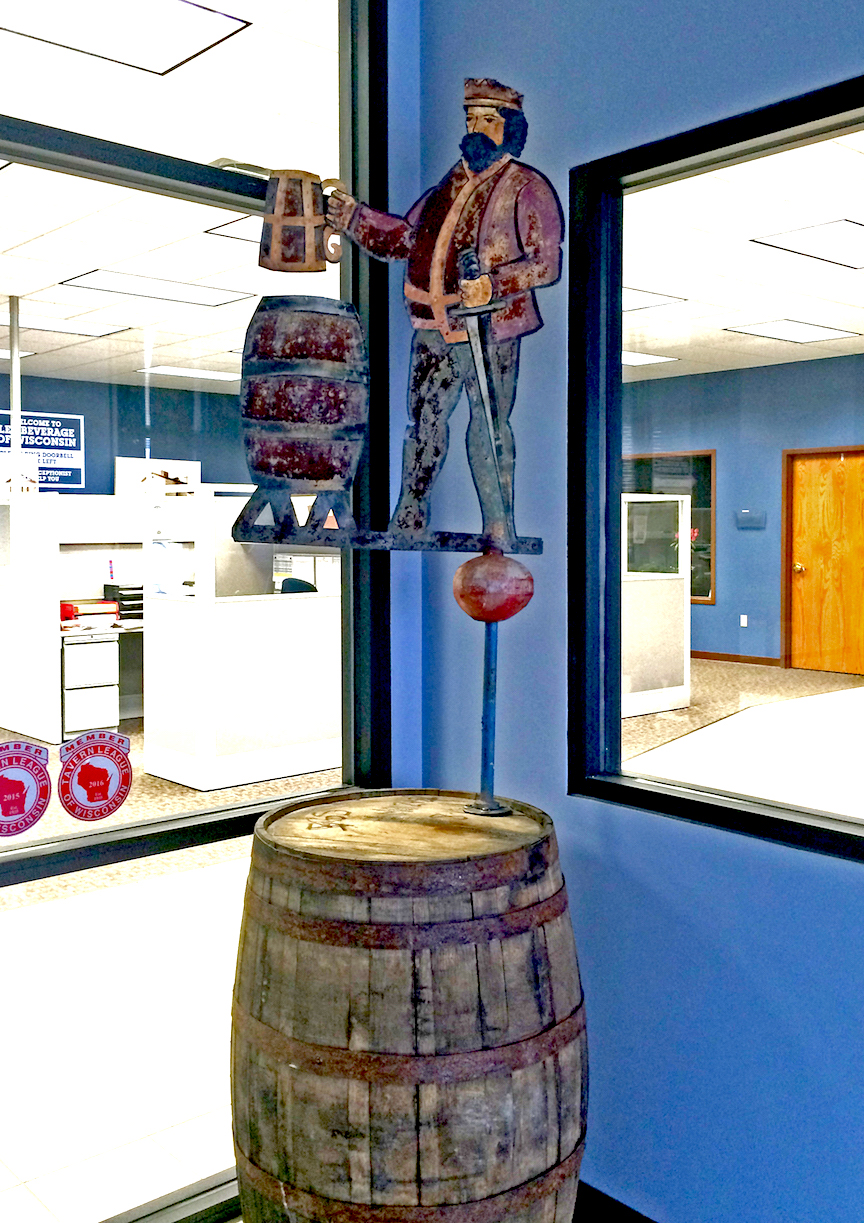
What we’re looking at is a large weathervane that spun with the wind blowing over the Gambrinus Brewery. It depicts King Gambrinus, patron saint of brewers. Gambrinus is holding a stein. He’s standing next to a beer barrel.

For a brewery named Gambrinus, it was only natural that King Gambrinus would become its  favored symbol. The image was used frequently in the brewery’s advertising. Here’s an example. This is a close-up of a corner sign that hung outside the Adolph Baier tavern at the northwest corner of Ohio Street and 7th Ave. The image is a bit hazy, but that’s Gambrinus in the middle with a mug of beer held aloft.


The image quality is going to improve as we move along, I promise.

Let’s get back to the story of that weathervane….

When the Gambrinus Brewery was taken down, the Kuenzl family saved the symbolic figure that hovered over their brewery all those years. It wound up in the hands of Lorenz Kuenzl’s grandson. He was also named Lorenz Kuenzl. His nickname was Shorty. Here's a photo of Shorty Kuenzl, circa 1960.

Photo courtesy of Kay Kuenzl-Stenerson
Shorty Kuenzl had a long and interesting beer career in Oshkosh, most of it with the Oshkosh Brewing Company. Kuenzl retired from OBC in 1963. He then went on to play a major role in Lee Beverage, an Oshkosh-based beer distributorship. When Kuenzl went to Lee Beverage, the King Gambrinus weathervane came with him. And that’s where it is today.

Let’s finally get a good, up-close look at this thing.


Considering its age, the piece has held up magnificently.  It’s at least 125 years old and spent much of its time being battered by the elements. At Lee Beverage, it was resting in storage for years, but now it’s out again. It’s mounted atop a wooden barrel near the entrance to the building.


I’ve spent a lot of time researching the elder Lorenz Kuenzl and his brewery. Sometimes I think I know the man far better than I really do. But when I think of that weathervane and imagine the hundreds of times Kuenzl looked up to see it there above his brewery, I realize he’s still an utter mystery to me. He always will be.

For an in-depth history of the Gambrinus Brewery, go here.

Monday, August 8, 2016

The Fall of the House of Gambrinus


By 1914, the Oshkosh Brewing Company had settled in its imposing, new brewery. It was a modern facility in every way with an enormous capacity of 90,000 barrels annually. The new brewery was more brewery than the company needed.


The upgrade created a dilemma: what to do with the three breweries that had been the engine of OBC prior to construction of the new brewery?

One of the older breweries was preserved. The Horn & Schwalm brewery near 16th and Doty streets was converted into an office and bottling house. That brewery still stands. The other two didn’t fare as well.

The Glatz brewery at the south end of Doty Street was demolished. At least most of it was. Part of the brewery’s stone foundation and beer cellars were left intact. Some of its pieces are still there today.

The Gambrinus Brewery on Harney Ave. got the worst of it. It was the smallest of the three breweries that merged to form OBC in 1894. After the merger, the east-side brewery saw only sporadic use; sometimes as a bottling plant, other times as a brewhouse for OBC’s Berliner Weiss beer. But by 1906, the once formidable brewery had been abandoned. It rapidly fell into disrepair.

I have a few pictures I want to share of the brewery in its final days. Before I get to those, though, let’s take a look at this brewery in better days. This is what you would have seen, if you were standing in front of what is now 1235-1239 Harney Avenue in 1893.


The imposing stone and brick building at the center of the image was the brewery’s ice house. It was approximately 44-feet tall. At the right you can see a frame building with wooden siding. That was the brewery and malt house. By the way, the man in front with white sleeves was the brewery’s owner, Lorenz Kuenzl.

The next picture was taken from nearly the same vantage point as the previous shot, but about 17 years later. The brewery had been closed for several years by this time.


The next picture is also circa 1910. We’re looking at the brewery’s backside, which faced towards what is now Stevens Park. Just behind the open door would have been the brewery’s mash tun and boil kettle.


Here’s the brewery coming down in pieces. This picture was probably taken in 1914. It shows the dismantling of a secondary icehouse used by the brewery. This was located behind the larger, stone and brick icehouse shown previously.


The next two pictures are lower quality images, but they’re worth a look.

The first of these was taken in 1915. In the picture, you’ll see Mary (Kern) Kuenzl with her sons, Frank and Andrew (in stroller). Mary was the wife of Anton Kuenzl, who was the son of Lorenz Kuenzl, the owner of the Gambrinus Brewery. They’re standing in front of an entrance to a tunnel that led underground to the brewery’s cellars. I’d love to know if those cellars were ever filled in. There could still be beer down there!


This last shot is from 1919. The house you see being built in the background is at 1239 Harney Ave. The rubble you see in the foreground is from that massive icehouse, we saw earlier. It took a while to clear that land.


It’s all gone now, folks. Here’s an interactive view of the neighborhood as it looks today. I walk that neighborhood frequently. I wish I could have walked it back in the day.

Monday, December 15, 2014

Then and Now: Kuenzl’s Gambrinus Brewery

Click on the image to enlarge it.
The top photograph was taken circa 1893. The photo below it was taken yesterday morning.

Seen in the top photo wearing a hat and with his arms resting on the fence is Lorenz Kuenzl, the owner and brewmaster of the Gambrinus Brewery. Standing beside him is his wife, Barbara. The home behind them also appears in the newer photo. It is located at 1225 Harney Avenue.

The older photo shows the Gambrinus Brewery along with its outbuildings, and the brewery’s stone and brick icehouse. The brewery was built by Gottlieb Ecke in 1868. Lorenz Kuenzl took over the brewery in 1875. The capacity of the brewery was approximately 20,000 barrel annually.

In 1894, Kuenzl merged the Gambrinus Brewery with Horn & Schwalm’s Brooklyn Brewery and John Glatz and Son’s Union Brewery to form the Oshkosh Brewing Company. Following the merger, brewing operations at the Gambrinus Brewery were gradually discontinued. Thereafter, the location was used primarily for bottling beer.

Most activities at the Gambrinus brewery had ceased by 1907. The brewery was vacated in 1912 after the completion of a new brewery by the Oshkosh Brewing Company. The buildings of the Gambrinus Brewery were demolished in 1914.

For more on the history of the Gambrinus Brewery visit this earlier post.