Showing posts with label Beer in Oshkosh. Show all posts

Thursday, September 4, 2025

Pints of the Past

The Winnebago County Historical Society and the Society of Oshkosh Brewers are getting together for an evening of beer-based time travel. Pints of the Past will happen on Saturday, October 25 from 6-9 pm, at the historic Morgan House in Oshkosh.


Pints of the Past is an evening of beer tasting commingled with Oshkosh history. The tasting will feature 13 beers brewed by members of the Society of Oshkosh Brewers. Each beer has been made from a recipe used in Oshkosh by a brewery that operated here at some point over the past 176 years. The oldest recipe used in this pack of brews dates back to 1849.

The 13 beers will cover the entire breadth of Oshkosh’s history as a center for brewing. Included in the line-up are famous lagers of the past such as Rahr’s Elk’s Head, Peoples Holiday & Bock beers, and Chief Oshkosh Bock. Among the more recent re-creations are Chief Oshkosh Red Lager and Fox River’s Caber Tossing Scottish Ale.


The tasting path will wind through the historic Morgan House, built in 1884. Guides will be available to discuss the histories of both the beers and the home, creating a uniquely immersive experience.

The Morgan House at 234 Church Avenue.

Tickets for this event are limited and must be purchased in advance. More info and tickets are available HERE. And here's the Pints of the Past Facebook event page.


A Pint for John R. Morgan.
There’s a tasty bit of irony to all of this. The Morgan House was built for John R. Morgan (1833-1906) and his wife, Eleanor (Hughes) Morgan. John Morgan wasn’t especially loud about his views on alcohol. But every indication of his opinion on the matter suggests he was a Prohibitionist. Morgan was associated with temperance groups, like the American Bible Society and the First Congregational Society. He was also a supporter of Rev. Edward Henry Smith, a leading light in Oshkosh’s sputtering temperance movement of the late 1800s. So if you make it to the Morgan House for Pints of the Past, maybe take a moment to raise a glass to John R. Morgan. He could have probably used a beer or two. Hope to see you there, Prost!

John R. Morgan


Thursday, April 25, 2024

Oshkosh Peculiar

All is not well in the world of beer. American beer sales are trending steadily downward, and craft breweries are failing at an unprecedented rate. Yet there’s little evidence of such withering here. Last year, Oshkosh's three breweries – Bare Bones, Fifth Ward, and Fox River – each saw their sales volume increase.

“Maybe it’s just that we’re a couple of years behind the trend,” says Ian Wenger, co-owner of Fifth Ward Brewing. Wenger may be half joking, but the concern is genuine. When it comes to beer, Oshkosh has a history of being slow to adopt national trends. If the local homebrewing scene is any indication, though, this may be one trend that skips the city altogether.

Homebrewing has been looked upon as a bellwether for the craft beer industry. In fact, the struggle that now besets craft brewers was preceded by a sharp downturn in homebrewing. Membership in the American Homebrewers Association has fallen by 35 percent since 2018, and the organization has canceled its annual conference for 2024. Over the past three years, however, the Society of Oshkosh Brewers homebrewing club has increased its membership by 35 percent. The club now has 69 members.

Scott Westpfahl during a recent meeting of the SOBs at Fifth Ward Brewing. Photo by Staci Saunders.

Scott Westpfahl has been president of the Society of Oshkosh Brewers (the SOBs) since 2021. He has no doubts about what makes the Oshkosh club different. “We have a lot of people here who are truly invested in the club,” Westpfahl says. “It’s a very active membership. It makes all the difference. And we’re so tied into the community. The SOBs are engaged with every brewery, cidery, meadery, and distillery in the region.”

At Fifth Ward, brewery co-owner Zach Clark takes a similar view. “I go around to a lot of other towns on sales calls, and one thing you notice here is that the enthusiasm hasn’t died down the way it has in some places. We see it in our taproom. People want to go out and do things and be active. I mean, we have a pretty advanced crowd coming in here. They’ve evolved along with us. You don’t see that everywhere.”

Clark says it probably helped that the craft beer scene in Oshkosh didn’t grow as quickly as it did some larger cities. “It happened more gradually here, and I think that’s meant that we’ve never had the oversaturation that you see in other places where there might be too many breweries, and people kind of losing interest because it's just too much to keep up with. I think people around here have remained engaged with what’s going on.”

The engagement is an expression of social life in a city where tavern culture has been foundational. Wenger sees a shift taking place. “I know that some of our taproom regulars are people who used to spend more time in bars, but maybe they just wanted a different sort of atmosphere. We see a lot of the same faces, and they might be with their families and they're getting together, and they can all feel comfortable here. I don’t know if that kind of thing is happening in the bars so much anymore.”

The Fifth Ward's taproom in Oshkosh. Photo by Staci Saunders.

Fifth Ward is looking to build upon its taproom success. Clark and Wenger are currently exploring the possibility of opening a second taproom in the area. After doubling the capacity of its brewery over the past two years, Fifth Ward became the largest producer of beer in Oshkosh last year selling 1,480 barrels.

“We could already make twice as much beer here as we do now, so we absolutely have the capacity to supply another taproom,” Clark says. “The question we’re thinking about is how far do we want to go in that direction? We’re trying to figure out where the equilibrium is.”

For the Oshkosh homebrewers the future appears as promising, but far less complex. “I mean, for us it’s all about having fun,” Westpfahl says. “And right now we have such a great group that’s really invested in the overall experience of being an SOB. We’re in a good place.”

The Society of Oshkosh Brewers invites the community to get a taste of the SOB experience on Saturday, May 4, when the club will hold its annual Big Brew from 9am until 1pm at The Cellar homebrew shop at 465 N. Washburn Street. The event is open to the public and will feature brewing demonstrations.

A slightly different version of this story appears in today’s Oshkosh Herald.

If you would like to receive a notification when a new blog post is released, send me an email to OshkoshBeer@gmail.com with “Subscribe” in the subject box. Your email address will never be shared or sold.

Wednesday, March 27, 2024

Oshkosh Brewers Celebrate 175 Years of Brewing in the City

In the summer of 1849, a German immigrant named Jacob Konrad established a brewery just south of Ceape Avenue on the shore of Lake Winnebago. Konrad’s brewery was the first in Oshkosh. The brewing culture he initiated here is still going strong 175 years later.


Brewers in Oshkosh are celebrating their heritage this year with beer releases and events that tap into the city’s history as a center for beer making. 

April 4: Fifth Ward's 175 Bock
The series begins at Fifth Ward Brewing on Thursday, April 4, with the start of Oshkosh Craft Beer Week. Fifth Ward will commemorate the anniversary with the release of 175 Bock, a strong German-style lager.

April 20: The SOB's Book Release at Bare Bones
On Saturday, April 20, the Society of Oshkosh Brewers homebrew club will be at Bare Bones Brewery for the release of Oshkosh Classics, the club’s first recipe book. The collection includes twelve recipes that illustrate the history of Oshkosh’s beer and brewing culture. The SOBs will share free samples of homebrewed beer made from recipes included in the book. In addition to the book release, Bare Bones Brewery will release Peoples Bock, made from the original recipe used at Peoples Brewing of Oshkosh in the 1950s and 1960s.

June 1: Bare Bones' Helles Bock
On Saturday, June 1, Bare Bones Brewery will release a Helles Bock made from a recipe that amplifies the brewery’s popular Oshkosh Lager. 

Fox River's Pre-Prohibition Bock
Fox River Brewing Company will round out the series with the release of a pre-Prohibition style Bock later this year. Each special release will be available on draft and in a collectible can featuring a commemorative “175” emblem.


It’s especially fitting that the anniversary will be observed by an offering of Bock beers. This subcategory of lager beer was first brewed in Oshkosh in 1858. Over the next century, the robust Bocks became the most commonly produced specialty beer here. The annual spring releases were highly anticipated. Saloons and beer depots posted placards illustrated with a grinning goat in their windows to alert beer fans that the Bock was back. Aficionados on hoarding binges grabbed all they could afford, causing the Bocks to rapidly sell out.

The tradition survived well into the 20th century as Oshkosh’s small breweries grew into larger, more industrial concerns. By the early 1950s, Oshkosh was home to three breweries with a combined production of more than 90,000 barrels of beer annually. An astounding quantity considering that the city’s population was just 41,000 and that most of that beer was consumed locally. Last year, less than 3,500 barrels of beer were brewed in Oshkosh.

Industry consolidation led to the end of our large breweries in 1972 when Peoples Brewing Company closed. The city was without a brewery for the first time in 123 years. In response, a homebrewing movement developed in Oshkosh even though it was a crime to make beer in an unlicensed facility. Oshkosh Congressman William Steiger took care of that by introducing federal legislation legalizing homebrewing. Steiger’s bill was signed into law by President Jimmy Carter in 1978.

Our current breweries are a direct outgrowth of that early homebrewing movement. All three breweries here have brewhouses run by former homebrewers who came out of the local scene. The kinship with the city’s earliest breweries is no less tangible. After Jacob Konrad established his brewery in 1849, he began making hand-crafted, small-batch beer that he sold directly from his brewery to people living nearby. That description applies just as well to our current breweries.

There have been 21 breweries established in Oshkosh since Konrad came to town 175 years ago. That count doesn’t include the score of wildcat breweries that flourished, albeit illegally, in the city during Prohibition from 1920-1933. The beer and brewing culture here has been central to the identity of this place from the start. Oshkosh has always been a beer town. It’s time we celebrate that.

Tuesday, January 30, 2024

A Beer By Any Other Name

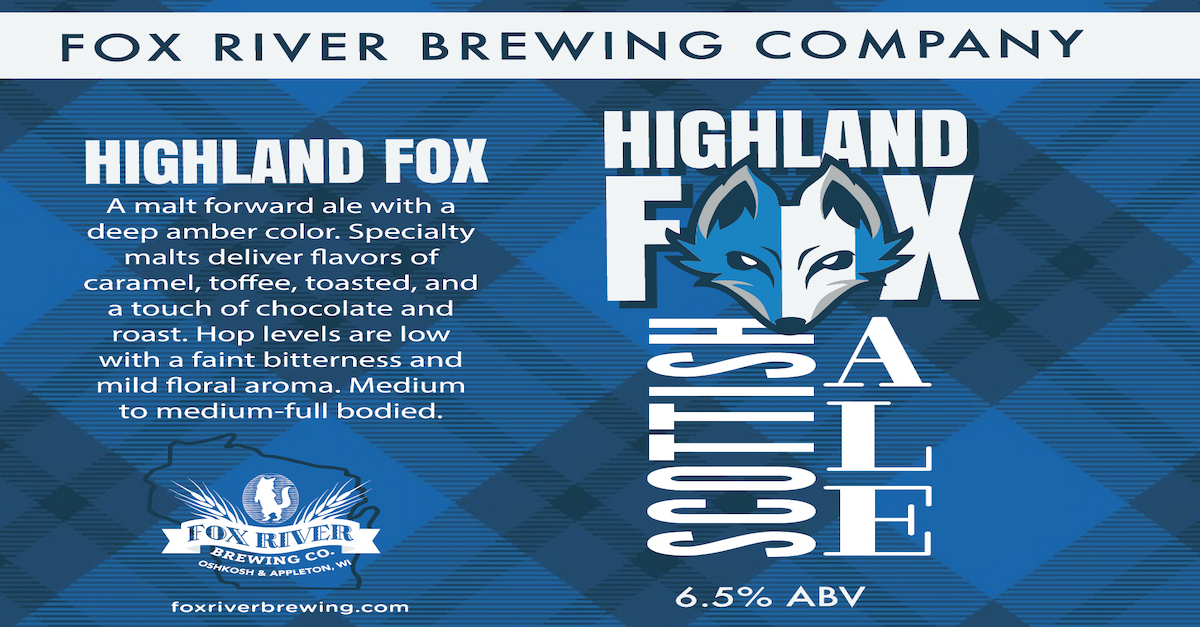
The longest-lived craft beer made in Oshkosh has a fluid identity. It’s a Scottish Ale from Fox River Brewing Company, and it was first served to the public at Fratello's Italian Cafe on Friday, December 15, 1995. On that day, it was called Caber Tossing. In 2014, Caber Tossing became Marble Eye. This February, the name will change again, this time to Highland Fox Scottish Ale.


Drew Roth is the head brewer at Fox River. He knows what’s coming next. “It’s kind of a running joke around the brewery. People will insist that Caber Tossing and Marble Eye were completely different beers with different recipes,” he says. “I can pull out recipe sheets and show them that they’re the same beers. It doesn’t matter. They just tell me I’m wrong.”

Drew Roth

Roth has 29 years of brewing logs backing up his claim. The recipe he is using for Highland Fox adheres, in every important respect, to the recipe that former Fox River head Brewer Al Bundee entered into the logbook for the first batch of Caber Tossing on November 25, 1995. “It’s a different name, but the recipe is not changing in the slightest,” he says.

In the trend-riddled world of craft beer, that kind of longevity is practically unheard of. But then, this beer was an outlier from the start. When Caber Tossing was introduced it became the strongest year-round beer ever produced in Oshkosh. At 6.5% ABV, with its deep amber color and caramelized malt flavor, Fox River’s Scottish Ale was altogether different from the mild, pale lagers that had been dominant here for a century.


Beer connoisseur and brewer Mark Stanek was among the early adopters. He became acquainted with Caber Tossing after moving to Oshkosh from Madison in 1997. “That beer was outstanding,” Stanek says. “It was malty in flavor and aromatics. It was one of the great beers from that time frame and was really well respected.”

In 2001, Caber Tossing took the gold medal in the Scottish-style ale category at the Great American Beer Festival. By 2006, it was the best-selling beer in Fox River’s portfolio. Caber Tossing-cum-Marble Eye held that position until 2014 when BLU Bobber became a year-round beer and the brewery’s runaway bestseller. Ten years later, Marble Eye, soon to be Highland Fox, still holds its own.

“It just continues to be that beer that consistently sells,” Roth says. “We have discussions every year about what beers are going to get pulled to make room for new things, but Marble Eye has never been up for discussion. It just keeps going, and we’re going to keep brewing it.”

That’s a rare declaration to attach to an amber beer these days. Nationwide, the popularity of darker-hued brews has fallen significantly. The decline is illustrated by the recently diminished Fat Tire Amber Ale. Ten years ago, Fat Tire was among the most popular of all craft beers. But deflating sales led to Fat Tire's reformulation last year. Gone is the amber. Fat Tire now wobbles along, drained of its color.

“Wisconsin is kind of a weird market in that way,” Roth says. “A lot of people here still want those darker beers. It might be our climate, or some of the traditions around here, I’m not really sure. Marble Eye is often our second or third best seller on draft even in the summertime.”

It's a beer that has been bucking trends for so long that it has entered the pantheon of Oshkosh classics such as Chief Oshkosh, Peoples Beer, and Rahr’s Elk’s Head. At 29-years old, what is about to become Highland Fox is the youngster of that bunch. Yet it remains an old friend to those who discovered their love of flavorful beer through Caber Tossing. “I know I’m going to hear about it, but I like the new name,” Roth says. “Highland Fox embraces our identity and what the beer is about. We're getting back to our roots on that.”

A slightly different version of this story appears in today's Oshkosh Herald.

Friday, July 14, 2023

Kellerbier Update

Last year, I won the Society of Oshkosh Brewers homebrew competition with a Kelleribier. And as I mentioned here back in May, Bare Bones Brewery asked if I would share the recipe for that beer so they could brew it. I was happy to, and today that beer gets released at the Bare Bones Tap Room in Oshkosh. I haven’t had a chance to try the beer yet, but I’m hearing good things. If you stop by Bare Bones in the near future, just ask for a Helen and they’ll serve you one of these. Prost!


Thursday, December 1, 2022

The Oshkosh Beer Drinkers Taste Test of 1977

In 1977, the beer scene in Oshkosh was at low ebb. The city had been without a brewery for five years. All of the beer here was being trucked in from somewhere else, and nearly all of it was mass-produced pale lager. The beer may not have been anything special, but at least there was plenty of it.

Dozens of brands filled beer depot shelves. Choosing the best was like trying to identify the ultimate shade of white. It amounted to minor variations on a minor theme. In the fall of 1977, the challenge was taken up at the Oshkosh Beer Drinkers Taste Test.

Sinking a sample at the 1977 taste test.

The competition, sponsored by a UW-Oshkosh student organization, took place on the Thursday evening of November 3, 1977 at Reeve Memorial Union on Algoma Boulevard. About 110 drinkers turned out for a blind sampling of 15 beers. The participants were asked to rate each beer on a scale from one to five, with five being the highest score. Here were the results along with the average score of each beer.

1: Old Style - 3.59
2: Olympia - 3.55
3: Miller High Life - 3.52
4: Hamm’s and Stroh’s (tied) - 3.46
5: Pabst - 3.41
6: Leinenkugels - 3.14
7: Special Export - 3.08
8: Budweiser - 3.05
9: Heineken - 2.90
10: Anheuser-Busch Light - 2.56
11: Miller Lite - 2.48
12: Coors - 2.45
13: Point - 2.28
14: Augsburger - 2.02
15: Schlitz Light - Score not reported

A taste-test volunteer wearing a Chief Oshkosh Beer t-shirt pours samples of Coor’s.

The beer selection didn't quite match up with what peoples in Oshkosh were actually drinking in 1977. Nationally distributed brands accounted for all but two of the 15 entries. Missing were brands such as Rhinelander, Kingsbury, Bohemian Club; regional beers brewed in Wisconsin that were widely popular here. The event’s advisor was almost certainly unaware of that.

Thaine Johnson, on the left, officiating at the Oshkosh Beer Drinkers Taste Test.

Thaine Johnson was a newcomer to Oshkosh but no stranger to beer. Born in 1920, Johnson was a chemist and a journeyman brewer who had made beer at Falstaff in St. Louis, George Wiedemann in Kentucky, and at Hamm’s in St. Paul. He was working as a brewmaster for Hamm’s when the brewery was sold to Olympia in 1975. The new owners replaced Johnson with one of their own.

A few months before the 1977 taste test, Johnson and his wife, Annella, left Minnesota for Oshkosh where he became vice president of manufacturing at the Oshkosh Seven-Up Bottling Company. But soda just wasn't his thing. Johnson was 57 and still had the itch to make beer.

In 1978, he went to Philadelphia to become the brewmaster for Christian Schmidt Brewing. After that brewery closed in 1987, Johnson was recruited by the newly formed Great Lakes Brewing in Cleveland. He finished his brewing career at Great Lakes where, among other things, Johnson developed the recipe for the highly awarded Dortmunder Gold Lager.

There was nothing at the 1977 tasting that tasted anything like that one. Johnson’s full-flavored Dortmunder became one of those early craft-beer success stories that helped create a new beer culture in America. The old brewer had turned pioneer.

Dortmunder Gold is still worth seeking out. And if you find one, raise a toast to our former neighbor.

Thaine Johnson (center) with Pat and Dan Conway, the brothers who launched Great Lakes in 1988.

Sunday, July 17, 2022

The Beers of 1946

1946 was a watershed year for Oshkosh. The previous 26 years had been riddled with hardships: Prohibition, the Great Depression, World War II. But now the war was over and the men who had been away were returning home. Tavern life in the city came roaring back.

Nigl's “Chieftin” Tavern at 9th and Ohio in the 1940s.

It wasn’t all back to normal. The federal government had yet to drop the price controls it began enacting in 1942 to curb inflation triggered by the war. Beer sold in taverns was one of the commodities subject to price-fixing.

Oshkosh tavern owners took their marching orders from the federal Office of Price Administration (OPA). The OPA dictated the prices tavern keepers were allowed to charge for bottled beer.


Not surprisingly, Oshkosh tavern owners hated being told what to do by the OPA. The bar keepers resisted (a story for another day) and for good reason. Most of the beer sold in Oshkosh was made at the city's three breweries: The Oshkosh Brewing Company, Peoples Brewing, and Rahr Brewing. The OPA's pricing structure placed the beer from these breweries at the extreme low end. And that meant less revenue for Oshkosh taverns.

Without going too deep into the morass of the OPA, it's clear that the price lists dreamed up by these bureaucrats served the interests of large "shipping" breweries with wide distribution networks. Meanwhile, smaller breweries - like those in Oshkosh - had their beer consigned to low-price ghettos.

For us, there's a silver lining in this mess. The OPA's pricing sheets present a nearly comprehensive list of the beers available in Oshkosh 75 years ago.

The following is from a price list issued by the Green Bay office of the OPA on March 1, 1946. The prices are for a 12-ounce bottled beer sold in taverns for off-premise consumption. In parenthesis are prices adjusted for inflation; an approximation of what it would cost today. OK, let's get to the beer...

Tier 1
15¢ ($1.99) per bottle / 90¢ ($11.94) for a six pack.

Ballantine Ale
Newark, NJ


Just one beer in this bracket and one of just three ales in a list dominated by lager beer. Six-packs weren’t yet common in 1946, but P. Ballantine and Sons was instrumental in changing that. The Newark brewery was the third largest in America at this point and Ballantine Ale was then the most expensive bottled beer sold in Oshkosh.


Tier 2
14¢ ($1.85) per bottle / 85¢ ($11.10) for a six pack.

Budweiser Beer
St. Louis

Miller High Life
Milwaukee

Schlitz Beer
Milwaukee


Here you have those large shipping breweries being allowed to charge top-dollar for their product. Anheuser-Busch (Budweiser) and Schlitz produced over three million barrels of beer in 1946. Miller was closing in on a million barrels. Of course, all three of these brands are now much cheaper. Can you imagine paying $11.10 for a six-pack of High Life?


Tier 3
13.5¢ ($1.79) per bottle / 81¢ ($10.74) for a six pack.
The fraction of a cent was applied when multiple bottles were included in the sale.

Heileman’s Old Style Lager
La Crosse

Pabst Blue Ribbon Beer
Milwaukee

Pabst Blue Ribbon Ale
Milwaukee


Pabst was the largest brewery in America in 1946. In 1947, Pabst lost that title to Schlitz, never to regain it. Today, Pabst is basically a shell company and owns the Heileman’s Old Style brand. Old style has been kicking around Oshkosh since the early 1900s. The brand took off here after Prohibition when Lee Beverage began distributing it. And to this day Lee Beverage distributes Old Style. It wasn't until the 1980s that Old Style lost its "Premium Beer" status around here. You can now get a 30-pack of Old Style in Oshkosh for less than $20.


Tier 4
13¢ ($1.72) per bottle / 78¢ ($10.32) for a six pack.

Hamm’s Beer
St. Paul

Kingsbury Ale
Manitowoc and Sheboygan

Rhinelander Export Beer
Rhinelander


Modern Oshkosh beer drinkers might find it hard to believe that Hamm's, Kingsbury, and Rhinelander were once considered premium beers. Today, Hamm's is often the cheapest beer available in Oshkosh with 30 packs going for just a few bucks more than the (adjusted) cost of a 1946 six-pack. I'm sure Kingsbury and Rhinelander were better beers back in the 1940s. By the time I got to them in the 1980s both were dreadful. That didn't keep me from drinking them.


Tier 5
12.5¢ ($1.66) per bottle / 75¢ ($9.96) for a six pack.

Blatz Pilsner
Milwaukee

Braumeister Pilsner Beer
Milwaukee

Gettelman's Rathskeller
Milwaukee

Kingsbury Pale Beer
Manitowoc and Sheboygan

Silver Fox de Luxe Beer
Chicago

Schoen’s Lager Beer
Wausau


Now we're into the thick of it. Aside from Blatz, which appears to be on life support, all of these brands have died. If I could revive one of them it would be Gettelman. After Prohibition, Gettelman beer grew to be quite popular in Oshkosh. The brand began fading in the 1960s after Miller aquired it. There remain a few lingering traces of Gettelman around town, though. The last time I checked, the sign below was still tacked to the front door at Andy's Pub & Grub on 9th Ave.


Tier 6
12¢ ($1.59) per bottle / 72¢ ($9.54) for a six pack.

Fauerbach Beer
Madison

North Star Lager Beer
Wausau


Here we go into the bottom half of the list where small, Wisconsin breweries were fighting an uphill battle against industry consolidation and stagnating prices. Then along comes the OPA to enforce that stagnation. North Star Lager was made at Mathie-Ruder Brewing, which closed in 1955. The Fauerbach brewery went out in 1966.


Tier 7
11.5¢ (1.53) per bottle / 69¢ ($9.18) for a six pack.

Meister Brau Beer
Chicago


Just one beer in this tier, the lowly Meister Brau. In 1946, MB was being made by Peter Hand Brewing of Chicago. It was already cutting a path to the budget bin. Miller bought the brand in 1972 and made it into a true cellar dweller. By 1973, Meister Brau was selling for $2.50 a case in Oshkosh. Only the loathsome Buckhorn and Bohemian Club were priced lower.


Tier 8
11¢ (1.46) per bottle / 66¢ ($8.76) for a six pack.

Berlin Export Beer
Berlin, Wis.

Knapstein Beer
New London, Wis.


Lager beer from a couple of small-town, Wisconsin breweries. These weren't cheeky, little boutique breweries squeezing out a few hundred barrels of gimmick-laden "craft" beer per annum. These were production breweries making thousands of barrels of down-home lager each year. Throughout the 1940s you could find breweries like these servicing communities across Wisconsin. Now those towns are flooded with Busch Light. How sad.


Tier 9
10.5¢ ($1.39) per bottle / 63¢ ($8.34) for a six pack.

Fox de Luxe Beer
Chicago

Haas Extra Pale Pilsner
Houghton, Michigan

Hochgreve’s Beer
Green Bay

Jung Pilsner Beer
Random Lake


The stinker in this group is Fox de Luxe. This iteration of de Puxe came out of the Peter Hand Brewery in Chicago. It was an early example of a large brewery dumping cheap beer into smaller markets. Schlitz would later perfect this strategy with Old Milwaukee. The beer that looks the most interesting to me in this set is the Jung beer brewed in Random Lake. The brewery described it as an amber, fully-aged "Old Country Lager." Most breweries at this time were boasting about how pale their beer was. Not Jung! None of that watery, feeble bullshit for them.

Photo courtesy of Tom Traxler.

Tier 10
10¢ ($1.32) per bottle / 60¢ ($7.92) for a six pack.

Adler Brau Beer
Appleton

Chief Oshkosh Beer
Oshkosh

Oconto Pilsener Beer
Oconto

Peoples Beer
Oshkosh

Rahr’s Old Imperial Beer
Green Bay

Red Ribbon Beer
Wausau


Here come the Oshkosh beers bringing up the rear. You may have noticed that Rahr Brewing of Oshkosh is missing. That may have something to do with Rahr's limited distribution during this time. This list applied to nearly all of Northeast Wisconsin. Rahr’s beer was, for the most part, confined to Oshkosh. Perhaps Rahr didn't rise to the level of OPA scrutiny. The 10¢ limit set on bottles of Chief Oshkosh and Peoples was pathetic. The price had been at that level for nearly a decade. Then comes the federal government mandating that price limit while the cost of making that beer had risen substantially. It's a wonder these breweries survived.

Tier 11
9.5¢ ($1.26) per bottle / 57¢ ($7.56) for a six pack.

Mellow Brew Beer
Kaukauna

Point Special Beer
Stevens Point


The bottom of the barrel, so to speak. Point Special is the perfect example of just how thick headed these pricing schemes tended to be. Point was almost certainly a superior beer to Schlitz even as far back as 1946. Yet the value of Point was capped at 47 percent below that of Schlitz. What a sick making application of policy. Point is the only small, Wisconsin brewery on this list that’s still with us. The Electric City Brewing Company of Kaukauna, maker of Mellow Brew Beer, closed in 1947. That same year, the highly controversial OPA was abolished.

The rest of the small breweries in this list were driven out by the 1970s. The large breweries then turned to cannibalizing one another. By the 1980s, the American brewing industry had become an oligopoly with the six largest breweries producing 92 percent of the beer made in America. That market domination is no better today despite the emergence of craft beer and the more recent proliferation of extremely small breweries.

Just about everything else here has been turned on its head. The premium beers of 1946 have been reduced to budget-beer status. While the beer made by Oshkosh's new and smaller breweries is sold at a premium price. But the taverns in Oshkosh no longer favor the locally brewed beer. The city's three breweries (Bare Bones, Fifth Ward, and Fox River) probably make less than 5% of the beer sold in Oshkosh taverns. The connection has been lost. It’s a whole other world.

Bare Bones Brewery, 2017.

The barroom at the Oshkosh Elk’s Club in the 1940s.


Sunday, June 13, 2021

The 920 Brew Project


It was mid-March and Dan Dringoli was finally seeing brighter days ahead. COVID-19 had been a fact of life in Oshkosh for a year now. Bare Bones Brewery, which Dringoli co-owns with his wife Patti, had struggled through that year battered by waves of restrictions and public fear concerning the sort of gatherings that the Dringoli's business relies upon. But the tide was turning. People were being vaccinated. Restrictions were being eased. Something closer to normal was on the horizon.


On March 18, Dringoli sent an email to his fellow brewers in the area suggesting they collaborate on a beer to mark the passing of what for all of them had been an exceptionally difficult period. "We overcame significant adversity together," Dringoli wrote. "We've leaned on each other quite a bit. We came up with collective solutions to battle this unprecedented time and we survived."

Patti and Dan Dringoli of Bare Bones.

Dringoli then presented the seed of an idea that would be cultivated over the coming weeks by those he had reached out to. "Let's do a different kind of collaboration, built around the strength of the brewing community," he wrote. "We owe a ton of gratitude to our fellow breweries and our customers who kept coming in and getting beer to go. We truly owe them everything. So let's come up with a collaborative thank you to our collective customers. A beer created by all of us."

Dringoli's proposal has led to the largest brewing collaboration of its type in the State of Wisconsin. It involves a meadery and 10 breweries scattered across three counties. Taking part in the collaboration are Oshkosh's Bare Bones, Fifth Ward, and Fox River breweries. Neenah-based breweries Barrel 41 and Lion's Tail. Appleton's Stone Arch Brewpub, McFleshman's Brewing, and Appleton Beer Factory. Knuth Brewing from Ripon. Omega Brewing of Omro, and Rushford Meadery & Winery.

The group's working title became The 920 Brew Project, after their shared area code. They had quickly come together, but then came the first hurdle: how to find agreement among 11 independent-minded brewers on what to brew. It turned out to be no problem at all.

"It was like a subconscious thing," says Bobby Fleshman of McFleshman's Brewing Company. "I was talking to Jody (Cleveland, head brewer of Bare Bones), and I mentioned this idea for a cucumber Kolsch. Jody took that to mean, 'hey, let's do a cucumber Kolsch.' He put it out there and everyone agreed on it right away. We were all in the same frame of mind. It came together so quick."

Bobby Fleshman in the brewhouse at McFleshman's.

It was agreed that the beer would be produced at the Bare Bones facility. In early April, Cleveland sent out his recipe for the Kolsch, a German-style of light ale noted for its clean, quenching drinkability. The idea would be to enhance those characteristics with the bright flavor of cucumber while maintaining the more subtle aspects of the base beer. For the cucumber flavor, they discussed purchasing a pre-processed, aseptic puree, but then decided against it. Instead, they'd begin with fresh cucumbers. "I think we all kind of know what our strengths are and where our input is useful," Fleshman says. “That’s where Shane came in.”

Shane Coombs of Rushford Meadery & Winery has a deep background in working with a variety of fresh, plant-based ingredients that he sometimes incorporates into his meads and wines. For the trial beer, Coombs pressed and processed 72 cucumbers then handed off the “cuke juice” to Ian Wenger and Zach Clark of Fifth Ward Brewing. Clark and Wenger began experimenting with dosing rates using their 1869 Blonde Ale to get a sense for what might work with the Kolsch. By the end of April, the blended samples were being passed around among the other brewers.
Shane Coombs
"I don't even know how many people from the breweries were involved at this point," says Fleshman. "It must have been about 18 or so of us. We all kind of picked out our favorite dosing rate. I think we landed on something that people are going to really dig."

On May 24 and 25, brewers from Barrel 41, Fox River, Lion's Tail, Omega, and Rushford got together with Jody Cleveland at Bare Bones to brew 25-barrels of Kolsch. As the beer completed its fermentation Coombs processed 124 pounds of fresh cucumbers. And on June 8, the final blend of the beer was prepared by Cleveland, Coombs, Fleshman, and Steve Zink of Omega Brewing.

May 24th in the brewhouse at Bare Bones. From left to right,
Steve Zink of Omega, Jody Cleveland of Bare Bones, and Jeff Eaton of Lion' s Tail.

"We could not have pulled off something like this if we had not already been so close knit," says Fleshman. “I think most brewers would be hesitant to get into something like this because of that ‘too many cooks in the kitchen’ kind of thing. But we're already so tight that we figured it could work. We'll probably even do something like this again."

The 920 Brew Project's Cucumber Kolsch will begin pouring in the taprooms of each of the collaborators in mid-June. The beer will likely be on tap through the remainder of the month. In Oshkosh, Cucumber Kolsch will also be available in cans at Bare Bones, Fifth Ward, and Fox River.

Friday, September 11, 2020

New Top Dog: Oshkosh's First Collaboration Beer

Oshkosh's first brewery was launched 171 years ago. Since then, we've had 21 legal breweries and at least a dozen illegal breweries. And in all that time, there's never been an instance of two Oshkosh breweries collaborating on a beer. Until now.

New Top Dog Golden Ale.

On August 27, the brewers from Bare Bones and Fifth Ward got together to brew New Top Dog, a honey golden ale, that will be released at each brewery's taproom on Saturday, September 12.
  
From left to right: Ian Wenger and Zach Clark of Fifth Ward
with Jody Cleveland of Bare Bones during the New Top Dog brew.

New Top Dog is an English-style golden ale made with additions of honey and spelt. "We wanted to make something super approachable," says Zach Clark of Fifth Ward. "We used local honey from a producer in Neenah that has hives all around this area. We included some spelt in the grain bill to give it a nice kind of nutty aroma that should go well with the biscuity flavor we get from the English malt we're using."

"Super approachable" is a good way to put it. New Top Dog is an easy-drinking ale with an interesting fruity character and a clean, grainy finish. It's quaffable in the extreme. This is a young beer with flavors that are bright and fresh, which is exactly what you want in a light ale. The sooner you can get to this beer the more you're likely to enjoy it. In a lot of ways, this beer exemplifies what local brewing is all about.

New Top Dog was brewed and kegged at Fifth Ward. There were 42 cases of it canned yesterday afternoon at Bare Bones. You'll be able to pick up sixers of it at each brewery beginning Saturday. The beer will also be available at Wagner Market in Oshkosh in the near future.

Friday, September 10. Canning New Top Dog at Bare Bones.

The idea for the collaboration didn't come from either brewery. It was set in motion by Steve Romme of the Oshkosh Mid-Morning Kiwanis. "Steve asked me what I thought about doing a beer for a fundraiser that would feature dogs," Clark says. "He thought we could also get Bare Bones involved with it. So I got together with Jody (Cleveland, head brewer at Bare Bones) and we put together a recipe"

"This thing came together really fast," says Cleveland. "It all just fell into place."

Part of the proceeds from the beer will benefit the Oshkosh Area Humane Society and the Oshkosh Mid-Morning Kiwanis Club. In conjunction with the release, dog owners can bring their pets to either brewery on September 12 and 13, to have them photographed and entered into a competition to have their dog's picture appear on the label of next's year collaboration. For more on that aspect of the fundraiser click here.

With Oshkosh's lengthy history of beer making it would seem a collaboration like this one would have happened long before now. In any case, we won't have to wait another 171 years for it to happen again. Next year's collaboration between Bare Bones and Fifth Ward is already being discussed. "We're thinking this is going to be an ongoing thing," Clark says.

Notes
For more info on the first Oshkosh brewery, which launched in 1849, click here.
For more on those dozen or so illegal Oshkosh breweries, click here.

Tuesday, July 14, 2020

The Changing Flavor of Beer in Oshkosh

A slightly different version of this article appears in the July 15, 2020 edition of the Oshkosh Herald.

It might not look like beer. It certainly doesn't taste like beer. And the way it's made raises the question if it should be called beer at all. But none of this matters to those who relish the novel flavor combinations area brewers are creating as they redefine beer in an effort to attract customers who wouldn't otherwise consider themselves beer drinkers.

The idea is simple. A brewer makes a beer, usually a light or dark ale, and then flavors it with an array of ingredients more common to the grocery store or kitchen than the brewhouse. Most anything goes: candy bars, fruit puree, milk sugar, vanilla, peanut butter flavoring, coconut... The list of potential ingredients is endless. As are the permutations that result.

Tangerine Dream Frootenanny, a kettle-soured blonde ale made with
tangerine purée and Madagascar bourbon vanilla paste.

The darker beers in this vein are flavored with sweet, dessert-type ingredients and are generally referred to as pastry stouts. The beers that begin with a light-ale base primarily rely on pureed fruit for flavoring. And there's nothing discreet about the flavors these ingredients impart. These "adjuncts", as they're called, are not used to accentuate the flavor of the beer. They are the flavor of the beer. If you order a stout that has the words peanut butter in its name, you can rest assured that the flavor of peanut butter is going to be front and center.

The popularity of such beers has been building for the last couple of years. All the breweries in Oshkosh have dabbled with the trend, but at Fifth Ward Brewing, at 1009 S. Main St., such beers have become commonplace on the brewery's tap list. For Ian Wenger and Zach Clark, the brewers and co-founders of Fifth Ward, these beers are entirely consistent with their brewery's mission. 

"We always had this idea in our business plan to bridge the gaps to wine drinkers and cocktail drinkers that don't think about drinking beer," Clark says. "We constantly get people who say they don't like drinking beer, so part of the program of fruited beers and adjunct beers is to try and reach those people."

The most popular of these beers at Fifth Ward fall under the banner of the brewery's Frootenanny series. It's an ongoing cycle of beers that begin as light, tart ales and are then flavored with various combinations of processed fruit and other adjuncts. "What we're doing has changed the way we brew," Wenger says. "With our fruited sours, that base beer is brewed to be fruited." 

The flavors that result are familiar and easily identifiable. That's part of the appeal. "The customer has an easier time understanding these beers," Wenger says. "They know what they're getting. Like with our Tangerine Dream, people expect that it's going to taste like tangerine and vanilla. We get people in here who wouldn't normally drink beer, but they'll drink Tangerine Dream. Some of them aren't beer drinkers at all. These are beers that open doors for them."

"We'd hear that from people," Clark adds. "I remember this one guy telling me he couldn't bring his wife here because she won't drink beer. That doesn't really happen anymore." But it's not just a niche audience that's gravitating towards these beers. A casual scroll through Fifth Ward's social media pages makes it immediately clear that these are the beers that generate the most excitement among the brewery's customers. At the same time, Clark is quick to point out that he and Wenger haven't abandoned their commitment to the brewery's more traditional offerings.

"We put a lot of time and energy and passion into our traditional beers," Clark says. "I'd like it if they got more attention, but we have a lot of people who come in here that will only drink those fruited beers. We do run a business and those beers make money. People keep buying them. You can't ignore that. And we put a lot of work into them. The biggest thing is we try to be diverse in a lot of ways. We want to always have something for everybody. That's always the focus."

Thursday, October 31, 2019

Irrational Fear at Fox River Brewing

Probably it's because I'm a homebrew geek, but I'm much more interested in beer flavor created through the brewing process and the transformation of raw ingredients than I am in beers flavored with syrups, extracts, and the like. So for me, what's been happening lately at Fox River Brewing has been worth following.

the brewhouse at Fox River in Oshkosh.

Andrew Roth took over as the brewmaster at Fox River in August. Since then he's been changing the brewery's approach to making a number of its beers. You won't notice it in Fox River's core brands such as BLU Bobber, but it's readily apparent in the new beers released in the brewery's taprooms. Today (Thursday, October 31) at Fox River, they're releasing a new IPA named Irrational Fear that demonstrates what some those changes taste like.

The beer's hop profile is built along the lines of a hazy IPA, with a large and late addition of hops. For Irrational Fear, Roth used Citra, Mandarina Bavaria, and Michigan-grown Chinook. The hops come in at the end of the boil and in the whirlpool after the wort has cooled to 170ºf. Then it gets dosed again with dry hopping. There was no bittering addition.

The grist includes flaked barley and Blonde RoastOat Malt. This is a new malt from Briess Malting of Chilton that imparts slightly sweet and toasty flavors while creating a creamy mouthfeel. It's definitely a modern IPA sort of malt.

Roth has also been dealing with the water chemistry for the IPAs he's brewing at Fox River. If you've made IPAs with Oshkosh water you already know it can be a challenge making a pale beer with a pronounced hop flavor that doesn't come off as harsh. Since taking over as the head of brewing operations, Roth has been adjusting the mineral content of the local water to create a profile more hospitable to hop-forward beers.

I'm looking forward to seeing how these changes continue to present themselves in the beer Roth is making and tasting those changes in real time. Maybe this stuff isn't as sexy as the latest Chocolate-Peanut-Vanilla-Slushee-Habernaro Stout, but it's a lot more drinkable. And, for me at least, a lot more interesting.

Thursday, July 27, 2017

The Independent Brewer's Seal

At the end of June, the Brewers Association (BA) introduced the Independent Craft Brewer Seal. The BA's objective is to offer a quick, visual indicator that differentiates independent brewers from international conglomerates such as Anheuser-Busch InBev, Heineken, and MillerCoors.


Independent brewers who adopt the logo can apply it to just about anything: bottles, cans, tap handles, websites... We should see it beginning to appear around here later this summer.

If you care about such things, the information is welcome. Non-independents have grown especially crafty in shielding their identity. Look at any label, tap handle, or ad from Goose Island, Golden Road, 10 Barrel, or Elysian and you'll find no indication that they're, in fact, products of Anheuser-Busch InBev. They'd prefer you didn't know.

Both Oshkosh breweries have signed on to use the seal.

At Fox River Brewing Co., they've begun work to put it in place. "We are starting to implement the new Independent Seal on all new beer related material and any updated pieces," says Jay Supple, of Fox River. "We like the new logo, it’s a great representation for independent brewers, plus lets our customers know we are an independent craft brewer."

Bare Bones Brewery owner Dan Dringolli shares that viewpoint. "We're really good with the emblem," Dringolli says. "We're going to use it. Hopefully, a lot of people will. I think it's good to have some way to separate truly independent breweries from those that pretend to be. It's another way to help educate people about what's going on."

For small breweries such as Bare Bones and Fox River, it may be a while before the logo appears on their bottle labels. Label stock for core brands is typically bought well in advance of production. Running through the labels they have on hand may take months.

Lion's Tail Brewing of Neenah doesn't plan to use the logo.  "I don't see a lot of value in this thing," says Alex Wenzel of Lion's Tail. "I don't think it tells my customer anything that they didn't already know."

He has a point. Local drinkers of craft beer are already aware that Winnebago County's breweries are independent. Those who don't know that probably don't care. For larger independents such as New Glarus, the distinction would likely hold more value.

There are a couple of potential pitfalls to this thing. Use of the label is free, but as Wenzel pointed out, the BA is leaving the door open to adding a fee for its use in the future. That would be a mistake and stifle its use. The last thing a small brewer needs is another fee attached to its operation.

An unintended outcome might be the sort of "badge wars" you see among food products claiming to be organic or cruelty-free. There would be nothing stopping AB InBev from creating its own badge to muddle the issue. AB InBev appears intent on creating just this sort of confusion.

And that's reason enough for independent breweries to stake out a position. If ownership weren't important, you'd see the AB InBev, Heineken, MillerCoors and the other conglomerates putting their names on the beers they produce. That they don't, speaks volumes about their intent. They like to keep you in the dark.

Thursday, July 13, 2017

How We Get Our Beer

Monday morning Leoš Frank drove his small van across Wisconsin. It was loaded with beer he made. Frank is the brewmaster and co-owner, with his wife Theresa, of Lazy Monk Brewing in Eau Claire.

He reached Oshkosh a little after 10 a.m. His first stop was Gardina's. He immediately began unloading cases and kegs of beer from his van.

Leoš Frank

It's becoming more common for small, Wisconsin breweries to deliver their own beer. It was once the rule here. That ended with Prohibition.

When Prohibition was repealed in 1933, new restrictions were put in place. At their core was the three-tier system; a web of regulation intended to create a barrier between breweries and retail outlets.


More than 80 years after its implementation, the three-tier system remains. One outcome has been to stifle the direct contact small brewers once had with their customers. LeoÅ¡ Frank doesn’t subscribe to that.

In Wisconsin, breweries producing less than 300,000 barrels of beer annually can circumvent the second tier. Frank, who brewed 648 barrels last year, has taken the alternate route. He distributes his own beer. Hence his Monday morning trip across the state.

“I wanted to do it this way because it gives me a connection to my customer,” Frank says. “And I thought this is a better way to represent myself. I might not have as much exposure as with a beer distributor, but this way there's no insulation between me and the customer.”

Frank, who launched Lazy Monk in 2011, has been delivering his beer to Oshkosh for almost two years. His first outlet here was Gardina’s. He’s since expanded to include The Ruby Owl, Oblio’s, and the Lion’s Tail Brewery Tap Room in Neenah. He also takes his beer to La Crosse, Madison, Milwaukee, and Waukesha. Still, the majority of his sales come from his brewery's tap room in Eau Claire.

Between the brewery and tap room, Frank struggles to find time to get out on the road. “There are plenty of times that I wish I didn't have to go pick up kegs, but if I didn’t think it was worth it, I wouldn't be doing it,” he says. “I think that it's worth it just because of the personal connection. The beer business is a personal business. Nothing else.”

Others have come to see it that way, too. Currently, four breweries self-distribute in Oshkosh. Black Husky Brewing of Milwaukee has been at it the longest. In the past year, Lion’s Tail Brewing of Neenah and Knuth Brewing of Ripon have also brought their beer to the Oshkosh market.

Of course, money plays a significant role in the decision to self-distribute. Distributors typically take a 25-30% cut on the gross margin. That money stays with a brewery that self-distributes. But that comes at a price.

A significant downside is access to market. Getting beer into larger outlets such as chain grocery stores and gas stations can be next to impossible for a brewery that goes it alone. Frank has had better luck than most. He’s been able to get his beer in Walgreens and Target stores in Eau Claire. But on his terms. “This way I can control the growth,” he says.

For a small brewer that element of control can be critical. Especially when distributors have been quick to fill their portfolios with beers they have little interest in promoting or selling. It’s a way to reduce competition. And a small brewery that finds itself buried at the back of a distributors book has little hope of extricating itself. The law is stacked heavily in favor of distributors.

Wisconsin's beer distributors aren’t taking the self-distribution trend lightly. In June, it was leaked that lobbyists for the Wisconsin Beer Distributors Association are working on legislation aimed at making three-tier regulations more rigid. The plan would make it more difficult for a brewery to sell beer directly to its customers. The proposal has been roundly criticized by brewers.

Barring any sudden, reactionary moves by the state legislature, we’ll likely see more breweries going the self-distribution route. Most recently Bare Bones Brewery of Oshkosh began self-distributing its beer in the Green Bay market. And both  Fifth Ward Brewing and HighHolder Brewing plan to self-distribute when they open in Oshkosh in the coming year. Unfortunately, none of them will be rolling through the streets of Oshkosh in the thundering style of their predecessors.


Thursday, June 22, 2017

Oshkosh and the New England IPA

For the past couple years, the most hyped American beer style has been the New England IPA. Or, if you'd rather, the Northeast IPA. Call it what you will. Except if you're in Oshkosh.  Around here there's no point calling for it at all. You're not going to get it.

Before cracking into what that's about, a brief summary of the style. I'll call it NEIPA for short.

Visually, these beers are striking. Others would say sickening. The classic NEIPA is intentionally hazy. Murky even. To the point being opaque. They can look like juice purée. For example...


The aromatics are just as distinct. A billow of citrusy hop aroma is typical. The flavor is hop-saturated. People often describe them as juicy. Tropical fruit notes are pronounced. It’s a showcase for modern hops. Think Citra, Mosaic, Simcoe, Galaxy. The mouthfeel is lush. Soft. The bitterness noticeably subdued. It’s not what you’d expect from a beer so infused with hop flavor. People fucking love them. But you can’t get them in Oshkosh.

I've been drinking beer here for more than 20 years. There's never been a style of American craft beer so elusive in Oshkosh as this one. Blame geography.

The leading brewers of the style are located, as you might expect, in New England. The best known are Massachusetts breweries Tree House and Trillium. And Vermont's The Alchemist and Hill Farmstead. None of them distribute here.

That’s not necessarily a bad thing. These beers are notoriously poor travelers. The hop dependent aromatics and flavors degrade quickly. This style benefits greatly from proximity.

And it’s gradually making its way closer. Over the past year, NEIPAs have been produced by Wisconsin breweries in Baileys Harbor, Cedarburg, Milwaukee, Madison, La Crosse, and Waunakee among others. Our local breweries have been apprehensive to join in. That’s about to change.

Lion’s Tail in Neenah will likely be the first brewery in this area to produce a NEIPA. Alex Wenzel, owner and brewmaster at Lion's Tail, recently became interested in the style. He says he's been drinking his share of it lately. Alex is currently working on his formulation for a NEIPA that he hopes to release this summer.

There's more. Fifth Ward Brewing and Highholder Brewing are on schedule to open in Oshkosh later this year / early next. Each is considering adding a NEIPA to their portfolio.

Ian Wenger and Zach Clark of Fifth Ward says they will "absolutely" produce a NEIPA, once they're open. And Mike Schlosser of Highholder is considering brewing the style for his brewery's second set of batches. By this time next year, Oshkosh ought to be a lot more familiar with what these beers are about.

Until then, there are a couple beers currently available here that play off the NEIPA style. Hop Debacle from O’so Brewing was released in Oshkosh in May. It certainly looks right.


The aroma was spot on, too. But O'so went a bit wide of the mark when it came to mouthfeel and bitterness. I found Hop Debacle to be overly bitter and lacking the soft palate synonymous with NEIPAs.

Toppling Goliath's Double Dry Hop Pseudo Sue another in this line. This beer wasn't brewed to hit the style mark, but in most respects comes close to what you'd expect in a NEIPA.


Both these beers are available in the bottle shop at Gardina's. I believe I spotted the Toppling Goliath beer at Ski's as well. They'll have to do... for now.