Thursday, September 16, 2010

Oshkosh Beer of the Week: Hacker-Pschorr’s Oktoberfest

There’s no shortage of choice beer flowing in Oshkosh this week, but there’s a beer on tap at Oblio’s right now that fits the season better than any other brew you’ll find. Oblio’s has been pouring Hacker-Pschorr’s Oktoberfest for a couple weeks now and there’s something about sitting down behind a pint of it at that worn bar during the chill of mid-sepetmber that seems so right it makes all those boisterous, American craft beers seem a little too brassy. It’s time to pull those gardens down and celebrate with a rich mug of amber brew.

The Hacker-Pschorr Oktoberfest has a shimmering copper hue with an aroma that’s part caramel and part biscuit underscored with a dash of noble hops. The beer has a medium palate with a slight and smooth caramel sweetness making it a hearty, satisfying brew that’s still very easy to drink. The beer closes with a wisp of hop bitterness and a malty, bittersweet finish ideally suited for a fall session of lager drinking.

Todd at Oblio’s says they’re going to keep this beer on for the next couple months, so if you’re looking for a new “buddy beer”, this might be a good choice. I’ve been by Oblio’s for a few of these already and it seems to get better each time I order it.

Bonus Beer: Another beer you might want to check out this fall is the Foxtoberfest that recently went on at Fratellos. This is Fox River Brewing’s take on the Oktoberfest style and it has turned into something of a local tradition. The beer was introduced in 2002 and it’s been coming back each fall ever since. Brewmaster Kevin Bowen has been kind enough to give us his notes on the beer and you can check those out here.

Wednesday, September 15, 2010

An Oshkosh Shopper's Guide to Oktoberfest Beer

Some folks look to the first robin of Spring as a reassuring sign that another harsh winter is nearing its end. And then there are those of us who possess a less sunny disposition. We’re the  people who thrive in the dark and cold. We prowl liquor stores in anticipation of seeing that first six-pack of Oktoberfest hit the shelves. This is our liquid symbol encouraging us to hang in there, that the miserably hot and too bright days of late summer will soon be over. I saw my first Oktoberfest on August 12th and when I did I issued a groan of relief. The guy stocking the shelves scowled at me as if I were a creep.

Anyway, Capital Brewery takes the ribbon this year for placing the first batch of Oktoberfest in Oshkosh. It arrived during the second week of August and since then the rich, amber fluid of fall’s beer has been flowing into town unabated. At the moment, you’ll find no less than 12 different Oktoberfest beers on sale in Oshkosh stores. Some of them are good, some of them are not so good. A few of them are great. To help the Oshkosh beer buyer find their way through this maze of seasonal beer, we convened a panel of tasters to determine the best Oktoberfest of 2010 available for purchase in Oshkosh.

Just a couple of notes before we get to the list. First, this list only includes bottled beer. There are a number of taverns in Oshkosh with Oktoberfest on tap, but for the sake of continuity none of those were included in these tastings. Second, where our tasters could not come to agreement on rankings we used composite scores from Beer Advocate and Rate Beer to resolve disputes. So without further ado, here are the top Oktoberfests of Oshkosh ranked in order from best to... not so best.
  1. Sprecher Oktoberfest
  2. Hacker-Pschorr Oktoberfest-Märzen
  3. New Glarus Staghorn
  4. Capital Oktoberfest
  5. Paulaner Oktoberfest-Märzen
  6. Spaten Oktoberfest Ur-Märzen
  7. Lakefront Oktoberfest
  8. Samuel Adams Octoberfest
  9. Point Oktoberfest
  10. Berghoff Oktober Fest Beer
  11. Leinenkugel's Oktoberfest
  12. Beck's Oktoberfest
Sprecher's Oktoberfest was the runaway favorite of the bunch. Malt-rich and creamy, this is a beer lover's beer. There's nothing "extreme" about it, this is simply a delicious and incredibly balanced traditional brew. If you drink one Oktoberfest this season, it ought to be this one. Beers two through four wound up in a virtual dead heat with Hacker-Pschorr getting the slight edge, but each of them was so good that at any given tasting the rankings could be quite different. Actually, there wasn't a bad beer in the top 10. We were surprised just how consistent they turned out to be. Each of the top 10 beers were quite drinkable and in-line with what they should be style-wise.

Finally, if you'd like to stage your own Oktoberfest tasting check out the BJCP Style Guidelines for Oktoberfest before you begin. Understanding what these beers are all about will deepen your appreciation of them and enhance your drinking pleasure. Prosit!

Monday, September 13, 2010

The New Beer at the Old Town

If you were a beer enthusiast living in Oshkosh in 1965 you were in a tough spot. It’s impossible to overstate just how uniform and banal the beer in Oshkosh was at that time. There were no pale ales, no IPAs, no wheats, no stouts, no porters. There was nothing amber, brown or black. Unless you possessed an unquenchable thirst for adjunct-laden, pale, American lager, you were you out of luck.

That’s a far cry from the state of things today and it begs the question, when did the beer in Oshkosh begin to change for the better? The harbinger of what would be a long, slow evolution occurred in August of 1966 with the opening of the Old Town Pub and Restaurant. The Old Town, at 1013 North Main Street, was the first establishment in Oshkosh that tried appealing to people who craved something more substantial than fizzy, light lager. The pub featured 16 different imported beers and a brew-pub style menu and when it opened for business there was nothing remotely like it in Oshkosh. In fact, there wasn’t another spot in the city - be it a tavern or liquor store - that promoted their beer based on quality. It was all about quantity and price.

The Old Town came in at a time when the Oshkosh beer scene was at one of its lowest points. Rahr Brewing had gone under and both Peoples and Oshkosh Brewing had been demoted to second tier status and selling their beer at prices well under those offered by the heavily promoted national brands such as Budweiser, Pabst and Schlitz. In addition, the aftershock of Prohibition was in full force. The drinkers who were coming of age in 1966 were the first generation whose parents had been born during the dry years. The beer culture that had been the birth-right of generations of Oshkosh residents had been effectively wiped away.

Considering the atmosphere it was trying to do business in, it's not surprising that The Old Town lasted just six years. The pub closed in 1972 and the building that had been constructed for it was converted into a dentist's office. You can still see it today on the west side of North Main Street between Melvin and Prospect. These days it's the dental office of Dr. Vin Vu and the facade offers not a clue that this was once the place to be if you were on the hunt for good beer in Oshkosh.

Saturday, September 4, 2010

Off to Asheville

Nobody deserves a vacation less than I, but that’s just how it works sometimes. I’m heading to Asheville, North Carolina to sample every beer I can get my hands on, so the blog will be on hold for the next week. Oshkosh Beer will resume September 14th. See you then!

Thursday, September 2, 2010

Oshkosh Beer of the Week: A Little Sumpin' Sumpin' Ale

After all that squawking about hops yesterday, this was an easy choice for Beer of the Week. A Little Sumpin' Sumpin' Ale from Lagunitas has been flowing at Becket’s and catching the attention of Oshkosh beer freaks who crave a snootful of hops with their ale. This is an excellent end-of-summer brew that starts with a shout of American-hop aroma. Take a nice, long whiff off it. You’ll get grapefruit juice, pine, tropical fruit... all the usual suspects are there raising hell.  But what differentiates this beer from your typical hop bomb is the smoothness of its flavor. The smell has you anticipating a punishing bitterness and though there’s all manner of “C” hop thunder in the offing, the beer finishes with a lightness that’s unexpected. The brewers at Lagunitas say they run a lot of wheat into this beer and perhaps that’s what accounts for the fluffy ending. For a high I.B.U. beer that clocks in at 7.3% this thing drinks ridiculously easy. Just one caveat: Becket’s has had this beer on for over a week now and the quick way they cycle through their taps probably means it won’t be around too much longer. If you want it, you’d better go get it. And if you miss it, don’t worry, you’ll be all right. A couple faucets over they’ve got Bitter Woman IPA from Tyranena pouring. There’s another beer that’ll fix your hop jones.

Wednesday, September 1, 2010

A Last Look at the Oshkosh Hops of 2010

Did you see the big, orange moon last week? It was a sure sign that another summer is coming to its end. And with it goes the hop growing season in Oshkosh. So before those lush cones are pulled down, dried out and boiled into wort, let's see what the season has provided. 2010 was a good year for the hops.

Nick’s Hop Operation
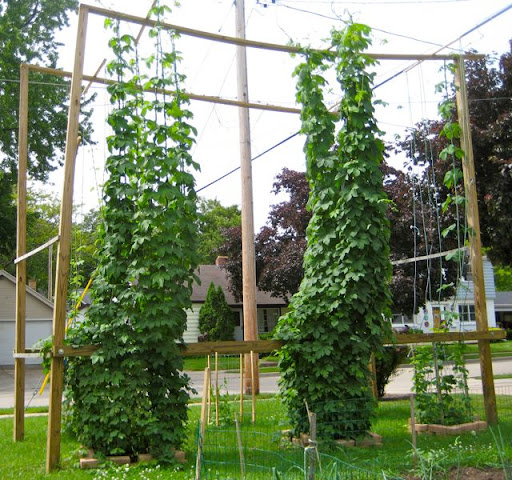
We'll start with the most fruitful hop farm within the city limits of Oshkosh. Not far from the corner of Jackson and Murdock, Nick’s Hop Operation is in its third year and in full bloom. He’s growing Zeus, Brewers Gold, Willamette, Cascade and Hallertau and most of his plants are loaded with fat, sticky cones that are bursting with aroma. When I walked up to take these pictures on Monday, I could smell hop resin from the sidewalk framing his yard. The growth of Nick’s set-up is amazing. To see how it’s progressed over the season go HERE & HERE.

Scott’s Hops
An utterly unique hop growing arrangement has developed on Adams Avenue. These are Scott’s hops and he's set them up in an unusual way. Instead of training his Cascades up a trellis or pole, he’s using an evergreen bush to support his plants. The hops and the evergreen have proven to be surprisingly compatible and at first glance the intertwined growth looks like a demented arborvitae sprouting hop cones. Stranger yet, Scott’s hops have meandered into a nearby prickly pear cactus and are putting out cones there, as well. Maybe we’ve got a new strain of hop here. The Oshkosh Prickly Pear Hop is born!


The Oshkosh Tall Boy

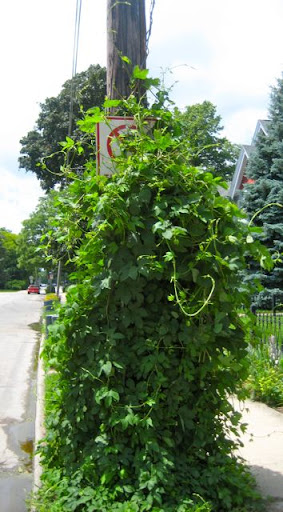
This must be the tallest hop plant in Oshkosh. It’s well over 25 feet tall and grows on a terrace near the western end of New York Ave. The plant’s incredible height is all the more baffling when you consider the small patch of dirt it occupies. This one is a late bloomer, but the cones have recently begun to develop and it should produce plenty of excellent fruit. If you haven’t seen this plant, take a drive down New York and check it out sometime. It’s a startling thing to encounter. THIS is what it looked like a couple months ago.


My Hops.
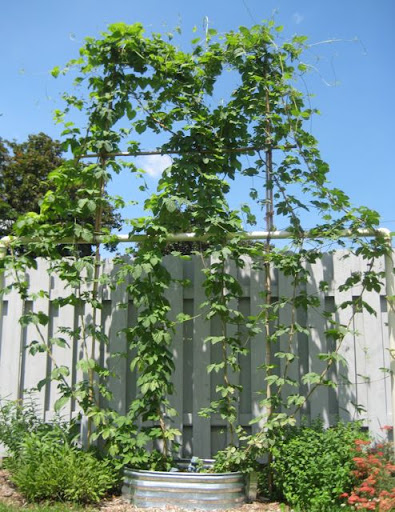
Finally, here are the hops I’m growing on Evans Street. They had a rough year. Twice they were flooded and the storm of July 14th ripped them down from their trellis. And though they had to learn to grow in a new direction (horizontally), they pulled through and are even thriving. These are a mix of Nugget and Cascade and I’m going to wait another week or so before I harvest them. I’m hoping to end up with about two pounds of hops after they’re dried, which ought to be enough to brew approximately 50 gallons of beer. THIS is what they looked like in mid-June.

Thanks to the Oshkosh hop growers for their help over the course of the summer. May your beer be bitter!

Monday, August 30, 2010

Small Beer No.1: Wet Hops & SoBe

In the course of researching some of the stories that wind up here on the blog, I often come across tidbits related to beer and brewing in Oshkosh that don’t warrant a whole lot of examination, but are interesting, all the same. It’s the sort of stuff that’s good for cluttering your head and not much else. It’s a nice sort of clutter, though, and I’d like to start passing some of this useless information along. So here’s the first installment of Small Beer. Feel free to drop these nuggets the next time there’s a lull in the conversation. Those within earshot will immediately develop a new appreciation for silence.

The First Wet-Hopped Beer Comes to Oshkosh

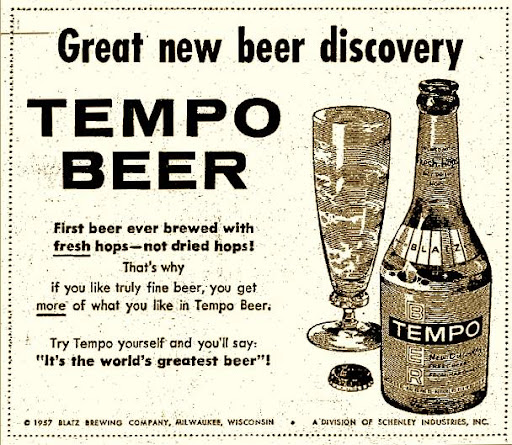
The hop harvesting season is nearly upon us in Oshkosh and there'll soon be a few local homebrewers making beer with hops they've plucked fresh from the vine. Well, that ain't nothin' new. This is an advertisement that ran in the Oshkosh Northwestern on July 10, 1957 and it claims that Tempo was the first beer to be brewed with fresh hops, as opposed to the dried hops brewers typically use. That's wrong. The first people to stumble upon the realization that hops added something good to their brews certainly hadn't gone to the trouble of drying them out. That came later. Truth be damned, it remains impressive that Blatz was marketing a wet-hopped beer here in Oshkosh more than 50 years ago. But you've got to wonder just how "fresh" those hops could have been. They were selling this beer in July, hardly the time of year for fresh hops in Wisconsin. The problem is, fresh hops don't hold up very well. You need to go from the hop plant to the kettle in just a few hours. If you miss that window of opportunity your beer ends up tasting as if you brewed it with lawn clippings. Still, you've got to admire the Blatz chutzpah. How many brewers these days would dare to run an advertisement for their beer claiming "It's the world's greatest beer"! By the way, there's an excellent beer bar in Milwaukee named the Bomb Shelter that supposedly has an old bottle of this floating around in their collection. Unfortunately, I've heard it's empty. But of course, it’s empty. You wouldn't expect the world's greatest beer to have gone unopened, would you?

SoBe and the Oshkosh Brewing Connection

Thomas Hardy Schwalm
At first glance, it wouldn’t appear that the iridescent fluid sold under the brand name SoBe would have much to do with beer or brewing in the city of Oshkosh. Look a little deeper though and you’ll find that SoBe is actually the wayward issue of the forefathers of beer in Oshkosh. SoBe was co-founded in 1996 by Thomas Hardy Schwalm, an Oshkosh native with a pedigree that maps to the heart of a bygone time in our city. Schwalm’s grandfathers were Oscar J. Hardy, publisher of the Oshkosh Northwestern from 1917 to 1950 and Arthur L. Schwalm, president of the Oshkosh Brewing Company from 1941-1961. His father, A. Thomas Schwalm, was brewmaster for the Oshkosh Brewing Company until he abandoned beer in 1950 to join his in-law’s newspaper business. But Thomas Schwalm wanted to be a beer man. He followed in the footsteps of the Schwalm men before him and over the course of his career worked for Schlitz, Stroh's and Barton Beers. Then came the SoBe gold mine. In 2000, Schwalm sold SoBe to Pepsi for a whopping $370 million dollars. Schwalm passed away in 2009 at his home in Greenwich, Conn. He was 64. He may have died a happy man, but he should have stuck with beer.

Thursday, August 26, 2010

Oshkosh Beer of the Week: New Glarus Abt

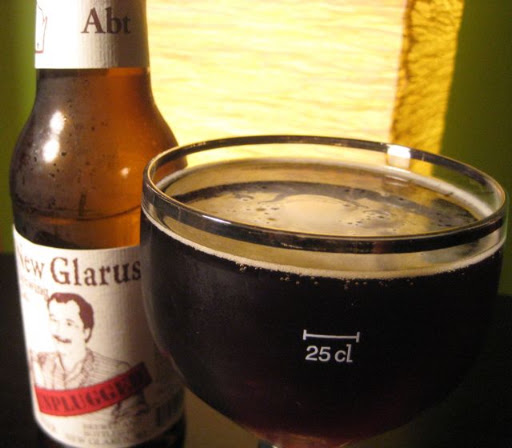
There’s a strong, rich beer named Abt that just arrived in Oshkosh and it has come to hurt you. But this New Glarus Unplugged beer is so smooth and inviting you won’t mind the pain it leaves in its wake. Style-wise, Abt runs along the lines of a Belgian Dark Strong Ale and with that you know you’re in for a heavy beer. The amazing thing about this one is how lightly it carries its weight. The beer’s 9.6% ABV isn’t hidden, but it’s presented in such a mellow, rummy way that the heat of its alcohol is entirely welcome. There’s a lot going on in this beer. It pours deep, deep red with a thick aroma of over-ripe dark fruit. That aromatic heft is contradicted, though, by the beers surprisingly light, almost fluffy, mouthfeel. As the Belgians would say, this one is highly digestible. The mouthfeel is just about the only thing light about it. There’s a kaleidoscopic depth of flavor here that ranges from chocolate to sweet raisin to cola to brandied cherries. It all conspires to gently draw you in. Then it slaughters your resolve and warps time. It made my Wednesday morning come way too early.

You’ll find Abt at Festival Foods in Oshkosh residing in the high-end beer ghetto where it’s being held without refrigeration. That’s no way to treat a good beer! On the other hand, you don’t want to drink Abt straight from your refrigerator, either. Let it rest and warm for a good half-hour before you pop it open. I made the mistake of starting the first bottle a little too cold and that made the beer seem sharp and harsh. This is a beer that grows lush as it warms.

Homebrewers: If you like to play around with yeast, notice the spicy yeast character of Abt. Last Spring I brewed a Belgian Dubbel using White Labs WLP530 and that yeast seems very similar to the strain New Glarus is using for Abt. WLP530 is supposedly the Westmalle yeast and I was lucky to have a Westmalle Dubble around the house while I was drinking Abt so I opened that up, too, and found that the yeast profiles do have a lot in common. If you prefer Wyeast, their 3787 is supposed to be the same strain. Either way, this would be a fun beer to try to clone.

Bonus Beer: Just got word from Peabody’s that they have Gandy Dancer Porter, a new beer from Potosi, now on tap. I’ve yet to try this one, but the folks at Potosi say their porter is “a bit bigger, hoppier, and or roastier than their European predecessors.” If you like a good porter you might want to plan a stop at Peabody’s this weekend.

Wednesday, August 25, 2010

The Return of the Regionals

From March 23, 1956
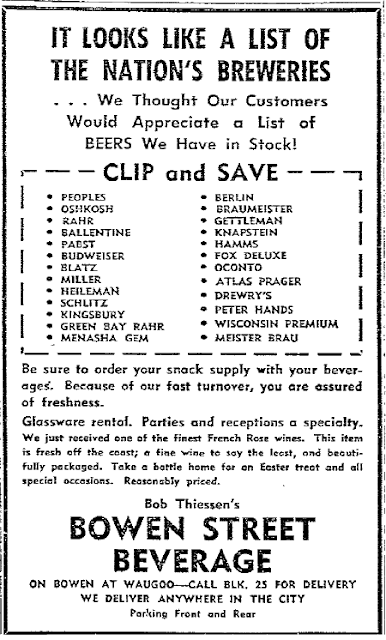
Fifty years ago, if you bought a beer in Oshkosh that beer was probably made in Wisconsin. Much of the beer sold here came from regional Wisconsin breweries located in cities like Potosi, Oconto, La Crosse, and Oshkosh. This local approach to beer was largely taken for granted. A 1956 advertisement for Bowen Street Beverage that ran in the Oshkosh Daily Northwestern is typical of the period. The ad shows an inventory of the 25 beers that the liquor store stocked and boasts “It looks like a list of the nation’s breweries.” It must have seemed like a much smaller nation in 1956. Of the 25 beers listed 18 were made in Wisconsin. Three of them were made here in Oshkosh.

It took a handful of large brewing corporations about 30 years to obliterate that approach to local beer, but the stranglehold they once had on the Oshkosh market is rapidly becoming a thing of the past. The next time you walk through the liquor department at Festival Foods in Oshkosh notice how much of the shelf space has been given over to Wisconsin-based, regional breweries. Festival stocks beer from about 20 small, Wisconsin breweries and though their beer may be quite different from those that were on hand at Bowen Street Beverage these newer breweries are working the same turf as their mid-century predecessors.

Two recent additions to the Festival shelves are representative of what’s going on here. The Pearl Street Brewery of La Crosse now has four different beers at Festival and the Potosi Brewing Company has brought in three. Each of these breweries sell their beer predominately in Wisconsin and the cities they hail from have long histories of bringing their beer to Oshkosh. And though their ales may not be similar in taste to the lagers that were once brewed in their respective cities, they’ve maintained a traditional approach by making beer that is suited to everyday drinking as opposed to the high-octane, extreme beers that are often featured by small breweries out to make a name for themselves.

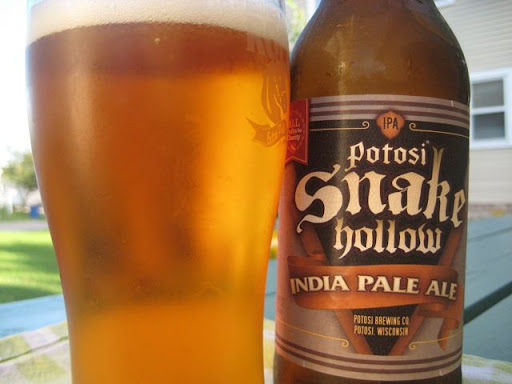
Lately, I’ve been liking the beers from Potosi quite a bit. The three beers they’re selling in Oshkosh are well-made, flavorful and easy to drink. They’re the sort of beers you reach for when you’re kicking back and having a few with friends. The Snake Hollow IPA is my favorite of the bunch. This is a prototypical Midwestern IPA. It’s a medium-bodied beer that features a fresh, citrus-hop flavor and a bitterness that’s firm without being harsh. The Potosi name and neo-retro packaging may be familiar, but what’s inside has little in common with the lagers that were once favored at Bowen Street Beverage. Now if we could only get some beer made in Oshkosh back on the shelves.

Monday, August 23, 2010

Clarence “Inky” Jungwirth’s Oshkosh Growler Story

Last week we touched on the infamous Oshkosh Growler, the greased buckets that were used for transporting beer from the taverns to home or work. Here’s more on the subject. The clip below is Clarence “Inky” Jungwirth’s telling of a legendary Oshkosh Growler story that Inky swears is true. This slice of oral history is about the children of Oshkosh in the early 1900s transporting beer to their fathers working in the factories. As Inky explains, sometimes the kids delivered the beer in a highly modified form...