Monday, March 16, 2020

Oshkosh Saloons and the Influenza Pandemic of 1918

The autumn of 1918 was a time of panic in Oshkosh. A deadly pandemic had arrived.


The virus for what would come to be known as the Spanish Flu had been spreading west since early September. By the end of the month, it was a full-blown pandemic. The first cases in Oshkosh were reported on October 5, 1918. City Health Commissioner Dr. Arthur H. Broche confirmed that 10 city residents had been diagnosed with the Spanish Flu. Two days later, two of them were dead.

It was a horrid, rapacious disease. It struck so quickly that some were reduced to helplessness within hours of first showing symptoms. It began with a raging fever, head and body aches, and burning eyes. Then hair loss, delirium, and vomiting blood. Death within a day or two of onset was not uncommon.

Over the next three days, more than 150 people in Oshkosh became infected. Signs were posted on their homes: "Warning! Influenza Here." The city came to a near standstill. A ban was placed on public gatherings. Schools, churches, and businesses closed. Events of all kinds were canceled. There remained, however, a refuge for those unwavering in their commitment to social living. The swinging doors of Oshkosh's saloons continued to swing open.

Inside Tom Ryan’s Clipper Club saloon on North Main Street, Oshkosh, in the early 1900s.

There's a well-known adage favored by politicos: never let a good crisis go to waste. The pandemic of 1918 roused Oshkosh's ineffectual anti-liquor agitators. The rising body count inspired them. On October 12, a week into the crisis, a crowd of Oshkosh prohibitionists rallied at City Hall demanding to meet with Oshkosh Mayor Arthur C. McHenry. The mob was made up mostly of women representing groups such as the Winnebago County Dry League, The Woman's Christian Temperance Union, and the Women's Missionary Society.

"The delegation was quite large, but because of the order of the board of health against people congregating in considerable numbers, only one representative from each organization was present at the conference. The others remained outside the mayor's office or at the Otter street entrance to the city hall while it was in progress."
   - Oshkosh Daily Northwestern; October 12, 1918.

The protestors delivered a predictable set of demands. Shut down all saloons and pool halls in Oshkosh. Now.

Arthur C. McHenry had been Oshkosh's mayor for seven months. He was "avowedly wet" and defiantly pro-saloon. McHenry had no use for prohibitionists. He had campaigned saying, "I stand for the largest possible measure of personal liberty... my attitude toward the saloon will be my attitude toward all legitimate business – a square deal to all without fear or favor!”

The anti-liquor crusaders couldn't have been too surprised with the result of their efforts. This was a group grown accustomed to losing in Oshkosh. The Daily Northwestern reported that "Mayor McHenry received the delegation with courtesy and gave attention to what its members had to say, but he declined to accede to their request."

McHenry told them that he'd already done all he was going to as far as the bars were concerned. The city had instituted a 5:30 pm curfew on cafes, restaurants, pool halls, and saloons. Onto that was tagged a "no spitting" ordinance. Though as one Oshkosh man observed, it did little to stem the saliva tide. He counted 108 globs of expectorant on North Main Street between Algoma and Church.

A sign common across the nation during the the 1918 influenza pandemic.

A few days after the confrontation at city hall, McHenry was being less solicitous towards the anti-saloonists. He noted that in Madison, a dry town, deaths from Spanish Flu far exceeded those of wet Oshkosh. McHenry added that he wouldn't be cowed by "Agitators whose interest in the spread of the epidemic is evidently secondary to their desire to grasp this opportunity in closing institutions whose business does not coincide with their ideas of public welfare."

But McHenry's tactics were more nuanced than his rhetoric. The 5:30 pm curfew was tantamount to shutting the saloons down. The majority of Oshkosh’s saloon patrons didn’t leave work until 5 or 6 pm. So the taps were off by the time they reached their watering hole. The curfew had the effect of preventing people from congregating at the bar without making it a mandate.

Meanwhile, the disease raged on. By the end of October, approximately 1,000 cases of Spanish Flu had been confirmed here.

The Oshkosh flu wagon outside of the State Street Fire Station.
The city’s old, horse-drawn ambulance remerged in 1918 to transport those sick with the flu.
The motorized ambulance was reserved for those with illnesses other than the flu.

The mayor’s approach proved effective. In early November, the spread of the disease in Oshkosh appeared to be under control. Restrictions were eased but then reinstated after another spike in new cases. Finally, in late November, the disease abated. Eight weeks after the first reported cases, the curfew and ban on public gatherings were lifted. Schools reopened on the first Monday in December.

By that time, 116 Oshkoshers were said to have died from the dread disease. Christmas was coming. Black wreaths were hung from the doors of the dead.

Wednesday, March 11, 2020

The Oshkosh Brewers

Here's a picture that I believe is the first of its kind. Here are all of Oshkosh's brewmasters together in one place. I took this Saturday at the Winter Beer Fest at Bare Bones.


From left to right we have: Zach Clark of Fifth Ward Brewing Company, Mike Schlosser of HighHolder Brewing Company, Andrew Roth of Fox River Brewing Company, Jody Cleveland of Bare Bones Brewery, and Ian Wenger also from Fifth Ward.

I haven't seen another picture from any other era that shows all the brewers from Oshkosh together like this. Thanks for indulging me, guys. I’ve wanted to do this for years.


Tuesday, March 10, 2020

Beer Production in Oshkosh and Beyond

The Wisconsin Department of Revenue recently issued its final set of 2019 reports for beer production in the state. Let's see what those numbers have to say about what's happening here in Oshkosh.

Filling Kegs at Bare Bones Brewery.

In 2019, Oshkosh’s four breweries produced a combined total of 2,296.43 barrels of beer (a barrel contains 31 gallons). That's a 5% increase over last year's combined output. Here's how that production is distributed among the breweries here.


Fox River Brewing
Fox River Brewing led the way again this year. The 1,200.57 barrels Fox River made at its Oshkosh brewery is more than all the other breweries in the city combined. That, however, is just one part of Fox River's output. The brewery produced an additional 1,555.54 barrels of beer at its Appleton facility where its bottling line resides. After outgrowing its capacity last year, Fox River began contract brewing beer at the Hinterland facility in Green Bay. This year, Fox River brewed an additional 1,500 barrels in Green Bay. That puts the brewery's total production for 2019 at 4,256.11 barrels; about a 19% increase over last year. That's an especially large bump for a brewery that's been around for 25 years.

For the second year in a row, Fox River is the largest brewery in the Fox Valley metropolitan area that includes Oshkosh and Appleton. Stone Arch of Appleton remains second with a production of 2040.43 barrels. It's also interesting to see that Fox River's production now outpaces that of O'so Brewing, which had long been a prominent brand in the Oshkosh area. O'so produced 3905.23 barrels in 2018.

Fifth Ward Brewing
Fifth Ward had a break-out year. The brewery's 2019 production of 547.17 barrels is a 26% increase over its 2018 output. "We were running at full capacity at the end of 2019," Zach Clark of Fifth Ward said. "If we continue at this pace, we're going to have to look into increasing our capacity at some point later this year." Fifth Ward is still doing all of its own distribution. The brewery now sells its beer throughout the Fox Valley and into Green Bay and Sheboygan.

Bare Bones Brewery
Bare Bones had another good year in 2019 with production of 544.19 barrels; an increase of 1% over its 2018 output. The brewery's output has been consistently in this range for the past three years; a period that has seen a significant increase in local competition. Bare Bones distributes its beer through Lee Beverage, but the brewery doesn't have a salesperson. That may be changing soon, and if it does, I would expect you'll see the brewery's output increase.

HighHolder Brewing
HighHolder is Oshkosh's only nano-brewery and it had a rough year in 2019. Early in the year, Mike Schlosser – HighHolder's jack of all trades – had a serious health scare that put the brewery on hold for much of the year. The 4.5 barrels Schlosser managed to brew was a 62% decrease from 2018's output. But Schlosser is now back in the brewhouse and this year has already surpassed his 2019 output. He expects HighHolder to produce about 20 barrels this year.

The Overall
At this moment, the picture in Oshkosh looks fairly encouraging. The 5% increase in overall production is slightly better than the projected 4% increase for craft breweries nationally. But this market is definitely tightening.

There are now more than 8,000 breweries in America. Approximately 200 of them are in Wisconsin. And eight of those are in Winnebago County. I'll end here with production numbers for several other area breweries. This illustrates how competitive it's becoming for small breweries in this region.

2019 Production in Barrels
Stone Arch Brewpub, Appleton: 2040.43 ( Down 1.6% from 2018)
Lions Tail Brewing, Neenah: 683.23 (Up 25% from 2018)
Knuth Brewing, Ripon: 441.59 (Up 18% from 2018)
Appleton Beer Factory: 317.46 (Down 5.1% from 2018)
McFleshman's Brewing, Appleton: 327.14 (First full year of production)
Barrel 41 Brewing, Neenah: 228.04 (First full year of production)
Rowland's Calumet Brewing, Chilton:  169 (Up 1.8% from 2018)
Omega Brewing Experience, Omro: 32.39 (Up 31% from 2018)
Emprize Brew Mill, Neenah: 17.82 (First began reporting production July)

Note: After this story was posted I received a message from Alex Wenzel, owner of Lion’s Tail Brewing. He informed me that the Department of Revenue’s 2019 reporting for Lion’s Tail was incorrect. Lion’s Tail’s actual production was 683.23 (the DOR reported 514.68). This post has been updated to correct the error.

Thursday, March 5, 2020

Here Comes the Fourth Beer in the Oshkosh Heritage Series: The Busch Brewery's Salvator

The fourth beer in the Bare Bones Brewery Heritage Series arrives this weekend. This time we're going all the way back to 1858 when the Busch Brewery of Oshkosh released a bock beer named Salvator.


Our story begins in 1857 when German immigrants Tobias Fischer and Christian Kaehler teamed up to launch a new brewery in Oshkosh. They bought land in the old Fifth Ward and went to work digging beer cellars and building a brewhouse. By the winter of 1857, Fischer and Kaehler had the Busch Brewery up and running. It stood near the southeast corner of Algoma and Vine on land that's now part of the UW - Oshkosh campus. Not a trace of the old brewery remains.

The northwest end of the UW Oshkosh Campus, former home of the Busch Brewery.

That first winter, Fischer and Kaehler brewed a strong bock beer they named Salvator. At the time, Salvator was considered a style of beer; like Pilsner or Porter.  Some 40 years later, the Paulaner Brewery in Munich would trademark the Salvator name. But prior to that, dozens if not hundreds of breweries made a Salvator beer. The little Busch Brewery in Oshkosh was among them.

Fischer and Kaehler released their Salvator at the brewery on May 1, 1858. They announced its coming in the Oshkosh Deutsche Zeitung newspaper. Here’s their ad with a translation following it.


Salvator Bier
“Oshkosh’s beer-thirsty souls
Will soon rejoice
That above Bacchus’ majesty
Gambrinus reigns supreme!

This famous Salvator Beer, which was
brewed on the coldest day of this
winter, has now finished its lagering
period and is to be tapped at our
brewery on the coming Saturday
evening, the 1st of May.

We invite all Oshkoshers to visit us on
Saturday and the following days in our
Busch Brewery, and we promise to give them
a pleasure like never before.
Come, come all to
Fischer and Köhler.”

The Busch Brewery's Salvator would have been quite unlike the Salvator you find on grocery store shelves today. The Salvators of old began with a concentrated wort that was fermented in a manner that left plenty of residual sugar in the finished beer. It was sometimes referred to as "liquid bread." The beer was moderately strong and especially hearty; perfect for ushering out the remaining cold days of winter.

Jody Cleveland, head brewer at Bare Bones, and I knew we were taking a shot in the dark when we decided to try to replicate this one. The Busch Brewery had lasted just a couple of years. No brewing logs from it are known to have survived. But we did have a fair amount of information on how this type of beer was being brewed in 1858. We coupled that with known tendencies of Oshkosh brewers during the era that Fischer and Kaehler worked here. I'm pleased to say, the beer turned out just as we expected. You probably haven't had a lager like this one before.

Here's a look under the hood: We started with a blend of malts that included Wisconsin Munich and 6-row to emulate the sort of grist Fischer and Kaehler would have worked with. The beer was hopped with Cluster, which was almost certainly the hop of choice at the Busch Brewery. The original gravity was 1.074 (or 18 plato). The finishing gravity was 1.025 (or 6.3 plato). The result is a 6.4% ABV beer with an apparent attenuation of just 65%. Hat tip to Jody Cleveland for hitting that mark. An attenuation level like that one is tricky to obtain using modern ingredients and equipment. But it's essential if you're trying to reproduce the character of a 1800s-style Salvator.

The Busch Brewery Salvator is going to get a fairly wide release around Oshkosh in the coming days. Its first appearance will be at the Bare Bones Winter Beer Fest this Saturday, March 7. On Tuesday, March 10, a limited-edition bottle release (six-packs labeled with the 1858 advertisement seen above) will take place  at 5 pm at the Bare Bones taproom. Then on Wednesday, March 11, Jody Cleveland will be at Dublin's Irish Pub pouring Slavator from 5-7 pm as part of the Bare Bones tap take over for Oshkosh Craft Beer Week. Jody will be at Chester V's on Thursday, March 12 for another Oshkosh Craft Beer Week event starting at 6:30 pm. That event includes a wing-pairing that'll feature Salvator as part of the gustation. Meanwhile, Salvator will continue pouring at the Bare Bones taproom.

Here’s to Fischer and Kaehler. Prost!

Wednesday, March 4, 2020

In Today's Oshkosh Herald...

If you live in Oshkosh, you’ll see the Oshkosh Herald delivered to your door today. I have a story in there about Oshkosh’s first Craft Beer Week. If you don’t live in Oshkosh, you can check it out HERE.


Thursday, February 27, 2020

The SOB's Oyster Stout

Saturday morning, The Society of Oshkosh Brewers will be doing the sort of things those SOBs do. They’re brewing an Oyster Stout at The Cellar Brew Shop. And yes, that beer will include actual oysters. Brew day starts at 10am. Stop by The Cellar and check it out.


Sunday, February 23, 2020

Wisconsin: The "Rotten" Spots

Here we have an ugly artifact with a strong upside. The map below is from 1918. It was prepared by the “hyper-patriots” of the Wisconsin Loyalty League. The shaded areas show the "rotten spotted" sections of Wisconsin "infected" with German immigrants. Oshkosh was rotten indeed. Just so happens those rotten spots were also where the breweries flourished. I'll take the shade any day.


Thursday, February 20, 2020

Ask the Brewmaster Saturday at The Cellar

This Saturday, February 22, Fox River Brewing Company brewmaster Drew Roth will teach an Introduction to Brewing class at The Cellar Brew Shop, 465 N Washburn St, in Oshkosh. Class begins at 11 am. And it's free.


Drew is going to go through the basics of homebrewing using an extract kit to demonstrate all the steps along the way to making your own beer. He'll cover cleaning and sanitization, gravity readings, the fermentation process, and the basics of racking and bottling your beer.

If you're interested in getting started in homebrewing, this will set you on the right path. A class like this is helpful even if you're just into drinking beer. You'd be surprised how much the experience of beer is enhanced when you know how the fluid in your glass came into being.

All of which reminds me... In the 1950s, the Oshkosh Brewing Company ran a series of ads titled "Let's Ask the Brewmaster" featuring OBC brewer Wilbur Strottman. Each week, Strottman would answer basic questions about beer and brewing. I always liked that idea. A brewer ought to care enough about their customers to take a little time to help educate them. That’s something sorely lacking in the current scene. I’ll spare you my rant on that. Here’s a couple of those Ask the Brewmaster ads from 1957.

July 12, 1957; Oshkosh Daily Northwestern.

November 11, 1957; Oshkosh Daily Northwestern.

Tuesday, February 18, 2020

Oshkosh Craft Beer Week

Oshkosh will celebrate its first Craft Beer Week with nine days of beer-centric events beginning Saturday, March 7 and running through Sunday, March 15. It's all being organized by the Oshkosh Convention and Visitors Bureau with help from each of Oshkosh's four breweries.


Craft Beer Week will be bookended by a pair of beer fests. The week kicks off with the 3rd Annual Winter Beer Fest at Bare Bones beginning at 12 pm on Saturday, March 7. Tickets for that are still available and if you get them in advance you'll save $10. You can find tickets and more info on that fest HERE.

The week concludes with the EAA's Hops & Props beer tasting on Saturday, March 14. The beer dinner portion of that fest is already sold out, but tickets are still available for the beer sampling. More on that HERE.

Finally, O'Marro's will host an afterglow sort of event on the bloody Sunday morning of March 15 with a "St. Paddy's Season Sunday Service" at the pub beginning at 10 am. You don't want to go cold turkey, after all.

Throughout the week, there'll be a host of new beer releases, special offers, and prizes available in Oshkosh's brewery taprooms. The best place to keep up with all of that is HERE. You might want to bookmark that site. The Convention and Visitors Bureau continues to update it as new events are added.

The Convention and Visitors Bureau would like to make Oshkosh Craft Beer Week an annual event and expand it to include more venues in Oshkosh. Let's make this a success and get out and enjoy our local beer scene!

All right, one last thing... would you like a sticker like this one?


Go to the Oshkosh Craft Beer Week Facebook Page and message them your address. They'll mail it to you. Prost!

Monday, February 17, 2020

Back in Bock

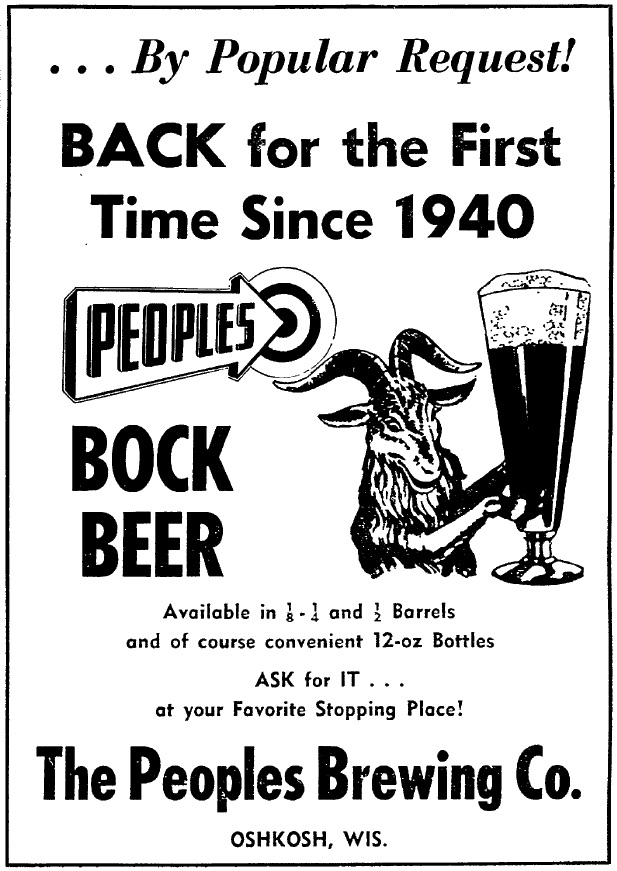
This week in 1959, Peoples Brewing reintroduced a beer that the brewery hadn't made in 19 years. It was the return of Peoples Bock Beer.


Peoples’ 1959 Bock Beer arrived 45 years to the day after the brewery had released its very first bock on February 20, 1914. That was an important beer for Peoples. The brewery had opened just eight months earlier. It was a direct outgrowth of the German immigrant community in Oshkosh. Bock was the first beer from Peoples that spoke explicitly to the heritage of those folks. The list of Oshkosh saloon keepers who put it on tap was full of names with a distinctly Germanic ring.


Most of that 1914 bock was served on draft in saloons. But Peoples also offered the beer in pint-sized bottles. You could get a dozen of them for 80 cents. That would be about $20.70 in today's money. The next year, Peoples came out with 12-ounce bottles of its bock for 90 cents a case.  Here's the label used on those 12-ounce bottles.


The bock beer season in Oshkosh usually ran from late February until mid-April. It was a celebrated event. A sign that spring was on its way. Each of the city's three breweries would bring out their own version of bock beer.


When Prohibition came in 1920 all of that was put on hold. For the next  dozen years, folks in Oshkosh had to go looking for robins to remind them that someday spring would come.

Beer became legal again on April 7, 1933; eight months before the full repeal of Prohibition. The beer produced during the interim period could contain no more than 3.2% alcohol by weight, which is 4% alcohol by volume. The bock-beer season had nearly passed, But Peoples released one anyway. It was more of a symbolic gesture than anything else. At a mere 4% ABV, Peoples’ 1933 Bock lacked the kick that veteran drinkers of bock beer were accustomed to. Perhaps that's why the goat was left off the label.

Image courtesy of Bob Bergman.

Peoples 1934 bock was back to the brewery's standard: dark and strong, rich and malty. The goat was back, too.


"Every Winter Peoples Brewing Co. brews and ages a superb Bock Beer," began the 1940 announcement. It would be another 19 years before they could say that again. After the 1940 release, Peoples stopped making its bock beer. The brewery never explained why.

The drought ended on February 20, 1959 when Peoples trotted the old goat back out.


In the 1950s and '60s, Wilhelm Kohlhoff was one of two principal brewers at Peoples. He recalled making Peoples Bock after its reintroduction. "We added all the special malt; it was darker, it was a brown color malt, and then what you used was brown sugar, 600 pounds of sugar in the kettle and that makes the beer a different color, too." Kohlhoff said.

That's a lot of sugar for a 100-barrel batch of beer. The use of sugars in American beers of this period isn't unknown, but I haven't come across another example of its use in bock beers during that time.


Peoples Bock never regained its former popularity. The last mention I've found of the beer is from 1963. Bock beers in general had fallen out of fashion. What had been an anticipated sign of spring was now a specialty brew indulged in by the older crowd. Like the people who drank it, bock beer faded away.

Unfortunately, bock hasn’t undergone a revival like some other styles have in the new era of smaller breweries. But the old goat still kicks. Within the next few weeks, Bare Bones, Fifth Ward, and HighHolder will all release a bock beer. It will be the first time in 80 years that three Oshkosh breweries will have a bock pouring in the run-up to spring. No need to look for robins this year.