Monday, May 11, 2020

Bill Steiger and the Bathtub Beer Bill

Considering the history of this place, it’s not too surprising that someone from Oshkosh would have played a central role in the legalization of homebrewing in America.

William A. Steiger.

On January 4, 1977, Congressman William A. Steiger of Oshkosh introduced House Resolution 1337. It was a sausage-like bill that, among other disparate parts, included a provision that would legalize the making of beer at home "for personal and family use." Just over two years later, the federal prohibition on homebrewing came to an end.

For his part, Steiger never professed any special love for the home craft of making beer. He was born in 1938, five years after Oshkosh's once-vibrant homebrewing scene had been made redundant by the repeal of Prohibition. The city was home to three breweries during Steiger's time, but young Bill was brought up about as far removed from all of that as was possible for any person living in Oshkosh.

Bill Steiger was born into a wealthy family. His father, Carl, was president of Oshkosh's Deltox Rug Company and heavily involved in politics on both the local and state levels. Bill grew up in a posh neighborhood on Algoma Boulevard in a mansion that had been built for lumber baron Edward Paine in 1860. Steiger probably never heard that there had once been a brewery run by a German named Kaehler just a few doors down from the family home. That part of the story was forgotten by the time the Steigers arrived.

The Steiger family home.

Bill Steiger quickly made a name for himself. Upon graduation from the University of Wisconsin in 1960, he ran for and won a seat in the Wisconsin State Assembly. In 1966, he was elected to Congress and at 28 became its youngest member. By 1977, Steiger was a rising star within the Republican Party and being groomed as a potential Senate or Vice‐Presidential candidate.

William Steiger and Richard Nixon, 1966.

William Steiger, 1968. At the far left is Steiger's intern, future Vice-President Dick Cheney.

So why would a guy like Bill Steiger bother to insert an unrelated clause legalizing homebrewing into a larger bill concerned with excise taxes on trucks and buses? The thanks goes to one of Steiger's colleagues on the House Ways and Means Committee. A Congressman from Rochester named Barber B. Conable.

Barber B. Conable

Conable had been trying to get homebrewing legalized since 1975. On September 27 that year, he introduced House Resolution 8643, a bill to authorize the home production of beer. Homebrewing was a federal crime punishable by a $5,000 fine and/or five years in jail. Conable’s bill would eliminate that penalty for a two-adult household making less than 200 gallons of beer a year. He later told a reporter from Copley News Service that the idea for legalization had come to him via a constituent who made kits for homemade beer and wine.

The man who had Conable’s ear was probably Jack Leonard, president of Rochester’s Vynox Industries. Vynox was then selling wine and beer making kits and equipment from the back pages of Popular Science magazine. Leonard was one of the early voices campaigning for legalization and had testified before Congress in December 1975 on behalf of Conable's bill. That bill never came to a vote.

Popular Science, October 1976. 

The legislation Steiger introduced in 1977 was a repackaging of the Conable bill. And as the new bill took shape, Conable became its chief advocate.

It took a year for the Steiger bill to come out of committee. The process left it significantly deformed. Officials from the Bureau of Alcohol Tobacco and Firearms (BATF), had gotten into the mix. They managed to insert a provision requiring homebrewers to register with the federal government. It was a matter of bureaucratic quid pro quo.

At the time, home winemakers were required by law to register with the federal government before producing any wine. Many home winemakers simply didn’t bother. But some 21,000 others sent in Form 1541 each year to remain on the right side of the law. Steiger’s bill would eliminate that prerequisite. The BATF wanted something in return.

The grasping nature of the agency's argument was evident. “Unregulated homebrewing might facilitate evasion of taxes on distilled spirits,” a BATF official said. "The mash that is left after beer is brewed can be distilled into hard liquor." Of course, you could accomplish much the same by distilling wine. But at this point, the bill had garnered little attention. Perhaps the BATF was banking on others not noticing what it was up to.

The bastardized bill sailed through the House with little fanfare and no opposition. It passed on a voice vote on Monday, March 13, 1978. It then went to the Senate where it was named the Homebrew Beer Equality Act of 1978. Newspapers called it the Bath Tub Beer Bill. Homebrewers weren’t amused. Their annoyance turned to outrage when they learned of the onerous addendums the bill had been saddled with.

It wasn’t just the federal registration requirement. The bill allowed for 100 gallons of beer production per year for a single adult household, and 200 gallons for households that had two or more adults. But those limits came with the stipulation that no homebrewer could have more than 30 gallons of beer – either finished or under fermentation – on hand at any one time.

Homebrewers pushed back. California homebrewing clubs the Maltose Falcons and San Andreas Malts appealed to Senator Alan Cranston of their home state. They found a powerful ally in the Senate's second-ranking member. Cranston jeered the BATF's meddling, saying it was "beer-ocracy at its worst." He called it "white-collar leaf raking."

The Maltose Falcons, 1974.

Alan Cranston

When the bill hit the Senate floor, Cranston was waiting with an amendment of his own that stripped the extraneous provisions and restored the bill to something very much like those Conable and Steiger had proposed in 1975 and 1977. No federal registration. No 30-gallon limit. Cranston had already lined up all the support he needed. His revisions passed through both the House and the Senate and October 4, 1978, the finalized bill was sent to President Jimmy Carter.

On October 14, 1978, Carter signed H.R. 1337 into law. Public Law 95-458 ended the federal prohibition on homebrewing effective February 1, 1979. By then, Bill Steiger was gone.

On December 4, 1978, the 40-year-old congressman from Oshkosh died unexpectedly of a heart attack. The New York Times, in its obituary of Steiger, noted that "He was widely regarded as one of the most promising political figures in his party... known for his wit, sunny disposition and informal appearance."

Steiger had grown up in a small, "informal" city with three breweries. He saw each of those breweries fail during the consolidation of the industry that occurred during the 1950s, '60s, and '70s.

Today, Bill Steiger's hometown has four breweries. And each of the brewhouses here is run by a former homebrewer who directly benefited from the legislation Steiger introduced in 1977. It was the trigger that set into motion the unanticipated transformation of America's beer culture.


Monday, May 4, 2020

The Longevity of Oshkosh Breweries

Breweries come and go. In Oshkosh, we have 171 years of brewing history that hammers that point home.

The demolition of Peoples Brewing, July 1974.

What follows is an illustrated list of every Oshkosh brewery ranked in order of their longevity. If you want to dig deeper, I've added links at the bottom of the post that will lead to much more information on all of the breweries mentioned here. Off we go...

1. Rahr Brewing Company, 1865–1956
The Rahr Brewing Company is Oshkosh’s longest-lived brewery having remained in operation for 91 years. Located at the end of Rahr Avenue on the shore of Lake Winnebago, Rahr remained a small, family-owned business throughout its history.

The Rahr Brewing Company, late 1800s.

2. Oshkosh Brewing Company, 1894–1971
Located at what is now 1642 Doty Street, Oshkosh Brewing was in business for 77 years. OBC was formed in 1894 by the merger of the Horn and Schwalm, Glatz, and Kuenzl (Gambrinus) breweries.

The Oshkosh Brewing Company, circa 1918.

3. Peoples Brewing Company, 1913–72
Peoples Brewing was initiated by a group of Oshkosh saloon keepers and lasted 59 years. The brewery was located at what is now 1512 South Main Street.

Peoples Brewing Company shortly after it closed in 1972.

4. Horn and Schwalm’s Brooklyn Brewery, 1866–94
This brewery was launched by German immigrants August Horn and Leonhardt Schwalm. It remained an independent entity for 28 years and was located at what is now 1630–70 Doty Street.

Horn & Schwalm's original Brooklyn Brewery; destroyed by fire in 1878.

5. Franz Wahle/ John Glatz Union Brewery, 1867–94
The brewery at the end of Doty Street was privately owned and operated for 27 years before becoming part of the Oshkosh Brewing Company in 1894.

The John Glatz Union Brewery.

6. Loescher’s (First) Oshkosh Brewery, 1852–78
The first of two breweries George Loescher and his family operated in Oshkosh was in business for 26 years. It was located at what is now 1253–83 Bay Shore Drive.

Detail of an 1858 map showing the location of Loescher’s first Oshkosh Brewery.

7. The Gambrinus Brewery, 1868–94
The large brewery at what is now 1239–47 Harney Avenue lasted for 26 years. It was first run by Gottlieb Ecke and later by Lorenz Kuenzl. It merged into the Oshkosh Brewing Company in 1894.

The Gambrinus Brewery circa 1893.

8. Fox River Brewing Company, established 1995
Welcome to the modern era. Fox River is now in its 25th year of operation.

Fox River Brewing Company, Oshkosh.

9. Busch Brewery/Fifth Ward Brewery, 1858–1880
For 22 years, Christian Kaehler ran this brewery at the southeast corner of Algoma Boulevard and Vine Avenue. The land it occupied is now part of the University of Wisconsin – Oshkosh campus.

Oshkosh City Directory, 1872.

10. The Lake Brewery, 1849–68
Oshkosh's first brewery was launched by German immigrant Jacob Konrad. It remained in operation for 19 years. The brewery stood on the east side of Lake Street, just south of Ceape Avenue.

1858 map showing location of the Lake Brewery.

11. Loescher’s (Second) Oshkosh Brewery, 1880–89
The second brewery operated by George Loescher and his family remained in business for nine years. This brewery was at the northeast corner of Frankfort Street and Bay Shore Drive.

Loescher’s second Oshkosh Brewery shown in an 1885 insurance map.

12. Bare Bones Brewery, established 2015
The brewery at 4362 County Highway S has been a going concern for five years now.

Bare Bones Brewery upon its opening in June of 2015.

13. Leonard Schiffmann’s White Beer Brewery, 1875-1879
This weiss-beer brewery was active for four years at what is now 1864 Doty Street.

A stoneware bottle used by the Schiffmann Brewery in the late 1870s.

14. Mid-Coast Brewing Company, 1991–95
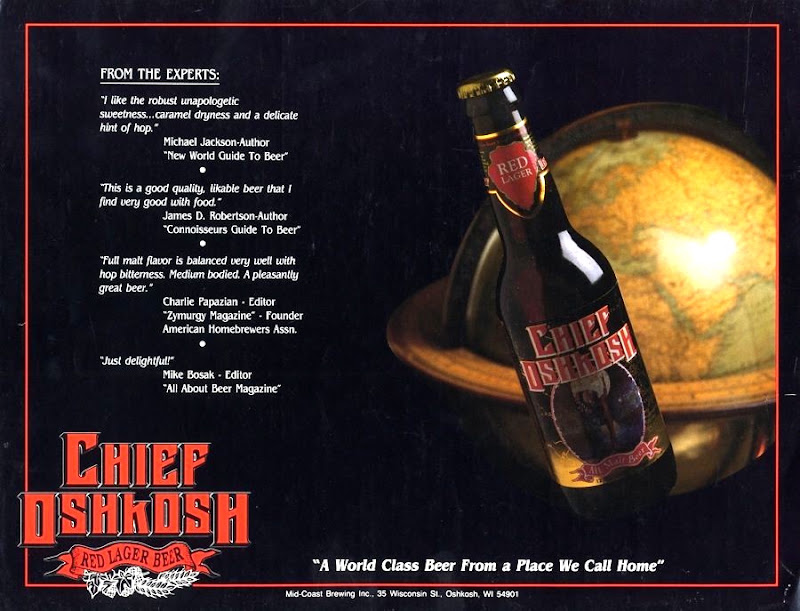
The maker of Chief Oshkosh Red Lager was active for four years. The brewery's office was located at 35 Wisconsin Street in Oshkosh. Its beer was brewed on contract at the Stevens Point Brewery.


15. Joseph Schussler’s Oshkosh Brewery, 1849–52
Schussler opened Oshkosh's second brewery in the fall of 1849. Three years later he went bankrupt and the brewery closed. This brewery was on the south side of Bay Shore Drive, midway between Bowen and Frankfort Streets.

An 1890s drawing of Joseph Schussler.

16. Leonard Arnold Brewery, approximately 1875–78
Arnold ran this obscure beer and vinegar brewery for approximately three years. His plant was at the southeast corner of Sixteenth Avenue and South Main Street.

1600 South Main Street today. The former site of Leonard Arnold’s brewery.

17. Frederick Voelkel Brewery, late 1870s.
Voelkel was a saloon owner who ran a weiss beer brewery from his home for about three years. His base of operations was at the northwest corner of Doty Street and West Seventeenth Avenue.

The location of the Voelkel shown in blue on Doty Street near the Horn & Schwalm Brewery.

18. Fifth Ward Brewing Company, established 2017
A relative newcomer, Fifth Ward opened its brewery at 1009 South Main Street three years ago. 

September 2017. Zach Clark (left) and Ian Wenger of Fifth Ward in their new brewery.

19. Fischer and Weist, 1856–1858
This brewery, initiated by German immigrants Tobias Fischer and August Weist, remained active just two years. It was located near the southwest corner of High and New York Avenues.

The red dot indicates the approximate location of where the Fischer and Weist Brewery stood.

20. HighHolder Brewing Company, established 2018
HighHolder began distributing its beer two years ago. The brewery operates, albeit sporadically, from a suite behind O'Marro's Public House at 2211 Oregon Street.

Shawn O'Marro (left) and Mike Schlosser of HighHolder, shortly before the brewery opened.

21. Rudolph Otten Brewery, 1865
Almost nothing is known of Rudolph Otten's brewery. It appears to have lasted for less than a year. The brewery may have been located on Oxford Avenue.

An 1867 drawing showing what may have been the location of Otten’s brewery on Oxford Street.
To learn more about any of these breweries, visit the Oshkosh Beer Timeline. You can also search the individual breweries using the “Search The Oshkosh Beer Blog” tool that appears in the left-hand panel. If you’re on a phone, you’ll need to be in full website mode to access that feature.

If you want to pinpoint the exact location of any brewery mentioned here, this interactive map will show you the way. 

Finally, the above list doesn’t include the wildcat breweries that operated in Oshkosh during Prohibition. You can go here to tour that byway of Oshkosh brewing history.

Wednesday, April 29, 2020

FOLLOW YOUR WEIRD!

Here’s Barry “Wildman” Snyder. He’s a former Oshkosher living in Erie, Colorado where he makes art from fruit and produce stickers. He’s currently working on a tribute to the Oshkosh Brewing Company. His father was Robert “Doc” Snyder, who taught for years in the Radio-TV-Film program at UW-O.


For more on Barry and his work, go here.

Thanks to my buddy Leigh Aschbrenner for pointing me in Barry's direction.

Monday, April 27, 2020

Pandemics and the Breweries of Oshkosh

For breweries in Oshkosh, the coronavirus pandemic has been crippling. The core of their business – selling beer to people gathered in their taproom – has been eliminated by the state's Safer At Home Order. With another month of shutdown ahead, the road to recovery for these breweries is going to be punishing. If, in fact, they manage to recover at all. It's bad. And it's not without precedent.

The 1918 influenza pandemic took a similar toll on Oshkosh's breweries. The three breweries here – Oshkosh Brewing, Peoples, and Rahr – were utterly dependent on local saloons. The saloon trade accounted for approximately 80% of their total beer sales. All three breweries either owned or were financially tied to many of the saloons that sold their beer. The scope was different, but the arrangement is comparable to the taproom model our current breweries rely upon.

The Nigl tavern in the 1940s at what is now 815 Ohio St.
It was tied to Peoples Brewing from 1913 until 1920.
The building is now home to DD's BBQ Company. 

During the 1918 pandemic, Oshkosh breweries had their main revenue stream reduced to a trickle. Saloons were placed under a strict mandate to prevent people from gathering. Their hours of operation were curtailed to a brief period of each day. It allowed enough time for folks to come in and pick up a growler or two of beer. But when 5:30 pm came, the taps had to be turned off. It wasn't so very different from what's occurring today.

Beer being prepped for takeout at Bare Bones Brewery.

What makes the current period somewhat more encouraging for brewers is that they're approaching an end date to the restrictions and the chance to resuscitate their businesses. The brewers of 1918 had no such hope. Their pandemic was merely a dark prelude to a future that appeared even more bleak.

The 1918 pandemic shut down the City of Oshkosh for most of October and November of that year. On November 29, the ban on public gatherings and the restrictions on saloons were finally lifted. That came too late for the brewers here.

The day after the shutdown ended, breweries were forced to stop making beer. The order came down from President Woodrow Wilson as part of an effort to conserve resources during WWI. This despite the war having come to an end weeks earlier. The following Monday, the Oshkosh Northwestern reported, "The manufacture of beer stopped in this city Saturday night, perhaps forever."

In the meantime, state legislatures across the country were voting on an amendment to the constitution that would ban the production, sale, and distribution of alcohol in the United States. The ratification of the 18th Amendment came on January 16, 1919. A year later, national Prohibition was imposed. Bad times were here to stay. For the breweries and saloons of Oshkosh, the pandemic of 1918 had been just the beginning of their nightmare.

The 18th Amendment.

Normalcy, if you could call it that, would not return until 1933. By then more than 25% of all the breweries in Wisconsin had permanently closed. The count would go on falling for the next 50 years. Oshkosh had the unusual distinction of seeing all three of its pre-Prohibition breweries return after the repeal of the dry law. But they, too, would eventually succumb.

The disruption we're seeing now is nowhere near as cataclysmic as that which began with the 1918 pandemic. Yet our current breweries are more vulnerable than the Oshkosh breweries of 1918. Each of the earlier breweries had far greater financial resources than any of the Oshkosh breweries now in operation. The real impact of what's happening today won't be realized for another six to nine months.

I keep thinking back to the Winter Beer Fest held at Bare Bones Brewery on March 7. I was there and didn't hear a single person mention the word Coronavirus. It was a great day for the beer scene here. All the local breweries were on hand. Hundreds of people had gathered on a cold, bright afternoon to kick off Oshkosh's first Craft Beer Week and celebrate the incredible revival of our beer culture. I remember thinking that it felt like a high point. I'm sure I’m not the only person who had that thought.

Just ten days later, Wisconsin began its shut down and social distancing became our mantra. That day in the parking lot at Bare Bones seems almost surreal now.


Friday, April 24, 2020

Oshkosh Beers to Drink this Weekend

To hell with this shutdown, beer never sleeps. Here’s a trio of Oshkosh’s finest to get into this weekend.


Fox River Houblon de Citron
Fox River is back in the swing of things with the release of Houblon de Citron, a Belgian-style IPA that makes its debut today. HdC starts off with a bloom of citrusy hop aroma spiced with peppery Belgian yeast. The palate has a pillowy, Saison-like quality; there's some raw wheat in here contributing to that. The rustic character quickly gives way, though, to a blush of modern hop flavors. The Lemondrop hops used here seem to stand out. It presents as slightly sweet, sort of like Lemonheads candy. It pairs well with those yeasty esters. This is a fairly big beer at 8.8% ABV, but the alcohol is well hidden and the beer finishes dry. This isn't like those Belgian IPAs that were in vogue about six years ago. This is more like an American Saison. And it's excellent. Fox River is releasing a limited run of wax-finished bombers of Houblon de Citron that will be available for curbside pick-up when the brewery opens today at 4 p.m. More on that, here. And for the true geeks among us, go here, to dig under the hood and see what brewmaster Roth is up to with this beer.


Bare Bones Busch Salvator
Bare Bones recently set up a slick online platform for ordering beer that you can try out here. I’d suggest adding Bare Bones’ Busch Salvator to your cart. This beer was released just prior to the start of the shut down and hasn’t gotten the attention it deserves. Full disclosure: this beer is part of the Bare Bones Heritage Series and I had a little bit to do with the recipe formulation. That aside, I think Salvator may be my favorite Bare Bones beer to date. This is a true, mahogany-brown bock beer. There’s a swirl of rich malt flavor here that begins with toast, works up to caramel, and finishes close to chocolate. This is a 6.4% ABV spring warmer ideal for the sort of chilly/damp weather they’re predicting for this weekend. Get the full backstory on Salvator, right here.

Fifth Ward Vanta Black Ale
Since the start of the shutdown, Fifth Ward has been kicking out a steady stream of small-batch brews spiked with all sorts of novel adjuncts. This for example...


And while beer-adjacent concoctions like that are grabbing all the attention, there awaits a wonderful black ale lurking in the shadows. Fifth Ward released Vanta shortly before before Coronavirus hell broke loose. It seems to have gotten lost in the Fifth Ward shuffle. They’re calling it a Black Ale. I’m calling it what it is: a robust porter. It’s black as night with a lush malt flavor that gets put in check with just the right amount of roast and hop bitterness in the finish. By the numbers Vanta is 5.9% ABV with 30 IBUs. It’s a REAL BEER! My faith in humanity has been reaffirmed (for the time being, at least). One of my top three Fifth Ward beers of all time.

C’mon folks, take a pass on Festival Foods and the shitty curation of their beer isle. Hit up your local breweries or the beer coolers at Gardina’s or Wagner Market instead. They’ll appreciate your business a hell of a lot more than the dullards in De Pere ever will.

Wednesday, April 22, 2020

Pandemic Homebrewing

A slightly different version of this story appears in today's Oshkosh Herald.

Homebrewing in Oshkosh tends to surge each time the local breweries falter. It happened in 1920 with the start of Prohibition. It happened after 1972 with the closing of Peoples Brewing. And it's happening now with the restrictions on breweries in response to the COVID-19 pandemic. Instead of spending the afternoon in a brewery taproom, folks in Oshkosh are bringing out their kettles and making their own beer.

Jeff Duhacek, co-owner of The Cellar Brew Shop in Oshkosh, has seen the spike in homebrewing first hand. "We're having people coming in buying two or three beer kits thinking they're going to be home for the next few weeks with time on their hands," he said. "We're also seeing more first-time brewers and people who are dusting off equipment who haven't brewed in a while getting back into it."

Oshkosh homebrewer Travis Sullivan is one of those who has been putting some of his unexpected free time into making beer. Sullivan, a Certified Registered Nurse Anesthetist, is spending far less time in the operating room now that elective surgeries have been canceled.

He's filled the gap by brewing several batches of beer including a cream ale he calls Dad's Weekend Ale. Sullivan, a father of two, describes it as a "crushable" 6% ABV beer. "I also whipped up six gallons of Chardonnay wine," he says. "And This week I'll be brewing up an Imperial Belgian Blonde for a barrel-aging project that a few of us SOB's (Society of Oshkosh Brewers) are collaborating on."


Sullivan is part of The Society of Oshkosh Brewers, a homebrewing club that's feeling the pinch of Wisconsin's Safer At Home Order. The club has canceled its events for the foreseeable future including a gathering of members that was to take place at McFleshman’s Brewing Company in Appleton. Like all breweries, McFleshman’s has been forced to close its taproom. The impact on small breweries has been devastating.

The Brewers Association, a trade group representing craft brewers, has reported that among its members beer sales have dropped 77% since the wave of shutdowns began in late February. Small brewers across Wisconsin continue to sell beer that was already in their pipeline, but most have ceased regular brewing operations. Among those breweries that have stopped making beer for the time being is Bare Bones Brewery in Oshkosh.

Jody Cleveland, head brewer at Bare Bones, was furloughed from his position in March. His beer brewing journey began with homebrewing and now he finds himself returning to his roots. "Brewing beer is the first hobby I’ve ever had and as much as I hate being laid off, I do like that I have time to brew at home again," Cleveland says.

He's been working up pilot batches on his home system that he'd like to dial in and eventually produce commercially when he returns to work. "One of them uses wild yeast that I captured in my backyard," Cleveland says. But going back to brewing five-gallon batches at home is a far cry from the 15-barrel batches he's accustomed to producing at Bare Bones.

"It’s been weird to say the least," Cleveland says. "I took a huge risk two years ago to follow my dream and brew professionally. I wouldn’t trade that for anything, and I’m really glad I did it, but I never dreamed I’d be in the position I am now. I’ve been living in fear day to day about where everyone’s going to be at the end of this. Homebrewing helps me escape all that."

Back at The Cellar, Jeff Duhacek says the uncertain times have brought in others who share that sense of unease. "We've had a bunch of people come in and buy champagne yeast for bread because stores don't have any yeast right now," Duhacek said. "We've had people come in and buy five-gallon buckets of honey because they want to make sure they have something to sweeten things with or to make bread with that doesn't spoil. It's just a different mindset right now."

Tuesday, April 21, 2020

Growlers

With brewery taprooms off limits, a lot of people are getting beer in growlers again. Here's the 1930s/1940s version of the growler.


These held 64-ounces of draft beer. They were especially popular during WWII when metal and cork shortages made bottle caps scarce. Here's a better view of that label.


Of course, the growlers we're using now are entirely different. But then, so is the beer...


Sunday, April 12, 2020

Rounding Up the Wildcats

Here's one of the great ironies of Prohibition in Oshkosh: when beer was legal in 1919, there were three breweries in this city. When brewing was illegal, from 1920 to 1933, Oshkosh had no fewer than a dozen breweries. And there were almost certainly many more. These were secretive, outlaw operations. We’ll never know how many there may have been.


I've been able to confirm the locations of 12 Oshkosh wildcat breweries that produced real beer during the dry years. I've made an interactive map that shows the location of each of them. Most of the entries on the map also include a link leading to the backstory of each brewery. For the full view of the map, CLICK HERE and take a tour of our city’s hidden history.

Tuesday, April 7, 2020

Brewing Wildcat Beer in Oshkosh

Oshkosh didn't quit its beer habit when Prohibition hit in 1920. After the city's established breweries ceased production a swarm of illegal breweries emerged. They were called wildcat breweries. They flooded Oshkosh with beer.

601 South Main Street in Oshkosh, former site of a wildcat brewery.

The wildcats operated in ways that were similar to that of their licensed predecessors. They brewed, they kegged, they bottled, and they distributed. Their beer was sold, albeit illegally, in the same places that had previously taken their beer from Peoples Brewing, Rahr Brewing, or the Oshkosh Brewing Company.

The federal raids that occurred on Oshkosh's wildcats led to court cases and newspaper reporting that shed light on the inner workings of these breweries. More revealing, yet, is a 1980 interview with former Oshkosh bootleggers Cyril (last name withheld) and Ed "Slim" Suda. Cyril and Slim were brewers of wildcat beer in Oshkosh.

Ed “Slim” Suda.

"There were breweries all over town," Slim said. "A lot of them were small places. Some were in the basements of homes."

But this wasn’t homebrewing as we know it today. These breweries made beer on a commercial scale. When the brewery in the basement of the Safford family home on Kentucky Avenue was raided in 1930, Federal agents found more than 2,000 gallons of finished beer on hand. Enough to fill almost 900 cases of beer.

The former home of the Safford’s wildcat brewery at 1627 Kentucky Ave. in Oshkosh.

Producing that much beer in the basement of a home like that one would have been impossible if not for the assistance of breweries that had been established before Prohibition. Those breweries could no longer legally make beer. But they could produce and sell wort.

Wort is the sugary, liquid precursor to beer made from a mash of water and malted barley. It gets dosed with hops and then boiled prior to being fermented into beer. The production of wort in volume required a set of skills, equipment, and real estate most wildcat brewers had little hope of attaining. But there was no need for that. Not when there were so many strapped legal breweries in the immediate vicinity happy to provide all the wort you could ever want.

So, the first step in the brewing process for the wildcats was a visit to one of those suffering, law-abiding breweries to purchase a thousand gallons or so of wort. "We done business in Waupun with Arnold Peterson," Slim said. "Butch Youngwirth (head of another wildcat brewing outfit in Oshkosh) done business over in New London with Knapstein."

Both the Waupun Brewing Company and the Knapstein Brewing Company were being used as wort manufacturing facilities in the service of bootleggers.

The Waupun Malt Company, formerly the Waupun Brewing Co.

"You had to bring it back and dump it in the working tank and add yeast to it and let it work out," Cyril said. The "working tank" was the fermentation vessel where the wort, inoculated with yeast, fermented into beer. The size of these tanks varied depending upon the location of the brewery.

In the home-based basement breweries, the working tanks tended to be smaller and more numerous. Some were made of wood and lined with pitch. Others were earthenware crocks. In these breweries, 50-gallon tanks were often employed.

A typical sort of fermentation tank used in basement breweries.

Larger tanks were used in the breweries that could accommodate them, such as those located on farms or in outbuildings. The working tanks at these breweries typically had a capacity of 10 barrels or more. Large enough to produce approximately 130 cases of beer per batch.

"Most of those breweries had four tanks, some of them five tanks," Cyril said. These were open vessels made of wood. "You'd get the tanks soaked and tight and then you could go right in business," Slim said. "We'd make five batches a week. That would be the top."

"Sometimes it worked faster than others," Cyril said. "You had to wait until it had worked off or else you couldn't get it in the bottle. It would blow the bottle up." It didn't always go according to plan. "A batch might spoil," Slim said. "You could get bacteria in it and it would go sour on you. You had to let her down the sewer then."

In the basement breweries, the aroma of so much beer fermenting in a confined space would have been overwhelming. "They'd have a vent going out the chimney," Cyril said. "The atmosphere took most of the smell."

Where everyone in the neighborhood could enjoy it. These breweries were hardly inconspicuous. But for the most part, they were accepted in Oshkosh. "You couldn't have stayed in business two weeks if the officials would have taken their job the way they were supposed to," Slim said. "But that was out of their line. They didn't care as long as you didn't bother anybody. You were giving the people something that they wanted. They wanted it themselves."

After fermentation, the beer was filtered and transferred to either another set of tanks or barrels for carbonation. "They had carbonating stones they run it through there and they carbonate it," Cyril said. "They didn't catch the regular gas off of the fermenting beer. They had no way of doing that."

Bottled beer required extra steps. "We had to wash all the bottles by hand in them days," Cyril said. "And they had an old steam boiler they used to pasteurize it with. They run that up the smokestack so they didn't see no smoke coming off of the steamer."

Slim recalled a bottling operation they had set up in a home-based brewery in Oshkosh. " I had the pasteurizer in the basement," he said. "Battis made the boiler so you could get it into the basement through the door. We'd pasteurize 125-130 cases of beer at a time. It got hotter than hell down there. After we moved out of there this thing dried up and everything opened up. The old hardwood maple flooring opened up. There was cracks all over in the house from all that steam from pasteurizing beer."


From the brewery, the beer was delivered to scores of nearby saloons that had been rebranded as "soft drink" parlors when Prohibition began. In 1931, federal investigator Frank Buckley said he counted 120 such places in Oshkosh. How many of them sold wildcat beer? "About 100 percent sold it," Cyril said. "If you didn't, you couldn't stay in business."

The wildcat breweries made their deliveries much like their licensed counterparts had before Prohibition. "You didn't hide it," Cyril said. "You put it out in the shed and they rolled it in and tapped it. And they always had some near-beer tapped beside it. All the breweries, they all made near beer... Peoples, Oshkosh, Rahr."

The first iteration of Chief Oshkosh was a non-alcoholic “near” beer produced during Prohibition.

Slim said some taverns had special taps designed to accommodate both the real and near beer. "They had a faucet, you push it one way and the real beer came out and if you brought it back the other way, over center, the near beer came out. Same faucet."

That sense of pretense infiltrated the ranks of those commissioned to enforce the dry law. "Mostly it was the feds you had to contend with," Slim said. "But even if you got raided they were pretty good about it. They'd break some of the bottles. They'd knock the bungs out of the kegs and let it run out, so you lost all of that, but you could help yourself. All you wanted to drink, you know. They'd let you take a pitcher and drink it if you wanted it. They wanted you to go back in business again, the way it looked. They could have destroyed the whole outfit if they wanted it. They could have taken a torch and cut it up and put you out of business. It seemed like they wanted you to stay in business, so they'd have a job."


In 1933, Prohibition ended and they all lost their jobs. Federal officials were concerned that the wildcat breweries would be an ongoing concern. It proved not to be so. Oshkosh's underground beer industry perished almost immediately upon repeal. Legal beer accomplished what Prohibition never could: it put an end to the wildcats.

Oshkosh Daily Northwestern, March 22, 1933.

Thursday, April 2, 2020

Slim Suda's Chicago Run

Here's a brief follow up to Monday's post about Oshkosh bootlegger Edmund “Slim” Suda. The video below contains an audio track of Slim telling the story of a 1928 trip he made to Chicago to purchase moonshine from one of the Chicago syndicates. This is Slim in his own words...