Sunday, November 14, 2021

Ruby Owl 1908

Here's what 1908 looked like if you were in the place that’s now home to Ruby Owl Taproom at 421. N. Main Street.


In 1908, this was Peter Kolb's candy and ice cream shop. Kolb had been in the candy business with John Oaks (of Oaks Candies fame) before going solo in the summer of 1907. His shop was done up in red and white and described as "The most handsomely appointed confectionery in the Northwest... The store, with its opalescent lamps, its huge mirrors and its elegant marble fountain, has the atmosphere of a real Parisian bon bon shop."

The cabinetry and fixtures were made by Brand and Sons on Ceape. The dining areas, where Kolb served light lunches, had 24 tables with a total seating capacity of 120. The view in the shot above is looking west and you can see a few of those tables in the back beyond the arch.

Unfortunately for Kolb, things didn't work out. He went bankrupt in 1909 and skipped town shortly thereafter. There's an all together different vibe in that space these days...


Thursday, November 11, 2021

Two Brewers. Four Years. Five Pictures.

I don't remember how this started. I know there was no long-term plan. But here we are... 

About this time every year since 2017, I've been taking a picture of Ian Wenger and Zach Clark of Fifth Ward in front of the tap handles at their brewery. It's become a habit that coincides with Fifth Ward's annual anniversary party, which happens again this weekend. So we've added another round. Here's our little trip down memory loss lane.

This first one comes from Fifth Ward's opening night four years ago.

Ian Wenger (left) and Zach Clark; November 12, 2017.

November 7, 2018.

November 4, 2019.

November 10, 2020.

October 28, 2021.

Wednesday, November 10, 2021

Those Barrels at Fifth Ward

Fifth Ward Brewing Company will celebrate its fourth anniversary on Saturday, November 13 at the brewery's South Main Street taproom. The annual event has grown into a showcase for Fifth Ward's barrel-aging program. This year will bring that into focus with the brewery releasing five barrel-aged beers over the anniversary weekend. They are among the most complex beers ever produced by an Oshkosh brewery.

"We got into barrel aging three years ago," says Zach Clark, who co-owns Fifth Ward with Ian Wenger, where they share the brewing duties. "We're at a point now where it's coming together in a really good way."

Zach Clark of Fifth Ward during a tour at the brewery.

In the world of craft beer, three years is an eternity. But there's no way to rush this sort of thing. The concept sounds simple. A finished beer is racked into a used spirits barrel where it matures and takes on qualities of the barrel and the liquor that had resided there. The actual execution, though, is much more involved.

It all starts with a recipe, or in this case several recipes. "It's never just brewing one batch of beer, putting it into a barrel, then coming back 12 months later and saying here's a barrel-aged beer," Wenger says. "We'll brew three or four completely different recipes, each with a specific quality in mind. One might be dryer and another sweeter. Another might be stronger with more bitterness."

"It's about trying to get the right balance," Clark chimes in. "We're always keeping in mind what we want the finished product to be. In the end, when we get to the blending, we have to have those different flavors to work with to get what we're looking for."


The recipes may be the least of it, though. These are process-driven beers. And it's a process unique to itself. The deviations begin upstream with the wort - the sugary liquid coaxed out of a mash of malted barley and water. For most beer, the wort is boiled for 60 to 90 minutes.

"With these beers, we'll go with a 13 or 14-hour boil," Clark says. "We're trying to thicken the wort, so we boil it down until it’s reduced to the volume we want."

"And you really need that super-long boil to caramelize some of those sugars," Wenger adds. "You need that for color, too. We want that dark-brown, cappuccino-like foam."

Fermenting a wort so thick with malt sugar is no less of a challenge. "With that kind of viscosity you need to pump in a lot of oxygen so the yeast can survive and stay healthy," Clark says. "Otherwise it will just quit on you. We literally have to pump oxygen into the tank during the fermentation to keep it going."

At the end of fermentation, the beers are dark behemoths that can be as strong as 14-percent alcohol by volume. Into the wooden barrels it goes. Over the past year, Clark and Wenger have been working with approximately 40 oak barrels. Their first use was in the production of spirits such as bourbon, rye whiskey, or tequila. About a third of those filled this year at Fifth Ward have been holding bourbon for the past 10 years. Each barrel is topped up with 53 gallons of beer. Then the waiting begins.

The back half of the brewery is the barrel cellar. Stacked four high, the barrels rest in an environment where the Wisconsin weather will add another layer of complexity. "In the summer the barrels up on top will get to be over 85 degrees," Wenger says. "And in winter it will get much colder back there than it does in the front of the building. They go through quite a range of temperatures."

Time is another influence. A full year of aging isn't unusual. "The youngest we've ever pulled was at five months, but that's not ideal," Clark says. "That's not enough time to create the flavors we're looking for."

At the end of September, the barrels employed for this year's batch of beers were brought out of the cellar for a tasting to determine the blends that will create the final beers. It's a heady art, akin to a painter mixing colors to create a specific hue. "We want to hit that right balance using the different qualities coming out of the individual barrels," Clark says.

Wenger pulling samples from the barrels.

"They're all components at that point," Wenger says. "You're looking for the best flavor and you have to build it out of those separate parts."

The extensive process produces a remarkably rich and nuanced beer. Big Willy Style – a blended, barrel-aged barley wine that will be released at the anniversary celebration – has booming notes of bourbon, vanilla, burnt sugar, oak, and raisin. At 16-percent alcohol by volume, it's stronger than most wines and has a depth of flavor that seems inexhaustible.

Until recently, that’s not the sort of beer you'd expect to find in a can. But this year, for the first time, Fifth Ward will release these beers in 16-ounce cans. "It's really what our customers are expecting now," says Wenger.

Both Clark and Wenger are intent on growing their barrel-aging program. "We could probably get this up to 200 barrels," says Clark. "But right now we just don't have the tank capacity to fill that many. We're working on that. This is still just the beginning."

Sunday, October 24, 2021

The Life and Times of Silvo Fenn

In 1882 Silvo Fenn traveled 4,000 miles to make a new life for himself in Oshkosh, Wisconsin.

A young Christian Frederick Silvo Fenn.

He was born on June 7, 1864, in Saalfeld; a mining town at the edge of the Thuringian Slate Mountains in central Germany.

The Saalfeld of Silvo Fenn’s youth.

The details of Fenn's life in Germany have been lost. What is known is that while in his teens he was trained as a brewer. He appears to have been eager to abandon whatever else his early life entailed. Fenn left Germany when he turned 18. He traveled north to Bremen, boarded the S.S Oder, and was gone. They had a phrase for what he was doing. Fenn was passing into eternity.

The S.S. Oder.

Fenn was two weeks at sea. He wasn’t alone. Ernst Lang, an 18-year-old brewer from Saxony, became his traveling companion. They deboarded together when the Oder reached New York City on October 13, 1882.

Fenn and Lang headed west. They stopped when they reached Oshkosh. On the south side they met August Horn, who had come to America from Bavaria 30 years earlier. Horn hired both of them to work at his brewery.

August Horn.

Horn & Schwalm’s Brooklyn Brewery was launched in 1865 by German-born brewer Leonhardt Schwalm. A year later Schwalm brought in his brother-in-law August Horn. Then, in 1873, Schwalm died unexpectedly. The entire brewery burned to the ground six years later.

The original Horn & Schwalm Brooklyn Brewery in the 1600 block of Doty.

August Horn had a new, much larger brewery built. Leonhard Schwalm's son Theodore stepped in to take over his dead father's role in the brewhouse. But Theodore's all-consuming alcoholism soon rendered him incapable of much of anything. That’s when Fenn and Lang arrived.

Silvo Fenn went to work in the brewhouse. He also bunked there for his first year or so in Oshkosh. Ernst Lang moved into the house next door to the brewery. Lang’s job was to coax Oshkosh saloon owners into buying the Brooklyn Brewery’s beer. Horn’s brewery began hitting its stride. By 1889 the Brooklyn Brewery was selling more beer than any other brewery in Winnebago County.

The new Brooklyn Brewery, built after the 1879 fire.

Time spent hawking beer in Oshkosh saloons made an impression on Ernst Lang. He quit the brewery and in 1889 opened a saloon at the northeast corner of 6th and Oregon. Lang took Leonhard Schwalm's daughter Hannah with him. The couple moved into the apartment above their saloon. They were in the heart of the Morgan Company complex. Thirsty workers were drawn to their bar night and day. Lang’s place was an immediate success.

Ernst Lang's saloon (on the right) at the northeast corner of Oregon and sixth.

Fenn, meanwhile, settled into the life of an Oshkosh brewer. In the spring of 1886, he married Anna Ritschke, who with her family had come to Oshkosh from Germany in 1871. Silvo and Anna had their first child a year after their wedding. Anna had another child, two years after that. And just about every year or so thereafter there was another. They would have seven kids in all.

In 1889, the Fenns bought an empty lot on Doty Street and built a home. The property was sold to them by Frederick Voelkel. He lived next door at the corner of Doty and 17th where he had run a saloon and white-beer brewery. Fenn’s neighbor to the north was a beer salesman for the Brooklyn Brewery. Across the street was the brewery where they worked and the mansion of their boss, August Horn. Fenn was fully immersed in the south side brewing scene.

 The Fenn family home at what is now 1663 Doty Street. The house still stands.

The August Horn home built in 1879 at 1662 Doty Street.

There was no rest in Fenn. He also worked as a finisher at Buckstaff, in addition to his job at the brewery. In 1892, Fenn took on another project. He began bottling beer.


Beer bottling in the 1890s was a messy affair. The Brooklyn Brewery, like many other American breweries, wanted nothing to do with it. The process was slow, laborious, and involved a senseless taxation protocol. It just wasn't worth the bother. But some people were willing to pay a premium for bottled beer. So a host of independents stepped in to fill the void.

An ad from the Oshkosh Labor Advocate of November 3, 1893.
Silvo Fenn listed among the bottlers of the Brooklyn Brewery’s beer.

Fenn wasn’t the first independent beer bottler in Oshkosh, but his operation would grow to be the most successful and enduring. Early on, he worked from his home. He'd buy kegs of beer from the Brooklyn Brewery, haul them across the street, and drain their contents into bottles by hand.

Then he had to peddle that beer. Sunday was the best day for it. Fenn would load a wagon full of beer bottles and go trolling through town. The sound of those bottles on a beer wagon was unmistakable. When the wagon came clattering the chime of the jingling glass was as distinctive as the music of an ice-cream truck. It brought people running.
The Brooklyn Brewery was growing prodigiously. Fenn was one of three bottlers for the brewery’s beer. His domain was the south side. Working at the brewery gave him a leg up on the others. August Horn was among the first business owners in Oshkosh to have a phone installed. If a call came in for bottled beer, Fenn was there to take it.

In 1894, Horn combined the Brooklyn Brewery with two other Oshkosh breweries to form the Oshkosh Brewing Company (OBC). The merger created one of the largest breweries in Northeast Wisconsin. Fenn became OBC's primary independent bottler.

An early ad for the Oshkosh Brewing Company that appeared in the Wisconsin Telegraph,
a German-language newspaper published in Oshkosh. Fenn is listed on the right
under “Aus Flaschen gefüllt von” identifying the beer bottlers for the new brewery.

Fenn’s bottling operation had completely outgrown its makeshift beginnings. He borrowed money – and probably advice – from Christian Elser who, before his retirement, had been the bottler for Glatz's Union Brewery. The bottling plant Fenn built behind the family home was the largest of its type in Oshkosh.

Detail from a 1903 Sanborn Map of Oshkosh. Fenn’s Bottling plant is at
287 Nebraska (now 1664 Nebraska). His home is shown at 52 Doty (now 1663 Doty).


The separation between his work and family life was non-existent. For example: in 1896 Fenn’s three-year-old son Sizzo spotted him behind the house sorting beer kegs. The toddler waddled over and...

The father hurled a heavy oaken keg to one side and the child received the full effect of the blow. He was crushed to the ground and picked up by the parent for dead. Medical assistance was summoned and it was found that the infant was suffering a long, deep scalp wound, a fractured skull, and a right leg broken in two places between the knee and the instep. His chances for recovery are considered doubtful.
     – Oshkosh Daily Northwestern, August 6, 1896

Sizzo survived. It wasn’t his last brush with an early death. He took a stray bullet to the neck while out hunting in 1933. That didn't stop him, either. Sizzo lived to be 98.

Sizzo Fenn on the left in 1929. At the time, Sizzo was the secretary for
the Oshkosh Pure Ice Company where this picture was taken.

Silvo Fenn finally quit his job at the brewery and went full-time into bottling beer. It still wasn't enough. He began getting help from Robert Nachtrab who had recently moved from a farm in the Town of Nekimi and into the house next door. By 1898, Fenn and Nachtrab had formed a partnership. Nachtrab focused on beer sales. Fenn focused on getting all that beer into those bottles.

The early Fenn and Nachtrab bottles were manufactured in Illinois, Indiana, and Milwaukee. They were pint-sized with the surnames of the bottlers embossed on the face. The blobbed top was sealed by a porcelain stopper held in place by a wire hinge and cuffed with a rubber gasket. A box of 12 pints went for about 50 cents (approximately $16 today).


The bottling houses in Oshkosh operated like ad hoc saloons with beer flowing freely from bottles and kegs. It annoyed the saloon keepers to no end. Unlike the bottlers, the saloon men paid a hefty licensing fee for the privilege of slinging their suds.

In November 1908, Fenn was ratted out and arrested. He was charged with selling liquor without a license at his bottling house. Fenn pleaded guilty and paid a $50 fine (about $1,450 today). After that, he ponied up the $200 licensing fee and continued pouring beer for his guests.

From the 1908 Oshkosh City Directory.

The business continued to grow. Family help was in constant rotation at the bottling plant. And by 1910, Fenn and Nachtrab had hired two additional full-time employees.

The Fenn and Nachtrab bottling plant, circa 1911, at what is now 1664 Nebraska.
The left (northern) portion of the building behind the beer barrels contained the ice house where
beer was stored both before and after bottling. The opposite wing housed the bottling line.
Fenn’s home can be seen through the opening at the end of the driveway.

From left to right: Hank Ritschke, Silvo Fenn’s brother in law. Laurence Nachtrab, Robert Nachtrab’s son. On the horse is Ernst Fenn, Silvo’s son. Silvo Fenn is in the white shirt with suspenders. Oscar Rand, an employee of the bottling plant, has his arms crossed. An unidentified youth, possibly Sizzo Fenn, wears a hat slanted on his head. Robert Nachtrab is in bib overalls at the extreme right.

They were working on borrowed time. Independent bottlers like Fenn were falling by the wayside. Breweries were warming to the idea of taking their bottling in-house. For the Oshkosh Brewing Company, that time arrived in 1912. When Fenn walked out onto the front steps of his home that spring he saw this looming over him....

Completed in 1912, the new brewery of the Oshkosh Brewing Company.

OBC had been doing at least some of its own bottling since 1894. With the completion of its new brewery in 1912, the company decided it was time to do away with the independent bottlers and take that business for its own. Things had changed. The burdensome tax laws had been streamlined and bottling technology had improved considerably. OBC's new brewery had a pipe running from its tanks to a bottling line in the old Horn and Schwalm brewery. Fenn had known this day was coming.

OBC began terminating its bottling agreements. Fenn and Nachtrab were the only bottlers to survive the culling. The others were given the less lucrative option of becoming distributors for OBC's beer. Fenn's long relationship with the brewery may have been what saved them. But the old ties that had bound the Southsiders were fraying. August Horn, the first president of OBC and Fenn’s early benefactor, had died in 1904. His successor, William Glatz, was not the sentimental type when it came to the beer business.

William Glatz

Fenn didn’t seem especially concerned about remaining in the good graces of Glatz. OBC had been the dominant player in the Oshkosh beer market for close to 20 years. The first formidable challenge to that dominance came in 1913 when Peoples Brewing began making beer just a stone's throw away from the OBC plant. Glatz was furious. He publicly railed against the upstart brewery that had been funded, in part, by Oshkosh saloon keepers. Fenn rubbed salt in the wound. He began distributing the new brewery’s beer.

It could have been a ploy to gain leverage. If it was, it worked. Within a year, Fenn dropped Peoples from his portfolio and was back to dealing and bottling OBC beer exclusively.

By the end of 1915, Fenn and Nachtrab had become the only independent beer bottlers still operating in Oshkosh. That distinction wasn’t theirs for long. In 1916, Fenn's bottling agreement with OBC ended. Like all the others, Fenn and Nachtrab were relegated to distribution. It was time for Fenn to bow out.

He hung around just long enough to enjoy one last beer bash. The old battle over Oshkosh saloons being open on Sundays had reignited. Sunday had always been the big day for beer drinking in Oshkosh. The local dries had been throwing fits about it for decades. In early 1917, the anti-fun crowd momentarily gained the upper hand forcing Oshkosh saloons to close on the Sabbath. Suddenly, the services of people like Fenn were in high demand. The old beer wagons were loaded up for another round.
Oshkosh Daily Northwestern, January 1, 1917.

That was the last hurrah. In July 1917, Fenn dissolved his partnership with Robert Nachtrab and quit the beer business. Nachtrab tried to keep the distribution operation afloat. He partnered with Ernst Berndt, who had been working for them since 1910. But with Prohibition on the horizon, there was little chance of the business surviving. It closed in 1919.

Fenn took a job as a fireman at the Deltox Grass Rug Company. His world had been upended. His entire adult life had revolved around beer. All of that was made illegal when Prohibition arrived in 1920. The bottling plant that he had built in his backyard sat vacant. The big brewery across the street that he had helped to make a success was turning out soda water and a dispirited, non-alcoholic brew named Pep.

Fenn decided to get away for a while. He had two sisters still living in Germany. He hadn’t seen them in 40 years. His flight-plan was similar to the one that had taken him to America. He headed north to catch a boat across the Atlantic. Fenn boarded the Empress of Scotland at the Port of Quebec on May 30, 1922. He was going home.

Silvo Fenn’s 1922 U.S. passport photo.

Fenn returned to Oshkosh in the late summer of 1922. He went back to work at Deltox. He quit that a few years later and took a job as a watchman at Gould Manufacturing. He retired in the early 1930s. Prohibition was about to be repealed. Fenn was 69 years old when it finally happened. Beer was legal again, but that world was just a memory for him now.

On December 12, 1944, Silvo Fenn died from a heart attack at his home on Doty Street. He was 77 years old. Fenn was survived by his wife, three sons, and two daughters. Silvo Fenn is buried in Peace Lutheran Cemetery.

Silvo Fenn’s weathered headstone.


End Notes
Oshkosh's independent beer bottlers were a fascinating and group. I've written a two part survey about them that can be found here: Part 1 / Part 2.

About five years ago, Oshkosh bottle collector Steve Schrage mentioned that I ought to write a longer piece about Silvo Fenn. I’ve been intending to do that ever since. The push that got me going came this summer from Tim Fenn, Silvo Fenn’s great grandson. Tim was a great help in making this piece happen. He also supplied several of the pictures in this post.

Thanks also to Bob Bergman, Matt Hostak, and Steve Schrage. Each of them helped me out with this in various ways.

Monday, October 18, 2021

Fifty Years Ago...

The Oshkosh Brewing Company ceased production 50 years ago today on October 18, 1971. With that, Peoples Brewing became Oshkosh's sole brewery. It was the first time since 1849 that Oshkosh was home to just one brewery. Two weeks after the closing, it was announced that Peoples Brewing had purchased the brands of the Oshkosh Brewing Company and would continue producing Chief Oshkosh Beer. Peoples Brewing would close a year later in November 1972.


Sunday, October 17, 2021

Wildcat Breweries of Oshkosh | Librarian Learns

Prohibition was the law in the 1920s, but in Oshkosh the beer never stopped flowing. It was made by wildcat breweries in almost every part of the city. Here’s a video Michael McArthur of the Oshkosh Public Library and I made where we check out a few of Oshkosh’s wildcat brewery sites.


Thursday, October 7, 2021

Dringoli Pils

 Bare Bones just released Dringoli Pils. If you’re into lagers, you should get your hands on this one. 

This is an Italian-style Pils, which is a hop-forward sub-style that emerged in Milan, Italy in the mid-1990s. This is the first time the style has been made by an Oshkosh brewery. It was dry-hopped with German Saphir, giving it a wonderful, floral aroma. It’s out now, on draft and in cans.

Sunday, October 3, 2021

Barrel Sampling at Fifth Ward

Saturday, Ian Wenger and Zach Clark of Fifth Ward pulled samples from 38 barrels to get a handle on the different flavors being produced in those casks. It was the first step in coming up with blends that will present the best of those flavors. Some of the beer coming out of these barrels will be ready in time for Fifth Ward’s anniversary celebration in November. I'll have much more on that as the date approaches. In the meantime...


Thursday, September 30, 2021

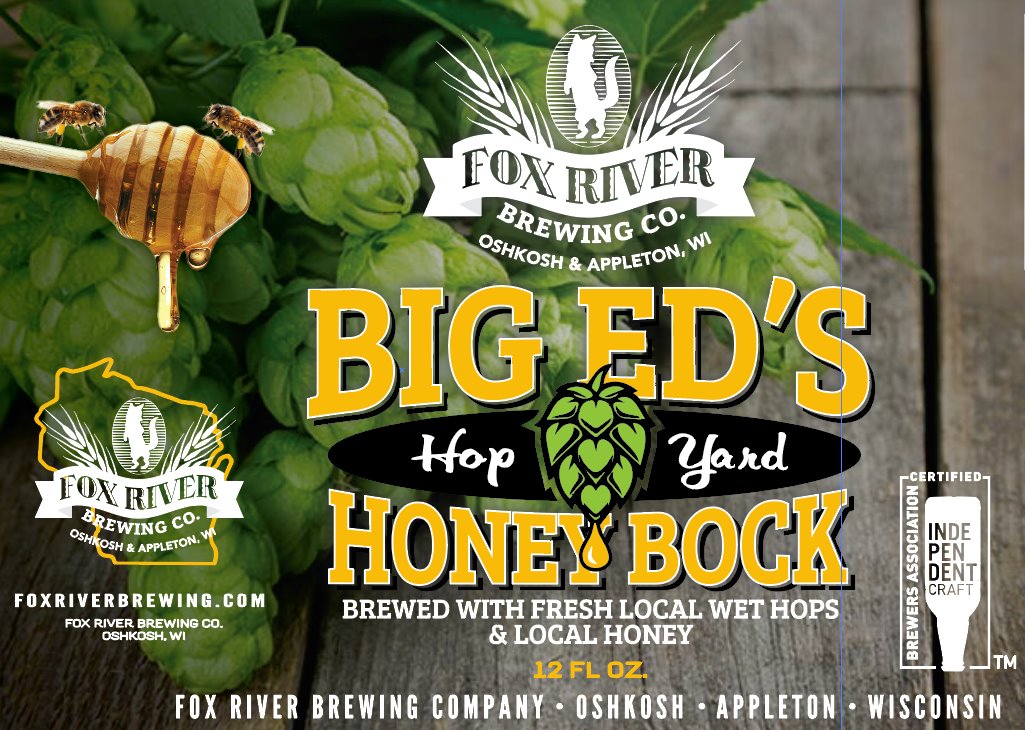
Big Ed's Hop Yard Honey Bock

Last Thursday, Fox River Brewing released its 2021 version of Big Ed's Hopyard Ale. Big Ed’s is a wet hop beer using fresh hops that go directly from the hop bine to the brew kettle without being dried or processed. The hops used in Big Ed’s come from Steve Sobojinski’s hop yard in the Town of Nekimi.

Picking hops for the 2021 Big Ed's.

This year marks the sixth year that Fox River has produced Big Ed’s. When the beer was introduced in 2016, it became the first commercial beer made in Oshkosh in more than 130 years to use locally sourced hops. This year, Fox River was able to gather 41 pounds of hops from Sobojinski’s yard.

Big Ed’s changes from year to year. As Sobojinski’s hop yard has matured, the flavor coming out of the field has grown deeper, more complex. Over the last couple of years, those hops have settled into a nice groove. The flavor is bright and slightly lemony with a piney undertow.

The base beer has also changed. Big Ed’s began life as a pale ale. But since 2019, when Drew Roth took over as head brewer at Fox River, the beer has gone through different iterations. Last year, Big Ed’s was a Cascadian Dark Ale. This year, it’s an American Bock made with an addition of honey from Talbot's Apiary in Ripon.

The 2021 version of Big Ed's.

“We seem to get a consistent character from the wet hops,” says Roth. “We have been trying things out (with the base beer) to find what we like. By changing it up we keep it interesting.”

Roth may have finally found the sweet spot with this year’s version of Big Ed’s. “It is by far the best batch of Big Ed’s we have done,” he says. “It’s a damn tasty lager.”

Big Ed’s in on tap now at Fox River in Oshkosh and Appleton. It will also soon be available in bottles.


Wednesday, September 29, 2021

Adam Carlson, Ruby Owl, and a Decade of Craft Beer in Oshkosh

For a decade now, Adam Carlson has been putting his stamp on the Oshkosh beer scene. You've known his influence if you've ever purchased beer at Gardina's Kitchen & Bar or The Ruby Owl Tap Room; each located on North Main Street in Oshkosh. In addition to being part owner and manager of Ruby Owl, Carlson curates the beer line-up for both venues. The taplists at these places tend to stand apart from what you'll find in other taprooms in town. That's because Carlson is not your typical, Oshkosh beer purveyor.

Adam Carlson

Carlson came to beer from the wine world. His drinks career began in 2010 as bar manager for what was then called Gardina's Wine Bar & Cafe. There, his nascent interest in craft beer got the better of him. It led to Gardina's installing a draft-beer system that Carlson filled with an ever-rotating cast of hard-to-obtain specialty ales. “The focus from day one was to be all craft all the time,” Carlson says. The success of the endeavor led to the opening of the beer-centric Ruby Owl in 2016.

Since then, Ruby Owl has become the benchmark bar for craft beer in Oshkosh. When Ruby Owl was launched five years ago, craft beer here was still something of a niche product. It went mainstream in the interim. And with that has come a new type of consumer.

"The snobby seriousness attached to the early days of craft beer has fallen," Carlson says. "We see a lot of people now that just want to enjoy a beverage and if that beverage happens to be beer, well that's great. But they're not involved in the minutia or the provenance. They just want something that's going to taste really good, something that might even transcend beer."

Which has led to Carlson pouring beers of a sort that would have been unimaginable a decade ago. "There's now a lot of overlap with things like hard seltzer and cocktails," he says. "The distributors will come to us with beers that are so packed full of fruit purees, and milk sugars, and those sorts of adjuncts that they barely qualify as beer. That's not to denigrate those things, but if you're a beer purist, that's not going to appeal to you."

The point, he says, is to draw from a larger pool of consumers. "The breweries are marketing these beers to compete in other categories. In a way, that's brilliant. We see where it's engaging a segment of the market that in years past would not have been at all interested in traditional beer."

"I can see a similar arc with wine, where it was a trend started by vinophiles and it picked up steam and hit the mainstream and you had an explosion of mass-marketed wine. It's not traditionally acceptable to do to wine what is being done to beer, but similarly to beer, these are wines made to attract that mainstream consumer who just wants something fruity and fun to drink."

Carlson isn't judgmental about the direction the market has taken. "To point these things out is not an indictment of anything," he says. "It's not that a brewery is wrong for making something like a marshmallow pina colada sour. It's just the cycle of things." The current cycle may not end anytime soon, but Carlson is noticing that some consumers appear to have grown weary of it.

"We're seeing more people coming in looking for lagers and for some bitterness in their IPAs," he says. “We’re also seeing more people who want less alcohol. Eventually you come to the realization that it's as much about the people you're with as the beer, and that you'd rather have two or three 4.5 percent beers instead of one super-high alcohol beer. There's a growing demand for well-made beer that doesn't have anything to hide. It's reverting back to something that's clean and crisp and refreshing."

That's a segment that Carlson likes to encourage. "A lot of what I put on tap is driven by what I want to drink," he says. "There are a number of breweries I'm loyal to that make consistently good beer. Breweries like Lakefront, New Glarus, Lazy Monk. I find myself coming back to their beers. They may not be flashy, but everything is always well made and their prices are fair. Those aren't the breweries that are going to set us apart, but I always like to have them in the mix."

All of which hasn't made Carlson's job any easier. Curating a tap list that can satisfy such diverse expectations has grown increasingly challenging. "When I started, the options were so limited," he says. "But now there are so many vendors, distributors, and salespeople out there vying for your draft lines, and vying for your time, that it's become dizzying. Everything is moving at such a hyper-speed that it's kind of crazy. It's never been like this before."

A slightly different version of this story appears in today's Oshkosh Herald.