Wednesday, June 30, 2010

The Night They Tried to Drink Oshkosh Dry

On this day in 1919 the people of Oshkosh set out to drink the city dry. And dry it was, when midnight arrived. June 30, 1919 was the true beginning of Prohibition in the United States. At midnight the Wartime Prohibition Act went into effect outlawing any and all intoxicating beverages. It would be another 14 years before you could enjoy a legal beer in Oshkosh. The drinkers of this city weren’t going to let this night pass without one last plunge.

In the days leading up to June 30th confusion reigned. The Wartime Prohibition Act was hastily drawn up. The perimeters of the new law were poorly defined. Many believed President Wilson would negate the Act altogether and that the scope of the law didn't include beer or light wine. Others seemed to realize exactly what was coming down. The Oshkosh Wine and Liquor Company took out a series of ads in the Northwestern notifying its customers that they were selling off their stock. “This is your last chance,” was their sober warning. Oshkosh’s three large breweries, Oshkosh Brewing, Peoples and Rahr’s, abruptly halted brewing operations and discontinued advertising their products. And the Elk’s Club announced they’d march a funeral procession down Main Street for John Barleycorn where the “Final disposition of all worldly effects of the deceased will be made.”
From June 26, 1919
 The early action of June 30th centered around the breweries, where they scurried to unload the last of their beer. The Northwestern reported that all three breweries sold-out their entire stock of bottled beer and “one brewery engaged extra autos, wagons... even sending out goods with bicycle riders.” As the work day ended things began to heat up. By early evening the Oshkosh's 107 saloons were crowded with rowdy drinkers out for a last, legal binge. “It was more or less of a wild night about town,” according to the Northwestern. “Jags were numerous and many people got a ‘bun’ on who have not been intoxicated in a long time.” The paper also noted that there was “considerable singing of barroom choruses” and at one unnamed saloon drinkers smashed their glasses after every round. Meanwhile the promised Elk’s Lodge Funeral March never materialized. Lodge members couldn’t be coaxed away from their clubhouse bar. The onlookers who had gathered along Main Street hoping to see something “unique” went home disappointed.

June 28, 1919
At midnight the saloons closed and the crowds took to the streets. The Northwestern reported that “beer parties were numerous,” with “groups of people who had not yet had enough carting away bottles and other containers and holding further revels in the open.” All that aside, there wasn’t much trouble. Only four arrests were made for intoxication and all four were released in the morning without having to face a judge.

The next day many of Oshkosh’s saloons opened once again... to sell soft drinks. At least, that was their story. Though July 1st would make it illegal, beer and liquor were never hard to come by in Oshkosh. The trade went underground. As the Northwestern put it in an editorial the day before the lid went down, many “will probably find ways and means to keep in the swim.” They were never more right.

Monday, June 28, 2010

A 1956 Tour of the Oshkosh Brewing Company

Unless you were lucky enough to traipse through the Oshkosh Brewing Company when it was up and running, almost 40 years ago, the three minute movie below is as close as any of us are going to get to actually seeing the place in operation. This short clip is taken from the 1957 movie Oshkosh Story, a four-hour documentary that was underwritten by a coalition of Oshkosh businesses calling themselves the Associated Industries of Oshkosh. Filmed in the fall and winter of 1956 by an Iowa company that made civic and industrial films, the movie was shown on WBAY in half-hour segments at 2 in the afternoon on consecutive Sundays beginning Easter Sunday in 1957. That first segment included this tour of the Oshkosh Brewing Company.


“The pleasant, relaxed moments of the citizens of our town.” I just love that! If that floats your boat, there’s more. A condensed (two hour) version of the original movie is available on VHS tape at the Oshkosh Public Library under the title This Is Our Town. It was produced by the Oshkosh Public Museum as part of Oshkosh’s 150th Anniversary celebration in 2003. It’s an incredible glimpse into 1950s Oshkosh and if you have a functioning VHS player you really ought to check it out. The Oshkosh Public Museum holds the footage to the film, let’s hope that one day the rest of the movie finds its way to the digital age.

Friday, June 25, 2010

Central Waters Illumination Double IPA Arrives in Oshkosh

It didn't look this blurry at the time.
Hop lovers and oral masochists of all stripes will want to add this beer to their shopping list. Central Waters Illumination Double IPA recently landed at Festival Foods in Oshkosh and if you’re out to terrorize your tonsils, dousing them with 12 ounces of this is guaranteed to leave them quivering.

You’ll know what you’re in for as soon as you put your nose to it. The beer gives off a meaty breeze of pine and candied grapefruit (is that Citra in there?) that won’t be leaving your nostrils anytime soon. The first gulp is almost overwhelming. The bitterness is so intense that it goes beyond mere taste and becomes a physical experience. It needles into your pharynx and travels up into your ears like a slow moving electrical shock. Is this pleasurable? In an odd way, yes. As I drank it I tried to sort out what I was tasting and soon gave up. What’s the point? It’s like going on a roller coaster ride and trying to appreciate the scenery. To hell with subtlety, this is a thrill-show beer that clocks in at 9% ABV and 108 IBUs. But that’s not to say this is some kind of gimmick. The beer is obviously well made and the fact that a brew this intensely bitter is still incredibly drinkable is testament to its quality. Often beers that are this aggressive become more of a chore than a pleasure about three quarters of the way through, but this one never grows overly thick or sappy. It does, though, cast a long, bitter shadow over anything that follows in its wake. After the Illumination I opened a New Belgium 1554, thinking I’d counter it with something malty. No luck, there. The Illumination just wouldn’t quit. That was the worst damned 1554 I’d ever swallowed.

Festival Foods in Oshkosh is selling 4-packs of Central Waters Illumination Double IPA for $10.49. They’ve got a stack of it in the back cooler. Go to it hop fiends!

Thursday, June 24, 2010

A Trio of IPAs

You can have your Shandys, your Wheats and your Fruit Beers. When I think summer I think IPAs. In particular, American IPAs. There’s something about the stinging, herbal flavor of American hops that goes perfect with a hot summer day. And if you’ve been trolling the locals lately you may have noticed that we’ve got a decent crop of hoppy beers pouring around town. Hop lovers, here are three IPAs currently on tap in Oshkosh that you shouldn’t miss.

Dogfish Head 90 Minute IPA at Oblio’s

Here’s a big, sticky glassful of hops for you. I like that this beer tends to vary somewhat from batch to batch and if you’re familiar with DFH90, you’ll notice that the keg they’ve got on at Oblio’s is a breed apart from the bottled version. Local homebrewer and beer aficionado Mark Stanek was drinking this at Oblio’s on Tuesday night and here’s what he has to say about it: “I thought the DFH 90 on tap was better than the bottled versions I have had.  The hops were fresher and the beer was tastier and had less of a syrupy feel to it.” I agree completely. Oblio’s has had this on for about a week now, so you might want to get to this one sooner than later.

Founders Centennial IPA at Becket's
Here’s an IPA that doesn’t bother much with trying to balance its pungent, citrusy, hop character with too much malt. Good on them. After all, if you’re drinking an IPA are you really there for the malt? This is an incredibly well-made beer that is generously hopped, yet never grows harsh. The beer comes across with layer upon layer of hop flavor without the mucky accumulation of bitterness that often accompanies beers that are hopped to this degree. You might want to pace yourself with this one, though. It drinks with an easiness that doesn’t hint at the 7.2% ABV it’s delivering.

Central Waters Glacial Trail IPA at Barley & Hops
I was glad to see Barley & Hops put this one on as I’ve been dying to try it on tap. I wanted to see how the keg version would match up to the bottle. If you’ve ever poured a bottle of Glacial Trail into a glass you know it’s one of the most rustic looking beers available. Unfiltered, the bottled version is hazy and full of dancing, little “floaties” that circulate through the brew as if it were still in ferment. The keg they’ve got on at Barley & Hops isn’t quite as dynamic as that, but it’s still like nothing else you’ll find from a commercial brewer. One thing that really comes across from the keg (aside from a load of hop flavor and aroma) is the deep, biscuit malt flavor that forms the foundation of this beer. It lends the beer a creaminess that works as an ideal counterpoint to the citrus and pine aspects of the beer’s hop profile. Another excellent beer from one of the best Wisconsin breweries.

Tuesday, June 22, 2010

Get Ready for Brews n' Blues 2010

Summer must be here because Brews n' Blues is just around the corner. On July 17th the 15th annual microbrew and music festival organized by the Oshkosh Jaycees will take place at the Leach Amphitheater in Oshkosh from 3-7 p.m. This year’s event is looking good. More than 30 breweries will be on hand pouring  samples of over 100 brews. Meanwhile, the blues side of things will be taken care of with live music from Greg Waters and The Broad Street Boogie and Donnie Pick and The Unit .

This year, the Jaycees are adding a new wrinkle. They’re including a “Brew School” hosted by the Society Of Oshkosh Brewers. The SOBs will be on-hand to brew a few beers and talk about the process to anyone yearning to learn how the good stuff gets made. If you’re interested in making beer, this would be a fun way to take the short course on brewing your own.

This is a nicely priced festival with tickets just $30 in advance and $40 at the door. And you can feel good about buying them, too, with proceeds going to help the Christine Ann Center for Domestic Abuse and other Oshkosh area charities. Be one of the first 700 people through the gate you’ll get a 2010 Brews n' Blues collectible sampling glass.

These things have a tendency to sneak up, so don’t put off getting those tickets. In Oshkosh, advance tickets are available at Barley & Hops, Dublin's, Festival Foods and O’Marro’s. July 17th is going to be a great day at the Leach!

For more info check out the Oshkosh Jaycees website.

Monday, June 21, 2010

Introducing The Peoples Brewing Company of Oshkosh

On June 21, 1913 The Peoples Brewing Company of Oshkosh announced they were open for business. The company introduced itself with a half-page advertisement in the Daily Northwestern that showed off their new brewery, told of the beers they were producing and asked the people of Oshkosh to give them a shot, “A Trial Is All We Ask.”

Daily Northwestern June 21, 1913
It was a quick start to a large-scale brewing business that had been little more than an idea bouncing around a table at the Revere Hotel two years earlier. In November of 1911, William C. Kargus, a former employee of the Oshkosh Brewing Company, filed articles of incorporation for what would become Oshkosh’s first and only cooperatively owned brewery. By the end of 1911, the group led by Kargus and Joseph J. Nigl had gathered approximately 200 shareholders and were looking for a brewhouse. They tried to purchase Charles Rahr’s Oshkosh brewery in January of 1912, but the deal fell through so they decided to build their own. A week later Peoples Brewing bought a block of land between Fifteenth and Sixteenth Streets on the east side of South Main. Construction of the new brewery began in April of 1912 (a couple blocks away The Oshkosh Brewing Company was just then wrapping up construction of its new brewery). A carpenter’s strike temporarily delayed construction, but a year and a month later the plant was fully operational and spilling out beer.

The first two beers Peoples Brewing produced were Asterweiss, a pasteurized, light-bodied, low-alcohol, beer sold in clear bottles; and their “Standard” beer, which would eventually come to be known as Aristos. Aristos sounds like the interesting one. It was their full-bodied, draught beer served from brown, pint bottles or wood barrels. Wood Barrels! I’m not much for nostalgia, but wouldn’t it be great to have an Oshkosh beer served from a wood barrel again?

Friday, June 18, 2010

Hoppin' Around Oshkosh

We’ve reached the mid-season mark for hop growing in Oshkosh. So far, it’s been a great year with most plants well ahead of where they were last year at this time. If you have an established vine it’s probably nearing it’s full height and beginning to display those bright yellow buds that eventually develop into the bitter fruit that makes beer drinkers happy. So let’s take a look at some of the interesting hop plants growing this summer in Oshkosh.
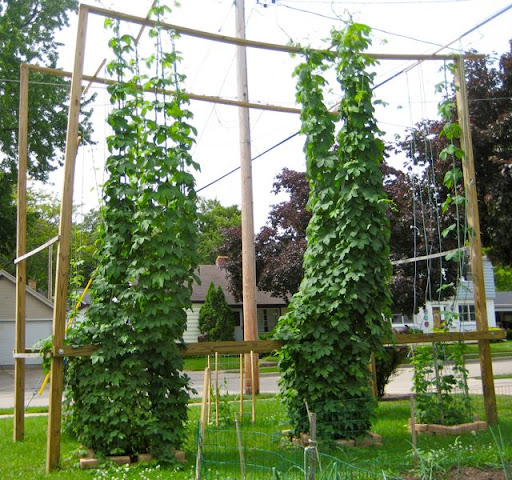
We’ll start off with what is probably the most impressive hop growing set-up in town. This is Nick’s Hop Operation near the corner of Jackson and Murdock. We featured Nick’s hop garden a little over a month ago and his rate of growth since then has been startling. Here’s the earlier post. Compare those pictures to this one and you’ll see what I mean. Nick is growing Zeus, Brewers Gold, Willamette, Cascade and Hallertau.

Nick's Hop Operation
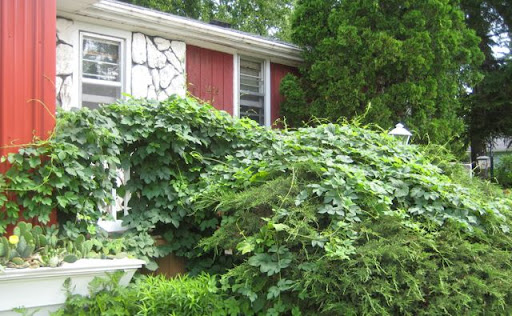
Across town on Adams, Scott has a unique method for growing his hops. His Cascade plant grows horizontally, using an evergreen bush instead of a vertical trellis for support. It’s a huge, sprawling plant loaded with buds. This method may not be practical for most hop growers, but it obviously works.

Scott's Hops

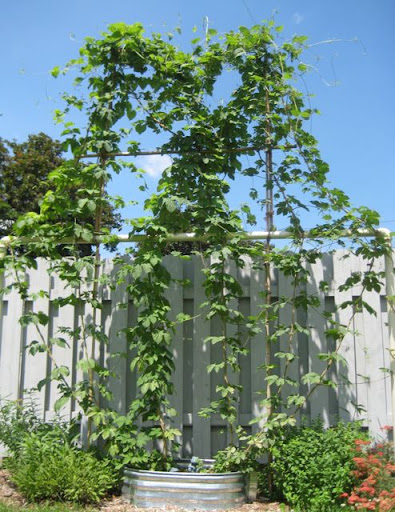
These are mine on Evans Street. I’ve got Cascade and Nugget growing together. They shot over the trellis weeks ago and have grown into a knot, but they seems to like the set-up. I’m anticipating a banner harvest.

My Hops

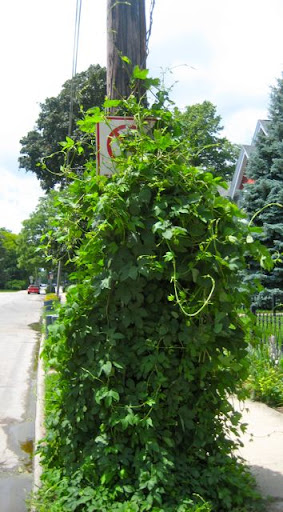
Finally, this may not be the biggest plant in town, but it’s my favorite. Here’s a bit of guerilla gardening that’s resulted in a dense, healthy bush of hops (Cascade?). These grow on a terrace along New York Ave. For the next few weeks I’m going to find one excuse after another to peddle by and have a look.

Guerrilla Hops

Thursday, June 17, 2010

Screwballs to Become the Chief Oshkosh Saloon

Screwballs Sports Pub will soon be no more. According to Oshkosh Mayor Paul Esslinger, the owner of the tavern at 216 North Main Street, Screwballs will close for remodeling on July 5th to reemerge about a week later as the Chief Oshkosh Saloon. The tavern will feature a historic Oshkosh theme with items from Esslinger’s collection of Oshkosh memorabilia prominent in the redesign. A focal point of the tavern will be a display of Esslinger’s collection of brewery related pieces from Oshkosh’s brewing past and at each end of the bar will be a life-sized, fiberglass lion from the Pride of Oshkosh project of 2004. 

Esslinger, who took over Screwballs from Joe Jungwirth last June, says he’s been toying with the idea of transforming the tavern for while and decided that with Main Street construction “putting a damper on things” now was a good time to move ahead. “I’m thinking of it as a complete overhaul,” he says. The new sign for the tavern will show the Chief Oshkosh Saloon logo and Esslinger says, “I’m hoping to have the first protruding sign back on Main Street.”

In keeping with the historic theme, Esslinger will introduce the Chief Mug Club awarding persistent patrons with a t-shirt showing the recipient among a gathering of Oshkosh historical figures, including Chief Oshkosh. And to help kick things off, the tavern will have a Waterfest special on Thursday,  July 14th.  For $10 you’ll get a ticket to Waterfest, a pint of beer and a brat or sausage of your choice catered by Kodiak Jack’s.

Esslinger says that if all goes to plan the Chief Oshkosh Saloon will be open for business July 12th.

Tuesday, June 15, 2010

The Magnet: Wisconsin's First Beer Bar

On this day in 1940 the Magnet, at 519 N. Main St. in Oshkosh, became the first tavern in the State of Wisconsin to be issued a beer-only license. Teenagers in Oshkosh finally had a place to drink beer. Legally.

The Magnet was at the vanguard of what would become a memorable Wisconsin phenomenon, the teen-age beer bar. These were spots where people 18-20 years old could enjoy their brew of choice in an atmosphere unspoiled by hard liquor. After Prohibition, Wisconsin reserved a “local option,” allowing municipal governments to set the age for legal beer drinking. The local option hadn’t been exercised, though, until Frank M. Hayes took out a class “B” liquor license and convinced Oshkosh officials he could run a clean-cut beer and billiard hall. By July of 1940 Wisconsin’s first beer bar was in business.

From July 6, 1940
But it didn’t start out as The Magnet and it didn’t start out on Main Street. The Magnet began as the Playdium on Washington Blvd. Its proprietor, Frank M. Hayes, was born in 1888 and lived on E. Irving. He’d been a semi-pro baseball player in Omaha and a postal clerk in Oshkosh. As a publican, Hayes proved to be a no-nonsense sort of guy. He didn’t tolerate rude behavior in his beer bar. Fighting, swearing and loud noises were not welcome at the Playdium.

The Road Construction View
In 1950 Hayes moved his bar to Main Street, but kept his beer-only status. He was walking a thin wire. Others had followed in Hayes’ wake and by the mid-50s the teen-bars had come under intense criticism. Now there were “wet” islands dotting the State. Cities like Oshkosh became destination points for traveling 18-20 year-olds who would come to get their fill of beer before taking to the highways and returning to their dry hometowns.

When Hayes died in 1959, Winnebago County was attempting to enact a law that would fix the beer age at 21 County-wide. They failed and the Magnet passed to Frank M. Hayes, Jr. In 1963, though, things changed. The Oshkosh Common Council decided it was time to abandon the local option and beer in Oshkosh once again became the privilege of those over 21. At the time there were five beer bars in Oshkosh. Though, the Magnet remained a beer-only bar for several more years, the tavern would eventually take a full liquor license.

The Magnet continues to carry on much as it always has. It’s still primarily a beer and pool hall and they’re still serving their famous Magnet chili dogs. After all these years of see-sawing liquor laws, the Magnet remains a good-time Oshkosh fixture. A place where you can have a beer, shoot some pool and touch history where it lives.

Monday, June 14, 2010

A Brief History of Beer by Clarence “Inky” Jungwirth

Oshkosh author and historian Clarence “Inky” Jungwirth suggested that we ought to include a history of brewing on this site. Not only that, he was good enough to go ahead and write it. Here’s Inky’s history of beer.

Sumerian Beer Recipe, 3200 BC
The Cities of Oshkosh and Milwaukee have been known since their founding for their large production and consumption of Beer, especially in the early years. One only has to look at their City Directories, especially those printed in the 19th Century and early 20th Century, to see the number of Taverns listed under the heading of either Sample Rooms or Bars or Taverns. The following is a History of Beer throughout the ages and is taken from various sources published many years ago.

Beer is an alcoholic beverage produced by extracting raw materials with water, boiling (usually with hops) and fermenting. In some countries beer is defined by law as in Germany where the standard ingredients are water, germinated barley, hops and yeast.

Egyptian Beer Brewing
Before  6000 B.C.,  beer was made from barley in Sumeria and Babylonia. Reliefs on Egyptian tombs dating from 2400 B.C. show that barley or partly germinated barley was crushed, mixed with water, and dried into cakes. When broken up and mixed with water, the cakes gave an extract that was fermented by microorganisms accumulated on the surfaces of fermenting vessels.

The basic techniques of brewing came to Europe from the Middle East. The Roman Historians Pliny (in the first century B.C.) and Tacitus (in the First Century A.D.) reported that Saxons, Celts, Nordic and Germanic tribes drank ale. In fact, many of the English terms used in brewing (malt, mash, wort, ale) are Anglo-Saxon in origin.

A Medieval Tavern
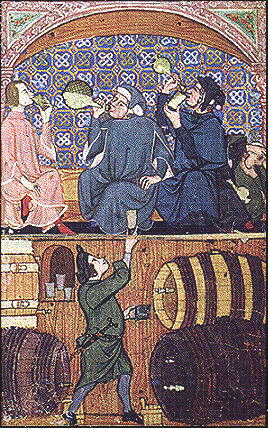
During the Middle Ages, the monastic orders preserved brewing as a craft. Hops were in use in Germany in the 11th Century, and in the 15th Century they were introduced into Britain from Holland. In 1420 beer was made in Germany by a bottom fermentation process (prior to this, top fermenting yeasts were the norm). Brewing was a winter occupation, and ice was used to keep beer cool during  summer months. Such beer came to be called lager (from the German word  "lagern" (to store). The term lager is still used to denote beer produced from bottom-fermenting yeast, and the term ale is used for top-fermented British types of Beer.

There have been beer lovers who get hangovers from too much beer drinking since ancient times. For 20th Century and 21st Century beer lovers the 19th Century Industrial Revolution perfected beer making as we have it today. It was also 19th century scientists such as Pasteur who helped in perfecting the process of preserving beer. The improvement of refrigeration processes in the late 19th and early 20th Century made the wide distribution of beer products available to the growing beer drinking public.

As we sit at the bar drinking a beer let us salute our ancient ancestors for inventing the nectar of the gods.