Monday, August 30, 2010

Small Beer No.1: Wet Hops & SoBe

In the course of researching some of the stories that wind up here on the blog, I often come across tidbits related to beer and brewing in Oshkosh that don’t warrant a whole lot of examination, but are interesting, all the same. It’s the sort of stuff that’s good for cluttering your head and not much else. It’s a nice sort of clutter, though, and I’d like to start passing some of this useless information along. So here’s the first installment of Small Beer. Feel free to drop these nuggets the next time there’s a lull in the conversation. Those within earshot will immediately develop a new appreciation for silence.

The First Wet-Hopped Beer Comes to Oshkosh

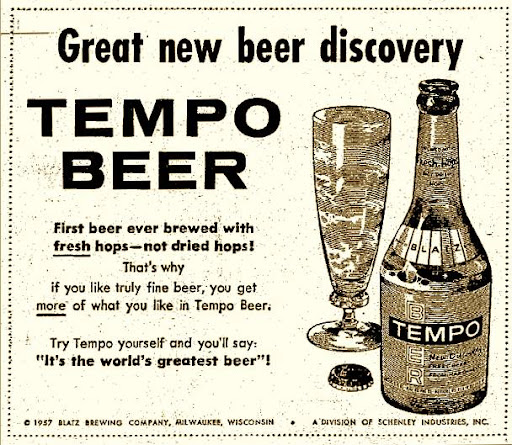
The hop harvesting season is nearly upon us in Oshkosh and there'll soon be a few local homebrewers making beer with hops they've plucked fresh from the vine. Well, that ain't nothin' new. This is an advertisement that ran in the Oshkosh Northwestern on July 10, 1957 and it claims that Tempo was the first beer to be brewed with fresh hops, as opposed to the dried hops brewers typically use. That's wrong. The first people to stumble upon the realization that hops added something good to their brews certainly hadn't gone to the trouble of drying them out. That came later. Truth be damned, it remains impressive that Blatz was marketing a wet-hopped beer here in Oshkosh more than 50 years ago. But you've got to wonder just how "fresh" those hops could have been. They were selling this beer in July, hardly the time of year for fresh hops in Wisconsin. The problem is, fresh hops don't hold up very well. You need to go from the hop plant to the kettle in just a few hours. If you miss that window of opportunity your beer ends up tasting as if you brewed it with lawn clippings. Still, you've got to admire the Blatz chutzpah. How many brewers these days would dare to run an advertisement for their beer claiming "It's the world's greatest beer"! By the way, there's an excellent beer bar in Milwaukee named the Bomb Shelter that supposedly has an old bottle of this floating around in their collection. Unfortunately, I've heard it's empty. But of course, it’s empty. You wouldn't expect the world's greatest beer to have gone unopened, would you?

SoBe and the Oshkosh Brewing Connection

Thomas Hardy Schwalm
At first glance, it wouldn’t appear that the iridescent fluid sold under the brand name SoBe would have much to do with beer or brewing in the city of Oshkosh. Look a little deeper though and you’ll find that SoBe is actually the wayward issue of the forefathers of beer in Oshkosh. SoBe was co-founded in 1996 by Thomas Hardy Schwalm, an Oshkosh native with a pedigree that maps to the heart of a bygone time in our city. Schwalm’s grandfathers were Oscar J. Hardy, publisher of the Oshkosh Northwestern from 1917 to 1950 and Arthur L. Schwalm, president of the Oshkosh Brewing Company from 1941-1961. His father, A. Thomas Schwalm, was brewmaster for the Oshkosh Brewing Company until he abandoned beer in 1950 to join his in-law’s newspaper business. But Thomas Schwalm wanted to be a beer man. He followed in the footsteps of the Schwalm men before him and over the course of his career worked for Schlitz, Stroh's and Barton Beers. Then came the SoBe gold mine. In 2000, Schwalm sold SoBe to Pepsi for a whopping $370 million dollars. Schwalm passed away in 2009 at his home in Greenwich, Conn. He was 64. He may have died a happy man, but he should have stuck with beer.

Thursday, August 26, 2010

Oshkosh Beer of the Week: New Glarus Abt

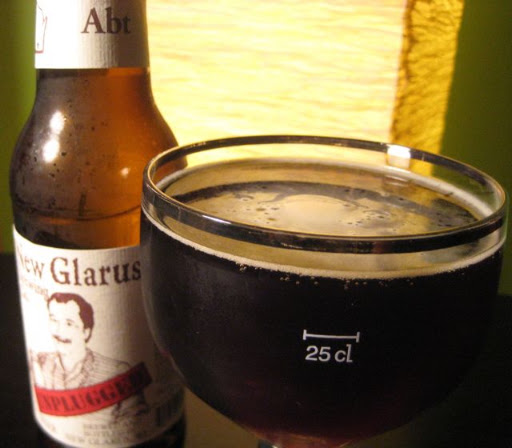
There’s a strong, rich beer named Abt that just arrived in Oshkosh and it has come to hurt you. But this New Glarus Unplugged beer is so smooth and inviting you won’t mind the pain it leaves in its wake. Style-wise, Abt runs along the lines of a Belgian Dark Strong Ale and with that you know you’re in for a heavy beer. The amazing thing about this one is how lightly it carries its weight. The beer’s 9.6% ABV isn’t hidden, but it’s presented in such a mellow, rummy way that the heat of its alcohol is entirely welcome. There’s a lot going on in this beer. It pours deep, deep red with a thick aroma of over-ripe dark fruit. That aromatic heft is contradicted, though, by the beers surprisingly light, almost fluffy, mouthfeel. As the Belgians would say, this one is highly digestible. The mouthfeel is just about the only thing light about it. There’s a kaleidoscopic depth of flavor here that ranges from chocolate to sweet raisin to cola to brandied cherries. It all conspires to gently draw you in. Then it slaughters your resolve and warps time. It made my Wednesday morning come way too early.

You’ll find Abt at Festival Foods in Oshkosh residing in the high-end beer ghetto where it’s being held without refrigeration. That’s no way to treat a good beer! On the other hand, you don’t want to drink Abt straight from your refrigerator, either. Let it rest and warm for a good half-hour before you pop it open. I made the mistake of starting the first bottle a little too cold and that made the beer seem sharp and harsh. This is a beer that grows lush as it warms.

Homebrewers: If you like to play around with yeast, notice the spicy yeast character of Abt. Last Spring I brewed a Belgian Dubbel using White Labs WLP530 and that yeast seems very similar to the strain New Glarus is using for Abt. WLP530 is supposedly the Westmalle yeast and I was lucky to have a Westmalle Dubble around the house while I was drinking Abt so I opened that up, too, and found that the yeast profiles do have a lot in common. If you prefer Wyeast, their 3787 is supposed to be the same strain. Either way, this would be a fun beer to try to clone.

Bonus Beer: Just got word from Peabody’s that they have Gandy Dancer Porter, a new beer from Potosi, now on tap. I’ve yet to try this one, but the folks at Potosi say their porter is “a bit bigger, hoppier, and or roastier than their European predecessors.” If you like a good porter you might want to plan a stop at Peabody’s this weekend.

Wednesday, August 25, 2010

The Return of the Regionals

From March 23, 1956
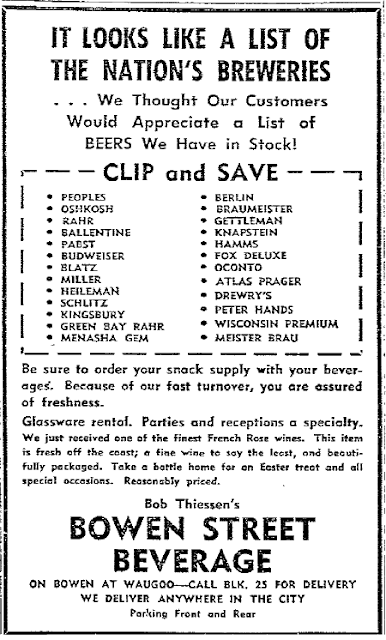
Fifty years ago, if you bought a beer in Oshkosh that beer was probably made in Wisconsin. Much of the beer sold here came from regional Wisconsin breweries located in cities like Potosi, Oconto, La Crosse, and Oshkosh. This local approach to beer was largely taken for granted. A 1956 advertisement for Bowen Street Beverage that ran in the Oshkosh Daily Northwestern is typical of the period. The ad shows an inventory of the 25 beers that the liquor store stocked and boasts “It looks like a list of the nation’s breweries.” It must have seemed like a much smaller nation in 1956. Of the 25 beers listed 18 were made in Wisconsin. Three of them were made here in Oshkosh.

It took a handful of large brewing corporations about 30 years to obliterate that approach to local beer, but the stranglehold they once had on the Oshkosh market is rapidly becoming a thing of the past. The next time you walk through the liquor department at Festival Foods in Oshkosh notice how much of the shelf space has been given over to Wisconsin-based, regional breweries. Festival stocks beer from about 20 small, Wisconsin breweries and though their beer may be quite different from those that were on hand at Bowen Street Beverage these newer breweries are working the same turf as their mid-century predecessors.

Two recent additions to the Festival shelves are representative of what’s going on here. The Pearl Street Brewery of La Crosse now has four different beers at Festival and the Potosi Brewing Company has brought in three. Each of these breweries sell their beer predominately in Wisconsin and the cities they hail from have long histories of bringing their beer to Oshkosh. And though their ales may not be similar in taste to the lagers that were once brewed in their respective cities, they’ve maintained a traditional approach by making beer that is suited to everyday drinking as opposed to the high-octane, extreme beers that are often featured by small breweries out to make a name for themselves.

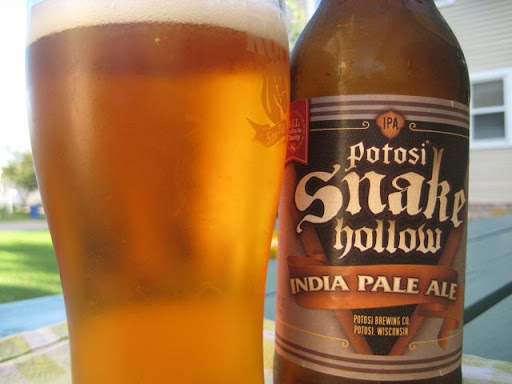
Lately, I’ve been liking the beers from Potosi quite a bit. The three beers they’re selling in Oshkosh are well-made, flavorful and easy to drink. They’re the sort of beers you reach for when you’re kicking back and having a few with friends. The Snake Hollow IPA is my favorite of the bunch. This is a prototypical Midwestern IPA. It’s a medium-bodied beer that features a fresh, citrus-hop flavor and a bitterness that’s firm without being harsh. The Potosi name and neo-retro packaging may be familiar, but what’s inside has little in common with the lagers that were once favored at Bowen Street Beverage. Now if we could only get some beer made in Oshkosh back on the shelves.

Monday, August 23, 2010

Clarence “Inky” Jungwirth’s Oshkosh Growler Story

Last week we touched on the infamous Oshkosh Growler, the greased buckets that were used for transporting beer from the taverns to home or work. Here’s more on the subject. The clip below is Clarence “Inky” Jungwirth’s telling of a legendary Oshkosh Growler story that Inky swears is true. This slice of oral history is about the children of Oshkosh in the early 1900s transporting beer to their fathers working in the factories. As Inky explains, sometimes the kids delivered the beer in a highly modified form...

Thursday, August 19, 2010

Oshkosh Beer of the Week: 1853

To commemorate the passing of August Horn, I thought it would be fitting to single out a hometown beer that harkens back to the early days of brewing in Oshkosh. It’s a nice coincidence that Fratellos in Oshkosh is currently pouring just such a beer. 1853 is a dark lager that Fox River Brewing first brewed in 2003 to help celebrate Oshkosh’s sesquicentennial. Kevin Bowen, Brewmaster at Fox River Brewing, says the beer was “styled in the tradition of Wisconsin beers for the period.” And though this is a modern beer and not an attempt to re-create the beer of that time, it’s still probably not too far off in flavor and appearance from the sort of lager August Horn would have been drinking in Oshkosh in 1853.

1853 pours deep ruby unto black and if you stick your nose into it as soon as it’s tapped you’ll catch a surprising and wonderful hop aroma that drifts up and dissipates quickly. This is an easy drinking beer with the slight sweetness of Munich malt being the dominant flavor. Overall, it’s light-bodied and fairly crisp without any of the ragged edges of roasted malt that sometimes mar beers that are this mild and yet dark. The beer finishes clean with just a touch of residual bitterness. A few pints of this would go along perfectly with a big plate of nachos.

Our Man, August Horn
But if you really want to experience this beer in a way that truly celebrates 1853, there’s only one way to do it. You’ll need to resurrect the infamous Oshkosh growler. It’ll take a little work, but I’m certain the servers at Fratellos will understand exactly what it is you’re doing and will fully cooperate with your mission. Here’s how it’s done: First you have to find a half-gallon wooden bucket. Keep in mind, this thing needs to hold beer so it’s got to be water tight. I have no idea where you’ll find such a thing. OK, now that you’ve got your wooden bucket, find a quality lard and use it to grease down the inside walls of the bucket. This may sound gross and it is, but the lard will help to keep the beer from foaming up when it’s tapped and ensure that you’ll get your full measure of pure beer. Now if you really want to make it special, take your bucket of dark, oily beer and walk about a half-mile due north of Fratellos. Get onto the Wiouwash trail and when you see Riverside Cemetery cut across the creek. That’ll put you on Oak and if you follow that to Myrtle you'll be at the site of August Horn’s grave. It’s easy to find. There’s just one thing left to do. Raise your Oshkosh growler and have a good, long drink to our Dead Homie. Peace, bitches!

Wednesday, August 18, 2010

A Toast to August Horn

August Horn
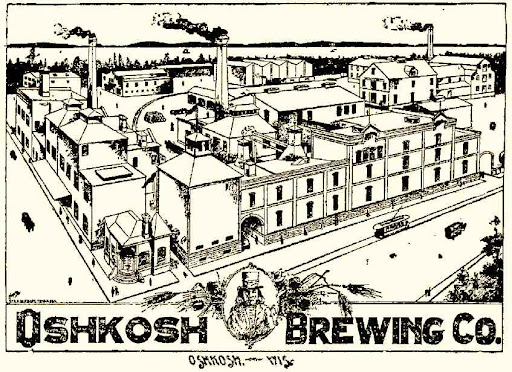
He was born in August, was named August and 106 years ago on Wednesday, August 17th he died. August Horn was the first president of the Oshkosh Brewing Company and the man who put Oshkosh beer on the map. Beginning in 1866, he took a small, thousand-barrel brewery and turned it into one of Wisconsin’s leading breweries. Not bad for a guy who started out laying brick.
Horn and Schwalm’s Brooklyn Brewery After 1879

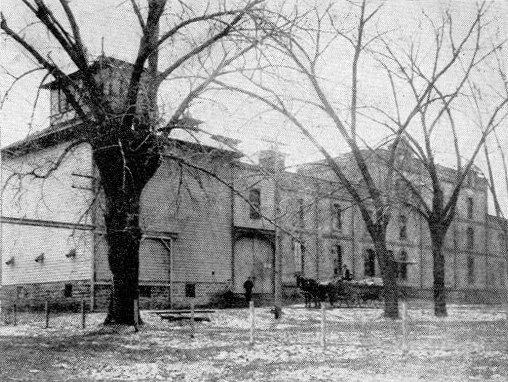
August Horn was born on August 6, 1835 in Plößberg, Bavaria. In 1852, at the age of 17, he immigrated to Winnebago County with his parents Gottlieb and Barbara and began farming in the Town of Black Wolf. As a young man, Horn was trained as a stone mason and wasn’t involved with beer, aside from consuming it, until the age of 31. So how does a farming, stone mason find his way to making beer? By marrying into the family of a German brewer. In 1856 Horn married Amalia Schwalm, a relative of a brewer who had been trained in Saxony named Leonhardt Schwalm. In 1866 August and Leonhardt built a small, wooden brewhouse on the east side of Doty Street just south of what is now West 16th Avenue. They named it Horn and Schwalm’s Brooklyn Brewery.

A 1900 Composite of Oshkosh Brewing
The early years at the Doty Street Brewery must have been lively. It was truly a family operation. Both the Horn and Schwalm families lived above the brewery with their 15 kids. According to some reports, employees of the brewery often lived there, as well. Unfortunately, the house party came to an abrupt end when the home/brewery was swept away by fire in 1879. A new and larger brick brewhouse was quickly put up at the sight of the original brewery, but this one was strictly business. The families now lived in their own homes on separate, adjacent parcels. They were moving up in the world.

August Horn's Marker
at Riverside Cemetery
in Oshkosh
In 1894 the Horn and Schwalm Brewery merged with those of Lorenz Kuenzl and John Glatz to form the Oshkosh Brewing Company. Horn was made president of the new company and by the time of his death, Oshkosh Brewing had become the leading brewery in the area, capable of producing 90,000 barrels of beer a year.

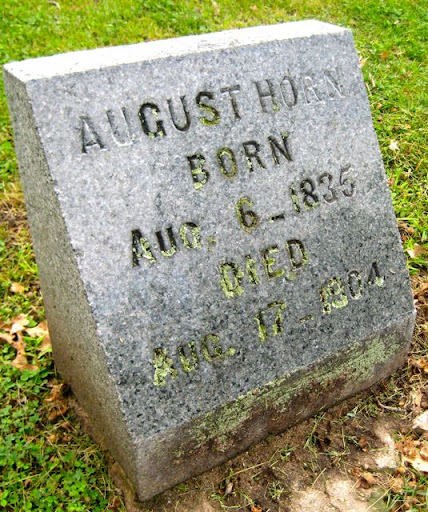
August Horn died in 1904 from congestion of the kidneys at 10pm at his home at 1662 Doty Street. He was 69 years old at the time of his death and still president of Oshkosh Brewing. By all accounts he was a genial, well-liked member of the community. His obituary in Oshkosh Daily Northwestern described him as ”one of the most prominent German residents of the city and very highly respected.” This week, let’s raise a glass to August Horn.

Tuesday, August 17, 2010

The Saturday Night Beer Festival at Dublin's

Dublin’s in Oshkosh is having their first beer tasting this Saturday night (August 21st) from 8 until 11 and it looks like it’ll be a good one. They’ll be pouring all the beer you’d like to drink from New Glarus, O'so, New Belgium, Magic Hat and probably a couple more. Along with the beer, your ticket includes a large dinner buffet and the chance to interrogate the brewers who will be on hand from O'so and New Glarus. Dinner and a beer festival for $30 is hard to beat, unless you get someone to come along with you, in which case you can get two tickets for $50. The tickets are available now at Dublin’s so you might want to stop by and pick yours up before Saturday to ensure your spot on the floor. Beer on!

Monday, August 16, 2010

Al Jacobson's Oshkosh Wine

Today we're going to take a short break from the beer to visit with Al Jacobson whose unique wines have become the stuff of legend in Oshkosh. Al is one of the founding members of the Society of Oshkosh Brewers and though he brews beer, we'll leave that topic for another day.

Al's Wine Garden
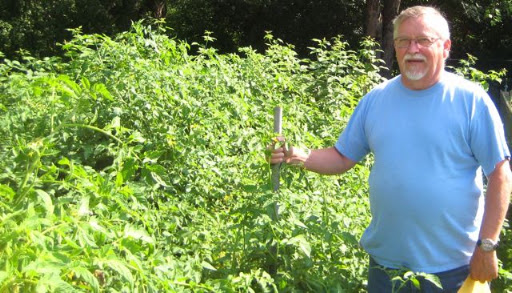
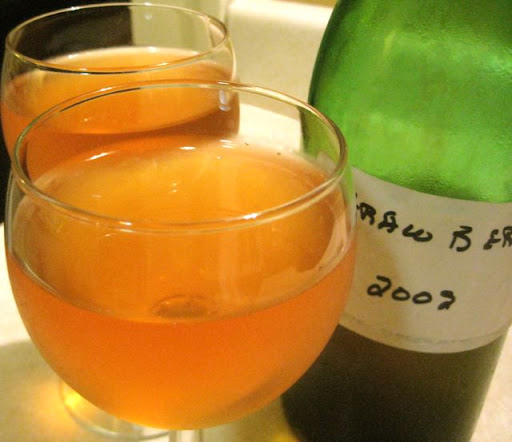
Al Jacobson is sort of different. He doesn't see things the way you or I do. When the average person encounters a zucchini they usually think food. Not Al. He wonders what might happen if he were to smash it to mush and let some yeast go to work on it. Al sees a zucchini and thinks wine. In fact, there isn’t much that hasn’t caused Al to think wine at one time or another. He’s made wine from green tomatoes, corn, beets, rhubarb, dandelions... if it grows, Al has probably tried to ferment it.

He’s been at it now for more than 40 years and he’s been inventive from the start. He made his first batch of wine in the late 1960s without so much as a recipe to guide him. “You couldn’t find any recipes back then,” Al says, “so we experimented. I was working for a grocery store and they had some leftover peaches they couldn’t sell. We smashed them up and put them in a five-gallon Red Wing jar with water and apples and a Red Star yeast of some sort.” It worked. He’d made his first wine. How’d it turn out? “It was a little cloudy, but we drank all of it.”

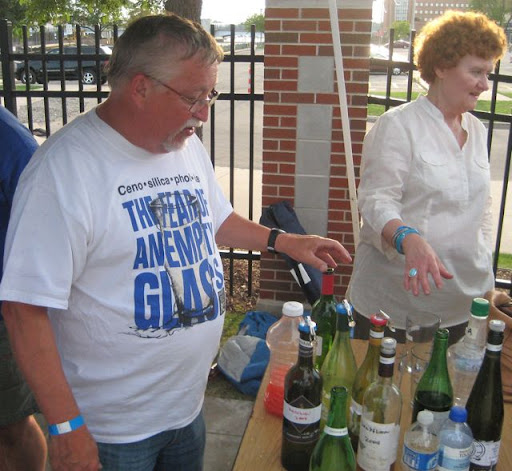
That same spirit of invention colliding with happenstance continues to inform his wine making. It’s an approach that finds inspiration everywhere. “My neighbor had an apple tree limb that fell off so I took the blossoms from it and made an apple blossom wine,” Al says. When I asked him what the apple blossoms contributed to the final wine he said “the name for one thing.” He wasn’t just being glib. Though much of his wine is made using ingredients some would consider unconventional, the flavors he achieves are anything but odd. His wines tend to be subtle and easy to drink. At first blush, his recipes may appear somewhat unusual but the point is always to make something that tastes good. The popularity of his wines at this year’s Brews ‘n Blues, indicates he’s doing something right. “I like taking it to beer festivals.” Al says. “Some people like it and some people don’t. Then there’s some people who keep coming back for more.”
Al & Kay Pouring at Brews 'n Blues 2010

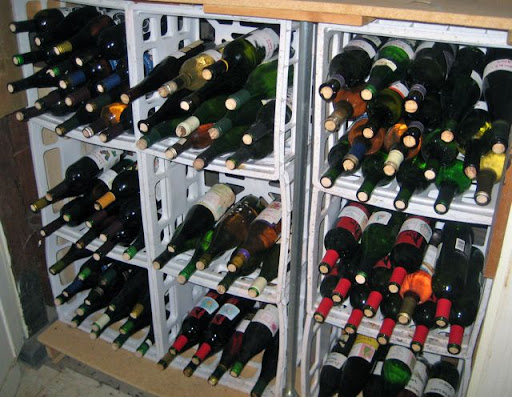
A quick tour of Al’s amazing wine cellar proves that it’s not all corn and tomatoes. “I do make a lot of grape wine,” Al says. “Mostly from wild grapes. I have a friend who grows fox grapes that I’ll make wine with, or else I’ll go out to Plummers Point and pick wild grapes.” He’s also dabbled with a more conventional approach to wine making. Back in the early 80s he even tried a wine kit. “I got a wine kit and a mushroom kit. The cats loved the mushroom kit,” Al says, but the wine kit was a bust. “That sort of wine making isn’t as satisfying. A kit is a good way to get started, but doing it from scratch is more fun.”

A Corner of Al's Cellar
Most of Al’s wines are made in batch sizes ranging from one to five gallons and they’re often provoked by circumstance. “Last year a guy brought a whole bunch of plums to an S.O.B. (Society of Oshkosh Brewers) meeting. Nobody wanted them so I made wine from it.” Little goes to waste. He and his wife Kay tend a large, practical garden at their home on the East Side of Oshkosh and Al says that “whatever is left at the end of the year becomes wine.” Sometimes he’ll use the leftover trub from a previous batch of wine to make a lower-alcohol “false wine.” Not even the weeds get away. “I like to make dandelion wine, but picking those dandelions is a lot of work,” he says.

A couple weeks ago Al and I were sitting in his back yard going through a binder of his recipes. I asked him if there’s anything he wouldn’t consider fermenting. He looked up at the sky as if the answer might drop on his head and spotted the fat, orange berries clustering in his neighbor’s Mountain Ash. “I’ll have to ask him what he’s gonna do with those,” Al said. I guess I got my answer.

Here's Al's recipe for Corn Wine.

Thursday, August 12, 2010

Oshkosh Beer of the Week: Belgian Style Blond from New Belgium

Let’s forget about those bitter beers for a moment and check out something malty for a change. Belgian Style Blond Ale from New Belgium’s Lips of Faith series recently went on tap at a couple of spots in Oshkosh. On the west side, you can catch it at Dublin’s and on the East side it’s pouring at Barley and Hops. The beer tastes great at both spots, so if you’re going to give this one a whirl you might want to opt for the location closest to home. At 8.5% this is a beer that’s going to make an impact upon you. Especially if you have more than one. And you’re probably going to want more than one. This is a delicious ale that masks it’s alcohol and urges you to keep drinking. 

Belgian Style Blond Ale pours bright yellow and slightly hazy with an odd aroma that’s part bread dough, part banana and part musty basement. Hey, it’s supposed to be Belgianesque, what did you expect? There’s nothing dank about the flavor, though. It starts with sweet, doughy malt that would be gooey if it weren’t for the intense carbonation, which makes the beer seem much lighter than it actually is. It finishes off with a little bit of pear-like sweetness before coming to a clean, dry end. You might notice a touch of fusel alcohol in the finish but you’ve got to hunt for it. Overall, I’d say it more closely resembles a Belgian Golden Strong Ale (think Duvel) than it does a Belgian Blond Ale (think Grimbergen Blond), but who cares. It’s an excellent beer and one worth going out of your way for. Luckily, you won’t have to. I had this beer at both Dublin’s and Barley and Hops last week and there wasn’t a shred of difference between the two pours. Now that’s a testament to clean lines!

Let me tell you, it’s tough picking just one beer for Beer of the Week, so here are few bonus beers that are currently blasting through the taps in Oshkosh and bound to please your beery itch.
  • At Peabody’s the Blonde Doppelbock from Capital is going strong. And I do mean strong (8% ABV).
  • At Oblio’s check out the ever-bitter and always lovely Two Hearted Ale from Bells. My liver is well aquatinted with this one.
  • Becket’s has a good thing pouring in Grand Teton’s Bitch Creek ESB. The hop flavor of this British-style beer is more American than British and it’s awesome.
  • And at O’Marro’s they’ve got Radeberger Pilsner on tap. I love authentic German Pilsners and this is one of the hoppy best. No green bottle blues, either!

Wednesday, August 11, 2010

Recipe Formulation with Joe Walts

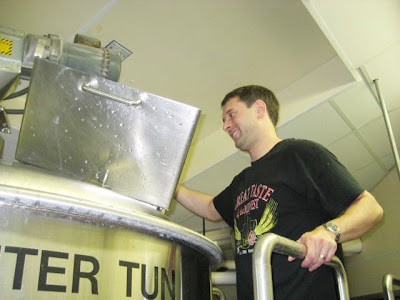
Joe Walts Brewing in Oshkosh
If you’re the homebrewing type who likes to put together your own recipes, here’s something for you. This is Joe Walts’ magnum opus on recipe formulation. A close read of what follows will definitely improve your ability to build your own beer.  Now for the bad news: Joe Walts is leaving us. After almost a year of making beer for Fox River Brewing in Oshkosh and Appleton, he’s moving on to work for Ale Asylum in Madison. We’re going to miss him in Oshkosh. Joe, you’ve been a great help to me and I appreciate all you’ve added to this blog. Thanks.

Recipe formulation is one of my favorite parts of the brewing process, and I was pretty excited when Lee asked me to write about it. I was tempted to geek out and highlight the fundamental calculations required to create beer recipes, but it would be a very long post and it wouldn't tell you anything new - provided you're willing to check out a presentation that I gave to the Madison Homebrewers and Tasters Guild last November. The file is named 'MHTG_Recipes.pdf' and you can download it at here.

When I make a beer recipe, I enter my recipe parameters into a spreadsheet. If you visit this RePublic link, you can download two different spreadsheets that will work for homebrew recipes. The one named Recipe_School.xls corresponds with the calculations in the MHTG presentation. The other, named Recipe_Gallons.xls is more detailed and acknowledges the complex interactions of ingredients (e.g. water chemistry, iso-alpha acid saturation and the affects of yeast starters on wort properties), but it's not necessary to make good beer or to learn about recipe formulation.

The first step of recipe formulation is to decide what type of beer to make. Until you have an intuitive feel for how ingredient quantities will affect the final outcome, I think the best place to start is with the BJCP guidelines. It should be mentioned that style guidelines are great at maximizing the objectivity of beer competitions, but they're not always accurate at describing commercial beers, especially those in other countries. That said, they're great for outlining the base specifications of beers within general stylistic ranges. For example, let's say that we want to brew a Witbier. According to the guidelines the beer should have an original gravity between 1.044 and 1.052, its bitterness should be between 10 and 20 IBUs, its color should be between 2 and 4 SRM, its grainbill should consist of 50% pale base malt and 50% unmalted wheat, and that Witbiers usually contain coriander and orange peel.

Here's where the fun starts. From drinking commercial Witbiers, I know they're usually pretty sweet. For a summer thirst quencher, I want something a little drier than a typical Wit. How do we address that? Disregard whatever you know about how Witbiers are mashed and perform a single infusion mash at 149 degf. Another method would be to replace the unmalted wheat with malted wheat, since malted wheat will contribute more amylase enzymes to the mash. It would be a shame to lose the unique flavor that unmalted wheat provides, though, so we'll stick with the BJCP grainbill. What about orange peel and coriander? They're nice spices and all, but they're totally played. Let's make something that could pair well with Mexican food. How does replacing the orange peel and coriander with lime peel and cilantro sound? Whether it sounds good or bad, you won't know the truth until you try it. Since Mexican food is usually somewhat spicy, and hops pair well with spice, we should hop the beer at the higher end of the bitterness range. 20 IBUs sounds good. Replacing the standard European hops with something like Amarillo should add a layer of citrus that works well with the lime and cilantro. As far as the processes go, though, we'll still be brewing something pretty similar to a BJCP Witbier.

In both of my recipe spreadsheets, white cells are your chosen variables and blue cells are the calculated results. From this point forward, I'll assume we'll build the recipe in the Recipe_School spreadsheet. Here's the information we'll need to know:
  • Target serving volume
  • Target original gravity
  • Target hop bitterness
  • Target boil time
  • Yeast strain and expected apparent attenuation
  • Maximum brewhouse efficiency (the percentage of available mash sugars that your brewing system can extract for a low-gravity beer)
  • Typical boil evaporation rate of your brewery
  • Typical losses in your brewery due to mash tun, kettle and fermenter geometries
  • Color, typical yield and extract contribution of each fermentable ingredient
  • Target mash temperature
  • Target water-to-grain ratio
  • Dry grain temperature prior to mashing
  • Hop varieties, alpha acid levels, form (pellet or whole), time added relative to the boil and usage rates of flavor/aroma hops (in lbs/barrel)
  • Other ingredient usages
  • Yeast type (dry or liquid) and beer type (ale, lager or hybrid)
Let's assume a 5-gallon batch and choose a mid-range original gravity of 1.048. We already know that we'll be hopping the beer to 20 IBUs. Boiling for an hour is usually a good compromise between protein coagulation, alpha acid isomerization and DME volatilization vs. not evaporating too much water (homebrew systems have much higher surface-to-volume ratios than commercial systems and therefore evaporate much higher percentages of kettle water). The obvious yeast choice for a Witbier is Wyeast Belgian Witbier or Wyeast Belgian Wit Ale. According to Kristen England, both products are the Hoegaarden strain. Since we'll be mashing at a low temperature and we all know to oxygenate the hell out of our worts, we can assume the high end of the manufacturers' attenuation ranges. Wyeast claims 76% and White Labs claims 78%; we'll use 76% because it sucks to end up with less ABV than you plan for.

The grain-handling system I use at home - an adjustable hand-cranked mill and a 10-gallon Gatorade cooler with a false bottom - will give me brewhouse efficiencies around 92% for low-gravity beers. Most people aren't as geeky about water chemistry as I am (that's a good thing), though, so let's assume a maximum brewhouse efficiency of 85%. I'm not sure how much wort I lose to my mash tun geometry (I'm talking about wort below the pickup tube, not wort retained by spent grains), so I just call it a gallon to be super safe. My 9-gallon kettle and propane burner typically evaporates 1.2 gallons per hour and I typically leave about 0.65 gallons of wort behind in my kettle. My spigot is crappily high, though, so I bet you usually lose less wort than me. Let's assume a kettle loss of 0.5 gallons. My fermenter, an unusually-modified (not by me) 10-gallon cornie keg, loses another 0.65 gallons. Assuming you're using a glass carboy, let's lower that number to 0.3 gallons.

For a Belgian ale, using Belgian pilsner malt makes sense. Its color (according to a manufacturer) is 1.6L and, as the BJCP says, it will account for 50% of the total wort extract. Because the starches of flaked wheat are already gelatinized, it makes sense to use flaked wheat instead of raw wheat. Briess flaked wheat has a color of 2.0L and will account for the other 50% of the total wort extract. The presentation I mentioned earlier lists some typical ingredient yields. From that chart, we can assume a yield of 76% for Belgian pilsner malt and 64% for flaked wheat. Since most barley starches gelatinize at 149 degf, that's the lowest temperature you should mash at for single-infusion mashes. Otherwise, a lot of your enzymatic conversion will happen during the sparge. It'll work that way, but it'll be less efficient and completely unpredictable in terms of fermentability. If you want high fermentability, which we do for this beer, mash at 149-150 degf. If you want low fermentability, i.e. a lot of dextrins in the wort, shoot for mash temperatures of 154+ degf. Let's assume we'll be mashing this beer at 149 degf.

Typical water-to-grain ratios are around 1.2 qt/lb to 1.5 qt/lb. I usually mash at 1.5 qt/lb because thinner mashes increase fermentability, but mashing thicker is useful for high-gravity beers because your first runnings are stronger. Mashing thicker than that (numbers lower than 1.2 qt/lb) results in efficiency losses because there's not enough water to dissolve all of the grain sugars at once, which raises the gravity of the last runnings that are lost to the mash tun and spent grains. Thinner than 1.5 qt/lb can also result in efficiency losses because the low density of the first runnings causes the sparge water to mix with it to a greater degree (therefore also increasing the gravity of the last runnings). Since we're not making a high gravity beer, and we want the wort to be as fermentable as possible, let's mash at 1.5 qt/lb. Let's also assume your dry grain is 72 degf.

My general bittering strategy is to use the same varieties as my flavor/aroma hops when my target bitterness is below 20-30 IBUs. When my target bitterness is higher than that, I like to use a clean high-alpha bittering hop - such as Magnum - to keep the vegetative matter low. For massively-hopped beers such as double IPAs, where late hop additions contribute significant amounts of the total IBUs, using high-alpha hops for both bittering and the bulk of flavor/aroma additions becomes essential. Thankfully, we've chosen a simple recipe today. Let's use Amarillo for everything. Here are some rules-of-thumb that I like to use for flavor/aroma hopping rates (these are certainly not gospel):
  • 0 to 0.2 lbs/barrel for malty lagers and beers where yeast flavors dominate0 to 0.8 lbs/barrel for moderately-bitter beers
  • 1+ lbs/barrel for hop-focused beers like APAs and IPAs
Adding hops 20 minutes before the end of the boil is more typical for continental beers, though, so we'll stick with the tried-and-true and follow suit. According to HopUnion, the alpha acid content of Amarillo is typically around 8-11%. Until we actually buy the hops and know what we're getting, let's assume the middle value of 9.5%. Let's also assume we'll be using pellets because they stay fresh longer than whole hops and they're often easier to find.

According to some brewers on the probrewer.com forums, typical usage rates for orange peel are 0.35-0.75 oz per 5 gallons. With spices, it's better to be too low than too high. Let's use 1/2 oz of lime zest for our beer. I don't know anything about using cilantro in beer, so we'll just need to try it out and see how it works. Let's start with half the weight of lime zest and use 1/4 oz. I doubt there's such a thing as too little cilantro.

Finally, the limited variety of dry yeasts will force us to use a liquid yeast strain. Witbiers are solidly in the "ale" category with respect to fermentation characteristics. Here's what the spreadsheet spat out:
  • Belgian Pilsner malt = 4 lb 9 oz
  • Flaked what = 5 lb 7 oz
  • Total water = 8.7 gal
  • Mash water = 3.7 gal
  • Mash water strike temperature = 159 degf
  • Target pre-boil volume = 7 gal
  • Target pre-boil gravity = 1.039
  • Target post-boil volume = 5.8 gal
  • Expected final gravity = 1.012
  • Expected alcohol content = 4.7% abv
  • Amarillo hops for bittering (beginning of boil) = 0.5 oz
  • Amarillo hops for flavor/aroma (20 minutes from boil end) = 0.3 oz
  • Required yeast cells = 182 billion -> yeast starter volume = 1138 mL
My presentation lists a number of additional resources for creating recipes. Good luck and have fun!