Tuesday, July 30, 2013

Oshkosh Beer Sampler 030: New Glarus Strawberry Rhubarb Ale

A slanted and endless survey of what’s pouring in Oshkosh, tallied one beer at a time.

What: Strawberry Rhubarb Ale, the latest fruit beer from New Glarus Brewing.

Where: Gardina's Wine Bar & Cafe in the packaged beer department where they’re selling it in 25oz, waxed-dipped, green bottles.

Why: Because even if don’t find most fruit beers especially thrilling, this is one you should a dip into. Here’s what it’s like: you ever had one of those Creme Savers Strawberry & Creme hard candies? We’ll it’s like a liquid version of that with just enough tartness from the rhubarb whistling in at the end to make it quenching and refreshing. It pours out to a murky puree of pink with just enough effervescence popping up from the bottom to make it appear not entirely off-putting. In the glass, this ain’t a pretty beer. The aroma is beautiful, though, with strawberries and creme flowing up in droves. The beer is soft and sweet, but its overt creaminess is kept in check by the tart of the rhubarb. This is an ideal summer dessert beer. The ABV isn’t listed on the bottle, but I’m guessing it falls under 5%.

While you’re there: step up to the bar at Gardina’s and check out the Hottenroth Berliner Weisse from the Bruery. This is a wonderfully drinkable German-style Berliner Weisse that delivers a firm jolt of sourness. The beer hits all the marks style wise; from it tangy lemon nose to is puckering finish. They even get the wee ABV of 3.1% right. They’re serving it on draught at Gardina’s. If you’re into sour, this will please you to no end.

Monday, July 22, 2013

Beer Ads in Oshkosh No. 14: Chief Oshkosh Red Lager, America’s Only All Malt Beer... Packaged In a Can

Click to Enlarge

Here’s an ad that’s probably getting more attention now than it did when it first appeared in On Premise Magazine in January 1992. This was one of the early ads for Chief Oshkosh Red Lager, which in 1991 became the first American craft beer to be sold in cans. That was no easy sell in those days. At the time, drinkers of microbrew weren’t exactly smitten with the idea of receiving their beloved wrapped in aluminum. Canned beer was considered low-brow; the domain of fizzy macro-swill. That’s changed, of course. Now craft beer in cans is all the rage among the aficionados.

The copy for the ad you see here was penned by Jeff Fulbright, the owner/operator/brewer for Mid-Coast Brewing of Oshkosh. This piece is now getting a fresh look thanks, in part, to Tom Acitelli whose cover story in the current issue of All About Beer Magazine tells the story of American craft beer in cans. Central to that history is Chief Oshkosh Red Lager and this ad. What I’ve always found most interesting about it is how Fulbright’s message from the early 1990s has been adopted – almost verbatim – by today’s canning craft brewers. Fulbright was certainly onto something. Unfortunately, he was too far ahead of his time to profit from it.

Hey, at least some people were into Fulbright’s concept. In 1992, the Beer Can Collectors of America named the Chief Oshkosh Red Lager can their beer can of the year. Check out this swank trophy they awarded him.

If you want the full story on Chief Oshkosh Red Lager, go HERE.

And if you’d like to learn more about the history of America’s craft beer revolution, check out Tom Acitelli’s fantastic new book, The Audacity of Hops.

Wednesday, July 17, 2013

A Bucket of Beer Links

Time to catch up with some of the recent chatter. Here’s a load of chitchat for the next time you find
yourself standing under a beer light at midnight bantering with the geeks.

Let’s start with some Wisco news. You may have seen that Wisconsin is now the fifth most beer drinkingest state in the U.S., but did you hear that two of the top three rated breweries in the nation are working the soil here? True to form, they’re both primarily lager breweries. About time the lager gets a little love.

Also: Wisconsin ranks 9th in the number of craft breweries in operation. Nationally, there are now 1,559 breweries in the planning stage. But not one of them is slated for Oshkosh. What the hell is with that?

Our good friend Jeff Fulbright, the man who brought you Chief Oshkosh Red Lager, is finally getting some props. He’ll be featured in the cover story of the September issue of All About Beer Magazine (and I think my name is going to pop up in there, too). The new issue should land on the shelves at Paper Tiger in Oshkosh later this week.

Now that homebrewing is legal in all 50 states, maybe it’s time you consider brewing your own. The Society of Oshkosh Brewers always welcomes new members. In fact, they’re having a meeting tonight (Wednesday July 17) you could drop in on.

Speaking of homebrewers, Oshkosh homebrewer Brett Hintz is now brewing beer for the Pigeon River Brewing Co. in Marion, WI. If you get up that way, drop in and check out their brews. I had their Dunkelweizen recently; it was fantastic.

Remember Joe Walts? He used to be the Assistant Brewer at Fox River Brewing here in Oshkosh and also used to write for this blog from time to time. After a stint at Ale Asylum in Madison, Joe is now Brewmaster at Narrows Brewing Company in Tacoma, Washington. The grand opening of the brewery was last Friday. Sounds like Joe’s beer is still kicking ass.

And finally, Dogfish Head will be returning to the beer isles of Wisconsin later this year. To be honest, I don’t really care. But this video they released about their return is sort of cute.

Enough. Prost!

Monday, July 15, 2013

Oshkosh Hops and the Jacob Ruppert Brewery

Last week I stumbled across something odd in the Oshkosh Daily Northwestern of July 22, 1927:
To old residents of the city, the mention of Col. Jacob Ruppert of New York City, owner of the Yankees and the Yankee stadium, where the Dempsey-Sharkey fight was held Thursday evening, has brought reminiscences of an uncle of that New York sports, magnate who visited this city frequently fifty years ago as a buyer of hops; Colonel Ruppert, then a brewer, realized the excellent quality of hops raised on the south side of the river and sent his uncle here to buy the best.
When I first read the article, I didn’t quite believe it. The “fifty years ago” mentioned in the blurb would take us to 1877. At that time, the Jacob Ruppert Brewery of New York City was the eighth largest brewery in the nation producing a whopping 84,432 barrels of beer (the largest American brewery at the time was that of George Ehret, also of New York City, with a production of 138,449 barrels). The notion of a brewery this size sourcing the hops of a small county 950 miles to its west seems far-fetched. Especially when you consider that New York State was then the largest producer of hops in the country. Why would Ruppert bother with Oshkosh? But after a little digging, it appears that the “old residents” weren’t just bullshitting us.

They were a bit off on the date and they were a little confused about who was running the Ruppert Brewery then, but it does indeed appear that Ruppert was buying hops in Oshkosh. The uncle referred to in the article is almost certainly Francis Ruppert. He was the brother of Jacob Ruppert Sr. who launched the Ruppert Brewery in 1867. In the late 1860s and early 1870s, Francis Ruppert kept a room in Oshkosh at the Tremont House at the northwest corner of State & Waugoo. He gave his occupation as a Hop Dealer in both the 1869-70 Oshkosh city directory and the 1870 Census. At the time, hops were a hot commodity in Winnebago County. Ruppert appears to have liked the stock here well enough to settle in to take his pick. It’s a telling piece on the quality of the hops grown here.

Too bad it didn’t last. In the 1870s, the hop market in Winnebago County began to collapse due to pricing pressures. Francis Ruppert returned to New York City. Brother Jacob Ruppert Sr. died in 1915 and his son Col. Jacob Ruppert Jr. took over the brewery. That same year, Ruppert Jr. bought the New York Yankees and with the help of Ruth and Gehrig made them into the most dominant team in baseball. So, how do you feel about that? Oshkosh hops played a minor role in establishing the Yankees dynasty. It’s a curious world, friends.

Here’s a whole lot more on the history of hops in Oshkosh.

Wednesday, July 10, 2013

Oshkosh Beer Sampler 029: A Couple of Unique Beers at Fratellos

A slanted and endless survey of what’s pouring in Oshkosh, tallied one beer at a time.

What: Two ales from Fox River Brewing Company. A strong Belgian-Style Golden Ale named Triple-Double and 2010 English Mild, a traditional English Dark Mild.

Where: On tap at Fratellos Waterfront Restaurant & Brewery, 1501 Arboretum Dr. Oshkosh. 2010 English Mild is being poured only in the Fieldhouse at Fratellos.

Why: Because here are a couple of utterly unique beers that might change the way you look at our local brewpub. We’ll start with the big one.

Triple-Double is something of a hybrid beer melding together aspects of a Belgian Tripel and a Blonde Doppelbock. It starts with an intense malty/sweet aroma that’s complex but also exceptionally clean, with little of the phenolic esters you’d associate with a Belgian beer. The palate is dominated by sweet malts and candied sugars that obscure the significant bitterness hiding in the finish. It’s a full bodied beer to be sure, but considering its heft – just a whisper under 10% ABV – it’s an easy drinker. Take your time with this one, it’s a hell of a beer.

2010 English Mild is at the other end of the spectrum. This is a spot-on English Dark Mild Ale.  Traditionally this is a low-alcohol style brewed to be drank in volume. No problem there, this beer comes in at just 3.6% ABV. It pours out to dark ruby with a grainy, toasted malt aroma. It's light-bodied, but flavorful with threads of caramel, chocolate and a wee draft of tobacco. The beer finishes with an easy dryness that invites quaffing. Here’s the kicker: this beer has been aged for three years. I remember enjoying multiple pints from this same batch back in April of 2010. If anything, the flavors have improved (grown more integrated?), which is somewhat surprising for a beer so low in alcohol. Then again, the English were aging low alcohol beers two centuries ago with good results, so why should we be surprised? Raise a pint to the death of another Craft Beer myth.

One Last Thing: Next time you’re at Fratellos, check out the barrel aging program they have going. Brewmaster Kevin Bowen has two beers aging in zinfandel wine barrels positioned just outside the brewhouse. I’m sure there’ll be more on that here once they start pouring.

Wednesday, June 26, 2013

Wisconsin’s Best Beer Guide (Gone Hunting For Beer)

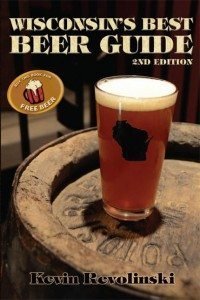
The typing here will cease for a couple weeks while I do some summer beer hunting. And guiding my stumble will be Wisconsin’s Best Beer Guide by Kevin Revolinski. This is the second edition of Revolinski’s field manual for beer drinking in our state. It has everything you could want in a barley-based travelogue.

Revolinski profiles almost 100 Wisconsin breweries, including a couple that have yet to open. The book features a good overview of each brewery or brew pub, along with beer lists, annual production and points of interest nearby. I especially like how he often illustrates the links these breweries have to the history and beer culture of their surrounding communities. You’ll have to get the book to see what he does in that regard with Oshkosh; it certainly put a smile on my face. The writing is smart and lively and the geekdom always takes a backseat to the primary aim – a good time with good beer. If you’ve ever seen any of the more typically British beer guides you know what an unsmiling affair these kinds of tomes can turn into. None of that, here.

Paging through this, I’m amazed by what has occurred in Wisconsin since 1985 when Randy Sprecher opened his microbrewery in Milwaukee and initiated the new wave of craft brewing here. The explosion of beer making in Wisconsin since then has been a great thing for us beer lovers. And the momentum seems to be gaining. There have been at least 20 new breweries launched in the state since the first edition of Revolinksi’s guide came out in 2010. And when you look at the quantities some of these places are producing – Courthouse Pub in Manitowoc, for example, with its annual production of just 48 barrels – it’s almost as if we’ve revived the neighborhood and farmhouse brewing culture of Wisconsin as it existed in the pre-Civil War period. Although I have to admit, that romantic notion goes to shit pretty quickly when you consider the 130,000 bbls or so New Glarus will likely produce this year.

One last thing: if you buy this book make sure you get the second edition, which was released last November and is still quite fresh. This LINK will take you to Amazon and that edition of the guide. For more info, go to Kevin Revolinski’s website about the book.

Have a great holiday, see you all in a couple weeks. Prost!

Monday, June 24, 2013

Pumpernickel Rye Now at Oblio's

Last week, I posted some notes about Oshkosh homebrewer Mike Engel and the beer he recently brewed at Stone Arch Brew House in Appleton. Mike’s Pumpernickel Rye made its debut this past weekend at Brews n’ Blues. But if you missed out on that, you can still get in on Mike’s beer. Oblio’s now has Pumpernickel Rye on tap and it’s tasting great. Just look at that happy homebrewer there tapping his own beer. Congratulations, Mike!
Mike Engel with his Pumpernickel Rye at Oblio's

Friday, June 21, 2013

Beer Ads in Oshkosh No. 13: One Hundred Years Ago Today – The Peoples Brewing Company of Oshkosh

From the Oshkosh Daily Northwestern; June 21, 1913
Here’s a repost of a beauty that’s 100 years old today. It appeared in the Oshkosh Daily Northwestern on June 21, 1913 upon the opening of the new Peoples Brewing Company at what is now 1506 South Main St. in Oshkosh. It’s a nice summation of what the new brewery was all about and includes an introduction to the first two beers the brewery offered. Asterweiss, was their pasteurized, light-bodied, low-alcohol, beer sold in clear bottles wrapped in paper. How elegant. More interesting was the “Standard” beer. This would eventually come to be known as Aristos. It was a full-bodied, unpasteurized draught beer aged in wooden barrels and served from brown, pint bottles or wooden kegs. This is the one that would be the big seller in Oshkosh and win over a large slice of the City’s saloon trade.

There’s also an interesting subtext to this ad. In the lower center portion of the ad are the words, “A Trial Is All We Ask.” It was the brewery’s way of asking the public to disregard the rumors being spread by its cross-street rival, the Oshkosh Brewing Company (OBC). In the months leading up to the opening of Peoples Brewing, OBC had done what it could to smear the reputation of the new brewery. OBC accused Peoples of making bad beer even before a drop of it had been sold out of the new brewery. At Peoples they shrugged off the slander. Early ads for Peoples asked Oshkoshers to decide for themselves if their beer was any good. The new brewery received the answer it wanted. Peoples Brewing was a success from the start and would outlast the Oshkosh Brewing Company.

Thursday, June 20, 2013

The Beginnings of Brews n’ Blues

Crowd shot at an early Brews n' Blues
“Now we’re seeing a rebirth. Good beer is here to stay.” 
Janic Cieszynski was looking back upon the inaugural Brews n’ Blues. It had been the first significant beer festival in Oshkosh and Cieszynski, who co-chaired the event for the Oshkosh Jaycees, was feeling a sense of relief. In the days before the beer tasting, there had been some worry. Cieszynski had struggled to get brewers to commit to the new festival. By the time the taps began flowing at noon on Sunday, July 21, 1996, he had secured commitments from only 18 brewers who brought in just over 40 different beers. It wasn’t quite the banquet of lager and ale that Cieszynski had hoped to present. It didn’t matter. The crowd loved it. More than 600 people gathered at Riverside Park for that first festival. Tickets had sold for $15 in advance and $18 at the door and the big gate galvanized Cieszynski and the Jaycees. Brews n’ Blues became an annual event.

The following year things went even better. “A lot of brewers who didn’t come last year heard through the grapevine that it was a well-run event,” Cieszynski told the Northwestern during the run-up to the ‘97 festival. “The good feedback made it easier this year for us to sign up brewers.” The number of beers presented almost doubled and Brews n’ Blues took on a more recognizable shape. The event was moved to Saturday. The local homebrewing club, the Society of Oshkosh Brewers, made their first appearance.

Brews n’ Blues has since become a fixture on the Oshkosh beer scene. This year there’ll be over 40 breweries represented pouring well over 100 beers. And the local homebrewing presence will be greater than ever. The Society of Oshkosh Brewers along with homebrewers from Fond du Lac and Appleton, will bring in almost as many different beers, meads and wines as were offered in total at that first Brews n’ Blues in 1996. If you’re at this year’s festival on Saturday, take a moment to look around and recall what Janic Cieszynski had to say after that first beer fest by the river. “Good beer is here to stay.” Saturday afternoon at the Leach, will confirm it.

Update: the backstory on how Brews n' Blues was born is here.

Wednesday, June 19, 2013

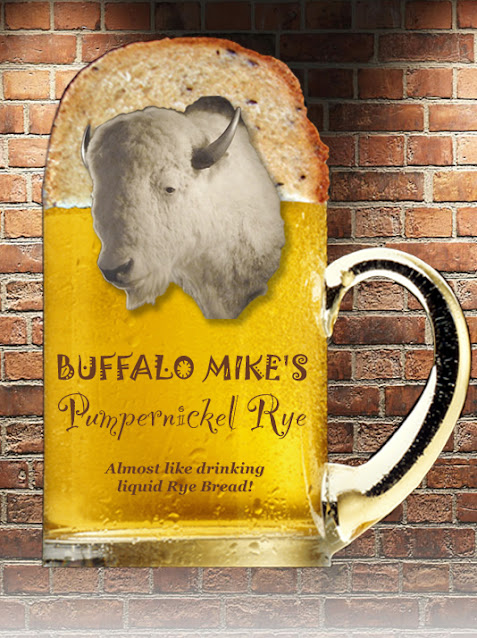
Oshkosh Beer Sampler 028: Buffalo Mike's Pumpernickel Rye

A slanted and endless survey of what’s pouring in Oshkosh, tallied one beer at a time.

What: Buffalo Mike's Pumpernickel Rye, a rustic ale brewed with flaked rye, molasses and caraway seeds.

Where: Brews n’ Blues 2013 happening this Saturday, June 22 at the Leach Amphitheater, Oshkosh. For more info on the beer fest go HERE.

Why: Because aside from its unique flavor, this beer has a good story. But first, let’s taste. I don’t have one in front of me, but I’m pretty sure I’ve drank enough of this beer to get it right. It pours to a rich amber and as it curls into the glass you get the unmistakable aroma of fresh rye bread. This is one of those beers that’s so aromatically evocative of the thing that inspired it that you’ll want to spend a few moments just breathing it in. The aroma anticipates the flavor in every respect. It’s bready and soft with a gentle twist of sweet and sour from the molasses and flaked rye. The caraway seeds add just enough spice to make it a dead ringer for rye bread. This would go perfect with a Limburger cheese sandwich or a reuben piled with sauerkraut.

The Story: Mike Engel of the Society of Oshkosh Brewers has been brewing his Pumpernickel Rye for years. He’s also made a habit of sharing it at local beer festivals. Along the way, his humble homebrew managed to pick up a solid following. Then last April, Engel was pouring his beer at a Barley & Hops beer sampling. The featured brewery at the sampling was Stone Arch of Appleton. Three of the brewers from Stone Arch were on hand that night. After a few samples, they invited Engel over to their place to brew a big batch of his beer on their 7-barrel system. And so he did. The beer will have its launch at Brews n’ Blues where Engel will be serving his homebrewed Pumpernickel Rye alongside the commercially brewed version. If you’re at Brews n’ Blues on Saturday, stop by the Society of Oshkosh Brewers’ tent and get a few snorts of both. If you can’t make that, the commercial version of the beer will be available on draught at the Stone Cellar Brewpub in Appleton.

To see Mike Engel talk about his Pumpernickel Rye, go HERE for a quick video that we shot during his brew day Stone Arch.