Wednesday, June 9, 2021

The SOBs Celebrate 30 Years

The Society of Oshkosh Brewers homebrewing club is celebrating its 30th anniversary this month with a series of beers made in collaboration with three Oshkosh breweries. The first of those beers will be released at Bare Bones Brewery on June 10. It will be followed by beer releases at Fox River Brewing on June 17, and Fifth Ward Brewing on June 26. The three beers were produced from recipes supplied by members of the Society of Oshkosh Brewers; or as they've come to be known locally, the SOBs.

A few of the SOBs during a recent group brew at Bare Bones.
In back on the steps of the brew deck is founding member Al Jacobson.

Al Jacobson's Christmas in June, a spiced ale, was brewed at Bare Bones and will be the first in the series to begin pouring. Jacobson is an original SOB. He was on hand when the club was launched in April 1991 at the now-defunct Galaxy Hobby on Oregon Street. He's also the last of the original members still active in the club. "It started with brewing classes at Galaxy," Jacobson says. "The club came out of those. There were about 10 or 12 of us in the beginning. We'd meet and try each other's homebrews and exchange ideas and recipes. That part of it hasn't changed much."

Some of those early brews were more powerful than expected. "I'm probably the only one that ever hit the ceiling at Galaxy Hobby," Jacobson says. "I took the cap off a beer I made and it shot out of the bottle and hit the ceiling." Remembering it still makes him laugh. "We were learning," Jacobson says. "You never knew what you'd get. We were making beer in soup pots."

SOBs making beer on a stove top in the early 1990s.

As a group, they accumulated knowledge and became a training ground for at least a dozen members who have gone on to brew professionally. Bare Bones' head brewer Jody Cleveland, and Fifth Ward's brewing team of Ian Wenger and Zach Clark are among the club’s alumni who have joined the professional ranks.

Future Oshkosh brewery owners Ian Wenger and Zach Clark during
an SOB visit to the Milwaukee Brewing Company in 2015.

The SOBs' influence has also spread beyond Oshkosh. The club has been the starting point for similar groups in Appleton and Fond du Lac and has been instrumental in re-shaping Wisconsin’s homebrewing laws. In 2012, the SOBs hosted Cask and Caskets, the first all-homebrewed beer festival in the state.

Jeff Eaton, who now brews for Lion’s Tail in Neenah, serving his homebrew
while dressed as a hot dog at Cask and Caskets.

Mike Engel has been the SOBs' president for 15 of the past 17 years. He's guided the club through its most dramatic period of growth. There are now more than 50 members in the club making it among the largest, most active organizations of its type in Wisconsin. “I can’t believe how successful the club has become over the past few years,” Engel says. “We seem to get one or two new members at almost every meeting.”

Engel's Pumpernickel Rye Ale will go on tap at Fifth Ward on Saturday, June 26. It's a rustic beer brewed with flaked rye, molasses, and caraway seeds. "What really gives it the flavor is the caraway seeds," he says. "It’s almost like drinking liquid rye bread." This is the third time Engel has had this beer produced by a commercial brewery. "It feels great," says Engel, who is stepping down as the club's president this year. "It’s kind of like the icing on the cake of my brewing career."

Mike Engel at Oblio’s pouring his 2013 version of Pumpernickel Rye
made by Stone Cellar (now Stone Arch) Brewpub.

But new brewers still come to the SOBs for the same reasons that Al Jacobson did 30 years ago. Logan Anderson joined the club in 2017 "I was 21 at that point," he says. "It was only a few months after I started brewing. I knew from the get-go that I was going to need to find some people who knew what they were doing to give me pointers. That was the best choice I could have made"

Logan Anderson filling a carboy during an SOB wort share last July at Fifth Ward Brewing.

Anderson, who recently graduated from UW-Platteville with a degree in engineering, will have his Kellerbier, a German-style lager, released at Fox River on June 17. "Having the opportunity to brew one of my beers on a large system is like a dream come true," he says. "Looking back five years ago, I never would have expected that I’d make it to this point."

Anderson says the club's appeal extends beyond brewing. "The real benefits go back to that community of beer thing," he says. "I’ve made lifelong friends and could not imagine a group of more enthusiastic and fun-loving people. We have a great beer history in Oshkosh, and I think that people who know about it are proud. So, to be part of that community and history was really a great draw."

The Society of Oshkosh Brewers will hold their next meeting on Thursday, June 17 at 7 pm in the Taproom of Fox River Brewing in Oshkosh. The meeting will be open to the public.

Sunday, June 6, 2021

Cerveceria Mexus

Cerveceria Mexus is a Neenah-based brewing company that launched last year. I started seeing their beer pop up in the Fox Valley earlier this year. The brewery currently has two beers in its line-up.


I haven't tried Chela, yet. If you look closely in the picture above, you can see that the brewery describes Chela as both an ale and a lager. Go figure.

Then there's Cheve. I came across a six-pack of this at the recently revived Club Liquor in Menasha. Cheve is a Vienna Lager and it is absolutely exceptional. It's among the best American-made Vienna lagers I've had.


Cerveceria Mexus is run by Alejandro Lagunes Gallina in Neenah. He's brewing these beers on contract at Titletown Brewing in Green Bay.

All of this brings to mind Chief Oshkosh Red Lager. Like Cheve, Chief Oshkosh Red Lager was a contract-brewed Vienna Lager. When it was introduced in 1991 it became (arguably) the first American craft beer packaged in cans. At the time, that was considered a strike against it. Now, of course, it's practically a requirement that craft beer be packaged in cans.

On the Cerveceria Mexus website, there's beer locator showing where you can find Chela and Cheve. If you dig Vienna Lager, you'll want to get after this one.

Wednesday, June 2, 2021

Oshkosh's Summer Beer Gardens

It’s been 150 years since Oshkosh last had a lakeside beer garden. Brews on the Bay is about to end that drought with a series of pop-up beer gardens that will begin on June 9 at the Kiwanis Shelter in Menominee Park. It will be followed by beer gardens in the park on July 14, August 11, and September 8. The monthly beer gardens will run from 5-9 p.m. and are being organized by the Parks Department.


Local beer may be the rally flag for these events, but Jen McCollian of the Parks Department says they're about more than that. "We'll have family yard games, and live music, and we'll definitely have food trucks," McCollian says. "We try to find things to do that are inexpensive to bring people and families to the park so they can get to know what we have to offer. Oftentimes, people aren't aware of the Children's Amusement Center or that we rent kayaks, and canoes, and aqua bikes, and those facilities are going to be open during that time as well."

But it wouldn't be a beer garden without beer. Oshkosh's Bare Bones Brewery, Fifth Ward Brewing, and Fox River Brewing, along with Omega Brewing from Omro will have their beer pouring at all four of the events. "They'll each have a line where they can feature whatever brew they choose," McCollian says. "We'll also have domestic beers, and water, and soda." Members of the Society of Oshkosh Brewers homebrewing club will participate by pouring samples of their homebrewed beers.

McCollian anticipates this year's beer gardens will provide the launch for what will become an annual summer occurrence. "We've been approved to have four through the city council this year," she says, "but we do want to see this grow and possibly even travel into other parks next year. It's definitely something we plan on doing into the future."

Traveling beer gardens have grown in popularity over the past decade. Oshkosh joins other Wisconsin municipalities such as De Pere, Glendale, Milwaukee, and Oak Creek in coordinating these public-park-based events. For Oshkosh, it will be the resumption of a legacy initiated in the 19th century.

Throughout the latter half of the 1800s, summer beer gardens were a staple here. Most wards featured an outdoor "beer resort" of some sort. The most ambitious of them was on the lakeshore just south of Menominee Park.

Oshkosh City Directory, 1869.

In 1869, Oshkosh hotelier Gustavus Bogk established Bogk's Pleasure Garden at what is now the end of Otter Avenue on the shore of Lake Winnebago. Bogk's resort was a sprawling, ten-acre beer garden that featured a bathing house, a dance hall, a restaurant, and a brass band playing every Sunday afternoon. The beer served there appears to have been provided by the three Oshkosh breweries then in operation. But it was a short-lived affair. Bogk, a serial entrepreneur who constantly teetered on the brink of bankruptcy, was forced by his creditors to abandon the property in 1871. It was the last of Oshkosh's lakeside beer gardens.

Brews on the Bay will revive that tradition with more backing than Gustavus Bogk was ever able to muster. "There's no way possible that we'd be able to do this without the help of the Oshkosh community," Jen McCollian says "We have some really great sponsors in addition to the breweries and the local restaurants. It's just something we would not be able to do without the support of the Oshkosh area community."

This post also appears in today's Oshkosh Herald.

Sunday, May 30, 2021

1959

Brewing was a major industry in Oshkosh. Here's a display from 1959 showing the economic impact of the Oshkosh Brewing Company.

OBC was producing more than 60,000 barrels of beer at this point. Across the street, at Peoples Brewing, they were producing close to 40,000 barrels.

Today, it’s an altogether different game. Last year’s total beer production in Oshkosh was less than 2,000 barrels.

Tuesday, May 25, 2021

Liquorland

Liquorland opened about a week ago at 50 Wisconsin Street.

This is the first stand alone liquor store we've had in Oshkosh in a decade.

The last of this sort was Jordy's Beverage Mart on 9th. Jordy's opened in 1962 and closed in 2012.


Sunday, May 23, 2021

Oshkosh Archeology

I was invited to tag along yesterday on a dig at the site of the old Gambrinus Brewery on Harney Ave. This was also the location of the first bottling plant of the Oshkosh Brewing Company in the late 1800s/early 1900s.

Oshkosh diggers Bob Bergman (in the hole) and Matt Hostak.

Oddly enough, the first thing out of that hole was an 1890s swing-top bottle stopper with the Charles Maulick logo. Maulick was the bottler for Schlitz Beer in Oshkosh in the 1890s. He was also the first proprietor of the Schlitz Beer Hall, which is now Oblio’s.


Further down were bottle shards with the Maulick imprint along with an Oshkosh Brewing Company stopper and bottle shards. I'll have more to share on the exploits of Bergman and Hostak this summer.

Thursday, May 20, 2021

Red Ram Redux

Here's a story that could only have happened in Oshkosh...


Drew Roth, the head brewer at Fox River Brewing, found those cards while he was sifting through the attic of his garage. He got in touch with me and asked if I'd ever heard of the Red Ram. I had. Just a couple of days earlier, I also had been sifting around down in a rabbit hole that was connected to the Red Ram tavern. I'll share what I found there in a moment.

In the meantime, Drew decided that Red Ram would be a good name for the bock beer he had recently brewed. That beer was released at Fox River this afternoon. We have a long history with bock beer in Oshkosh and this one fits beautifully into that lineage. It's an excellent beer. The Red Ram lives again.

Life at 103 High
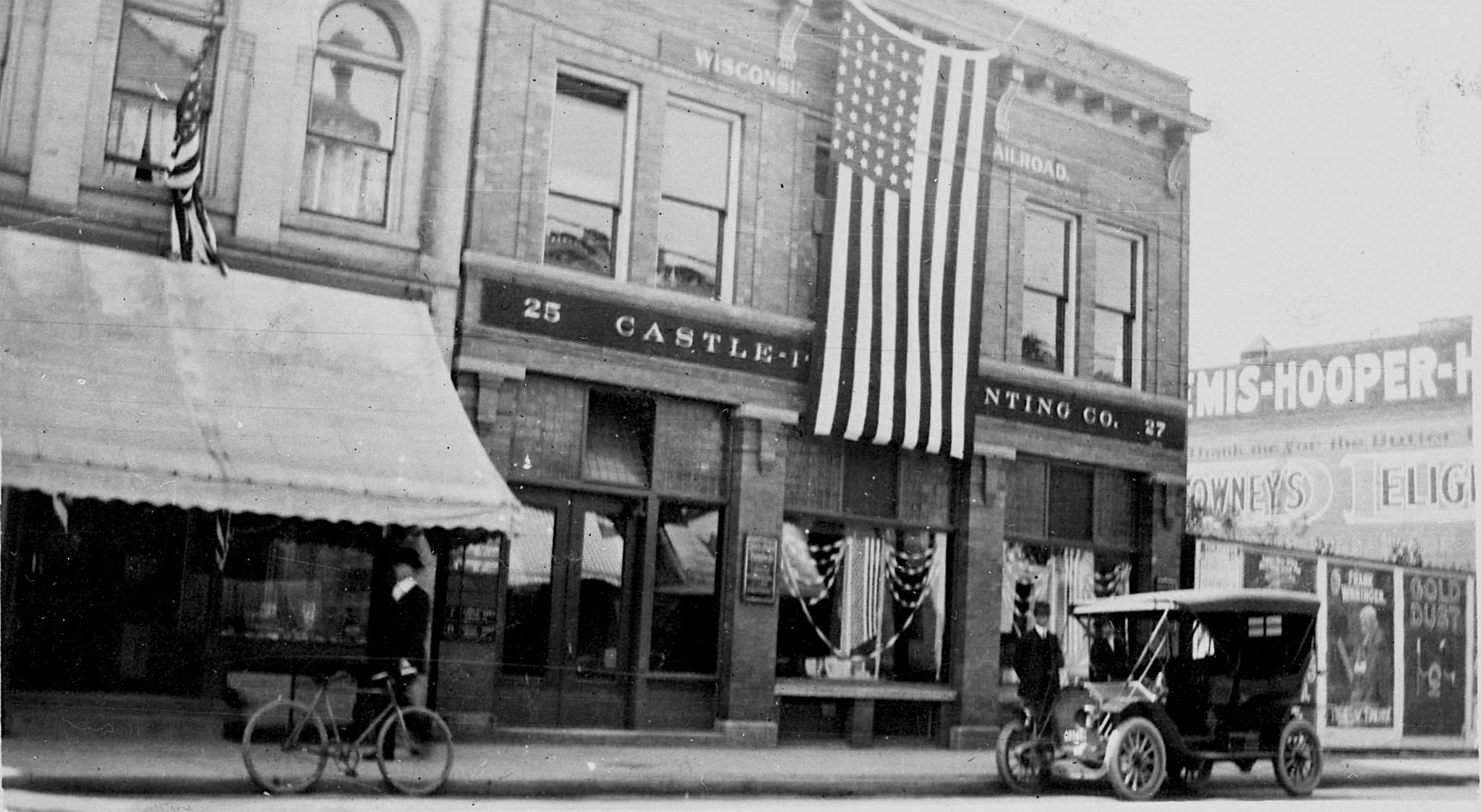
The Red Ram was located at 103 High Avenue in a building that went up in 1909. Originally, it was the home of Castle-Pierce Printing.

Castle-Pierce Printing in the early 1920s.

Castle-Pierce moved out of there in 1965. The fun begins. The first tavern license for 103 High was taken in 1968 by Charles Green, an insurance agent living in Neenah. Initially, the City of Oshkosh was less than eager to see Green go in there. He was co-owner of an infamous strip club named the Speak Easy on Omro Road. City officials had concerns about what Green might attempt with the old Castle-Pierce place. Would he have Helen from Hurley whirling on High?

Helen from Hurley appearing at the Speak Easy in February 1968.
When not performing, she was known as Mrs. Helen McKellip, aged 28 of Menasha.

Helen was a no-show. In fact, nothing much happened at 103 High until 1969 when plans for The Red Ram began to materialize. The man behind that plan was Green Bay Packer legend Jerry "The Zipper" Kramer.


The freshly retired Kramer was launching a chain of Red Ram bars and restaurants. There were Kramer-backed Red Rams in Chicago, in Denver, in Ames, Iowa... and as of April 1970, there was a Red Ram at 103 High in Oshkosh. It became the 15th Red Ram in the nation.

Outside the Red Ram, March 1970.

The Red Ram's Rathskeller had an alternate entrance through an underground areaway at the corner of Market and High. That areaway dates back to at least 1886. It's still there and one of the last of its kind in Oshkosh. You can see it in the picture below. Look to the left for the steps leading down.

103 High, where the Red Ram was located, is the Brown building on the right.

The Red Ram kicked the bucket the year after it opened. Out went the Ram and in crawled The Universal Turtle.
November, 1971.

The Turtle was the brainchild of John Hall, who had grown up in Oshkosh. His family had been in the hospitality business for years. John Hall's mother, Jeanne Hall, was the manager of the Athearn Hotel in Oshkosh in the 1950s. 

Here's a bit of a detour, but I like this next picture too much not to share it. The photo below shows Jeanne Hall in 1956 behind the wheel of the new Packard Caribbean convertible she was awarded by Server Magazine for her work at the Athearn.


OK, back to the Turtle Club. It was modeled after Turtles in Los Angeles and Seattle. In addition to the bar, the Oshkosh Turtle featured live entertainment. Among the early attractions were Johnny Diamond and his "fire" show; and Miss Nude Universe 1970, Sandi Shane.


The Turtle laid an egg. It closed in 1972. Then came the Paddock Club, which also promptly failed. Finally, there arrived a bar and restaurant with some staying power. A lot of Oshkoshers can recall Baxter's Beef & Pizza Company. Baxter's opened in January 1975.

1977.

The bar at Baxter’s. Photo courtesy of Dan Radig.

April, 1984.

Baxter's bit the dust in 1984. Its failure inspired another round of unsuccessful bars and restaurants at 103 High. There was Carlos Giovanni's Restaurant, Bravo's Bar & Restaurant, Steve's On High... with each passing year the place looked less inviting. The building sat vacant at the start of the 1990s.


The fun was done. In 1992, David Sparr's law office went in. Sparr and company have been there ever since.

103 High Ave.

Inside 103 High.

The building at 103 High is now part of the North Main Street Historic District and is listed on the Wisconsin Register of Historic Places. That’s fine, but in Oshkosh we have another way to memorialize these things. It comes full circle in a glass of beer. Prost to the Red Ram.

Red Ram Copper Bock at Fox River Brewing, Oshkosh.


Tuesday, May 11, 2021

Breweriana Show at Fifth Ward

The B'Gosh It's Good Breweriana show is this Sunday, May 16 at Fifth Ward Brewing.


Stop by, grab a beer, and peruse all manner of choice brewery memorabilia. They'll have 26 vendors and lots of Oshkosh items on hand. And it is FREE! The show starts at Noon. Last fall's show was great, this one should be even better...

Last year's breweriana show at Fifth Ward.


Sunday, May 9, 2021

Chilton's Last Call

Here's a growler I picked up last weekend from Rowland's Calumet Brewing in Chilton. It was filled with Last Call Pale Ale.


Last Call was made with malt from the last batch of malt made at the Briess malthouse on South Irish Road in Chilton.

The Briess facility in Chilton.

Briess' Chilton malthouse went into operation in 1902 as the Chilton Malting Company.


The Briess family became involved with the business in the 1950s and then bought the facility in 1978.

1978

The Briess malthouse in Chilton has been the source of brewing malt for many small breweries and homebrewers in Wisconsin. Earlier this year, Briess ended its malting operations in Chilton and moved that output to the old Rahr Malting facility in Manitowoc. 

I've been brewing with Briess malt for years. I always liked the idea that the I was making beer from barley that had been malted just across the lake. Right now, I have about 70 pounds of malt in my basement that came from the Chilton plant. I'll be thinking about that retired malthouse with every beer I make this summer.

Sunday, May 2, 2021

The Return of Oblio's

When Oblio's Lounge re-opened on April 12, it marked the beginning of another chapter for one of Oshkosh's best-known and longest-lived bars. Oblio's had been closed for more than six months beginning last October when COVID-19 infections were spreading rapidly in Oshkosh. Locking the door was a step that owners Mark Schultz and Todd Cummings didn't take lightly.

Mark Schultz (left) and Todd Cummings of Oblio's.

"We thought that what we were doing was right for us and the community," says Cummings. "I don't begrudge anybody for staying open. We have 42 years of business here, so it's a little bit different for us. It was just what we thought was right for us and our customers."

"That was the thing," Schultz says. "We think what we did was the right thing for our situation. Some people disagree. That's their right to disagree. But we were both on the same page this whole time."

It was just the second time in the past 135 years that the beer had stopped flowing at 432-434 N. Main Street. The building that is home to Oblio's was built in 1884 from a plan drawn by noted Oshkosh architect William Waters. The first saloon there, the Schlitz Beer Hall, took up residence shortly thereafter.

The sign for the Schlitz Beer Hall appears at the upper right. Circa 1887.

Schlitz Brewing purchased the building in 1886. At the time, there were already more than 80 saloons in the city. All but six of them sold nothing but locally-made beer. The Schlitz Beer Hall was one of the few places where variety was featured. The saloon became the 19th-century equivalent of a craft beer bar. Everything from Pilsner and Vienna lager to porter and stout was served there.

More than just pale lager; the Schlitz beers of1891.

It was a precocious start for a location that would go on to have more influence on the beer culture in Oshkosh than any other series of saloons or taverns in the city's history. But that high profile wasn’t always advantageous.

At the turn of the century, the Beer Hall became the target of prohibitionists who lobbied city hall to have its saloon license revoked. When Prohibition arrived in 1920, the Beer Hall became a speakeasy. The now renowned taproom was the sight of the first raid in Oshkosh by federal agents on a doomed mission to stem the flow of illegal liquor here. In 1927, during the depths of Prohibition, the bar was finally forced to close. It remained closed for the next nine years.

What is now Oblio's Lounge is shown at the extreme left, circa 1927.

Though the recent, six-month closure of Oblio's was comparatively short, it felt much longer for Mark Schultz and Todd Cummings. “It's become such a part of our DNA after doing it all these years," says Cummings.

When he and Schultz purchased the building in 1985 they became just its fourth owner. By that point, the two of them had already been running Oblio’s for 6 years and had managed to again make the bar into a destination for beer enthusiasts.

1997

The roots of craft beer in Oshkosh were established at Oblio's. But at the moment, things are different. Almost half of the bar's 27 tap lines are not currently being used.

"After we closed, we emptied all of the beer lines and had the distributors take the kegs back," says Schultz. “ We're gradually building the line-up back up. At this point, we want to make sure we're only putting fresh beer on.”

“We're also doing smaller barrels," Cummings says, "which is quite a bit more expensive. We want to keep the beer flowing and fresh. We're trying to ease back into it with a nice balance of beers."

Balance has long been a hallmark of the tap list at Oblio’s. It's become something of a rare take in a craft-beer market besotted with gimmickry. “Our demand isn't that great for those sorts of beers,” Cummings says. “We've dipped our toes into that, but overwhelmingly that's not what our clientele is asking for. Maybe it’s a clientele that's a little more experienced; or knowledgable. I don't want to sound condescending, but I think Oblio's customers come in looking for certain types of beer. We're not pushing an agenda, we're more trying to provide what our customers want.”


It’s that relationship with the customer that Cummings and Schultz say they missed the most during the time Oblio’s was closed. “There was never the thought of not reopening,” Cummings says. “It’s more than just Mark and me, it's this building and its history and the generations of people who come here. There's a lot of feeling of family here.”

“We really missed everybody,” Schultz adds. “It's so good just to see them again.”

Notes
A slightly different version of this post will appear in Wednesday’s Oshkosh Herald.

This piece touches only lightly on the deep history of this bar. There’s so much more to the story. You can find the full story in two parts Here and Here.